

Ever stood in the stands and wondered which lens will capture the game-winning slide in perfect clarity? Baseball moves fast, and a split second can make or break a photograph.
This guide will help you choose the best lenses for baseball photography and preview five pro-recommended options suited to different budgets and shooting positions. Expect practical advice, not jargon, so you can make a confident choice before the next pitch.
Focal length is the first big decision — it determines how close you can get to the action without leaving your seat. Whether you’re shooting infield plays or tracking outfield fly balls, reach matters more than you might think.
Aperture is the next key factor; wide apertures freeze motion and isolate players from busy backgrounds. They also let in extra light during twilight games and under stadium lighting.
Autofocus speed and tracking are critical for sharp images during steals, swings, and diving catches. Image stabilization helps when you’re handholding long glass or shooting from awkward angles.
Weight and handling affect how long you can shoot comfortably and how fast you can react. We’ll discuss the tradeoffs between portability and performance so you can match gear to your shooting style.
Read on to see which five lenses pros turn to and why each excels in different baseball scenarios. By the end you’ll know which features to prioritize when hunting the best lenses for baseball photography.
1. Sony 400mm f/2.8 G Master

Sony SEL400F28GM 400mm f/2.8 GM (E-mount)
Ultimate low-light sports and wildlife prime: blazing autofocus, stunning sharpness and creamy background separation in a lightweight, pro-grade build.
Check PriceThe Sony 400mm f/2.8 G Master is a dream for serious baseball shooters who need reach and image quality without compromise. That 400mm focal length lets you pull distant on-field action close with fine detail, while the f/2.8 aperture gives you control over depth of field and excellent low-light performance for evening games or shaded stadiums.
Optically this lens is ultra-sharp with high contrast, so your outfield catches and pitcher release points resolve with clarity. Built-in stabilization and exceptional image quality mean you can get tack-sharp shots even when shooting handheld in bursts of action.
Autofocus speed and precision are standout features; this lens pairs especially well with high-frame-rate bodies like the Sony Alpha 1. With a fast AF system you’re far less likely to miss critical moments, which is exactly why pros call it the epitome of sports photography.
Depth-of-field control is another practical advantage—wide aperture plus 400mm gives creamy background separation that isolates players from fences, crowds, and dugouts. That makes your subjects pop in busy stadium environments and simplifies post-processing.
Be realistic: handling and portability are trade-offs. The lens is built to pro standards and that premium construction brings significant weight, so it’s less portable for casual shooters and longer gigs may demand support or stamina.
If you’re a serious sports photographer who prioritizes sharpness, fast AF, and low-light capability, this lens is an investment that delivers pro-tier results. If you need something compact and travel-friendly, this might feel like overkill.
- Unrivaled sharpness and contrast at 400mm
- Outstanding autofocus speed and accuracy
- Excellent low-light performance with f/2.8
- Effective image stabilization for handheld use
- Heavy and bulky; less portable for casual shooters
- Premium build and optics come with significant weight
2. Sony 100-400mm f/4.5-5.6 G Master

Sony FE 100-400mm f/4.5-5.6 GM OSS
Versatile super-tele zoom delivering crisp imagery, steady optical stabilization, and fast, reliable AF for travel, birding, and action photography.
Check PriceAs a sports photographer I reach for the Sony 100–400mm f/4.5-5.6 G Master when I need flexibility across the whole diamond. The zoom covers moderate to long reach so you can switch from infield plays to outfield fly balls without changing glass.
Optical SteadyShot stabilization helps maintain clarity at the long end, which makes handheld shooting more practical during long innings. The lens also offers fast, accurate autofocus that keeps up with quick, unpredictable movement on the field.
G Master quality means the lens delivers high resolution and contrast, rendering fine detail that stands up to cropping and large prints. That level of sharpness and micro-contrast is especially useful when you want crisp jerseys, facial expressions, and seam detail on the ball.
In real-world use this lens behaves like a workhorse: it covers about 90% of the shots you’ll encounter at a baseball game and is praised for its versatility by traveling photojournalists and sports shooters. It’s a practical choice when you need a single lens that handles most situations without constant swapping.
If you shoot a lot in shade or under stadium lights, remember the aperture narrows to f/4.5–5.6 at longer focal lengths, which can limit low-light performance. It’s also slightly heavy and large compared to shorter zooms, but that trade-off is often worth it for the reach and image quality.
- 100–400mm range
- Fast, reliable autofocus
- Optical SteadyShot stabilization
- High resolution and contrast (G Master)
- Aperture narrows at long focal lengths (f/4.5–5.6)
- Slightly heavy and large
3. Canon EF 70-200mm f/2.8L IS III USM

Canon EF 70-200mm f/2.8L IS III USM
Professional-standard telephoto zoom with constant f/2.8, rock-solid image stabilization, weather-sealed construction and lightning-quick autofocus for weddings and sports.
Check PriceThe Canon EF 70-200mm f/2.8L IS III USM hits a sweet spot for baseball shooters who need a balance of speed, reach, and rock-solid image quality. Its constant f/2.8 aperture gives you low-light performance and creamy subject separation for isolating players against busy backgrounds.
Image stabilization rated at 3.5 stops helps when you’re tracking runners or making handheld panning shots from the dugout or stands. The weather-sealed build holds up to outdoor stadium conditions, so you won’t worry about light rain or dust during long innings.
Autofocus is driven by a ring-type USM motor, which is both fast and quiet and offers full-time manual override for fine-tuning focus on the fly. Photographers praise it as a dependable, universal sports lens for closer infield work and moderate telephoto needs thanks to its responsiveness and proven reliability.
Realistically, the 200mm maximum can feel short at larger ballparks or from distant seats, so plan to crop or use extenders if you regularly shoot outfield action. It’s a solid choice for pros and serious enthusiasts who value handling and optical performance, but be prepared for the extra weight during long shoots.
- Constant f/2.8 for low light
- Fast, silent USM autofocus
- Dust and moisture resistant
- 3.5-stop image stabilization
- 200mm max can be short for outfield
- Heavier; may need support
4. Sigma 150-600mm f/5-6.3 DG OS HSM Sports
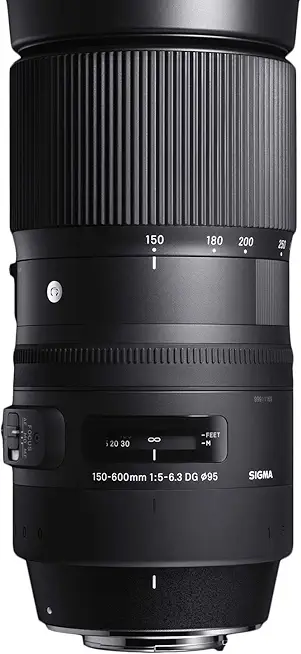
Sigma 150-600mm f/5-6.3 DG OS HSM Contemporary (Canon mount)
Affordable ultra-tele zoom offering massive reach, dependable optical stabilization, and portable handling—ideal for wildlife and distant action shooters on a budget.
Check PriceWhen I need extreme reach at a baseball game, the Sigma 150-600mm f/5-6.3 DG OS HSM Sports is the lens I grab. Its 150–600mm range covers deep outfield play and tight action from far seats without resorting to heavy primes or extenders.
The optics are surprisingly practical for a super-telephoto zoom. Special coatings and elements help reduce chromatic aberration at long focal lengths, and the large front element keeps contrast and resolution where it matters most. For the money, the lens delivers image quality that punches above its price point.
On the field it’s built to work. Optical stabilization helps when I’m handholding between pitches, and the weather sealing gives confidence in damp or dusty stadium conditions. The tripod collar is solid and the robust construction feels durable during long assignments.
There are trade-offs, of course. The small maximum aperture (f/5–6.3) means you’ll need higher ISOs under stadium lights or in twilight. It’s also heavy and large, so I often mount it on a monopod or tripod for long innings to avoid fatigue. Still, for photographers who need long reach without a pro-prime price, this Sigma is a very practical choice.
- Exceptional reach for distant field coverage
- Weather-resistant with water and oil repellent coatings
- Good stabilization for handheld use
- Robust build with tripod mount
- Small maximum aperture (f/5–6.3) limits low-light performance
- Heavy and large; often needs monopod/tripod for long sessions
5. Canon EF 300mm f/2.8L IS II USM

Canon EF 300mm f/2.8L IS II USM
Fast, short tele prime delivering exceptional subject isolation, rapid autofocus and reliable image stabilization for pro sports and wildlife photography.
Check PriceThe Canon EF 300mm f/2.8L IS II USM is a classic sports prime built for action. Its constant f/2.8 aperture delivers superb image quality and creamy background separation, which helps isolate pitchers, hitters, and fielders in busy stadiums.
At 300mm it’s more portable and lighter than longer primes, so you’ll notice the handling difference during long innings. That manageability makes it a great choice for closer distances and tighter stadium setups where mobility matters as much as reach.
Autofocus is very fast and accurate, which is essential for tracking baseball’s quick, unpredictable movement. Professionals praise its consistent AF performance in adverse weather, so you can rely on it during damp or challenging conditions.
If you need extra reach, this lens performs well with 1.4x and 2x extenders while maintaining sharpness, giving you flexibility for larger stadiums without immediately stepping up to a 400mm+ prime. The built-in image stabilization (IS) in the II version also helps keep shots steady when you can’t use a monopod.
In short, this 300mm f/2.8 is mostly a winner for baseball photographers who want prime-level image quality with reasonable handling. It’s especially suited to shooters positioned closer to the field or working tight aisles, and for pros who need durable gear that won’t quit in tough conditions.
- Constant f/2.8 for freezing motion and low light
- Excellent sharpness and bokeh
- Lighter and more manageable than longer primes
- Very fast, reliable autofocus for fast subjects
- 300mm can be limiting at larger stadiums without extenders
- Premium lens size and weight still significant versus smaller zooms
How to Choose the Right Baseball Lens
Choosing the right lens for baseball is less about picking the “best” glass and more about matching lens characteristics to where you’ll be standing and how you like to work. Think focal length first, then aperture, autofocus, stabilization and weight.
Telephotos in the 200–400mm range are the sweet spot for most field-level work; longer glass (500–600mm) helps from the stands. If you move around or cover both infield and outfield, a versatile zoom like 100–400mm or 70–200mm can cover most angles without swapping lenses constantly.
A fast aperture (f/2.8–f/4) lets you use faster shutter speeds and keeps autofocus happier in shade. It also gives the shallow depth of field that isolates players from busy backgrounds and simplifies messy scenes like fences and crowds.
Prioritize lenses with advanced AF motors and reliable tracking—linear or stepping motors are excellent for continuous subject detection. In practice, autofocus performance often matters more than a single stop of aperture when you’re trying to nail a decisive play.
Image stabilization is helpful for handholding long glass but won’t freeze a swipe tag—shutter speed will. Use IS to steady long focal lengths when panning or shooting in lower light, but keep shutter speeds high for action.
Remember crop sensors give extra reach, which is useful for the outfield, but they also magnify noise in low light. Think about your usual vantage: closer sidelines let you get away with shorter lenses, while upper decks demand more reach; match your lens to where you actually shoot most of the time.
Finally, be realistic about weight—big f/2.8 primes and 600mm zooms are heavy and will wear you down across nine innings. If you shoot long days, use a monopod or choose a lighter zoom as your workhorse, then add a bright prime for low light or tight isolation when you can. When in doubt, pick reach and reliable AF over marginal aperture gains—you’ll end up with more usable frames.
Why Wide-Open Aperture Creates Beautiful Bokeh
Open your aperture to f/2.8 or wider and the depth of field collapses so the subject really pops. That blur—bokeh—wraps your player in a smooth backdrop and tucks distracting fences and crowds out of sight.
A lens’s optical design and its aperture blades decide how those out-of-focus areas render. Some glass gives buttery, creamy blur while other optics produce busier discs around highlights. Long telephoto glass compresses the scene and helps those highlights melt together into a softer background.
Baseball stadiums are full of clutter: chain-link, dugouts, coaches, and fans. A wide aperture separates the athlete from that chaos, and the farther the background is from your subject the creamier the blur will be. It also lets you use faster shutter speeds so you can freeze throws and swings in low light.
The downside is a very shallow depth of field makes focus critical with moving players. At f/2.8 a fraction of an inch can be the difference between a tack-sharp eye and a soft miss. Use continuous AF, back-button focus, and be ready to stop down to f/4 if you can’t reliably nail focus.
Primes often deliver the creamiest bokeh, while pro tele zooms with a constant f/2.8 give practical flexibility around the diamond. Remember that extenders cut your maximum aperture and change the character of the blur, so test any combo before a game.
Before first pitch, spend a few minutes shooting wide-open at players and stadium lights to learn how your lens renders highlights. Think of wide aperture as a storytelling tool—isolate a moment, emphasize emotion, and hide distractions to make your baseball frames feel cinematic even from the stands.
What People Ask Most
What focal length lenses are best for baseball photography?
Telephoto lenses in the roughly 200–400mm range or longer are ideal for capturing on-field action from a distance. Zooms that cover 100–400mm add flexibility for different vantage points and framing.
What lenses do professional sports photographers use for baseball?
Pros commonly use fast telephoto primes and pro zooms such as 300mm and 400mm primes or 70–200mm and 100–400mm zooms. They prioritize lenses with wide apertures, reliable autofocus, and solid build quality for consistent performance.
Is a 70-200mm lens good for baseball photography?
A 70–200mm is excellent for infield work and closer shooting positions thanks to its speed and handling. It can be limiting from distant seats, so many shooters use it alongside longer reach or extenders when needed.
Do you need a telephoto lens to photograph baseball games?
Yes, telephoto reach is generally necessary to isolate players and capture detailed on-field action from typical spectator positions. If you have very close access, shorter lenses can work, but most game coverage benefits from longer focal lengths.
What aperture should I use for capturing fast action in baseball?
Use a wide aperture like f/2.8 or f/4 when possible to allow faster shutter speeds and help isolate subjects from distracting backgrounds. Wider apertures also aid autofocus performance in lower light and produce pleasing background blur.
Are prime lenses better than zoom lenses for baseball photography?
Primes often deliver wider apertures and slightly better image quality, which helps in low light and for subject isolation. Zooms offer much greater flexibility in framing and coverage, making them practical for varied stadium distances.
What lens settings and autofocus modes work best for baseball photography?
Continuous autofocus tracking and a responsive drive mode are key for following moving players and capturing decisive moments. Combining a wide aperture with stabilization when needed helps maintain sharp images while you track the action.
Conclusion for Best Baseball Lenses
Whether you’re shooting from the dugout or the upper deck, this roundup of five pro-recommended lenses gives a clear sense of which optical tools suit different distances and shooting styles.
Remember to match your choice to shooting distance, available light, autofocus needs, image stabilization, and how much weight you can comfortably carry during a long game.
Use the guidance here to prioritize the attributes that matter most for your camera, position, and workflow so you spend more time capturing decisive plays and less time second-guessing gear.
If you want to keep improving your baseball photography, read more articles on the site for practical tips and further gear guidance tailored to sports shooting.
Have questions or want advice for your specific setup? Leave a comment below — we usually reply within a few hours.


0 Comments