

Ever missed the winning goal because your lens couldn’t keep up?
In sports videography, the right lens can make or break a shot. The difference shows up in focus, reach, and the way motion reads on screen.
This guide compares five top lenses for sports videography. We’ll evaluate them against the factors that matter most: reach, autofocus, stabilization, aperture, and weather sealing. No jargon — just practical assessments you can use on a shoot.
Whether you’re covering a packed arena or a sprawling field, lens choice dictates what you can capture. We’ll break down how reach affects composition, how aperture shapes exposure and isolation, and how stabilization and AF keep moving subjects sharp. That perspective helps you match a lens to the sport and to your shooting style.
Expect clear, actionable advice for choosing the right tool for fast-paced action. You’ll get guidance on balancing reach, low-light performance, and mobility so you don’t miss decisive moments. Read on and get ready to upgrade your kit with confidence.
Whether you’re a seasoned pro, a freelance videographer, or a weekend content creator, this guide is for you. We combine hands-on testing with field experience to surface what actually works. Use these insights to shoot cleaner, smoother, and more cinematic sports footage.
1. Sigma 150-600mm Sports Zoom

150-600mm F5-6.3 DG DN for Sony E-mount
Super-telephoto zoom delivering extreme reach and sharpness for wildlife and sports, lightweight design with reliable autofocus and stabilized images for handheld shooting.
Check PriceThe Sigma 150-600mm f/5-6.3 DG DN OS Sports is a go-to telephoto for capturing distant action — think football sideline plays, motorsports, and birds-eye court shots where you can’t get closer. That 150–600mm reach is exceptional; it lets you isolate subjects from far away without changing lenses or rushing the sideline.
Autofocus is a strong point here. The lens delivers excellent AF performance for tracking fast-moving subjects, though you may need to tweak camera settings for optimal continuous tracking in tricky lighting. Its optical stabilization is effective for handheld or monopod work, which helps keep footage usable when you’re mobile or can’t rig a gimbal.
Physically it’s on the heavier side but feels well-balanced, and tactile controls make quick zoom and focus adjustments intuitive during live shooting. The build is weather-sealed, so it’s reliable outdoors in unpredictable conditions — a real plus for working pros and semi-pros who shoot both indoor and outdoor events.
If you regularly cover distant outdoor sports and prioritize reach and tracking over low-light shallow depth-of-field, this lens is a very good match. Be realistic about the f/5–6.3 variable aperture in dim arenas or late-day light, and note there’s minor corner softness at the longest focal lengths — usually not a problem for typical sports footage.
- Exceptional 150–600mm reach
- Fast, reliable autofocus
- Weather-sealed construction
- Optical stabilization improves handheld video
- Heavy; can be tiring on long shoots
- Minor corner softness at longest focal lengths
2. Sony 70-200mm f/4 G

Sony FE 70-200mm F4 G OSS
Compact professional telephoto with consistent image quality, fast focusing and built-in stabilization for portraits, events, and travel photography.
Check PriceThe Sony FE 70-200mm f/4 G OSS is a very balanced telephoto zoom built for sports videography where mobility and consistent image quality matter. Its constant f/4 aperture delivers good low‑light performance and keeps exposure steady across the zoom range.
Autofocus is smooth and reliable, which helps a lot when tracking athletes across the frame. Built‑in optical stabilization is effective for handheld shooting and cuts down on the need to rig a tripod or gimbal for most event coverage.
You’ll find it especially useful for both wide and tight shots in indoor arenas or outdoor fields — it’s designed for situations where you need reach but also want to move quickly. The lens has solid build quality and weather sealing, so it stands up well to unpredictable conditions on the sidelines.
Because it’s lightweight and compact compared to f/2.8 telephoto zooms, you can comfortably run with it for long periods without tiring as quickly. That said, f/4 is less ideal than f/2.8 in extremely low‑light scenarios, and it can be a bit slow to lock focus in very dim environments.
In short, if your priority is a portable, dependable 70–200mm that delivers steady exposure, good stabilization, and confident AF for most sports situations, this Sony is an excellent choice. If you regularly shoot in very dark arenas and need the absolute fastest AF and shallowest depth of field, plan accordingly.
- Lightweight and compact
- Constant f/4 for consistent exposure
- Effective optical stabilization
- Fast, accurate autofocus
- f/4 less ideal in extreme low light
- Can be slow to focus in very dim environments
3. Sigma 70-200mm f/2.8 Sports

70-200mm F2.8 DG DN OS for Sony E-mount
Fast-aperture pro zoom offering exceptional low-light performance, creamy bokeh, rock-solid stabilization and responsive tracking for sports and weddings.
Check PriceIf you need a workhorse telephoto for fast-paced sports, the Sigma 70-200mm f/2.8 DG DN OS Sports is an easy lens to recommend. It combines a bright, constant f/2.8 aperture with the reach and responsiveness you want for both wide and tight shots.
The f/2.8 gives you real low-light performance and clean subject isolation, which is invaluable in dim arenas or late afternoon outdoor matches. I’ve found the image sharpness and contrast hold up well across the frame, so tight cuts and action sequences look professional without heavy grading.
Autofocus here is excellent — quick and reliable when tracking sprinting athletes or sudden direction changes. Optical stabilization (OS) works very effectively for handheld or monopod use, smoothing out the small shakes that ruin otherwise usable footage.
Build quality matters on the sideline, and this Sigma is robust and weather-sealed, so you won’t worry about drizzle or dust during a long match. It’s also priced more affordably than some rivals while still giving the speed and handling pros demand.
On the flip side, the lens is heavier than some competitors, so expect fatigue on marathon shoots or when you’re constantly moving along the touchline. There have been reports of a slight hum from the optical stabilization in very quiet environments, which is worth noting if you record ambient stadium sound without a dedicated audio setup.
- Fast f/2.8 for low-light and DOF control
- Effective optical stabilization for handheld shooting
- Weather-sealed for adverse conditions
- Quick, reliable autofocus when tracking subjects
- Heavier than some competitors
- Slight hum from optical stabilization in very quiet environments
4. Tamron 70-180mm f/2.8

Tamron 70-180mm F2.8 Di III VXD for Sony E-mount
Lightweight constant-aperture zoom combining pro-level sharpness, lightning-fast focus and pocketable handling for travel and action shooters.
Check PriceThe Tamron 70-180mm f/2.8 Di III VXD is a shooter’s lens built around compact size, impressive sharpness, and a true f/2.8 aperture that performs beautifully in low light. As a working photographer, I appreciate how that constant f/2.8 lets you isolate subjects and maintain consistent exposure while tracking fast action.
It’s noticeably portable and easy to carry for extended periods, which matters during long shifts at arenas or sideline coverage. The construction feels solid and includes weather sealing, so it stands up to unpredictable conditions without adding the bulk that tires you out.
Autofocus on this model is fast and accurate, which is essential for keeping moving athletes sharp in video. The outline also notes effective optical stabilization for handheld shooting, making it a reliable partner when you need smooth footage without a gimbal.
Practically speaking, this lens excels when mobility is a priority — it handles both wide and tight shots in indoor arenas and outdoor fields with confidence. If you need a lightweight walkaround tele that doesn’t compromise image quality, this is a strong choice.
Be mindful of its limitations: the 70–180mm range can feel short if you routinely need extra reach, and in very dim environments the autofocus can slow down. Overall, for shooters prioritizing portability, f/2.8 performance, and solid AF/stabilization, the Tamron 70-180mm f/2.8 Di III VXD is a highly practical sports videography lens.
- Compact and lightweight for long use
- Fast f/2.8 for low-light performance and DOF control
- Quick, reliable autofocus
- Effective optical stabilization for handheld video
- Shorter focal length range may limit reach
- Can be slow to focus in very dim environments
5. Canon RF 100-500mm L IS
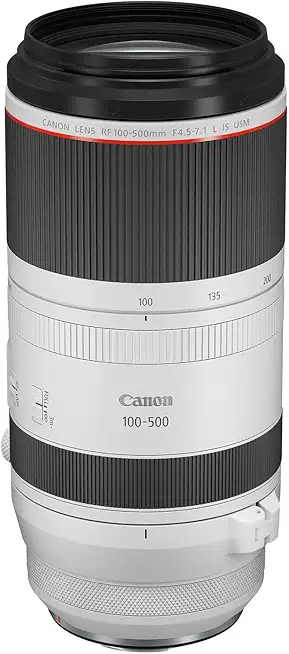
Canon RF100-500mm F4.5-7.1 L IS USM
Versatile super-telephoto range with elite optics, advanced stabilization and fast, quiet focusing for wildlife, aviation, and distant subjects.
Check PriceThe Canon RF 100-500mm f/4.5-7.1L IS USM is frequently used for sports videography because of its impressive reach and strong image quality. It’s built to let you capture distant action without constantly changing lenses.
Its 100–500mm range makes it remarkably versatile for both wide and tight shots, so you can frame the game or isolate a single athlete without swapping glass. That flexibility is a big advantage when you’re on the sidelines and can’t run back and forth.
Autofocus is fast and accurate, which matters when subjects are moving unpredictably. The lens also has effective optical stabilization, which helps keep handheld footage usable when you can’t or don’t want to use a monopod.
Canon designed this lens with weather-sealed construction, so it stands up to outdoor conditions and unpredictable elements during events. It’s used in both indoor and outdoor sports, though the variable aperture means performance can drop in very low light at the long end.
In short: if you need long reach and reliable AF with solid stabilization for handheld shooting, this lens will serve you well. Just be aware it can be tiring on long shoots, and the f/4.5–7.1 variable aperture may force higher ISO or slower shutter speeds in dim conditions.
- Exceptional 100–500mm reach
- Fast, reliable autofocus
- Weather-sealed construction
- Optical stabilization reduces camera shake
- Heavy; tiring on long shoots
- Variable f/4.5–7.1 limits low-light performance
Key Autofocus Features for Sports

Autofocus is the backbone of sports videography—it’s what keeps split-second moments usable instead of frustratingly soft. With athletes changing speed, direction and distance in an instant, you need a lens that locks on fast and stays with the subject.
Fast, quiet motors (USM, STM, Silent Wave) matter more than size or frames-per-second alone. They deliver near-silent, immediate jumps to the subject so you don’t miss a key expression and don’t annoy teams or crowds in quiet venues.
Continuous/servo AF with strong predictive tracking is non-negotiable; it reads motion and anticipates where the athlete will be next. Modern AI subject and eye‑tracking add another layer of reliability, especially for chaotic frames where multiple athletes cross paths. Also look for lenses and bodies with wide AF coverage and lots of focus points so the system can keep subjects off-center in frame.
Face and eye detection can make the difference when you cut from wide to tight shots of a player celebrating. Low‑light AF responsiveness is equally important; a lens with a fast aperture (like f/2.8) helps the camera’s AF sensors lock on faster in dim arenas. If you’re shooting nights or indoor sports, prioritize that pairing of bright glass and reliable AF performance.
Don’t assume a lens will perform identically on every body—phase‑detect AF, subject recognition and firmware can change results, so test the lens+body combo before game day. Use continuous AF (AF‑C/Servo) with a tracking or zone area mode. I almost always use back‑button focus and tweak tracking sensitivity to avoid “sticking” or overreacting to background motion.
In practical terms, prioritize lenses with fast, silent motors, robust continuous tracking, wide AF coverage and good low‑light sensitivity when choosing glass for sports. Those features will save more shots than chasing a quarter-stop of extra aperture or a few grams of weight.
Using Image Stabilization for Sports
In sports video, stabilization often turns footage from jittery to pro-level sharp. Small handshakes are amplified by telephotos, so good IS makes handheld and monopod work usable.
There are three types to know: optical (lens-based) IS, in-body IBIS, and electronic stabilization (EIS). I prefer OIS and IBIS — they preserve image quality — while EIS can crop and soften the frame, so use it only when you have resolution to spare.
When your camera and lens support both OIS and IBIS, use them together. The pairing usually gives the smoothest results, but test the combined mode ahead of a shoot to understand how it behaves.
Match the IS mode to the motion you expect. Normal or active modes work for handheld static shots, and panning mode prevents the system from fighting your intentional pans; using the wrong mode causes weird micro-corrections that look worse than no IS.
Turn IS off on a solid tripod — the system will hunt and create blur. On a monopod I leave IS on, and with a gimbal I often test both on and off since some gimbals benefit from lens stabilization for fine vibration control.
Remember that IS combats camera shake, not subject motion. For crisp athletes you still need appropriate shutter speeds or higher frame rates. Long lenses like 100–500mm or 150–600mm make IS essential for handheld work, but they don’t freeze fast-moving players.
If you must use EIS for extra smoothing, be mindful of the crop and the extra processing it applies. That’s why I try OIS+IBIS first and reserve EIS as a last resort, especially when shooting in 4K or higher where you have room to crop.
Finally, practice switching modes quickly and run a short stabilization test at the venue. A few practice pans and toggles before the action starts will save you headache and net you far cleaner, more watchable sports footage.
What People Ask Most
What focal lengths are best for sports videography?
Mid‑tele zooms such as 70–200 or 70–180 are versatile for both wide and tight shots and work well in arenas where mobility matters. Longer telephotos like 100–500 or 150–600 give the reach needed for distant outdoor action without moving closer.
Should I use prime or zoom lenses for sports videography?
Zoom lenses are commonly preferred because they let you reframe between wide and tight shots without changing lenses. Primes can offer advantages in speed or weight but often require more repositioning and lens changes during a shoot.
What aperture is ideal for sports videography?
A fast aperture such as f/2.8 helps in low light and gives better subject separation, making it useful for indoor and dim conditions. Constant f/4 zooms offer consistent exposure across the range but may be less capable in very low light, while variable slower apertures can limit performance at long reach.
How important is autofocus performance in lenses for sports videography?
Autofocus is critical for keeping fast‑moving subjects sharp and in frame during unpredictable action. Prioritize lenses with fast, continuous tracking, wide AF coverage, and reliable face or eye detection for best results.
Do I need image stabilization for sports videography lenses?
Yes — effective stabilization helps deliver smoother handheld footage and reduces shake with long telephotos or when using a monopod. Use optical or IBIS stabilization when possible, switch IS modes for panning, and disable stabilization on very stable supports.
Which lenses are best for indoor versus outdoor sports videography?
Indoor shooting typically benefits from fast mid‑tele zooms like f/2.8 70–200 or 70–180 to handle low light and isolate subjects. Outdoor events often call for long‑reach telephotos such as 100–500 or 150–600 to capture distant action, and weather sealing becomes more important.
What lens features should I prioritize for shooting fast-action sports?
Focus first on fast, reliable continuous autofocus and a fast aperture for low light and subject separation, then on effective stabilization that pairs with your camera system. Also consider reach appropriate to the sport, weather sealing, and a weight and balance you can handle for long shoots.
Conclusion for Best Sports Videography Lenses
In short, the best sports videography lens for you depends on balancing reach, autofocus reliability, image stabilization, aperture, weather sealing, and how comfortable the lens is to carry and operate during long shoots.
Match your choice to the sport and shooting conditions: prioritize long telephotos for distant outdoor action, fast mid-tele zooms for low-light arenas, and look for strong AF and stabilization whenever mobility matters.
If you want to sharpen your skills and make the most of whichever lens you choose, keep exploring the site for practical tips, setup guides, and workflow advice to help you shoot cleaner, steadier sports footage.
Have questions or want to share your own experiences with sports lenses? Leave a comment below and we usually reply within a few hours.



0 Comments