
Ever stood in front of a wall of Nikon lenses and felt paralyzed by the options? Which glass will actually help a beginner take better photos without breaking the bank? This concise, practical guide highlights five approachable Nikon lenses and explains when each one shines.
You can expect clear use cases, honest real-user feedback, and straightforward pros and cons. Advice covers entry-level DSLR setups and Nikon’s Z mirrorless line, so both DX and Z users benefit. No dense technical lectures—just real-world tips that beginners can act on right away.
We break down when a compact prime is a smarter first purchase versus a more flexible zoom. Expect guidance on low-light performance, handling, and how each lens shapes composition and workflow. There are trade-offs to know about, and we’ll help you balance image quality, weight, and budget.
By the end you’ll have a shortlist tailored to your shooting goals—portraits, travel, landscapes, or wildlife. These picks are chosen for ease of use, learning value, and real-world usefulness, not pro-only credentials. Ready to find the right first Nikon lens for your camera and style — read on.
You’ll also get real owner impressions — what beginners love and what often frustrates them. This focus on everyday shooting helps you avoid common mistakes and wasted money. Let’s cut through the specs and pick lenses that inspire you to shoot more.
1. Nikon DX 35mm f/1.8

Nikon AF-S DX NIKKOR 35mm f/1.8G 2183
Bright wide prime delivers sharp images, creamy bokeh, and excellent low-light performance in a compact, lightweight package.
Check PriceThe Nikon AF-S DX Nikkor 35mm f/1.8G is a standard prime built for Nikon APS-C (DX) cameras. On DX bodies it behaves like a “nifty fifty” — about a 50mm full-frame equivalent — which makes composition intuitive for beginners.
This lens shines for street work, portraits and indoor shooting without flash. Its compact, lightweight design makes it an easy travel or everyday lens to carry everywhere.
With a fast f/1.8 maximum aperture you get excellent low-light performance and pleasing shallow depth of field for subject separation. That wide aperture also helps create strong subject isolation and attractive bokeh for portraits.
Users consistently report very sharp images and pleasing color rendition. It’s a popular, affordable step up from kit lenses and a great tool for learning manual settings and exposure control. The lens’s size and handling encourage practice and creative shooting without weighing you down.
There are a couple of caveats. It’s not usable on full-frame (FX) bodies, so this is strictly a DX shooter’s lens. Autofocus can be a bit noisy and somewhat slow compared with higher-end lenses, though it’s still serviceable for everyday use by beginners.
If you shoot primarily on a Nikon DX camera and want to move beyond your kit lens, this 35mm f/1.8G is an excellent, budget-friendly choice. It gives you sharp results, low-light capability, and a focal length that fits a wide range of genres while remaining easy to carry and learn with.
- Very sharp images
- Strong subject isolation at f/1.8
- Lightweight and easy to carry
- Excellent low-light performance
- Not compatible with Nikon FX (full-frame)
- Autofocus can be noisy and somewhat slow
2. Nikon 50mm f/1.8
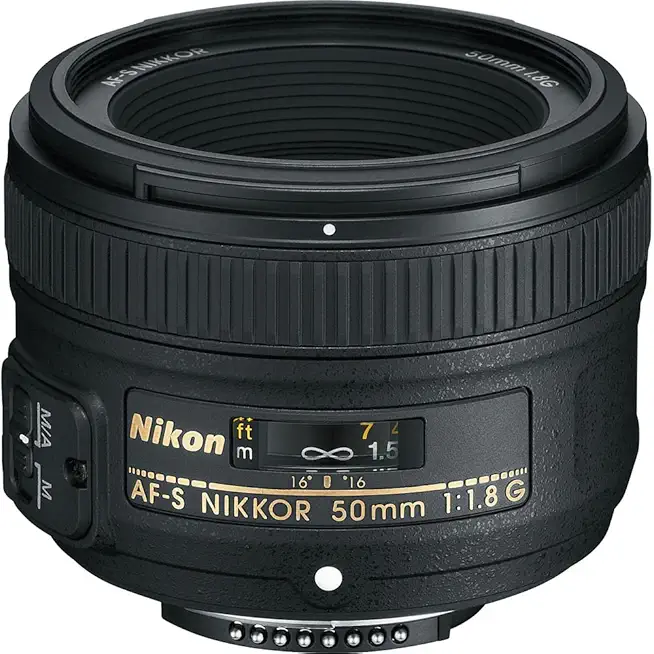
Nikon AF-S FX NIKKOR 50mm f/1.8G
Classic standard prime offering stunning sharpness, fast aperture for subject isolation and low-light shooting, affordable and versatile for everyday use.
Check PriceThe Nikon AF-S Nikkor 50mm f/1.8G is a classic standard prime that feels like a must-have for beginners who want to step up from a kit lens. It works on both DX and full-frame bodies, and on DX it acts like roughly a 75mm lens—great for tighter portraits and candid street work.
Its bright f/1.8 aperture gives you real low-light capability and creamy bokeh for subject separation. That wide aperture also helps you learn depth-of-field control and creative background blur without spending a fortune.
In practice the lens delivers sharp images and pleasing bokeh, which is exactly what you want when learning portrait and street photography. Autofocus is generally fast and reliable on modern Nikon DSLRs, so you’ll spend less time hunting focus and more time composing.
Handling is easy: it’s lightweight and compact, so you’ll actually carry it and shoot more. A few users note the barrel construction feels a bit less robust, and some bodies may require microadjustment to get the absolute best focus accuracy. Those are manageable trade-offs for the price and performance.
If you’re after an affordable prime that improves image quality, teaches you technical control, and performs well on Nikon DSLR bodies, this lens is a strong choice. It’s especially well suited for beginners focused on portraits, street, and general everyday use.
- High-quality, sharp images
- Lightweight and compact
- Affordable; excellent for portraits/street
- Reliable autofocus on DSLR bodies
- Plastic construction feels less durable
- Possible focus accuracy issues without microadjustment
3. Nikon Z 24-120mm f/4 S

Nikon NIKKOR Z 24-120mm f/4 S
Versatile mid-range zoom with consistent sharpness, reliable autofocus, and wide focal range ideal for travel, landscapes, and events.
Check PriceThe Nikon Nikkor Z 24-120mm f/4 S is a truly versatile all‑in‑one zoom for Nikon Z mirrorless users, covering a useful 24–120mm range from wide to medium tele. It maintains a constant f/4 aperture across the zoom, which keeps exposure consistent as you change focal length.
For beginners it’s an ideal walk‑around and travel lens that lets you avoid swapping glass constantly while still covering landscapes, portraits, and everyday shooting. Its modern optical design delivers strong image quality that many Nikon Z users appreciate.
Photographers consistently praise the lens for excellent sharpness, pleasing color rendition and solid contrast across the frame. In real use it produces clean, dependable results that reduce the need for heavy post‑processing.
Build quality is reassuringly solid and includes weather sealing, so you can use it outdoors with more confidence in mixed conditions. It’s larger and heavier than many compact lenses, but most users find the weight manageable for everyday shooting.
If you want a single lens that handles a broad range of subjects with consistent exposure and high image quality, this is a very strong choice. The constant f/4 and robust construction make it especially good for beginners who value convenience and durability.
Be mindful that the f/4 maximum aperture does limit extreme low‑light performance, so you may need higher ISO settings in dim situations. Also, its size and weight can start to fatigue users after long handheld sessions.
- Wide focal range for diverse shooting styles
- Good image quality throughout the zoom
- Constant f/4 aperture for consistent exposure
- Solid build and weather sealing for outdoor use
- Heavier than many compact lenses; may fatigue new users
- Maximum aperture f/4 limits low‑light performance
4. Nikon 20mm f/1.8G ED

Nikon AF-S FX NIKKOR 20mm f/1.8G ED
Ultra-wide fast prime delivering dramatic perspective, superb low-light capability and edge-to-edge clarity for landscapes, architecture, and night skies.
Check PriceThe Nikon AF-S Nikkor 20mm f/1.8G ED is a serious wide-angle prime that quickly becomes a go-to for landscapes, architecture, astrophotography and environmental portraits. Its 20mm field of view gives a dramatic perspective while remaining versatile enough for indoor and event work thanks to the bright f/1.8 aperture.
That f/1.8 makes this lens excellent in low light and lets you create shallow depth of field effects uncommon for wide-angle glass. Beginners especially praise it for night sky work — it’s highly rated for astrophotography and performs reliably under demanding conditions.
Optically, the lens delivers very high resolution when stopped down to f/5.6–f/8, so if you’re shooting landscapes or architecture and want edge-to-edge detail, closing the aperture will reward you. Users report minimal distortion and chromatic aberration, which keeps lines straight and colors clean without heavy correction in post.
Construction is sturdy, giving consistent results across different shooting environments, so it feels like a tool you can trust out in the field. That said, expect some corner softness when shooting wide open at f/1.8; it’s a trade-off for the fast aperture and dramatic wide-angle look.
Who is this lens for? Pick this if you’re a beginner leaning into wide-angle genres, night photography or creative environmental portraits and you value a bright aperture and solid build. If you want tack-sharp corners at every aperture or a compact lightweight prime, be aware it’s larger and heavier than standard primes.
- Bright f/1.8 ideal for low-light/night photography
- Excellent sharpness when stopped down
- Minimal distortion and chromatic aberration
- Strong choice for creative wide-angle shooting
- Some corner softness at widest aperture
- Larger size and heavier than standard primes
5. Nikon Z DX 50-250mm f/4.5-6.3 VR
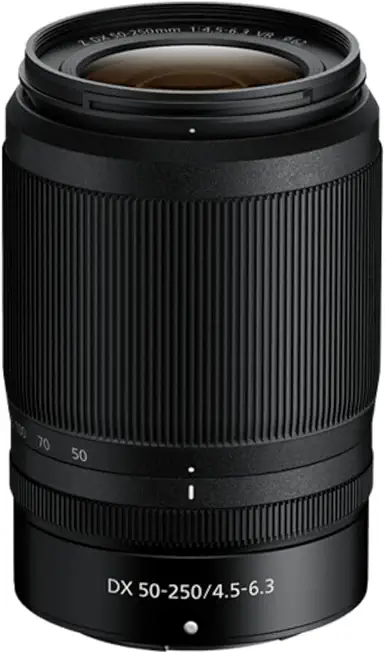
Nikon NIKKOR Z DX 50-250mm VR
Compact telephoto zoom with effective stabilization and versatile reach for wildlife, sports, and distant subjects on crop-sensor bodies.
Check PriceThe Nikon Z DX 50-250mm f/4.5-6.3 VR is a practical telephoto zoom built for Nikon Z DX mirrorless bodies, giving an effective full-frame equivalent of 75–375mm. That reach turns distant wildlife and sports into approachable subjects for beginners without needing heavy, pro-grade glass.
What I appreciate most as a working photographer is how compact and lightweight it is. The retractable design makes it easy to sling on a strap or tuck in a bag, so you actually take it out and shoot instead of leaving it at home.
Stabilization on this lens is genuinely useful: the VR performs well and is rated at an effective 5-stop advantage, which lets you handhold at longer focal lengths far more confidently. Autofocus is fast and accurate for everyday use, so you spend less time hunting focus and more time composing.
The obvious trade-offs are typical of a travel-friendly tele: the max aperture narrows to f/6.3 at the long end, so you’ll need higher ISO or faster shutter speeds in low light. Build-wise the plastic mount and lighter construction feel less premium, though image quality and handling remain solid for beginners.
If you’re a beginner focused on learning wildlife or sports photography without the bulk or expense of professional telephoto lenses, this Z DX 50-250mm is an excellent, user-friendly choice that balances reach, stabilization, and portability.
- Compact and lightweight
- 75–375mm effective reach
- Effective 5-stop VR
- Fast, accurate autofocus
- Max aperture f/6.3 limits low-light use
- Plastic mount/build feels less premium
Prime Versus Zoom for Beginners
Prime or zoom — it’s a classic beginner dilemma. Both are useful tools; the better choice depends on what you want to learn and how you like to shoot.
Primes lock you into a single focal length, which sounds limiting until you notice how much it improves your framing. They tend to be sharper and offer wider apertures like f/1.8, so they’re brilliant in low light and for creamy background separation.
Zooms give you a range of focal lengths in one barrel, so you can reframe without moving your feet. That flexibility is priceless on trips, at events, or when you don’t want to swap lenses every few minutes.
If your priority is exploration and convenience, start with a versatile zoom and learn what focal lengths feel right to you. If your goal is to speed up your understanding of exposure, depth of field and composition, pick a prime and let it force deliberate choices.
In practice I tell beginners to keep it simple: use a good zoom as your everyday lens and add a 35mm or 50mm prime when you’re ready to refine portraits or low-light technique. If you’re unsure, rent a prime for a weekend — trying a lens in the field beats reading specs.
A useful exercise is to spend a block of time with just one prime, then switch back to a zoom for another block. You’ll quickly feel how primes sharpen instincts and how zooms free you to react to moments.
Also factor in size, weight and aperture. Bright primes are lighter and great indoors, while a constant-aperture zoom gives predictable exposure across the frame for travel and run-and-gun shooting.
There’s no single right answer — most photographers eventually own both. Choose the lens that gets you out shooting today, and add the other when you want to push your creative or technical skills further.
Are Kit Lenses Good for Learning
Yes — kit lenses are an excellent place to begin. They give you a practical, forgiving platform to learn how focal length, aperture and composition work together.
Out of the box they cover the everyday focal lengths you’ll use most. They’re light, usually stabilised and autofocus reliably, so you spend time shooting not wrestling with gear. That versatility lets you explore landscapes, street, casual portraits and travel without buying separate lenses.
They do have limits. Variable maximum apertures like f/3.5–5.6 mean weaker low-light performance and less control over shallow depth of field. Build and optical perfection won’t match bright primes or pro zooms, so if you chase studio-level portraits or extreme low-light shots you’ll notice the difference.
Treat the kit lens like a classroom tool. Shoot the same subject at the wide and tele ends to see how perspective and compression change. Compare images wide open and stopped down to learn how sharpness and background separation react to aperture.
Use practical exercises to speed your learning. Switch between aperture-priority and full manual to feel how shutter speed and ISO interact. Limit lens swaps to reduce sensor dust and force creative problem solving with what you have.
Upgrade only when a clear need appears. If you crave creamy background blur or far-reaching reach, a fast prime or a longer zoom is a logical next step. Don’t buy new glass to “fix” pictures you can already improve with better technique.
In short: kit lenses are honest teachers. They won’t hold you back from making great images, and they’ll teach discipline, composition and exposure control that carry over to any future lens you choose. Master the basics here, and the next lens will feel like a natural upgrade.
What People Ask Most
What is the best Nikon lens for beginners?
There is no single best lens for everyone; it depends on what you want to shoot. Choose a versatile zoom to explore many styles or a simple prime to focus on learning composition and exposure.
Which Nikon lens is best for beginners for portraits?
A standard or short-tele prime that provides pleasing background separation and natural perspective works well for portraits. Pick a focal length that lets you frame subjects comfortably and matches your camera system.
What Nikon lens should a beginner start with for landscapes?
A wide-angle lens that captures broad scenes and holds good edge-to-edge sharpness is a strong choice for landscapes. Look for something that encourages including foreground interest and careful composition.
Are prime lenses good for beginner Nikon photographers?
Yes, primes are great for learning because their fixed focal length encourages thoughtful composition and exposure control. They are often compact and can help beginners develop a consistent shooting style.
Which Nikon lens is best for beginners for low-light photography?
A lens with a wide maximum aperture is helpful in low light because it lets in more light and helps separate subjects from the background. Combine the lens with steady technique or support to get the best results in dim conditions.
What Nikon lens is best for beginners for travel and everyday use?
A lightweight, versatile zoom or a compact prime that is easy to carry and covers common focal lengths is ideal for travel and daily shooting. Prioritize comfort, portability, and flexibility to suit varied scenes and situations.
Which Nikon lens is best for beginners for wildlife or sports?
A telephoto zoom that reaches distant subjects and focuses reliably suits wildlife and sports photography. Balance focal reach with manageable weight so you can shoot comfortably for longer periods.
Conclusion for Best Nikon Lenses for Beginners
This guide was meant to simplify your first lens decisions by outlining how different lens types support common shooting goals and learning paths.
Primes tend to favour portraits and low‑light creativity, zooms offer flexibility for travel and distant subjects, and wide options are best suited to landscapes and night skies.
Hands‑on testing—whether renting, borrowing, or trying lenses in the field—will quickly reveal which focal lengths, handling and trade‑offs fit your workflow.
If you want to keep growing as a photographer, read more articles on the site to build practical skills and confidence behind the camera.
Please leave a comment with your questions or experiences; we usually reply within a few hours and are happy to help guide your next steps.
Lens choices change as your style develops, so stay curious, practice often, and enjoy the process of finding what works for you.


0 Comments