

Want a lens that vanishes on your camera but still delivers striking images?
Pancake primes promise that exact mix: minimal bulk, discreet carry, and surprisingly capable optics. For Sony full‑frame shooters they’re a tempting way to travel lighter and shoot more often.
This article compares five compact pancake lenses that are most relevant to Sony users today. One of the five is an APS‑C design, so I call out any usage caveats. My notes come from hands‑on shooting, owner feedback, and real‑world testing rather than lab charts.
The focus is practical: clear pros and cons, how autofocus stacks up against manual focus, and everyday handling. You’ll learn where tiny lenses shine and where they compromise—low light, edge performance, or bokeh control. I keep the jargon light and the advice actionable for street, travel, and event photographers.
My goal is to help you choose based on what matters most to you. Size, aperture, autofocus speed, and image quality are the main trade‑offs I weigh throughout the guide. No hype—just honest field notes and buying guidance to simplify your decision.
Ready to see which micro‑prime will change how you shoot with your Sony? Let’s get into it.
1. Sony 35mm f/2.8 ZA Sonnar

Sony Sonnar T FE ZA 35mm F2.8
Crisp, compact prime delivering stunning edge-to-edge sharpness and natural contrast for everyday street and travel photography.
Check PriceThe Sony 35mm f/2.8 ZA Sonnar is the kind of lens you reach for when you want serious image quality without lugging a heavy kit. It’s praised for its compact size and lightweight build, making it ideal for travel and street photography.
On compact full‑frame bodies like the Sony A7C it’s especially enjoyable to carry and maintain a low profile. That discreetness is why some shooters even use it for entire weddings and events; it’s versatile enough to handle a wide range of situations.
Autofocus is a definite strength — fast and reliable, including continuous AF — so you won’t miss candid moments. The lens delivers excellent image quality for its size, with good sharpness and minimal distortion, which keeps editing to a minimum.
Practical controls add to the usability: a programmable button and a dedicated AF/MF switch let you make quick adjustments in the field. If you favor speed, discretion, and reliable results in a small package, this lens is mostly a very good bet.
Be mindful of its limits: the maximum aperture is f/2.8, so it won’t give the same low‑light performance or subject separation as faster 35mm primes. Some buyers also find it a bit expensive compared with third‑party alternatives, so factor budget into your decision.
- Extremely compact and lightweight
- Fast, reliable autofocus (including continuous AF)
- Excellent image quality for its size; good sharpness; minimal distortion
- Programmable button and AF/MF switch
- Maximum aperture f/2.8 limits low‑light performance
- Perceived as a bit expensive versus third‑party options
2. Samyang 35mm f/2.8 FE AF

Rokinon IO35AF-E 35mm F2.8 Sony E-mount
Lightweight autofocus lens offering fast, reliable focusing and pleasing bokeh for run-and-gun video and low-light stills.
Check PriceThe Samyang 35mm f/2.8 FE AF is a delightful little lens to carry all day. Its ultra‑compact design makes it one of the smallest full‑frame pancake lenses, so it disappears on a compact body and rarely gets in the way of shooting candid street scenes or travel snaps.
It’s also very light and comes in at a much friendlier price than many OEM options, which makes it attractive if you want a true grab‑and‑go 35mm without breaking the bank. Importantly, Samyang included autofocus here, so you don’t have to sacrifice practicality for compactness — AF works well enough for everyday shooting and casual video.
Optically the lens punches above its size. You get good center sharpness, minimal distortion and usable contrast straight out of camera. If you’re picky about absolute edge performance or color rendering, it won’t quite match top‑tier 35mm primes, but for most street, travel and documentary work it delivers more than enough detail and character.
In short, this is a mostly good buy for photographers who prioritize pocketability and value. It’s an excellent everyday option when you want a lightweight setup that still autofocuses and produces clean images. Just temper expectations if you demand the absolute best in build finesse or the last stop of micro‑contrast and color fidelity.
- Ultra-compact and lightweight
- Affordable price point
- Autofocus present
- Good image quality — minimal distortion, decent sharpness
- Image quality slightly behind top-tier 35mm primes (sharpness & color accuracy)
- Build quality feels less premium than some rivals
3. Viltrox AF 28mm f/4.5 FE

Viltrox 28mm F4.5 E-mount
Ultra-compact wide-angle ideal for landscapes and architecture, with balanced rendering and pocketable portability.
Check PriceThe Viltrox AF 28mm f/4.5 FE is one of the tiniest full‑frame pancakes you can mount on a Sony body, and that compactness is its primary appeal. If you prize a lens that disappears on a camera for travel or everyday carry, this one delivers—extremely compact and lightweight without feeling toy‑grade.
Autofocus uses a stepping motor that reviewers and users describe as both fast and quiet. That makes it unobtrusive for street work and pleasant for run‑and‑gun shooting where silence and responsiveness matter.
Optically, the lens is generally good for its size: center sharpness and minimal distortion are often noted, so images look clean straight out of camera. At the same time, the f/4.5 maximum aperture is a clear trade‑off; it keeps the profile pancake‑flat but reduces low‑light flexibility and background separation.
Build quality impressed users with a solid feel and weather sealing that you don’t always get at this price and size point. That durability makes it a practical choice for photographers who want a rugged compact lens for everyday use without babying it.
In short: choose this Viltrox if you want the smallest possible full‑frame 28mm with reliable AF, good center image quality, and a weather‑sealed build. Don’t choose it if you often shoot in dim light or demand the last bit of edge‑to‑edge sharpness wide open.
- Extremely compact and lightweight
- Fast, quiet stepping motor autofocus
- Good image quality with minimal distortion and decent sharpness
- Weather-sealed build
- Maximum aperture f/4.5 limits low-light performance
- Some users report edge softness, especially wide open
4. Sony 20mm f/2.8 E-Mount Pancake

Sony SEL-20F28 20mm F2.8 E-mount
Expansive field of view perfect for astrophotography and environmental shots, sharp corners and minimal distortion.
Check PriceThe Sony 20mm f/2.8 E-mount pancake (SEL20F28) is shockingly small and light — one of the tiniest pancake lenses made for APS‑C sensors. In hand it disappears on a compact body, making it a true everyday carry lens when you want minimal bulk without losing autofocus.
Optically it delivers generally good results for its class: decent center sharpness, minimal distortion and an overall pleasant rendering that suits travel and street work. The lens is significantly cheaper than other Sony pancake options, which makes it an attractive, budget‑minded choice if you want a fast wide-ish pancake without paying a premium.
Autofocus is present and works reliably for typical handheld shooting and casual video, so you don’t have to fight manual focus for quick scenes. Build and balance are aimed at portability — you’ll notice how the camera feels more nimble with this lens mounted.
There are trade‑offs to consider. Some edge softness has been reported when shooting wide open, so if you need corner-to-corner micro‑detail you may want to stop down a bit. Also, this is an APS‑C design, so full‑frame users should take that into account before buying.
- Ultra-compact and lightweight
- Affordable price point
- Autofocus present
- Good image quality with minimal distortion and decent sharpness
- Some edge softness wide open
- Designed for APS‑C sensors (note for full-frame readers)
5. Sony FE 35mm f/1.8

Sony FE 35mm F1.8 SEL35F18F
Bright, versatile prime delivering creamy background separation, quick autofocus and stellar low-light performance for portraits and street scenes.
Check PriceThe Sony FE 35mm f/1.8 is a compact, lightweight 35mm prime that feels at home on a travel or street kit. Its size and build make it easy to carry for long days of shooting without fatigue or drawing attention.
The fast f/1.8 aperture is the real practical win here — it delivers strong low‑light performance and pleasing subject separation for environmental portraits and street work. You get shallow depth of field when you want it, without lugging a heavier, bulkier lens.
Autofocus is quick and reliable, including continuous AF mode, so you can track moving subjects or shoot candid moments with confidence. Optically it performs very well: sharp images with minimal distortion mean you’ll spend less time correcting files in post.
All told, this lens is recommended as a compact, fast prime for everyday use — a solid choice if you prioritize a versatile 35mm with real low‑light capability. The trade‑offs are clear: it isn’t the absolute smallest pancake on the market because of the faster aperture, and it’s considered somewhat expensive compared to some third‑party alternatives.
- Compact and lightweight
- Fast f/1.8 aperture for low light and subject separation
- Fast, reliable autofocus (including continuous AF)
- Excellent image quality with minimal distortion and strong sharpness
- Not as compact as some other pancake lenses (trade‑off for faster aperture)
- Considered somewhat expensive versus third‑party alternatives
Autofocus vs Manual Focus Pancake Lenses
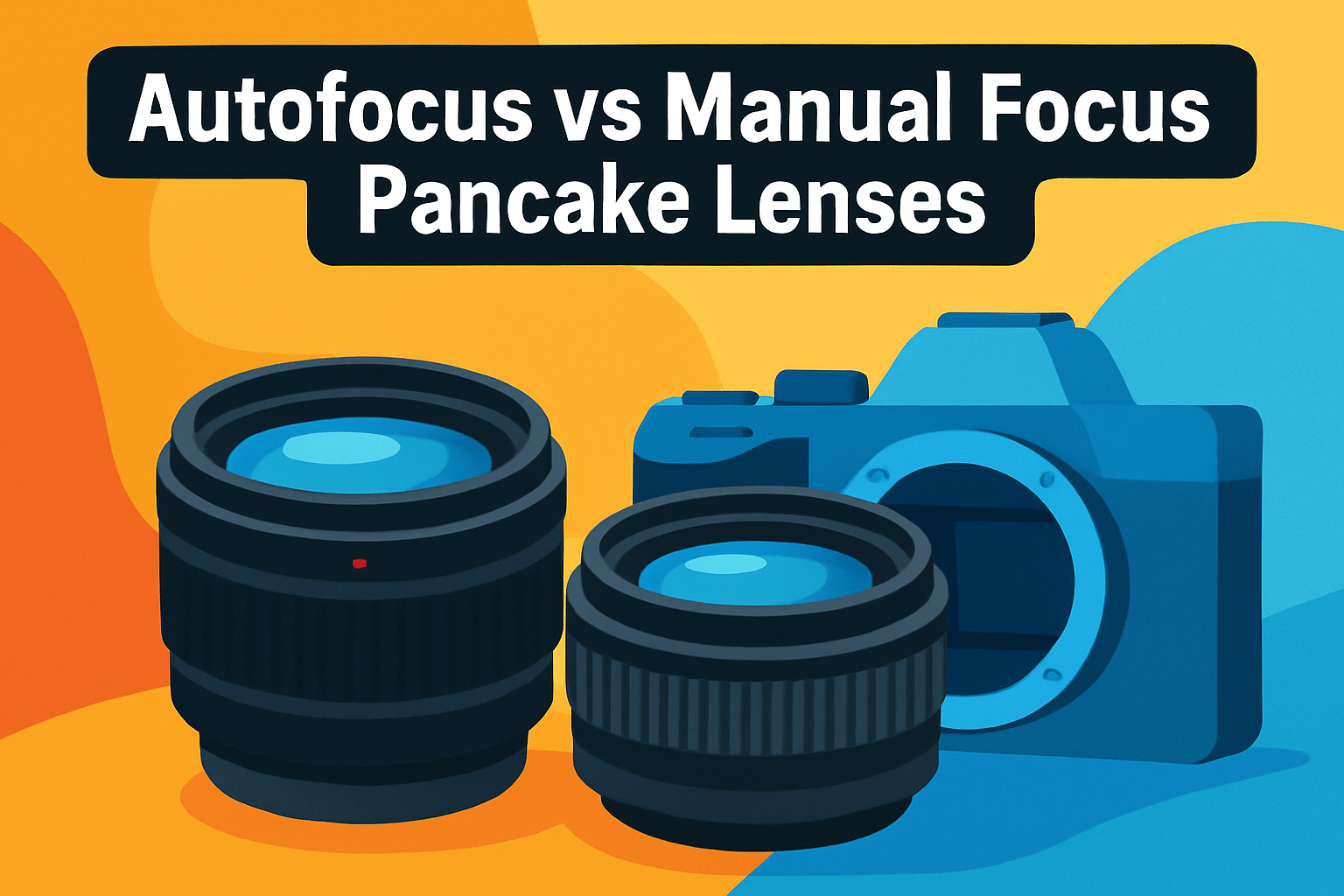
Choosing between autofocus and manual-focus pancake lenses is more about shooting style than specs. Both types can be tiny and well-made, but they reward different kinds of work: speed and convenience versus absolute compactness and control.
Modern AF pancake lenses use stepping or quiet DC motors that are surprisingly smooth and discreet. They integrate with Sony’s Eye‑AF and Real‑time Tracking, so they shine for street, travel, candid portraits and run‑and‑gun video.
That said, not every AF pancake performs the same. Budget models can be slower or noisier, and autofocus still struggles in very low light or at extreme close distances, so always test AF on your body and keep an eye out for firmware updates that improve performance.
Manual-focus pancakes give you a different kind of freedom: smaller size, silence and direct tactile control. They’re ideal for landscape, architecture, deliberate portraits and any situation where you can compose slowly and care about the feel of focus.
Do remember that tiny MF pancakes often use focus‑by‑wire systems with a short focus throw, so some feel more precise than others. Rely on focus peaking, live view magnification, or zone focusing to make manual lenses practical in day‑to‑day use.
In practice I usually carry an AF pancake as my go‑to because it handles most scenarios reliably. When I want to go ultra‑minimal or work very deliberately—nightscapes, architecture or quiet interiors—I swap to a small MF pancake for the lighter, quieter rig and the satisfaction of nailing focus myself.
Bottom line: pick AF for speed, tracking and video; pick MF for ultimate compactness and creative control. Test lenses on your camera, check focus aids and firmware support, and choose the tool that matches how you actually shoot.
Sony Pancake Lens Buying Guide
When choosing a Sony pancake lens, think about what you will realistically carry all day. The right choice balances compactness, aperture and autofocus so the lens actually gets used.
Pick the focal length that matches how you frame: 20–28mm for landscapes and architecture, 35mm for street and documentary work, and 50mm when you want classic portraits or tighter everyday shots. Each choice changes your working distance and how you interact with subjects.
Aperture is the trade‑off between size and capability. Faster glass like the Sony FE 35mm f/1.8 gives real low‑light advantages and nicer separation, while f/2.8 or f/4–f/5.6 pancakes keep the footprint tiny but will push ISO or shutter speed in dim conditions.
Most modern pancakes deliver crisp center sharpness and improve noticeably when stopped down a stop or two. Expect some edge softness, vignetting and distortion on the smallest designs, but those issues are usually manageable in‑camera or in post.
Hands‑on features matter: a metal mount, a usable AF/MF switch and filter threads add durability and practicality. Some budget pancakes feel plasticky and lack threads, whereas certain third‑party options like Viltrox punch above their weight with weather sealing and solid build — useful if you shoot outdoors.
Always confirm FE versus APS‑C coverage to avoid unexpected crop factors on full‑frame bodies. Also check whether the manufacturer provides firmware updates; modern AF performance often improves with firmware and camera updates.
Choose AF if you want speed and to leverage Sony features like Eye‑AF and real‑time tracking for street, travel and everyday shooting. Choose MF if you prize absolute compactness, silent operation and deliberate focusing for landscapes or architecture.
Finally, mount a few options on your camera to test balance, AF feel and focus‑ring ergonomics — specs don’t tell the whole story. Pick the pancake you genuinely enjoy carrying; the one you use matters more than the one that looks best on paper.
What People Ask Most
What are the best pancake lenses for Sony full-frame cameras?
Common recommendations include compact 35mm primes and small wide-angle FE options that balance size and image quality. Choices often cited are the Sony 35mm f/2.8 ZA, Samyang 35mm f/2.8 FE AF, Viltrox AF 28mm f/4.5 FE, and the Sony FE 35mm f/1.8 depending on your priorities.
Are there pancake lenses available for Sony E-mount full-frame bodies?
Yes, there are pancake lenses designed for Sony E-mount full-frame (FE) cameras as well as APS-C options. Make sure you choose an FE-designated lens if you want native full-frame coverage.
Which pancake lens is best for street photography on Sony full-frame cameras?
Compact 35mm primes are commonly preferred for street work because of their natural field of view and discreet profile. If low-light performance and subject separation matter, opt for the faster 35mm option; if ultimate compactness is the priority, the more compact 35mm pancakes are a solid choice.
Do pancake lenses provide good image quality on Sony full-frame sensors?
Many modern pancake lenses deliver excellent center sharpness and minimal distortion for everyday use. Corners can be softer wide open, and stopping down typically improves edge-to-edge performance.
Can I use APS-C pancake lenses on Sony full-frame cameras?
APS-C pancake lenses are designed for crop-sensor bodies, so using them on full-frame bodies may require camera crop modes or result in coverage limitations. Always check the lens designation and how your camera handles APS-C lenses before buying.
What are the advantages of using a pancake lens on a Sony full-frame camera?
Pancake lenses offer exceptional compactness and low weight, making them ideal for travel and street shooting where discretion matters. They also simplify carry and encourage more spontaneous shooting, though they can trade off maximum aperture and some edge performance.
Which Sony full-frame pancake lens has the widest aperture?
Among the lenses discussed, the Sony FE 35mm f/1.8 has the fastest maximum aperture and is noted for its strong low-light capability. That wider aperture also helps with subject separation compared with slower pancake designs.
Conclusion for Sony Full-Frame Pancake Lenses
Pancake lenses are ultimately about trade-offs: they offer unmatched compactness and discretion at the cost of the very fastest apertures and, in some cases, edge performance.
This article aimed to translate real-world use, autofocus versus manual focus behavior, and common pros and cons into clear buying priorities so you can match a small lens to how you shoot.
When choosing, focus first on what matters most to you — pocketable size, low-light aperture, AF speed and features, or simply the best value within your budget and camera compatibility.
If you want to sharpen your technique and make more confident gear choices, take a look through more articles on the site for practical tips and comparisons.
Have questions or want to share your own experiences with compact lenses? Leave a comment below and we usually reply within a few hours.


0 Comments