
Can a pocket-sized point-and-shoot freeze the exact split-second that makes an action photo unforgettable? Have you ever watched a great moment slip away because your camera was slow to react or lacked reach?
This guide compares five leading compact cameras built for shooting fast motion, without weighing down your kit. We keep things practical and honest, focusing on how each camera performs in real shooting situations.
We examine core attributes that matter for action: autofocus speed and accuracy, burst rate, stabilization, and tracking. We also consider handling, ergonomics, battery life, and how intuitive burst controls feel when the moment arrives.
Beyond specs, we note real-world pros and cons from field use so you can see strengths and limits in context. And we map those findings to common action use cases like street magic, family sports, travel scenes, rugged outdoor adventures, and long-reach situations.
Choosing the right compact is a study in trade-offs: sensor size versus zoom reach, durability versus pocketability, and raw speed versus battery endurance. This guide breaks those trade-offs into clear buying considerations so you spend money on what actually helps your shooting style.
By the end you’ll have a practical sense of which compact fits your pace and which compromises you can live with. Read on to find the point-and-shoot that helps you capture more decisive moments and fewer missed opportunities.
1. Fujifilm X100VI For Action

Fujifilm X100VI
Classic rangefinder-style camera with large APS-C sensor, hybrid viewfinder, fast prime lens and intuitive controls for stunning street and travel photography
Check PriceThe Fujifilm X100VI is a photographer’s dream for close, fast-moving scenes thanks to its 40MP APS-C sensor that delivers pin‑sharp images and superb detail even when you need to crop. The fixed 23mm f/2 lens (35mm equiv.) gives a natural field of view that’s ideal for street and documentary action where you can move with the subject rather than rely on a zoom.
It includes in‑body image stabilization and an advanced autofocus system—shared with the Fujifilm X‑T5—so subject tracking is reliable when you’re chasing fleeting moments. The hybrid optical/electronic viewfinder makes framing bright, contrasty scenes a pleasure and helps you keep eyes on the subject in changing light.
For hybrid shooters, the X100VI also supports 6.2K 10‑bit video, opening creative options for motion sequences and slow‑motion breakdowns. The camera is sturdy and built for everyday carry; reviewers praise its portability, though it won’t slide into tight jeans pockets.
There are trade‑offs to accept. The fixed focal length means no zoom, so distant sports and wildlife are outside its comfort zone. It also has a single card slot using UHS‑I cards, which is slower than newer standards and worth noting if you shoot high volumes or need robust backup.
In practice this camera excels for street, documentary, and close‑quarters action where image quality, fast AF, and stealth matter. Bring spare batteries for long days—battery life is moderate—and embrace the X100VI when you want top APS‑C IQ in a responsive, carry‑friendly body.
- Pin‑sharp 40MP APS‑C detail
- Fast, reliable AF with good subject tracking
- Sturdy, portable everyday‑carry build
- Hybrid optical/electronic viewfinder
- Fixed 23mm f/2 — no zoom (limits distant action)
- Single UHS‑I card slot (slower)
2. Sony RX100 VII For Action
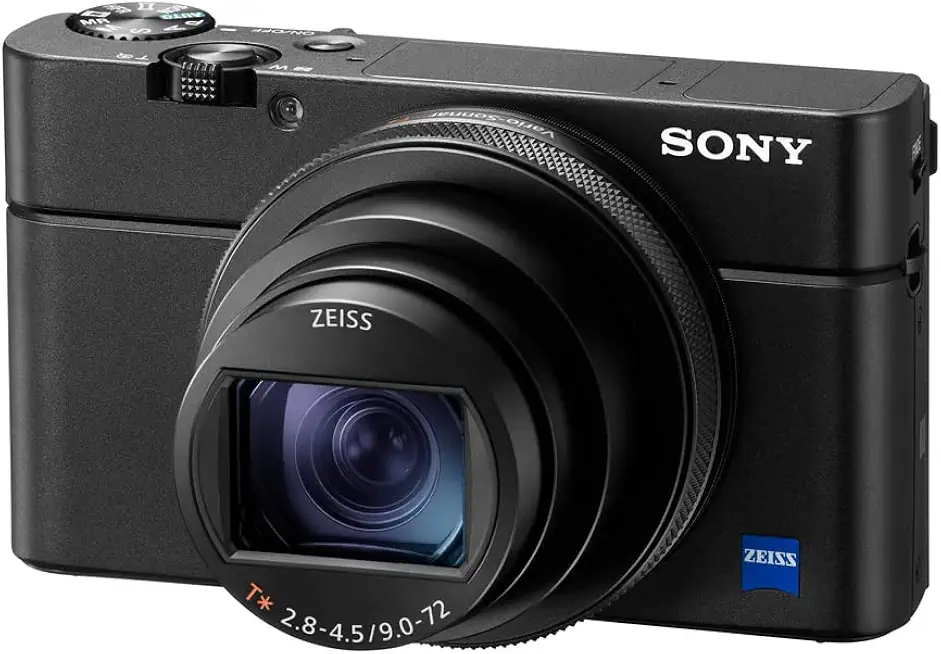
Sony RX100 VII DSC-RX100M7
Pocketable 1-inch sensor powerhouse with versatile zoom, lightning-fast autofocus, pop-up viewfinder and pro-level video features for creators on the move
Check PriceThe Sony RX100 VII is a compact powerhouse for action: its 20MP 1-inch stacked CMOS sensor pairs with a 24–200mm equivalent f/2.8–4.5 zoom to cover everything from wide-angle moments to tight telephoto action. What makes it sing for fast-moving subjects is the 20fps burst with full AF and tracking, so you actually get usable frames instead of a handful of misses.
Autofocus is a highlight — reliable subject and eye tracking keeps faces and athletes sharp across the frame, which is priceless when timing is impossible to predict. The pop-up OLED electronic viewfinder helps in bright sun, though it does feel small and a bit cramped compared with larger EVFs.
There are real trade-offs to accept. The small 1-inch sensor means image quality degrades above ISO 1600, so in low light you’ll see noise and less detail than larger-sensor cameras. Battery life is moderate in practice; for all-day events or long shoots you’ll want spare batteries or a way to charge via the USB‑C port.
Physically the RX100 VII is truly pocketable and discreet, which makes it ideal for travel, family events, and kids’ sports where you need speed without bulk. If you prioritize burst speed, reliable AF, and a versatile zoom in a pocketable body, this is an excellent choice — just be ready to manage low-light limits and menu navigation without a touchscreen.
- 20fps burst with full AF and tracking
- Pocketable and discreet for travel/events
- Excellent subject and eye autofocus
- Versatile 24–200mm zoom range
- Image quality drops above ISO 1600
- No touchscreen; menus less intuitive
3. Ricoh GR III For Action

Ricoh GR III HDF 28mm f/2.8
Ultra-compact street camera delivering razor-sharp wide-angle perspectives, tactile controls, and outstanding image quality in a pocketable magnesium alloy body
Check PriceThe Ricoh GR III is a camera I reach for when I want APS-C image quality without the bulk. Its 24MP APS-C sensor and 28mm f/2.8 lens (full-frame equiv.) deliver crisp, detailed images with pleasing color straight out of the camera, which is a rare combo in a pocketable body.
For action that’s close and unpredictable—think street moments, documentary bursts, or quick candid movement—the GR III shines. Image stabilization helps keep handheld shots usable, and the Snap Focus feature lets you pre-set a zone and fire off shots faster than waiting on AF, so you capture fleeting gestures and split-second expressions.
Ergonomically it’s a joy: the extremely compact, pocketable body and minimalist interface with dedicated controls mean you can bring it everywhere and react quickly. The trade-offs are real though—there’s no zoom, so you must physically move to change framing, and battery life is short, so I always carry spares for a long day out.
If your action is mostly close-range—street sports, kids at the park, or documentary work—the GR III is a brilliant, discreet tool that produces images better than most compacts. If you need reach or long shooting sessions without swapping batteries, it may frustrate you. For a photographer who values image quality, speed of use, and pocketability, it’s hard to beat.
- 24MP APS-C sensor — crisp, detailed images
- 28mm f/2.8 lens (full-frame equiv.) — great wide perspective
- Snap Focus for ultra-fast zone focusing
- Extremely compact, pocketable body
- No zoom — must move to change framing
- Short battery life — carry several spares
4. Canon PowerShot SX740 HS For Action

Canon PowerShot SX740
Travel-ready superzoom with enormous reach, 4K video, image stabilization and compact folding design for effortless long-distance shooting
Check PriceThe Canon PowerShot SX740 HS is a pragmatic choice when your action happens far away. Its 24–960mm (40x) optical zoom lets you pull distant subjects close without changing position, which is invaluable for amateur wildlife, zoo visits, or sideline sports.
For capturing movement, the camera offers a 10fps burst and 4K video, so you can both freeze decisive moments and record smooth action clips for playback or quick edits. Those specs make it a reliable travel companion when you want both stills and video from a single pocketable body.
Connectivity is modern with Wi‑Fi, Bluetooth and GPS, so geotagging and fast image transfer are effortless — useful when you’re cataloging shoots from different locations or posting highlights on the go. The body is lightweight and travel-friendly, which keeps you shooting longer without fatigue.
Be realistic about image quality: the 20MP 1/2.3-inch CMOS sensor is small, so images won’t rival larger-sensor compacts in low light and can show noise and detail loss indoors. That said, in good light and at moderate ISO the optical zoom and framing flexibility deliver compelling results for many users.
Handling is straightforward but basic — there’s no viewfinder and the camera relies on a simple LCD, so composing in bright sun can be tricky. Battery life is decent for day trips, but bringing a spare is smart for extended outings.
- 24–960mm (40x) optical zoom for long reach
- 4K video plus 10fps burst for action capture
- Lightweight and travel-friendly for vacations/zoo/sports
- GPS tagging and Wi‑Fi/Bluetooth for easy sharing
- Small sensor—noise/detail loss indoors/low light
- No touchscreen or viewfinder; basic LCD only
5. OM System Tough TG-7 For Action

OM System Tough TG-7
Rugged waterproof compact built for adventure with macro modes, reliable image stabilization and durable shockproof, freezeproof performance
Check PriceThe OM System Tough TG-7 is built for real-world action where cameras usually fail — think snorkeling, trail runs, and kids’ rough play. Its 12MP 1/2.33-inch BSI-CMOS sensor and 25–100mm f/2–4.9 zoom won’t win awards for low-light detail, but the body’s resilience makes it the go-to when durability matters more than ultimate image quality.
Physically it’s exceptional: waterproof to 15m, crushproof to 100kg, freeze-proof to −10°C and dustproof, so you can concentrate on the moment instead of babysitting gear. You also get GPS plus temperature, altitude and depth logging, which is genuinely useful for documenting outdoor sessions and diving logs.
For creative action work the TG-7 brings useful tricks — 4K video, a microscope mode for dramatic close-ups, and creative filters that let you make memorable shots in situations where changing lenses isn’t possible. The interface is straightforward and family-friendly, so it’s great for group adventures, surf trips, or coaching youth sports without worrying about fragile equipment.
Be realistic about limits: the small sensor produces softer images and struggles at high ISO compared to larger-sensor compacts, and the 4x optical range isn’t a substitute for a true superzoom if you need long reach. Still, if your priority is a “go-anywhere” action camera that survives knocks, wet environments, and cold nights, the TG-7 is an easy recommendation.
- Extreme durability — waterproof to 15m, crushproof (100kg), freeze-proof −10°C
- Macro/microscope mode and creative filters for close-up creativity
- GPS plus temperature, altitude and depth logging for outdoor records
- Waterproofing ideal for snorkeling, kayaking, and surf photography
- Small 1/2.33″ sensor — softer images, limited high‑ISO performance
- Limited 4x optical zoom — less reach than superzoom models
Why Burst Mode Matters For Action
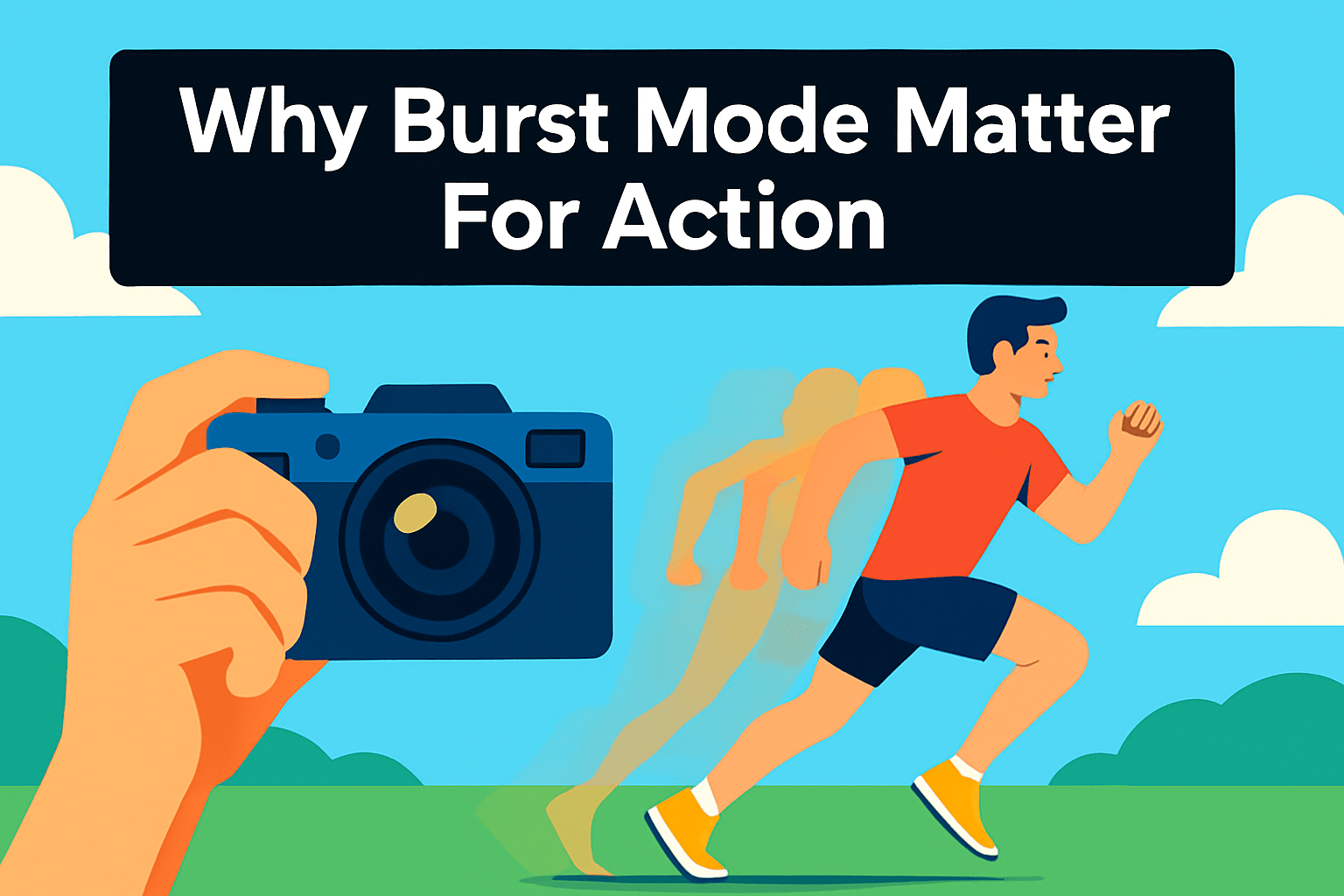
When subjects move fast, you don’t win by guessing the single perfect moment. Burst mode turns that guess into a sequence, giving you dozens of chances to catch the peak of action—the exact instant a foot hits the ball, a bird tucks its wings, or a skateboarder lands a trick. As a working photographer I rely on bursts to remove the timing lottery from fast-moving scenes.
Frame rate and shutter speed work together. High fps increases the odds you get the exact fraction-of-a-second expression or position, but you still need a shutter fast enough to freeze motion. As a rule of thumb, aim for at least 1/500s for most sports; faster subjects benefit from higher shutter speeds and faster burst rates. If you want a sense of motion, slow the shutter and pan with the subject while firing a steady stream of frames.
Autofocus behavior is the other half of the equation. Continuous AF with tracking and eye/subject detection makes burst shooting useful; otherwise you end up with rapid mush. Pre-focus when you can, use AF-C for unpredictable paths, and keep bursts short if your camera’s buffer or autofocus slows down after a while.
Practical limits matter: buffer depth, RAW vs JPEG capture, and electronic shutters all affect how long you can sustain high fps. Shooting RAW is tempting for post-processing, but it can clog buffers and slow recovery between bursts. I often switch to large-JPEG for long action sequences and save RAW for key moments.
Finally, practice with short bursts of 8–20 frames rather than holding the button forever. Learn your camera’s startup/lag characteristics and set intuitive drive controls so you don’t fiddle in a crucial moment. Burst mode won’t magically make every shot perfect, but used deliberately it dramatically increases the frames that are worth keeping.
Ease-Of-Use Features For Action Compacts
When shooting action with a compact camera, the camera’s ease-of-use often matters more than the headline specs. You want controls that get out of the way so you can read the scene and fire. Small, well-placed buttons, a responsive shutter and intuitive burst controls let you react instinctively instead of fumbling through menus.
Burst speed is one of those features you’ll notice immediately in the field. For most everyday action, something in the 5–10 fps range gives you plenty of chances to catch the right frame. If your camera can push to 20 fps with full AF, that’s a luxury; but buffer depth and real-world responsiveness matter just as much as the top number.
Autofocus behavior makes or breaks an action shoot. Continuous AF (AF‑C) with reliable subject or face tracking will keep kids, dogs, or cyclists in focus even when they cross the frame. Learn the camera’s tracking quirks, assign AF to a dedicated button if possible, and use back‑button AF when you need to separate focusing from shutter release.
Good image stabilization and sensible exposure automation save shots when you’re handholding or shooting in mixed light. Use a sports or action mode to lock shutter priority and let ISO breathe, or push a faster shutter and rely on IS for subtle motion. Don’t be afraid to let the camera help you—well-tuned auto modes reduce missed moments.
Finally, ergonomics and feedback count. A bright LCD or viewfinder makes following fast subjects in bright sun practical. Fast start-up, short shot-to-shot lag, and the ability to save custom modes for dance, surf, or sports cut precious seconds off your reaction time. Practice with the features you value and carry a spare battery and card so the only limit is your timing, not the kit.
What People Ask Most
What is the best point-and-shoot camera for action shots?
There is no single best model for every situation; the right choice depends on the type of action you shoot. Match the camera’s burst capability, autofocus, zoom reach, and durability to your typical subjects and shooting conditions.
Can point-and-shoot cameras keep up with fast-moving subjects?
Many modern compacts can keep up if they offer continuous AF and a solid burst mode, but performance varies by model. Higher-tier compacts with advanced tracking generally perform much better than basic entry-level cameras.
Which features matter most in a point-and-shoot for action photography?
Fast continuous autofocus and a responsive burst mode are the most important, followed by good image stabilization and ergonomic controls. A clear viewfinder or bright LCD also helps with tracking moving subjects.
Do point-and-shoot cameras have fast enough autofocus for sports?
Some do, particularly higher-end compacts with advanced AF systems and subject-tracking. Lower-end models may struggle, so look for hands-on tests that show how well a camera tracks moving subjects.
How many frames per second do you need for action shots with a compact camera?
Aim for around five to ten frames per second for most action, while much faster bursts help with extremely quick subjects. Also consider buffer depth and whether autofocus remains active during the burst.
Are point-and-shoot cameras good for shooting high-speed video and action?
Many point-and-shoots can record good action video, but capabilities vary with sensor size and stabilization. Check the available frame-rate options and stabilization for smoother motion capture.
How can I get sharp action photos with a point-and-shoot camera?
Use continuous AF, burst mode, and a faster shutter to increase your chances of capturing the peak moment. Track the subject smoothly, keep the camera steady, and use pre-focus or zone focus when appropriate.
Conclusion For Best Action Point-And-Shoot Cameras
This comparison should leave you better able to choose a point-and-shoot that fits the type of action you shoot most often, from street moments to rugged outdoor adventures.
In short: the Fujifilm is great for street and documentary work, the Sony RX100 VII is a versatile travel and family action compact, the Ricoh GR III excels at pocketable street photography, the Canon PowerShot SX740 HS gives you long reach for distant subjects, and the OM System Tough TG-7 is built for water and rough conditions.
Remember the main trade-offs are sensor size versus zoom reach and durability, along with burst speed, autofocus reliability, stabilization, and overall portability.
Match your purchase to the situations you shoot most—close-up street, family sports, distant wildlife, or wet and rugged environments—to get the best results for your needs.
If you want to sharpen your technique and gear knowledge, take a look through more articles on the site to build skills and confidence behind the camera.
Leave a comment with your questions or experiences below and we usually reply within a few hours.



0 Comments