
Looking for a pocketable camera that shoots cinematic video without weighing down your kit?
We tested and rounded up five of the best small cameras for video and vlogging to make that choice easier.
This guide focuses on small cameras that perform for creators on the move. It’s about real-world video: usable autofocus, stable handheld footage, and clean audio solutions.
We’ll look at the Sony ZV-1, Sony RX100 VII, Canon PowerShot V1, Fujifilm X-T5, and the DJI Mini 4 Pro. Together they span pocket vloggers’ rigs, flexible travel compacts, a high-res mirrorless option, and a compact drone for aerials.
Expect concise, practical advice rather than specs lists. I’ll break down strengths, trade-offs, and which camera suits common shooting styles.
Whether you’re trimming a carry-on bag, chasing daily content, or wanting higher-quality travel footage, this roundup will point you to the right tool. Read on to pick the best small camera for your video work.
Some of these are built for quick vlogs and run-and-gun shooting. Others prioritize image quality or reach — and one brings aerial capability in a featherweight package.
By the end you’ll know which small camera gives you the sharpest footage for low light, the smoothest handheld results, and the cleanest audio straight from the body. No needless jargon, just the guidance to get better video with less bulk.
1. Sony ZV-1 Vlogging Camera

Sony ZV-1 digital camera
Compact vlogging powerhouse with fast autofocus, bright lens, built-in directional mic, and easy face tracking for flawless handheld videos and content creation.
Check PriceThe Sony ZV-1 is a purpose-built compact camera for vloggers and video creators, centered on a 20.1MP 1-inch sensor and a bright 24–70mm f/1.8–2.8 lens. It’s designed to deliver clean, usable footage without the bulk of larger systems.
Autofocus is class-leading — it effectively tracks subjects and keeps face/eye focus locked, which removes a lot of the stress when you’re moving or framing yourself. That reliability alone makes it feel like a true run-and-gun tool for solo creators.
Video quality is impressive for its size, giving vloggers the kind of image that stands up on social platforms and lightweight productions. The body is compact and lightweight, so it’s easy to carry all day and pull out whenever a moment appears.
Audio options are well thought out for creators: there’s a 3.5mm mic port and a hotshoe for external microphones, so you can step up sound quality quickly without adapters. Those features turn a small camera into a capable one-person kit for interviews, B-roll, and talking-head videos.
In short, the ZV-1 is ideal for vloggers and content creators who prioritize video quality and ease of use. Users praise its portability and excellent autofocus, though you should accept a limited zoom range and no weather sealing as tradeoffs for the small form factor.
- Class-leading autofocus
- Impressive video quality
- Compact, lightweight for travel
- 3.5mm mic port and hotshoe
- Limited zoom range
- No weather sealing
2. Sony RX100 VII Compact Zoom
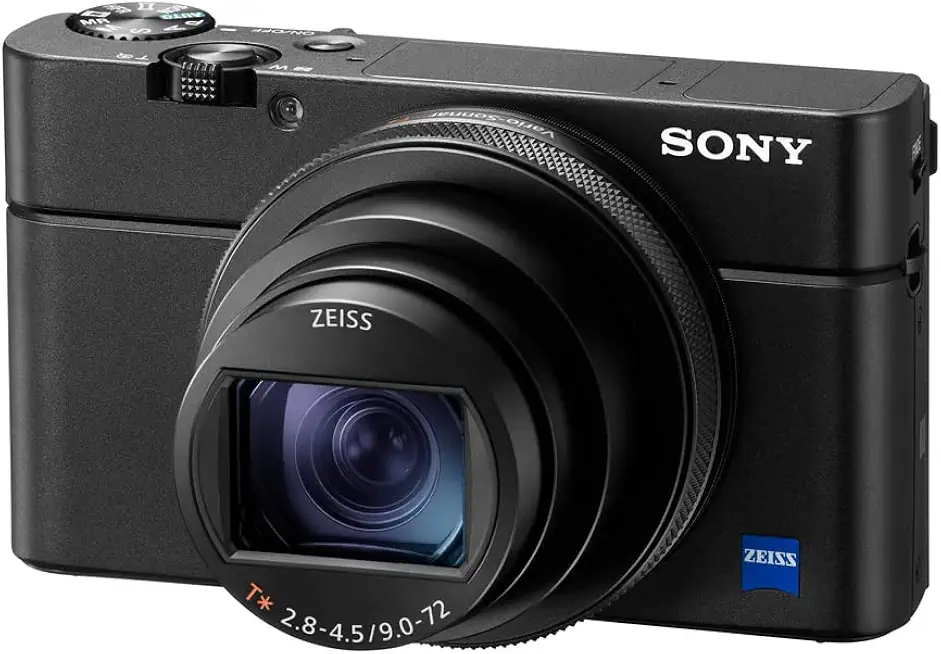
Sony RX100 VII DSC-RX100M7
Premium pocket camera with large sensor, versatile zoom, lightning-fast autofocus, and 4K video for pro-quality photos and seamless travel shooting.
Check PriceThe Sony RX100 VII is a genuinely versatile compact for photographers who also shoot a lot of video. It pairs a 20MP 1-inch sensor with a 24–200mm f/2.8–4.5 zoom, giving you a lot of focal-length flexibility in a pocketable body.
That long zoom range is the standout: 24–200mm covers wide environmental shots to tight telephoto without changing lenses, which is especially useful when you travel light. The camera also delivers high-quality video with good stabilization, so handheld clips look clean across much of that zoom range.
Beyond video, the RX100 VII’s fast continuous shooting makes it capable for action sequences and quick-moving subjects, so it handles stills and motion equally well. Its compact and portable build means you’re more likely to carry it everywhere, which translates to more shooting opportunities and less gear hassle.
Be mindful of the limitations: the 1-inch sensor won’t match the low-light performance or dynamic range of larger sensors, so if you frequently shoot in dim conditions the RX100 VII won’t be ideal. If you prioritize a true travel-allrounder that balances reach, solid video stabilization, and pocketability, this camera is a strong choice; if ultimate low-light quality is the main goal, consider larger-sensor alternatives.
- Wide 24–200mm zoom range
- Fast continuous shooting for action
- High-quality video with good stabilization
- Compact and portable
- 1-inch sensor limits image quality versus larger sensors
- Limited low-light performance compared with larger sensors
3. Canon PowerShot V1 Vlogging Camera

Canon PowerShot V1
Front-facing screen, image stabilization, and user-friendly controls deliver steady, selfie-friendly video and effortless social-media-ready stills.
Check PriceThe Canon PowerShot V1 is a purposeful little vlogging camera built around a larger-than-typical 1.4-inch sensor, and that immediately changes the game for compact shooters. You get cleaner images, better low-light behavior, and a shallower look than most pocket cams, which helps separate subjects from backgrounds when shooting talking-head videos.
Canon also packed in practical video tools: a built-in ND filter for exposure control in bright conditions and oversampled 4K 30p with an option for cropped 4K 60p. Those capture modes give you both high-detail 4K and higher-frame-rate options for smoother motion or slow-motion workflows.
Where the V1 really stands out is audio. It has a large, impressive microphone with a wind muffler built in, so you can record usable sound without hauling extra gear. For run-and-gun creators who need good out-of-camera audio, that’s a huge timesaver.
It’s an all-in-one that favors simplicity and portability. The trade-offs are predictable: the built-in lens keeps the body compact but prevents lens changes, and the Micro HDMI port may be less convenient for some setups. Still, for vloggers and creators wanting a compact, video-focused camera with strong audio and a larger sensor, the PowerShot V1 is a very compelling choice.
- Larger-than-typical sensor for improved image quality
- Built-in ND filter for exposure control in bright conditions
- Large, impressive microphone with wind muffler for better audio
- Oversampled 4K 30p and cropped 4K 60p options
- Built-in lens limits ability to change lenses
- Micro HDMI port may be less convenient
4. Fujifilm X-T5 Mirrorless Camera

Fujifilm X-T5 camera body
Lightweight mirrorless body with high-resolution sensor, advanced autofocus, and iconic film simulations for expressive, professional-grade photography.
Check PriceThe Fujifilm X-T5 is a mirrorless camera centered on image quality, packing a 40.2MP APS-C sensor that delivers exceptionally detailed stills and plenty of room for cropping. As a photographer, that resolution gives you freedom to reframe and extract high-quality frames for both photos and video thumbnails.
For video, the X-T5 punches well above its class: it offers internal 10-bit capture, Log recording and 4K up to 60 fps without a crop. Those specs mean you can grade footage aggressively and still retain latitude and detail — very useful for hybrid shooters who want cinematic footage from a compact body.
Handling is one of Fuji’s strengths here. The camera’s portable design combined with dedicated exposure dials gives you tactile control that speeds up workflows on set. The three-way tilting screen is practical for low-angle work and quick vlogging setups without contortions.
Autofocus on the X-T5 is reliable; it won’t feel inferior for most run-and-gun situations, though it’s noted as not quite as advanced as some competitors. In practice this means you’ll get solid subject tracking in everyday use, but you might test it for very fast action or complex tracking scenarios.
In short, the X-T5 is well suited to photographers who need strong video capabilities without sacrificing still-image quality. It’s ideal for users who value high resolution, flexibility and a portable package, as it balances pro-level video tools with Fuji’s familiar analog-style controls.
- 40.2MP APS-C sensor — detailed images and ample cropping
- Internal 10-bit capture, Log recording, and 4K up to 60 fps without crop
- Portable design with dedicated exposure dials
- Three-way tilting screen
- Primarily photography-focused despite excellent video features
- Lens selection more limited compared to full-frame systems
5. DJI Mini 4 Pro Camera Drone

DJI Mini 4 Pro Fly More Combo with DJI RC 2
Ultra-light, foldable drone bundle with obstacle sensing, 4K HDR video, extended flight time, plus extra batteries and controller for uninterrupted aerial creativity.
Check PriceThe DJI Mini 4 Pro is a compact drone built specifically for high-quality video capture, and it delivers surprisingly professional results for its size. Footage is crisp and clean thanks to being oversampled from 5.7K, which gives you excellent detail and latitude in post.
For bright outdoor shoots the built-in ND filter is a real time-saver, letting you keep motion-accurate shutter speeds without constantly tinkering with exposure. That, combined with lightweight, highly portable construction, makes this drone ideal for travel shoots and on-the-go creative work.
As a working photographer I appreciate the advanced safety and output features. Collision sensors make close-quarters flying less stressful, and multiple output options simplify ingesting footage into different editing workflows.
There are trade-offs to consider. The Mini 4 Pro is priced closer to higher-end models, so it may not fit tight budgets even though it sits in the compact category. Also, its weight can trigger local registration or operational restrictions in some regions, so check rules before booking a shoot.
In short, if you need high-quality aerial footage without hauling a larger drone, the Mini 4 Pro is a compelling choice—especially for travel, real-estate, or short documentary work where portability and image quality matter. Just factor in price and potential regulatory limits when planning assignments.
- Crisp, clean footage oversampled from 5.7K
- Built-in ND filter
- Lightweight and highly portable
- Collision sensors and multiple output options
- Priced closer to higher-end models
- May face restrictions in some areas due to weight
Sensor Size and Video Quality
Sensor size is one of the first specs photographers fixate on, and for video it truly matters. Bigger sensors collect more light per pixel, which translates to cleaner low‑light footage, broader dynamic range and less noise at higher ISOs. In practical terms you’ll see more detail in shadows and smoother highlights with larger sensors when the scene is contrasty.
That said, resolution and sensor size aren’t the same thing. An APS‑C camera can carry more megapixels than a full‑frame body, but those pixels are smaller and therefore gather less light individually. For video this means you might get very sharp images that become grainy sooner in low light compared with a larger‑photosite sensor at the same resolution.
Depth of field is another visible consequence. Larger sensors make it easier to separate subject from background with creamy bokeh, which helps interviews and cinematic looks. Conversely, smaller sensors naturally give deeper focus, which can be an advantage for run‑and‑gun work or vlogging when you want both face and background reasonably sharp without constant refocusing.
Don’t forget how much modern processing and lenses change the story. Good image processors, oversampling strategies and fast optics can make 1‑inch and Micro Four Thirds cameras deliver remarkably clean 4K, especially in well‑lit situations. So a compact with a smaller sensor plus excellent stabilization and a bright lens often shoots better in the real world than a larger‑sensor camera with a slow lens or poor stabilization.
When choosing a small video camera, match sensor size to your shooting style. If you work in low light or chase cinematic shallow depth of field, favor the larger sensor. If you value portability, extended depth of field and ease of use, a smaller sensor with strong stabilization and autofocus might be the smarter pick.
Finally, weigh the whole system: lens options, IBIS or optical IS, codecs and ISO performance matter just as much as sensor inches. Think of sensor size as a major influence, not the only one, and pick the combination that fits the light you shoot in and the look you want to create.
Image Stabilization in Small Cameras
Image stabilization is one of those make-or-break features for small cameras shooting handheld video. It turns footage that would otherwise feel shaky into something watchable, and for run-and-gun work it’s often more important than resolution or extra frames per second.
There are three flavors to know. IBIS (in-body stabilization) moves the sensor to cancel motion and works with any lens. Lens-based optical stabilization corrects motion inside the lens and can be very effective at longer focal lengths. Electronic stabilization uses software to smooth footage, but it crops the frame and can soften detail, so treat it as a useful backup rather than a first choice.
When a camera supports both IBIS and lens IS, the two can complement each other and produce the smoothest handheld results. Multi-axis systems are especially good at ironing out walking bumps, while single-axis solutions struggle with directional sway. Rapid or complex movements still overwhelm even the best built-in systems, which is where a gimbal comes in.
Practical technique matters as much as the hardware. Use wider lenses when possible, keep your elbows tucked, walk with bent knees, and use a neck or wrist strap as a stabilizing anchor. These small habits reduce reliance on electronic fixes and preserve image quality.
Be mindful of trade-offs. Electronic stabilization crops in and can steal a bit of field of view and fine detail; it also drains battery. Test combinations of IBIS, lens IS, and digital modes on your camera to see which setting produces the cleanest image for the subject and focal length you’re using.
If you anticipate a lot of movement — running, biking, or fast pans — plan on a gimbal. For everyday vlogging and travel video, a camera with robust IBIS and good lenses will keep your footage steady and your workflow simple.
What People Ask Most
What is the best small camera for video and vlogging?
It depends on your priorities; the Sony ZV-1 is tailored to vloggers with excellent autofocus and portability. Other options like the Canon PowerShot V1 offer stronger audio and a larger sensor for improved image quality.
What is the best compact camera for 4K video?
Several small cameras offer strong 4K options; the Canon PowerShot V1 provides oversampled 4K and a cropped 4K 60p mode, while the Fujifilm X-T5 delivers robust 4K capture with log recording for more flexibility. Choose based on whether you prioritize image processing or recording options.
Which small mirrorless camera is best for video?
The Fujifilm X-T5 is the standout small mirrorless choice thanks to its high-resolution APS-C sensor and advanced video features like internal 10-bit capture and Log recording. It suits users who want high image quality in a portable body.
What small camera is best for travel video shooting?
The Sony RX100 VII is well suited to travel thanks to its compact size and wide zoom range, offering flexibility without much bulk. It balances portability and versatility for varied travel scenarios.
Which small camera has the best image stabilization for video?
Compact models vary, but the RX100 VII is noted for good stabilization among pocket cameras, and systems with IBIS or multi-axis compensation generally deliver the smoothest handheld footage. For rapid or complex motion, an external gimbal can still help.
What small camera offers the best autofocus performance for video?
The Sony ZV-1 is highlighted for class-leading autofocus and reliable face and eye tracking, making it ideal when autofocus is a priority. Other models offer capable autofocus, but the ZV-1 is tuned for ease of use in video and vlogging.
What is the best pocket-sized camera for shooting professional-looking video?
Pocket-friendly choices like the RX100 VII and Sony ZV-1 are aimed at creators seeking professional-looking results in a small package, and the Canon PowerShot V1 adds strong audio and sensor benefits. Select the one that aligns with your needs for zoom, autofocus, audio, or sensor size.
Conclusion for Best Small Camera for Video
We covered five compact tools suited to different creators: the Sony ZV-1 for streamlined vlogging, the Sony RX100 VII for versatile travel use, the Canon PowerShot V1 for an all‑in‑one video and audio experience, the Fujifilm X‑T5 for high‑resolution photo‑forward work with strong video features, and the DJI Mini 4 Pro for portable aerial capture.
Each model excels in its niche—excellent autofocus and portability for the ZV‑1, zoom flexibility and speed for the RX100 VII, a larger sensor and onboard audio advantages for the PowerShot V1, high detail and video options for the X‑T5, and compact, detailed footage from the Mini 4 Pro.
When choosing a camera, prioritize what matters to your projects: sensor size for low‑light performance and background separation, stabilization for smooth handheld footage, autofocus for reliable tracking, audio quality for dialogue, and the level of portability you actually need.
Balancing those trade‑offs will help you pick the small camera that best matches your shooting style instead of pursuing a single “best” option.
If you want to improve your shooting and editing skills, keep exploring our site for more guides and practical tips to help you get the most from your gear.
Have a question or need personalized advice? Leave a comment below — we usually reply within a few hours.




0 Comments