
How confident are you that your next thermal inspection will catch every critical hotspot before it turns into an unplanned shutdown? In industrial settings a missed anomaly can mean downtime, safety risks, and expensive repairs. Choosing the right thermal camera is not just about resolution; it’s about matching the tool to your workflows and risks.
This concise buying guide compares five industrial-grade thermal imaging cameras and distills what matters for real-world inspections. It’s written for maintenance teams, technicians, engineers, and facilities managers who need reliable diagnostics and actionable data. We focus on the practical tradeoffs that affect work on the floor.
Expect clear guidance on durability, handling, and the analysis tools that turn thermal frames into maintenance plans. From rugged housings that survive dust and vibration to software that simplifies trend analysis, these elements determine how quickly you can find and fix problems. Portability and battery life also matter when inspections span large facilities.
Throughout this guide you’ll get simplified comparisons and decision tips rather than overwhelming specs and jargon. Use this to match inspection needs—detail versus mobility—site environment, and reporting requirements when choosing the best thermal imaging camera for industrial use. Ready to narrow your options and protect uptime?
1. FLIR T1020 Professional Thermal Camera

FLIR C5 Compact Thermal Camera
Pocket-sized inspector for electrical, HVAC, and building diagnostics with clear thermal imagery and easy reporting.
Check PriceThe FLIR T1020 is a top‑tier thermal camera built for professionals who demand the clearest thermal imagery possible. With an ultra‑high thermal resolution of 1024 × 768, it delivers the kind of detail that makes tiny anomalies readable at a glance.
As a photographer I notice immediately how the professional‑grade optics render sharp images even at distance, which is invaluable when you can’t get close to hot equipment. That clarity speeds diagnosis and reduces the need for repeat visits to capture usable imagery.
Onboard analytics are robust: measurement tools, alarms, and customizable reporting live on the device so you can annotate and act while still in the field. Connectivity into FLIR’s software ecosystem for PC and cloud review means you can build polished reports and archive time‑stamped surveys without juggling files.
The camera’s ergonomic design supports extended use and long inspection days, so handling feels balanced and intentional. It’s built to withstand industrial environments, though it is slightly bulkier and heavier than entry‑level options — a fair trade for its performance.
If you’re on a maintenance team, an electrical or mechanical engineer, or a facilities manager responsible for predictive maintenance, the T1020 is designed for your workflow. Be prepared for a steep learning curve with the interface and analytics, but once mastered it becomes an irreplaceable tool for professional diagnostics.
- Exceptional detail clarity for spotting small anomalies
- Onboard analytics simplify report generation
- Robust build for industrial environments
- Comfortable handling during long workdays
- Steep learning curve for interface and analytics
- Slightly bulkier and heavier than entry‑level models
2. Marmonix MTV-320 Pro Thermal Camera
High-resolution infrared scans for precise temperature mapping, ideal for maintenance, inspection, and predictive diagnostics.
Check PriceAs a photographer who often documents industrial sites, I appreciate tools that translate heat into clear, actionable images — the Marmonix MTV-320 Pro was clearly built for that purpose. It offers a 320 × 240 IR resolution with 70 mK sensitivity, which is plenty for routine plant-wide inspections and for spotting subtle thermal anomalies across large equipment arrays.
The camera measures from –10°C up to +330°C with ±2°C accuracy, so you can confidently log both low-temperature envelope issues and hot spots on motors, bearings, or electrical panels. That temperature span makes it versatile for most facility maintenance tasks without sacrificing measurement reliability.
What makes the MTV-320 Pro especially practical on site are the multiple imaging modes — infrared, visible, picture‑in‑picture, and fusion — which let you compare thermal and visual context side-by-side for reporting and repairs. It also stores more than 30,000 TIFF images on-device and includes PC software for deeper analysis, streamlining the workflow from capture to report.
Connectivity and durability suit industrial environments: quick Wi‑Fi and USB Type‑C transfers speed up data sharing, while an IP54 rating and a –20°C to +50°C operating range mean it tolerates dust, moisture, and typical temperature swings. In short, it’s a solid, workhorse camera for plant maintenance managers, facility operators, and service providers who need dependable field performance.
- Very large on-device storage (>30,000 TIFFs)
- Versatile imaging modes (IR, visible, PIP, fusion)
- Durable IP54 rating; operates –20°C to +50°C
- Fast Wi‑Fi and USB‑C data sharing
- 3.5‑inch display could be sharper
- May require spare batteries for extended use
3. Thermal Master P3 PCB Master Edition
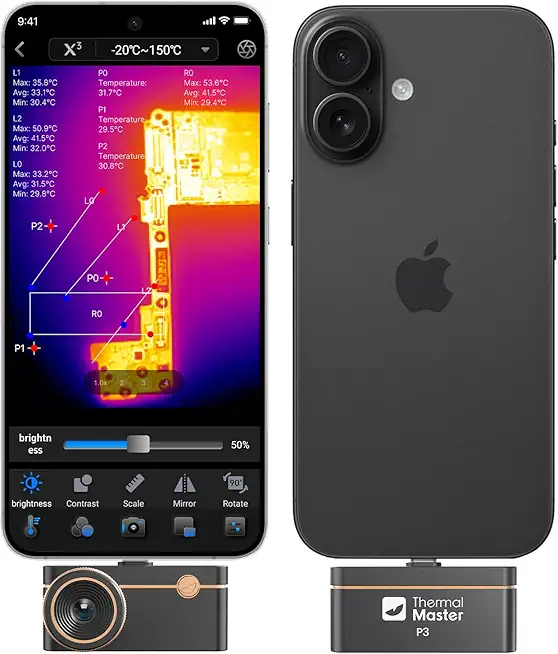
P3 Thermal Imaging Camera 512×384
Rugged professional tool delivering advanced thermal analysis and reporting for building, electrical, and industrial applications.
Check PriceAs a photographer used to reading tiny tonal shifts, the Thermal Master P3 – PCB Master Edition feels like a macro lens for thermal work. It’s built for precision diagnostics where tiny hot spots on circuit boards tell the real story.
The 512 × 384 X³ IR™ sensor delivers unusually fine thermal detail for such a compact tool, and the 8 mm manual macro focus lets you dial in on individual components. That combination means you can confidently separate adjacent heat sources the way you separate highlights and shadows in a close-up frame.
Temperature coverage from –20°C to +600°C with ±2°C accuracy makes it versatile across low- and high-temperature troubleshooting, while multiple palettes and measurement tools — live min/max, point/line/circle — give you immediate, actionable readings. Instant calibration keeps your readings trustworthy when conditions shift on the bench or in the field.
It’s smartphone-powered via USB‑C or Lightning with no internal battery, so the camera is pocketable and extremely lightweight in your kit, but requires a compatible phone to operate. A rugged molded carry case protects the unit between jobs, which I appreciate when moving between workshops or service calls.
In practice it’s ideal for electronics engineers, HVAC techs, automotive mechanics, and field service pros who need component-level clarity without hauling a full handheld imager. If you want precision, portability, and direct phone integration — and you don’t need built-in screens or heavy onboard analytics — this unit is mostly a perfect fit.
- 512 × 384 X³ sensor — pinpoint detail
- 8 mm manual macro focus for component-level inspection
- Phone-powered (USB‑C/Lightning); pocketable
- Instant calibration + live min/max, point/line/circle tools
- Requires compatible smartphone (no onboard screen)
- Advanced reporting relies on third‑party apps
4. FLIR E8-XT Industrial Thermal Camera

FLIR E8-XT Commercial Thermal Camera
Combines thermal and visible imaging for fast fault detection, clear documentation, and effortless on-site collaboration.
Check PriceThe FLIR E8-XT is positioned as the best overall thermal camera for everyday industrial maintenance. Its 240 × 180 IR resolution is well suited to electrical panels, motors, and HVAC systems.
MSX® technology blends visible edges with thermal data, so frames look sharper and anomalies are easier to interpret at a glance. That edge detail speeds up documentation and makes findings more communicable to colleagues.
The camera wears its industrial credentials with a rugged IP54 design and a responsive touchscreen with a simple interface. It’s built for quick, repeatable captures in a busy jobsite environment.
Battery life lasts a full workday, so you can complete inspection rounds without swapping packs. Intuitive controls mean minimal training for crew members getting up to speed.
Resolution isn’t class-leading, so the E8‑XT won’t replace premium FLIR models when you need to resolve tiny hot spots at long distance. For routine maintenance checks, however, it delivers consistent, repeatable results that matter most day-to-day.
For teams that depend on heavy onboard analytics and complex reporting, the E8‑XT may feel limited compared with high‑end units. But its simplicity is an advantage when decisions must be made quickly in the field.
As someone who values clear, communicative imagery, I appreciate how MSX-enhanced frames make before/after documentation crisp and useful. If you need a dependable, easy-to-use industrial thermal camera that balances performance and price, the E8‑XT is mostly a smart, practical choice.
- Intuitive controls; easy to use
- Durable for daily knocks and drops
- Consistent, repeatable results for common tasks
- Good balance of performance and price
- Lower resolution compared with premium FLIR models
- Lacks advanced analytics/reporting features of high‑end units
5. TopDon TC005 Thermal Camera

TOPDON TC005 Dual Thermal Camera 256×192 IR + 2MP Visual
Universal thermal inspection companion offering intuitive controls, fast image capture, and comprehensive reporting for professionals.
Check PriceThe TopDon TC005 is a compact, budget‑friendly thermal camera aimed at general industrial and building inspection. Its 256 × 192 thermal resolution gives a clear enough picture to spot hot spots on panels, motors, and roofs without the bulk of high‑end systems.
As a photographer used to judging scenes by eye, I appreciate the TC005’s multiple imaging modes — IR, visible, and two fusion options — which let you blend thermal detail with real‑world context for precise framing and faster diagnosis. The visible channel and fusion make it easy to document issues for reports or client handoffs.
Portability is a highlight: it’s lightweight, comes with a protective case and lanyard, and stores images to a memory card for easy transfer to PC. Battery life is impressive for fieldwork — up to 12 hours continuous use — so you can shoot an inspection day without worrying about spare batteries.
Keep in mind the on‑device review is limited by a small 2.8‑inch display, so I recommend transferring images to a larger screen for final analysis and reporting. Also, it lacks advanced analytics or multi‑spectral imaging, so while it’s excellent for routine inspections and documentation, it isn’t a replacement for high‑end diagnostic tools when you need deeper measurement or automated reporting.
- 256 × 192 thermal resolution
- IR + visible + two fusion modes
- Up to 12 hours battery life
- Lightweight with protective case and lanyard
- Small 2.8‑inch display
- No advanced analytics or multi‑spectral imaging
Durability and Build for Harsh Environments
In the field I treat my thermal camera like a good lens — it needs protection, but I also need it handy. Start by matching the camera’s environmental ratings to the site. IP67/IP66/IP68 or NEMA 4X are solid for dust, water and corrosive atmospheres, IK10 tells you how it stands up to knocks, and for truly hazardous zones look for ATEX or IECEx certified, flameproof enclosures.
Materials matter. Stainless and corrosion‑resistant alloys (think 316L) will outlast painted housings in chemical or coastal sites. Still, a full metal body adds weight; if you move between sites, consider a lighter camera plus a rugged external housing or a tough flight case to bridge the gap.
Temperature and vibration specs are more than numbers — they dictate workflow. Cameras rated to −40°C and beyond will need warm‑up routines to avoid fogging, while units specified to +65°C protect you near ovens and kiln lines. If you’re attaching to machinery, check vibration/shock ratings and use anti‑vibration mounts or tripods when possible.
Lens and screen care are small things that save big money. Use scratch‑proof filters and a soft microfiber for cleaning, avoid harsh solvents, and keep lens caps on between shots. Inspect O‑rings and seals regularly; a cheap gasket replacement in the shop beats a ruined sensor in the field.
Battery and storage discipline extend service life. Store cameras in low‑humidity, temperature‑controlled spaces and follow the manufacturer’s charging guidance. Carry spare batteries, avoid deep discharges, and let cold batteries acclimate before heavy use.
Finally, don’t let specs do all the talking — run a quick site audit before purchase. Consider ergonomics for long inspections, mounting options, and whether protective cases, lens filters, or explosion‑proof housings will be part of your kit. A small maintenance log and routine checks will keep the camera working long after the warranty runs out.
Software and Analysis for Industrial Reports
When I’m on-site shooting thermals, the camera is only half the job; the software does the storytelling. Capture radiometric images whenever you can—TIFFs that hold pixel-level temperature data let you correct emissivity, subtract reflected temperatures, and re-analyze later without losing accuracy.
Start your post-process with a fusion pass so clients see context and detail together. Blending the visible stream with infrared makes it easier to explain findings to non-technical stakeholders, and it reduces misidentification when equipment is crowded or reflective.
Use measurement tools deliberately: place consistent point probes, draw line profiles over suspect runs, and set area statistics for hotspots. Emissivity settings and reference stickers matter; if you don’t document the emissivity you used, trend comparisons become unreliable.
Templates are a time-saver. Build report templates that include on-image annotations, before/after comparisons, temperature trend graphs, and your standard palette. Automating thresholds and alarms lets you flag critical deviations across hundreds of images without re-scanning each file.
Cloud and team workflows change everything on large sites. Real-time streaming and time‑stamped cloud storage let maintenance crews act fast and track temperature history for predictive maintenance. Export CSVs or integrate with CMMS systems so thermography becomes part of the asset record, not just a PDF on someone’s desktop.
Finally, think like a photographer: consistency is clarity. Use the same palette, emissivity, and distance protocol for repeat inspections, embed serial numbers and notes in metadata, and always archive the original radiometric files. Those small habits make reports defensible and useful months or years down the line.
What People Ask Most
What is the best thermal imaging camera for industrial use?
There is no single best camera for every industrial use; the right choice depends on inspection detail, portability, durability, and reporting needs. Match the camera to the tasks you perform most often and the environment you work in.
What features should I look for in a thermal imaging camera for industrial inspections?
Look for clear thermal imaging, reliable measurement tools, rugged construction, good connectivity, and software for analysis and reporting. These features together make inspections faster and the resulting data more actionable.
How accurate are thermal imaging cameras for industrial temperature measurements?
Thermal cameras are well suited for spotting temperature anomalies and tracking trends, but measurement accuracy depends on factors like calibration, emissivity, and viewing conditions. For critical or precise temperature verification, confirm readings with a contact thermometer or calibrated reference.
What thermal resolution and sensitivity do I need for industrial applications?
Choose higher resolution and greater sensitivity when you need to resolve small targets or subtle temperature differences, and a more modest specification when inspecting larger, close-range equipment. Base the choice on the typical target size, distance, and the level of detail required for your inspections.
Can thermal imaging cameras detect electrical and mechanical faults in industrial equipment?
Yes, thermal imaging is effective at revealing hot spots, uneven heating, and overheating components that indicate electrical or mechanical issues. Use thermography as a diagnostic tool and follow up with hands-on checks or other tests as needed to confirm faults.
How do I choose between handheld and fixed-mount thermal cameras for industrial use?
Handheld cameras offer flexibility for routine inspections and hard-to-reach areas, while fixed-mount units are better for continuous monitoring and automated trend tracking. Consider inspection frequency, access constraints, and whether you need ongoing data collection when deciding between them.
What are the limitations and environmental considerations when using thermal cameras in industrial settings?
Environmental factors like dust, moisture, reflections, and extreme temperatures can affect image quality and measurements, and some sites may require certified or explosion‑proof equipment. Follow manufacturer guidance on protection, cleaning, and storage to maintain performance in harsh conditions.
Conclusion for Industrial Thermal Cameras
This guide distilled five industrial thermal cameras into clear tradeoffs—resolution versus portability, advanced analytics versus simplicity, and ruggedness versus compact convenience—so you can quickly see which direction fits your team’s needs.
Think through the inspections you run most often, the environments you face, and how you plan to store and report data; prioritizing those factors will narrow the field faster than chasing raw specs alone.
Durability, interface simplicity, and software integration matter as much as image clarity when it comes to reliable, repeatable inspections on site, so weigh build quality and reporting tools alongside imaging performance.
If you want to deepen practical skills and decision-making, explore more of our site’s how‑to pieces and gear guides to learn workflows, troubleshooting tips, and inspection best practices.
Have a specific use case or need help choosing the right model for your workflow? Leave a comment below and we usually reply within a few hours to help you out.



0 Comments