
Tired of muffled audio wrecking your best vlogs?
This concise 2026 roundup spotlights the five best wireless mics for vloggers, chosen after hands-on testing, expert reviews, and real user feedback.
If you value clear voice capture, reliable range, and fuss-free setup, the right wireless mic can transform your videos.
We focused on everyday shooting scenarios—street interviews, run-and-gun travel clips, and smartphone social posts—so recommendations match real workflows.
Expect practical breakdowns of each system’s strengths and trade-offs, not just marketing claims.
You’ll learn which designs favor portability, which prioritize signal stability, and which include safety features to protect your audio.
We also evaluate setup speed, connectivity with cameras and phones, and how each mic performs in noisy environments.
Charging life, monitoring options, and ease of use were top priorities during real-world tests.
Whether you’re a solo creator chasing crisp dialogue or an interviewer needing dual-mic solutions, this guide narrows the field fast.
Read on to find a system that fits your gear, budget, and shooting style without drowning in tech jargon.
No jargon, no filler—just concise, experience-driven recommendations and actionable setup tips for 2026.
This guide is ideal for vloggers using cameras, smartphones, or hybrid rigs who want straightforward results.
We tested in real environments to give you realistic expectations, not lab-only numbers.
1. DJI Mic 2 Overview

DJI Mic 2 1 TX 1 RX Wireless Microphone
Studio-quality audio with reliable long-range transmission, crisp clarity, and intuitive controls—perfect for vlogs, interviews, and mobile content creators.
Check PriceAs a working photographer who shoots a lot of behind‑the‑scenes video and on‑location interviews, the DJI Mic 2 has become my go‑to for dependable audio. It delivers 24‑bit audio quality and AI‑powered adaptive noise cancellation, so voices stay clear even in busy environments without a lot of fiddling.
The system’s wireless range is impressive — up to 250 meters in ideal conditions — which makes it great for run‑and‑gun shoots and outdoor work where I need freedom of movement. Each transmitter also stores 8GB of onboard recording as a safety backup, so if RF drops out I don’t lose the take.
I like the touchscreen on the receiver for quick settings and monitoring; it keeps setup intuitive on a shoot day. The charging case offers multiple recharges and robust battery life, so I can extend a full day of shooting without hunting for power outlets.
For smartphone creators, DJI Mic 2 supports direct 16‑bit recording over Bluetooth for a compact workflow, and it can capture 32‑bit float if you want maximum headroom — just be ready to do a little post‑processing. Overall it’s versatile across cameras, smartphones and standalone recorders, making it a solid all‑around performer for serious vloggers and hybrid shooters.
- 24‑bit audio with AI noise cancellation
- Up to 250 meters wireless range
- 8GB onboard recording per transmitter
- Touchscreen receiver and charging case
- 32‑bit float features need post‑processing
- May be overkill for casual vloggers
2. Rode Wireless Micro Overview

Rode Wireless Micro 2 Mics with Charging Case
Dual microphone set with onboard charging case, delivering professional-grade sound, extended battery life, and easy setup for run-and-gun recording.
Check PriceRode Wireless Micro is a tiny powerhouse for mobile vloggers and smartphone creators who value simplicity and portability. As a working photographer I often pick kits that won’t weigh me down — these transmitters are extremely compact and lightweight (~12g transmitters), so they disappear on talent or in a pocket.
Setup is delightfully frictionless: it’s plug‑and‑play with USB‑C or Lightning for smartphones, which means you can move from shooting to posting in minutes. The system is praised for ease of use and fast setup, ideal for grab‑and‑go social content where every second counts.
For creators who aren’t audio engineers, GainAssist is the real lifesaver — it auto‑adjusts audio levels so dialogue stays balanced even when subjects shift their distance from the camera. That automatic gain keeps levels consistent across takes, reducing the time you spend fixing audio in post.
One downside is the lack of live volume monitoring; you can’t listen to the feed in real time on the device. There are also no advanced audio controls on the unit, so if you like to manually sculpt EQ or gain on the fly, this won’t meet that need.
In practice, Rode Wireless Micro shines for run‑and‑gun vlogging, social clips, interviews on the move, and any shoot where minimal kit and speed trump studio‑grade control. If your workflow is smartphone‑first and you prefer simplicity over tweakable pro features, this is a smart, lightweight choice that lets you focus on framing and performance rather than fiddling with menus.
- Ultra‑lightweight and highly portable
- Instant setup with minimal steps
- Great for casual vloggers and social creators
- Automatic gain keeps levels balanced
- No live audio monitoring
- Not suited for users needing manual/pro audio controls
3. NearStream AWM25T Overview
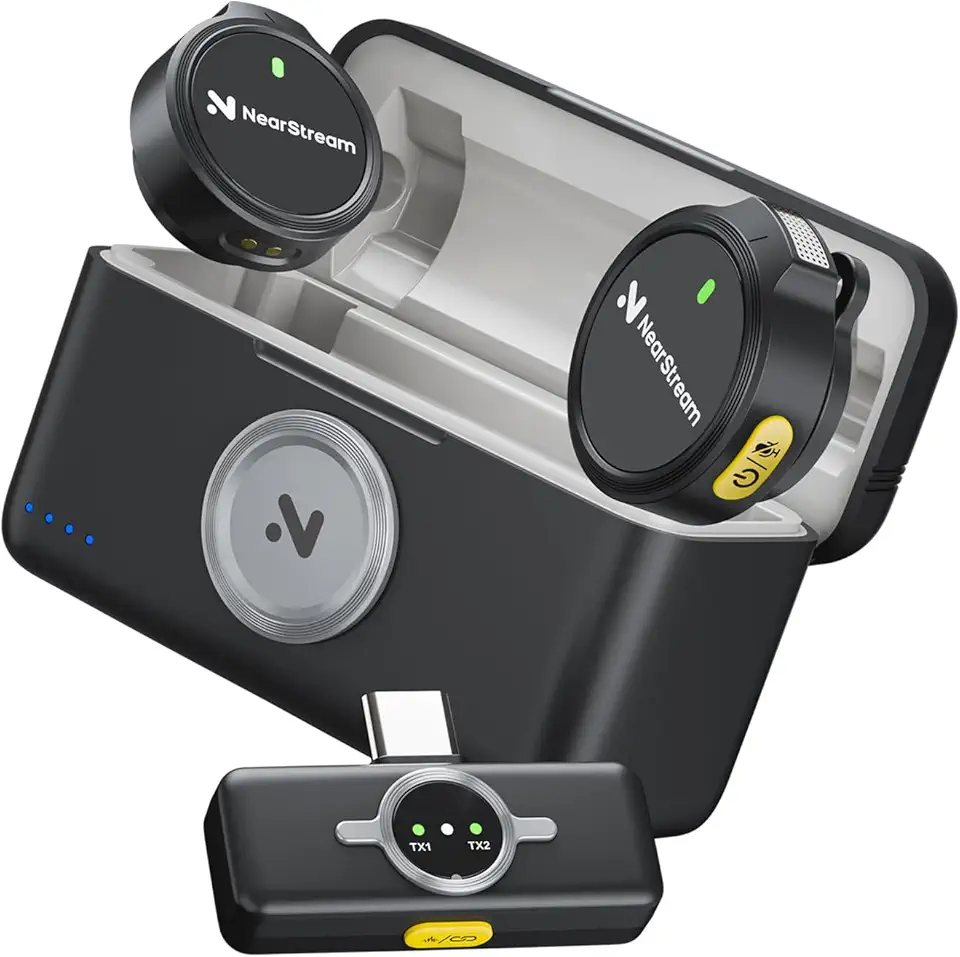
NearStream AWM25T Wireless Lavalier Microphone Lightning USB-C
Compact lavalier offering direct Lightning and USB-C connectivity, clear vocal pickup, and plug-and-play convenience for smartphones and tablets.
Check PriceNearStream AWM25T is an entry‑level wireless lav that punches above its weight, offering studio‑quality sound aimed at budget creators. As a photographer who also shoots talking‑head vlogs, I appreciate systems that sound clean without fuss — and this one fits that bill.
The mic supports 32 kHz / 16‑bit audio, delivers a 70 dB SNR and can handle peaks up to 125 dB, so voices come through clear and undistorted. In practical terms that means good clarity for narration and the headroom to cope with louder moments without noticeable clipping.
It uses ENC (environmental noise cancellation) and includes mute/unmute controls you can use during recording, which is a real time‑saver on location. The transmitters clip on with a compact magnetic clip and run on a stable 2.4 GHz transmission, making setup fast and reliable for run‑and‑gun shoots.
Battery life is solid for a budget kit: about 6 hours per charge and up to 36 hours when you use the charging case, so a full day of shooting plus backups is realistic. The system is plug‑and‑play and offers real‑time monitoring on the receiver, so you can confirm levels on the spot without extra adapters.
Where it isn’t perfect: the wireless range is limited to roughly 20 meters, so it’s best for vlogs where you stay relatively close to the camera. It also lacks advanced pro audio controls, so if you need granular EQ or multi‑channel routing, this won’t replace higher‑end rigs.
- Studio‑quality clarity (32 kHz / 16‑bit, 70 dB SNR)
- Long battery life with 36‑hour charging case
- Plug‑and‑play with real‑time receiver monitoring
- Lightweight magnetic clip for quick attachment
- Limited wireless range (~20 meters)
- No advanced pro audio controls
4. SYNCO G2 Mega Overview

Synco G2A2 MEGA Wireless Lavalier System Dual Transmitter 8GB
Dual transmitter kit with onboard recording, robust wireless range, and secure clip-on lavalier mics, ideal for interviews and multi-subject shoots.
Check PriceSYNCO G2 Mega is the kit I reach for when I need stealth and reliability on location. Its discreet magnetic clip design lets me hide the transmitter under clothing, which is a huge win for run‑and‑gun interviews or street reporting.
One feature that gives me real confidence is the 8GB onboard recording per transmitter. That safety copy has saved takes more than once when a signal hiccup or camera issue popped up during a rush shoot.
Battery life is practical for long days in the field — each transmitter runs about 8 hours, and the charging case tops that up to 24 hours. For travel vloggers and journalists who may not have access to frequent charging points, that kind of endurance keeps shoots moving.
In use, the G2 Mega delivers stable outdoor audio and handles noisy environments better than many rivals, which is why it’s a favorite for travel pieces and street interviews. The tradeoffs are straightforward: it’s priced higher than some compact alternatives, and the body is larger than ultra‑compact mini mics, so it’s less invisible if you’re after the tiniest footprint.
- Magnetic clip for hiding under clothing
- 8GB onboard recording per transmitter
- 8‑hour transmitter life; charging case up to 24 hours
- High‑quality sound in noisy outdoor environments
- Higher price than some rivals
- Larger form factor than ultra‑compact mics
5. Saramonic Blink 500 B2+ Overview

Saramonic BLINK500B2+ Wireless Lavalier Microphone
Compact, ultra-light audio system providing clear voice capture, quick pairing, and portable battery performance for creators on the move.
Check PriceThe Saramonic Blink 500 B2+ is a solid budget option that punches above its price class, delivering professional‑quality sound and active noise cancellation that keeps dialogue clear on the go. As a photographer who also shoots quick interview segments, I appreciate systems that reduce post work — this one does that without costing a premium.
What sets it apart for vloggers is the included dual transmitters. That makes on‑camera interviews and multi‑person vlogs straightforward, and the aux output lets you record to a smartphone and camera at the same time for an easy safety track.
The unit is built for fast, grab‑and‑go setups. Its durable construction and reliable transmission mean fewer retakes and less fiddling between shots, which is invaluable when you’re juggling framing, light, and audio under time pressure.
This kit suits creators who regularly capture two people or who want the versatility of dual‑device recording. It’s especially good if you need dependable audio quickly and want active noise cancellation to tame background distractions during run‑and‑gun shoots.
Be aware of the tradeoffs: the Blink 500 B2+ feels a bit plasticky compared to premium kits, and it’s not ideal if you need an ultra‑compact or stealthy setup under clothing. If stealth or luxe build are top priorities, consider those needs before buying.
- Pro‑level audio at a budget price.
- Two transmitters and dual‑device recording versatility.
- Sturdy construction and reliable transmission.
- Quick and easy to use.
- Plasticky build compared to premium kits.
- Less suitable for ultra‑compact or stealth setups.
Wireless Mic Range Considerations
Range is one of those specs that looks great on paper but rarely tells the full story once you’re out shooting. Frequency band, line‑of‑sight, buildings, and even pocketed phones all shrink a manufacturer’s claim, so think in terms of practical use rather than absolute max distance.
2.4 GHz systems are convenient and often auto‑pair, with stable digital links and ranges commonly up to around 100 meters in open air. They can struggle in busy Wi‑Fi environments, though, so if you’re filming in a café or at an event you may hear dropouts that won’t show up on a spec sheet.
UHF systems (roughly 470–952 MHz) give you more channel options and tend to be more resilient in crowded RF spaces, making them a safe choice for urban shoots and live events. VHF gear is cheaper and can be fine for short, controlled setups, but expect shorter reliable range and bulkier antennas.
In the field I plan for obstacles. A wall, a car, or a crowd will cut your range dramatically, so aim for line‑of‑sight whenever possible and position your camera or receiver to minimize obstructions. For run‑and‑gun vlogging I prioritize systems with good real‑world reach over headline numbers.
Interference is often the real culprit behind dropouts. Look for mics with automatic frequency scanning or manual channel control so you can switch away from congestion quickly. If you shoot in busy RF areas regularly, opt for professional UHF options or digital systems with robust channel management.
One practical safety net I never skip is onboard transmitter recording. If the wireless link fails mid‑take, having a local backup—like some higher‑end kits provide—can save an interview or a cover‑to‑cover vlog segment. It’s peace of mind that beats chasing unreachable range figures.
Finally, match the system to your shooting style. If you’re mostly doing close indoor interviews, you don’t need the same long‑distance system a travel reporter would. Run a quick location test before the shoot to confirm placement, check for interference, and verify you have reliable coverage for the whole scene.
Wireless Mic Setup Tips for Vloggers
Good audio starts with placement. Clip the lavalier about 6–12 inches below the chin on the chest or collar and angle it roughly 45° away from the mouth to tame plosives. Keep it clear of jewelry and rough fabrics that can rub, and run a quick movement test while you talk so you hear any rustle before you shoot.
How you hide and secure the transmitter matters. Use a pouch, belt clip or magnetic mount to keep the unit steady and out of sight, and tuck cables under clothing where possible to prevent snags. If you’re using a stealth setup, position the mic so it’s not pressed or twisted when the subject moves.
Always match outputs and inputs. Check whether the receiver needs TRS or TRRS adapters for your camera or phone and carry one adapter rather than trying to jury‑rig during a shoot. Some systems let you record directly to a phone via Bluetooth — great for run‑and‑gun work — but confirm recording quality first.
Interference is real, especially in cities and events. Keep transmitters away from smartphones, Wi‑Fi routers and laptops, and be ready to switch channels if you hear dropouts. When possible maintain line of sight to the receiver and use antenna diversity features to increase reliability.
Wind and outdoor noise ruin takes fast. Use foam or furry windscreens and tuck the mic into the collar bone area to reduce gusts. For interviews, position subjects slightly angled into the wind rather than facing it directly.
Monitoring and backups save shoots. If your receiver has a headphone jack, listen live on critical recordings. Prefer systems with onboard transmitter recording as a safety net — that extra track can rescue an otherwise lost take.
Battery planning is simple but essential. Charge everything the night before, bring spare power or a charging case, and watch low‑battery indicators during long shoots. Quick‑charge features are lifesavers when time is tight.
Finally, practice in the real location before you press record. A short test run shows placement issues, background noise and level clipping. Fixing those small things up front keeps your footage sounding as professional as it looks.
What People Ask Most
What is the best wireless microphone for vlogging?
The best wireless microphone depends on your priorities like audio quality, range, and ease of use. Choose a system that balances reliable transmission with features that match your shooting style.
What is the best wireless lavalier mic for vlogging?
A suitable lavalier should offer clear vocal capture, discreet mounting, and straightforward connectivity. Pick one that works cleanly with your camera or phone and provides dependable transmission and battery life.
Can I use a wireless mic with my smartphone for vlogging?
Yes, many wireless systems are designed to work with smartphones either directly or via a simple adapter. Confirm the receiver output and any required apps or connection steps before filming.
How do wireless microphones work for vlogging?
Wireless mics transmit audio from a body‑worn transmitter to a receiver attached to your camera or recording device using radio signals. The receiver converts that signal back into audio for recording or monitoring.
Are wireless microphones better than wired mics for vlogging?
Wireless microphones offer greater mobility and cleaner framing, while wired mics can be simpler and more consistent in some setups. Decide based on convenience, reliability, and the specific demands of your shoots.
What should I look for when choosing a wireless mic for vlogging?
Prioritize audio clarity, transmission reliability, device compatibility, and battery performance, plus any safety features like backup recording. Also consider size, mounting options, and how easy the system is to set up and monitor.
How far does a wireless microphone reach for vlogging?
Effective range varies widely by model and the shooting environment, with walls and interference reducing reach. Choose a system that reliably covers the typical distances and conditions you plan to film in.
Conclusion for Vlogging Wireless Mics
This roundup gives you a clear path to choose a wireless mic that matches your shooting style, whether you prioritise professional clarity, ultra‑compact portability, budget value, stealthy concealment, or multi‑person recording.
Each option is meant to solve real vlogging problems—reliable signal, easy setup, backup recording and battery life—so pick the type that fits your typical shoots rather than chasing top specs.
Put the setup tips into practice with a quick test in your shooting environment to confirm placement, levels and interference handling before any important take; those small checks make a big difference.
If you want to level up your audio and filming skills, explore more guides and gear advice on the site to build confidence and faster workflows.
Have a question about your setup or a mic choice? Leave a comment below and we usually reply within a few hours.


0 Comments