
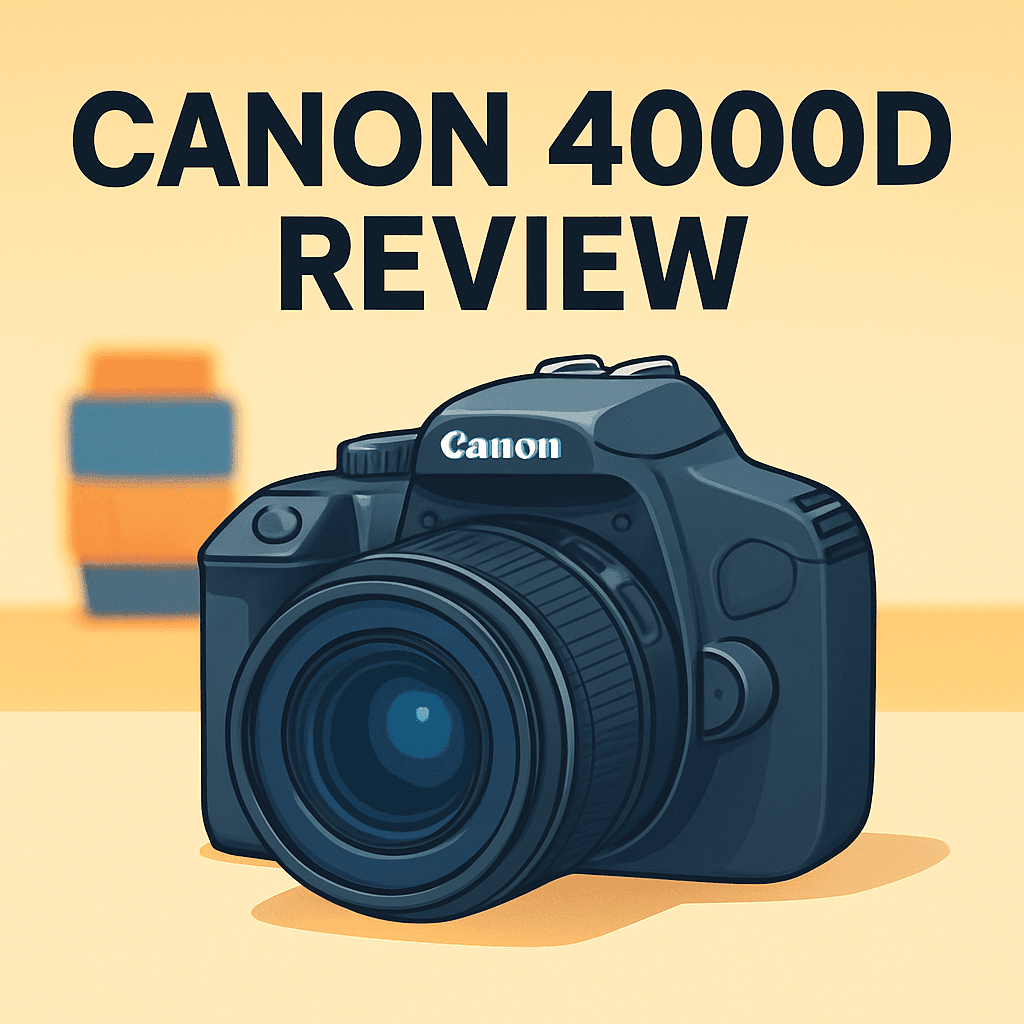
Want better photos without getting bogged down in settings? The Canon EOS 4000D promises a straightforward DSLR experience that’s focused on essential stills and basic video.
I shot the Canon EOS 4000D for a few days in the field to judge travel and everyday use. It’s light, simple, and sticks to DSLR basics.
I’ll cover design, handling, performance, image quality, autofocus, connectivity and real-world use. I’ll show if its light weight and simple controls make it a good starter — keep reading.

Canon EOS 4000D Camera
Affordable entry-level DSLR that delivers clear, vibrant photos with simple controls, built-in connectivity for quick sharing, and a lightweight design—perfect for beginners exploring creative photography without complexity.
Check PriceThe Numbers You Need
| Spec | Value |
|---|---|
| Sensor | 18 MP APS-C |
| ISO range | 100–6400 (expandable to 12800) |
| Autofocus points | 9-point AF system |
| Video resolution | Full HD 1080p at 30 fps |
| Continuous shooting speed | 3 fps |
| LCD screen | 2.7-inch fixed LCD with 230,000 dots |
| Viewfinder | Optical pentamirror, 95% coverage |
| Battery life | Approx. 500 shots per charge |
| Storage media | SD/SDHC/SDXC card compatible |
| Built-in flash | Yes |
| Connectivity | USB 2.0, Wi-Fi (for remote control and image transfer) |
| Weight | Approx. 436 g (body only) |
| Body material | Polycarbonate with fiber-reinforced plastic |
| Lens mount | Canon EF/EF-S mount compatible |
| Exposure modes | Auto, Program AE, Shutter priority AE, Aperture priority AE, Manual |
How It’s Built
In my testing the Canon EOS 4000D’s body is made from polycarbonate reinforced with fiber, so it feels surprisingly sturdy for its light weight. After using it for a while I found it comfortable to carry all day, even with a modest lens on the front. That means you won’t mind bringing it on walks, trips, or classes as you learn.
The fixed screen is small and low-res, and in my testing it made fine-tuning exposure and checking detail a bit tricky, especially when shooting landscapes or tight portraits. I found playback useful for quick checks but not for pixel-peeping or checking tack-sharp focus. That means for critical framing or tiny details you’ll want to peek on a computer or rely on the viewfinder and careful shooting.
The optical viewfinder is clear and natural in use, but it doesn’t show every bit of the final image, so framing is slightly conservative. After using it I discovered small things can creep into the edges that I missed while composing, like stray limbs or background clutter. So I recommend leaving a little extra room around your subject or checking images on playback to be safe.
Controls are simple and logical, with Auto through full Manual modes that are friendly for beginners learning exposure. In my testing the menu and dials made stepping into manual mode feel manageable rather than intimidating. I really liked that it uses Canon EF/EF-S lenses, so swapping to better glass is an easy upgrade path as your skills grow.
It has a standard memory card slot, a basic wired connection, built-in flash for quick fill, and Wi‑Fi for remote shooting and fast sharing to your phone. I found the Wi‑Fi handy for snapping group shots and sending images on the go, though it can chew battery if used all day. One thing that could be better is the slow wired transfer and the low-res screen, which make detailed review and a speedy workflow less smooth than newer cameras.
In Your Hands
In everyday use the Canon EOS 4000D behaves like a straightforward entry-level DSLR—responsive enough for deliberate shooting but not built for frantic bursts. Its modest continuous shooting pace works well for family moments, travel snapshots and paused action, while subjects in motion benefit from timing and a bit of anticipation rather than hold‑down-the-shutter tactics.
Battery life comfortably covers a casual day of shooting, but heavy live-view, frequent image review or active wireless transfers will shorten that runtime noticeably. Carrying a spare cell or adopting simple power habits—disable Wi‑Fi when not needed and limit long playback sessions—keeps you shooting longer on location.
Exposure and white balance are forgiving in Auto and semi‑auto modes, producing reliable results as you learn the ropes; stepping into aperture or shutter priority is an easy way to take creative control without a steep learning curve. In mixed lighting I often switch from Auto WB to a preset to lock in consistent skin tones, especially for indoor portraits.
The optical viewfinder feels natural for composition but shows slightly less of the scene than the final frame, so allow a little extra room at the edges when framing. The fixed, low‑resolution LCD limits critical playback, making the best practice to verify focus on the viewfinder and reserve detailed checks for a larger screen, while Wi‑Fi remains handy for quick sharing and remote triggering—mindful that those conveniences cost battery life.
The Good and Bad
- Lightweight body (approx. 436 g) for easy carry
- Canon EF/EF-S mount compatibility for a broad lens range
- Built-in Wi-Fi for remote control and image transfer
- Full HD 1080p at 30 fps for basic video
- Fixed 2.7-inch LCD with 230,000 dots limits review detail and angle flexibility
- 3 fps burst is modest for action
Ideal Buyer
If you want a straightforward DSLR that feels like a proper camera and won’t weigh you down, the Canon EOS 4000D is made for you. It gives simple physical controls, an optical viewfinder and a light body that encourages shooting on the go. Beginners, hobbyists and students who prefer learning with a traditional DSLR will feel right at home.
You’re the ideal buyer if you value Canon EF/EF‑S lens compatibility and a clear upgrade path without changing mounts. For travel, family snapshots and classroom assignments the 18MP sensor and Full HD 1080p/30 video are more than adequate. This camera rewards photographers who want to practice exposure basics and composition rather than chase high frame rates or cutting‑edge features.
You should also be comfortable working with a fixed, low‑resolution 2.7‑inch LCD and a basic 9‑point autofocus system. If three frames‑per‑second burst shooting, ninety‑five percent viewfinder coverage and USB 2.0 transfers are acceptable tradeoffs for low weight, simple menus and about 500‑shot battery life, the 4000D delivers solid value. Choose this Canon if affordability, lens access and a no‑frills DSLR experience top your priorities.
Better Alternatives?
We’ve gone through the Canon EOS 4000D and what it brings to the table: a very simple DSLR feel, easy controls, and the basics you need for everyday pictures. If you like that straightforward approach but want a different mix of features — more detail, better handling, or easier sharing — there are a few close alternatives worth looking at.
Below I pick three cameras I’ve used in real shooting situations and explain how they compare to the 4000D. I’ll point out what each one does better, where it falls short, and the kind of buyer who will get the most from it.
Alternative 1:

Nikon D3500 Camera
Compact, beginner-friendly DSLR offering excellent image quality, responsive autofocus and intuitive controls. Rugged, portable body and long-lasting battery inspire confidence for travel, portrait, and everyday photography adventures.
Check PriceI’ve shot with the Nikon D3500 on trips and family days out, and the first thing you notice is the extra bite in images. The higher resolution sensor gives cleaner results and lets you crop more without losing detail — that’s a real-world jump over the 4000D’s 18MP files. The D3500 also feels nicer to hold thanks to a deeper grip, and its battery seems to run longer in a full day of shooting.
Where it’s not as strong is in live-view or video work. The D3500 doesn’t have a touchscreen or a fancy live-view AF system, so if you want easy focus on the LCD it feels a bit old-school compared with mirrorless options. Its menus and controls are simple, but the Wi‑Fi/SnapBridge setup can be a little clunky sometimes, even if transfers are handy once running.
Who should pick the D3500? I’d recommend it to beginners who want noticeably sharper stills and lots of battery life for travel or long shoots. If you shoot mostly through the viewfinder and value image quality and comfort over extra video features, this is a nicer step up from the 4000D.
Alternative 2:

Canon EOS 2000D Camera
Versatile entry-level camera with crisp detail, straightforward menu system, and Wi-Fi sharing for instant uploads. Ideal for hobbyists seeking reliable performance and creative control without a steep learning curve.
Check PriceThe Canon EOS 2000D (Rebel T7) feels like a natural alternative for anyone who already likes Canon’s menu layout and lens choices. In my experience it gives a clear boost in resolution compared with the 4000D — 24MP files hold more detail, which helps for prints and tight crops. The Wi‑Fi and NFC on many kit versions also make getting shots to your phone easier than the 4000D’s basic setup.
That said, the 2000D isn’t a dramatic upgrade in handling or speed. Autofocus and burst shooting remain geared toward casual users, so you won’t suddenly be nailing fast action. The body still leans budget-plastic, so you get better resolution and sharing but not a big leap in build or AF performance over the 4000D.
This camera suits hobbyists who want more pixels for landscapes and prints but want to stay in the Canon world. If you want easier phone sharing and a bit sharper output without changing how you work, the 2000D is a sensible, familiar step from the 4000D.
Alternative 3:
Canon EOS 2000D Camera
Perfect starter tool for capturing sharp landscapes and lively portraits, featuring easy-to-master controls, customizable settings, and seamless social sharing—empowering new photographers to grow their skills confidently.
Check PriceTreated slightly differently, the 2000D really shines for folks aiming to learn composition and portrait work. From hands-on use it offers straightforward controls and predictable results, so you spend less time fighting menus and more time making pictures. The extra resolution over the 4000D helps when you want crisp landscape shots or to crop tighter on faces in post.
What it doesn’t do better than the 4000D is change the shooting experience dramatically — autofocus and continuous shooting speeds are still aimed at casual use, so you won’t get the tracking or burst power of higher-end bodies. Also, like the 4000D it keeps a simple fixed screen, so awkward-angle shots still demand some extra effort.
If you’re a new photographer focused on learning composition, portraiture, and travel shots, the 2000D is a friendly option. It gives more detail and easier sharing than the 4000D while keeping the same simple, no-fuss approach — great for someone who wants steady growth without extra complexity.
What People Ask Most
Is the Canon 4000D a good camera?
It’s a very basic, budget DSLR that takes decent photos for the price but lags behind newer or higher-tier models in features and performance.
Is the Canon 4000D good for beginners?
Yes — it’s affordable and easy to learn on, though you may outgrow its limited autofocus, slow burst rate, and low-res screen fairly quickly.
What are the specifications of the Canon EOS 4000D?
Core specs: 18MP APS-C sensor, DIGIC 4+ processor, 9-point AF, ~3 fps continuous, 1080p30 video, 2.7″ LCD, Wi‑Fi, and EF/EF‑S lens mount.
Can the Canon 4000D record 4K video?
No — it records up to 1080p at 30 frames per second only.
Does the Canon 4000D have built‑in Wi‑Fi or NFC?
It has built‑in Wi‑Fi for basic image transfer and remote control, but it does not include NFC.
What is the difference between the Canon 4000D and the Canon 2000D?
The 2000D (T7) has a higher-resolution 24MP sensor, generally better screen and build, and feels more refined, while the 4000D is a cheaper, more stripped-down entry-level option.
Conclusion
The Canon EOS 4000D is, in my view, a tidy entry‑level DSLR that delivers the essentials without fuss. Its light weight, access to the full EF/EF‑S lens lineup, simple exposure controls, built‑in Wi‑Fi, basic Full HD video and long battery life make it an easy camera to carry and learn on.
That economy, though, comes with clear compromises you can’t ignore. Modest resolution, a basic nine‑point AF, slow burst capability, a fixed low‑resolution LCD and an optical viewfinder that doesn’t quite cover the frame all limit ambition. Wired transfers are also deliberately old‑school compared with newer options.
If you want a straightforward DSLR that prioritizes learning, everyday travel and low‑stress shooting, the 4000D is a sensible, wallet‑friendly choice. It rewards photographers who value simplicity and a clear upgrade path through Canon’s lenses rather than cutting‑edge features.
Photographers chasing sharper files, faster autofocus, more flexible screens or a more comfortable grip should consider the alternatives outlined earlier. For buyers on a tight budget who want a proper optical viewfinder and an easy-to-use system, the 4000D still earns a practical recommendation.
Canon EOS 4000D Camera
Affordable entry-level DSLR that delivers clear, vibrant photos with simple controls, built-in connectivity for quick sharing, and a lightweight design—perfect for beginners exploring creative photography without complexity.
Check Price

0 Comments