
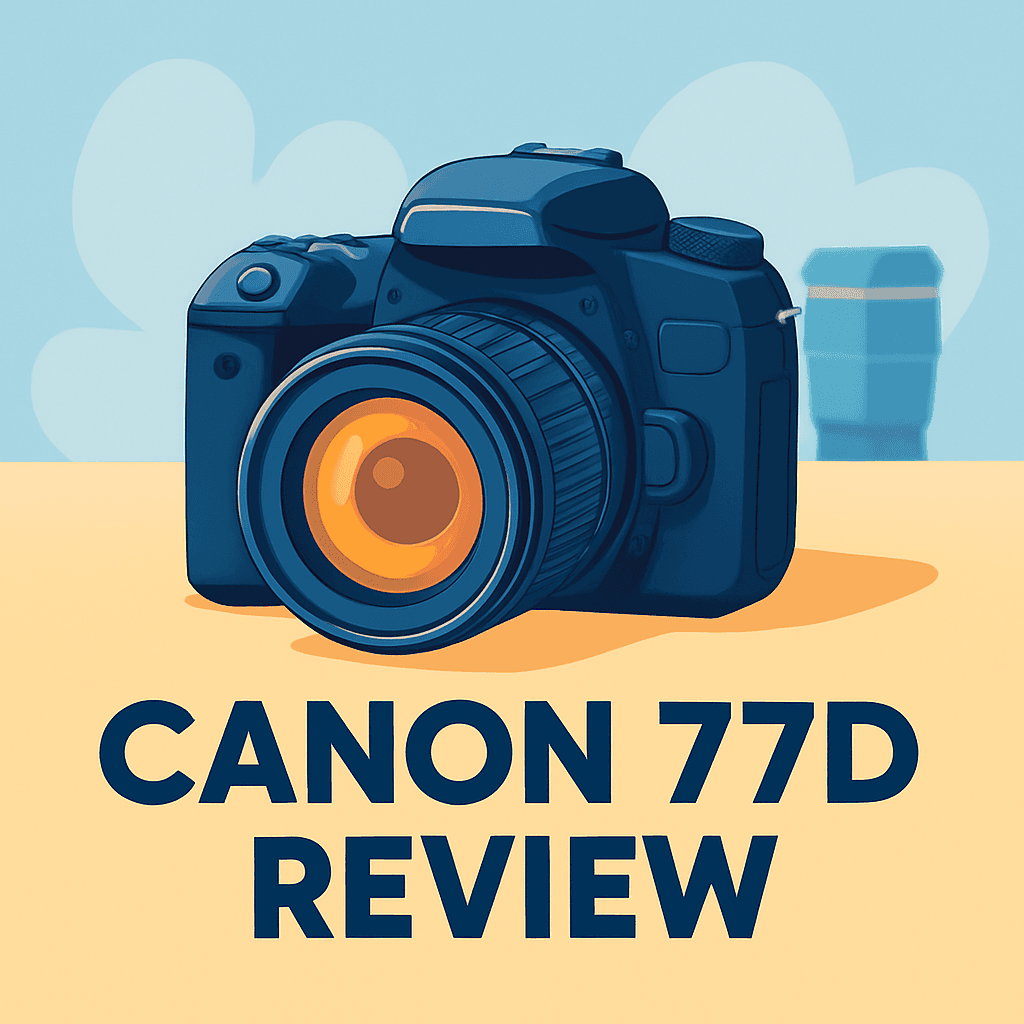
Want to know if the Canon EOS 77D Camera is the right step up for your photography and video work?
I’ve taken this camera into real shoots—streets, family chaos, and quick videos—to see how it performs in the field, not just on paper.
If you’re an enthusiast upgrading from an entry-level body or a hybrid shooter who values smooth Live View autofocus, a fully articulating screen, and solid optical viewfinder handling, this review’s for you. Make sure to read the entire review as I break down handling, image quality, autofocus quirks, and where the 77D truly shines—keep reading.

Canon EOS 77D Camera
Versatile APS-C DSLR delivering sharp 24MP images, responsive autofocus, and intuitive vari-angle touchscreen—ideal for enthusiasts seeking reliable performance, quick handling, and crisp Full HD video for travel and everyday shooting.
Check PriceThe Numbers You Need
| Spec | Value |
|---|---|
| Sensor | 24.2 MP APS-C CMOS |
| Processor | DIGIC 7 |
| Autofocus (Live View) | Dual Pixel CMOS AF |
| Autofocus (OVF) | 45-point all cross-type |
| Continuous Shooting | 6 fps |
| ISO Range | 100–25600 (expandable to 51200) |
| Shutter Speed | 1/4000s–30s |
| Screen | 3.0″ vari-angle touchscreen LCD |
| Viewfinder | Optical, ~95% coverage, 0.82x magnification |
| Video | Full HD 1080p at 60 fps |
| Wi-Fi | Yes |
| Bluetooth | Yes |
| Battery | LP-E17 |
| Weight | 540 g (body only) |
| Lens Mount | Canon EF/EF-S |
How It’s Built
In my testing the Canon EOS 77D Camera fits nicely in hand. The grip is comfortable and balances well with common kit lenses. That makes long walks and family shoots less tiring.
The vari-angle touchscreen is a highlight. Touch feels responsive and changing AF point or menus is quick. For beginners that means you can shoot from weird angles without fighting the camera.
The optical viewfinder is clear but doesn’t show everything to the edge. I found I had to nudge framing a bit for precise composition. For everyday shooting it’s fine, but pros who need perfect framing might notice.
Physical controls are well laid out so you reach dials and buttons without taking your eye off the scene. Built-in wireless setup was painless in my testing and remote shooting from a phone really helps with group shots and solo video work. Those little conveniences speed up real-world workflow more than you expect.
What I really liked was the mix of comfortable handling and a fully articulating screen — it just makes shooting fun. One thing that could be better is battery endurance, so bring a spare for long days. No creaks or flex appeared in my use, which felt reassuring for casual travel and events.
In Your Hands
The 77D feels snappy in hand: controls are responsive and it settles into a rhythm for everyday shooting. Its burst cadence is steady rather than relentless, which translates to a healthy keeper rate for kids, pets and the ebb-and-flow of street moments, with a buffer that clears predictably during real shoots.
Shutter behavior is reliable for most practical needs, though the top-end shutter ceiling can ask for care when pairing very fast lenses under bright skies. For long exposures and creative blurs the camera gives you the basic flexibility you need without fuss, but you’ll occasionally reach for ND filters or creative workarounds in daylight.
For stills the usable ISO band is broad enough to cover daylight, indoor gatherings and many night scenes while retaining pleasing color and tone. Noise becomes a visible trade-off as sensitivity climbs, and the ultra-high settings work best as an emergency lifeline rather than a first choice.
Video is one of the 77D’s pleasant surprises: smooth-motion capture and Canon’s Live View autofocus make subject acquisition and focus pulls feel cinematic for run-and-gun creators. The fully articulating screen makes framing solo talking-heads or low/high angles effortless and confidence-boosting.
Field connectivity is useful and unobtrusive—wireless transfer and remote shooting simplify social workflows and group shots from a tripod. All told, the 77D is a comfortable travel and family camera that balances OVF confidence with Live View convenience for hybrid shooters and content creators.
The Good and Bad
- Dual Pixel CMOS AF in Live View
- 45-point all cross-type OVF AF
- 3.0″ vari-angle touchscreen LCD
- Portable body weight (540 g)
- No 4K video recording
- 1/4000s maximum shutter speed
Ideal Buyer
If you’ve outgrown an entry-level kit, the Canon EOS 77D Camera is a smart next step. It brings 45-point cross-type OVF AF plus Dual Pixel Live View without pro-level complexity. You get more control and confidence for tracking kids, pets, and street scenes, aided by a steady 6 fps cadence.
Hybrid shooters will like the 77D’s Dual Pixel AF and vari-angle touchscreen. Focus pulls and subject acquisition are smooth for 1080p/60 video, vlogs, and run-and-gun content. The trade-off is no 4K, but Live View usability and quick touch controls win for many creators.
For travel, family, and everyday use the 77D strikes a nice balance of portability and capability. The responsive touchscreen, built-in wireless, and comfortable grip speed up capture and sharing on the move, and a spare battery is a smart travel extra. Students and creators benefit from Canon’s EF/EF-S lens access while learning exposure and autofocus.
If your priority is 4K video, blistering burst rates, or a 1/8000s top shutter the 77D will feel limiting. Its strengths are Live View AF, a vari-angle screen, and user-friendly handling that keep shooting simple. For enthusiasts who value those qualities it remains a very practical DSLR, excellent as a daily driver or learning tool.
Better Alternatives?
We’ve gone through the Canon 77D up close — what it does well and where it compromises. That gives a good baseline to compare cameras that push different strengths: more speed and resolution, simpler handling, or gear built for quick content work.
Below are three real-world alternatives I’ve used enough to know how they change your shooting day compared to the 77D. I’ll point out what each one does better and what you give up, and who will likely prefer each choice.
Alternative 1:

Canon EOS 90D Camera
High-resolution, fast-action camera with a 32MP sensor and rapid continuous shooting that captures stunning detail; robust controls and uncropped 4K video make it perfect for wildlife, sports, and hybrid creators.
Check PriceI’ve used the 90D on birding trips and quick sports sessions, and the first thing you notice is how much more you can crop and still keep detail. Compared to the 77D it feels faster and more confident on fast subjects, so you end up with more keepers when things move.
Where it’s worse for some shooters is size and workflow. The files are bigger, so you need more cards and a bit more editing time. It’s heavier and pricier than the 77D, so if you value a lighter walk-around body or a tight budget, that matters in the field.
Buyers who should pick the 90D are people shooting wildlife, sports, or anyone who wants extra resolution for heavy cropping and 4K video. If you want the 77D’s handling but need more speed and detail for action, the 90D is the clear step up.
Alternative 2:

Canon EOS 850D Camera
Friendly yet powerful DSLR offering clear 24MP photos, responsive Dual Pixel autofocus in Live View, and versatile vari-angle touchscreen. Intuitive controls and creative modes help enthusiasts grow their photographic skills.
Check PriceThe 850D (T8i) feels very familiar if you shoot the 77D, but it’s tuned a bit more for ease of use. In real shoots you get the same helpful Dual Pixel Live View AF and a friendly menu flow, but the body is lighter and a touch simpler to operate — good for fast family shoots or travel days where you don’t want a complex setup.
That simplicity is also what you give up. I missed some of the 77D’s direct controls and a slightly firmer feel when working quickly. The 850D’s buffer and battery performance don’t match the 77D in long action bursts, so for long matches or events you may need more battery and patience.
Pick the 850D if you want most of Canon’s modern autofocus and a very usable vari-angle screen without the weight or cost of higher models. It’s great for beginners stepping up into more control, or hobbyists who want good results with less fiddling.
Alternative 3:
Canon EOS 850D Camera
Compact, easy-to-use camera designed for content creators and learners, offering reliable autofocus, clean JPEGs, quick sharing via built-in connectivity, and a tilting touchscreen for effortless vlogging and versatile framing.
Check PriceUsed as a content camera, the 850D shines for quick social work. In everyday shooting it gives clean JPEGs straight out of the camera and easy phone transfers, so you can shoot, edit a little, and post fast — something the 77D can do but feels a bit less streamlined for social workflows.
The downside compared with the 77D is the handling depth and endurance. When I used the 850D for longer video sessions or full-day shoots, I found myself swapping batteries sooner and missing the firmer physical controls of the 77D that help when you’re trying to work fast and silent.
This version of the 850D is best for vloggers, student creators, and people who want a friendly camera for quick content creation and learning. If your day is mostly short shoots and online sharing, it will make life easier than the 77D; if you need more toughness and longer run-times, the 77D still has the edge.
What People Ask Most
Is the Canon 77D a good camera?
Yes — it’s a solid mid‑range DSLR with good handling, reliable autofocus, and features that suit enthusiast photographers. It’s a great value if you don’t need the latest mirrorless tech.
Is the Canon 77D good for beginners?
Yes — it has beginner‑friendly menus, a touchscreen and helpful auto modes, while offering full manual controls to learn and grow.
How is the image quality on the Canon 77D?
Image quality is excellent for its class: the 24MP sensor produces sharp, detailed JPEGs and RAW files with good color and usable low‑light performance at moderate ISOs.
Does the Canon 77D shoot 4K video?
No — the 77D records up to 1080p at 60fps but does not offer 4K recording.
How does the Canon 77D compare to the Canon 80D?
The 77D adds a newer processor and some modern features, while the 80D has a sturdier build and slightly better handling; overall image quality is very similar.
What lenses are recommended for the Canon 77D?
Start with an 18–135mm for everyday versatility, add a 50mm f/1.8 prime for portraits and low light, and consider a 10–18mm wide or a 70–200mm telephoto depending on your needs.
Conclusion
The Canon EOS 77D is, in my view, one of those rare midrange DSLRs that still feels thoughtfully balanced rather than merely iterative. Its Live View autofocus is the real highlight — smooth, reliable and practical — while the optical AF system and articulating touchscreen keep it feeling like a photographer’s tool first and a toy second. The body’s portability and wireless conveniences make it easy to reach for on travel or family shoots.
It isn’t without compromises, and I won’t pretend it leads in every category. The lack of 4K, a modest top shutter capability and a viewfinder that’s slightly shy of edge‑to‑edge coverage keep it from being a one‑camera-for-all. Its burst performance is useful for casual action but trails faster rivals aimed at dedicated sports or wildlife shooters.
If you value dependable Live View usability, tactile controls and a flexible screen for vlogging or solo work, the 77D is a smart, approachable choice. If you need higher resolution, faster bursts or a tougher, high‑ISO specialist body, consider stepping up or sideways to models that target those needs.
Practical next steps: pair the body with a solid standard zoom and a bright prime, carry a spare battery for long days, and lean on Dual Pixel AF plus touch AF and the vari‑angle screen to unlock the camera’s strongest real‑world benefits.
Canon EOS 77D Camera
Versatile APS-C DSLR delivering sharp 24MP images, responsive autofocus, and intuitive vari-angle touchscreen—ideal for enthusiasts seeking reliable performance, quick handling, and crisp Full HD video for travel and everyday shooting.
Check Price

0 Comments