
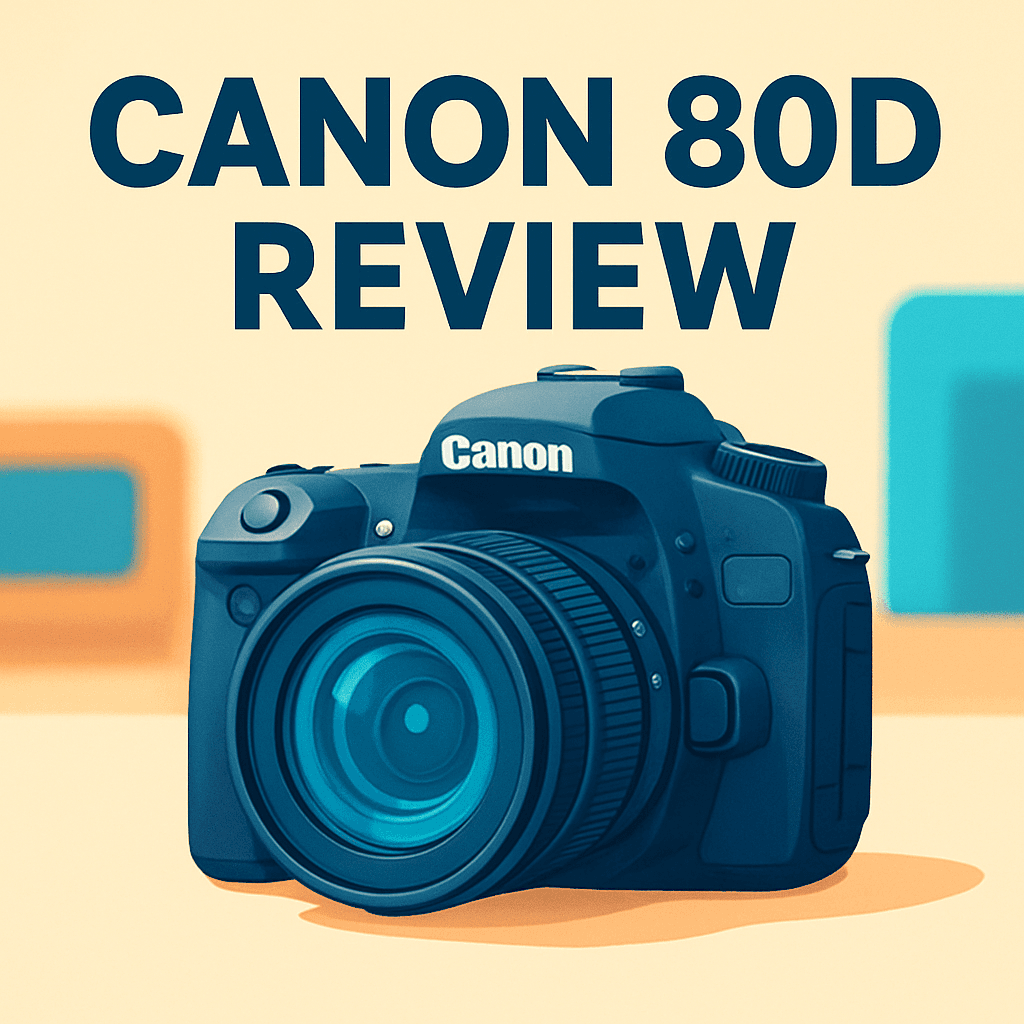
Want to know if the Canon EOS 80D Camera will actually improve your images and suit your shooting style?
I’ve spent time with it in real shoots, so this review focuses on what really matters: handling, AF reliability, practical image quality, and basic video usability.
If you’re a DSLR fan, own EF/EF‑S glass, or prioritize stills and long battery life, this could be a great fit; if you need 4K or bleeding‑edge AF, maybe not. Make sure to read the entire review as I break down its real-world strengths and where it falls short — keep reading.

Canon EOS 80D Camera
An enthusiast-focused DSLR delivering responsive autofocus, clear 24MP stills and smooth Live View shooting. Intuitive articulating touchscreen and built-in Wi‑Fi make sharing, focusing and framing fast for hybrid photographers.
Check PriceThe Numbers You Need
| Spec | Value |
|---|---|
| Sensor | 24.2 MP APS-C CMOS |
| Autofocus | Dual Pixel CMOS AF, 45 Points |
| Continuous Shooting | 7 fps |
| ISO Range | 100–16,000 (expandable to 25,600) |
| Video | 1080p at 60 fps |
| LCD | Vari-angle Touchscreen |
| Lens Mount | Canon EF/EF-S |
| Card Slots | Dual SD/SDHC/SDXC |
| Metering Modes | Evaluative, Center-weighted, Spot |
| Exposure Modes | Manual, Aperture Priority, Shutter Priority |
| Shutter Speed | 1/8000s to 30s |
| Built-in Flash | Yes |
| External Flash | Yes, via hot shoe |
| Weight | Approximately 650 g |
| Dimension | 139 x 105 x 79 mm |
How It’s Built
In my testing the Canon EOS 80D feels like a camera that was built for hands, not for pockets. The deep grip and familiar control layout made long shooting days easy and steady. I really liked how balanced it felt with my Canon lenses on it.
The buttons and dials give clear, tactile feedback so I could change settings without looking. That helped a lot at fast-paced events, though wearing thick gloves made some of the smaller buttons fiddly. For beginners this means you can learn the controls fast, but glove users might want to plan ahead.
The vari-angle touchscreen is a real winner in the field. I used touch-to-focus for quick live-view shots and flipped the screen for low or awkward angles with zero hassle. The screen does pick up fingerprints, so keep a cloth handy during long shoots.
The built-in flash is handy for quick fill and the hot shoe makes adding a bigger flash easy. After using it in a few rainy shoots the body felt solid, but it’s not invincible in bad weather. Be aware of limited weather protection if you shoot in rough conditions.
In Your Hands
The Canon EOS 80D Camera is quick enough for chasing kids, pets, and events; its continuous burst mode nets a dependable keeper rate without being a pro-sports specialist. In the field the AF and buffer pairing felt steady through a run of shots. Fast shutter capability also makes bright-prime control and long-exposure work straightforward.
Its ISO behavior is pragmatic: I push it into modest high-ISO territory when needed but prefer a conservative cap for critical work to avoid intrusive noise. RAW files hold up well, with usable shadow recovery and pleasing skin tones straight from camera. Faster lenses noticeably improve low-light usability.
For video the 80D is a strong Full HD performer — Dual Pixel AF delivers smooth, confident focus pulls and touch focus simplifies single-operator shoots. The vari-angle touchscreen makes handheld, low-angle, and vlogging setups far easier. Still, hybrid creators who need higher-resolution video will view this as a limitation.
Battery life and DSLR ergonomics make the body reliable for all-day shoots and travel; I never felt rushed for power. Kit zooms balance well for run-and-gun coverage, while fast primes reward you with snappier AF, shallower depth of field, and cleaner low-light results. Build quality held up across wet, dusty, and fast-paced assignments.
The Good and Bad
- Dual Pixel CMOS AF delivers smooth, confident live-view and video autofocus
- 7 fps burst with 1/8000s top shutter aids action and bright-light control
- Vari-angle touchscreen enhances both stills and video usability
- DSLR ergonomics and optical viewfinder feel; strong battery life compared to compact mirrorless bodies like the a6400
- Broad EF/EF-S lens ecosystem and hot shoe support
- 24.2MP files balance detail with reasonable storage requirements
- No 4K video; limited to 1080/60p
- Continuous AF tracking not as advanced as the Sony a6400’s real-time subject/eye AF
- Lower burst rate and resolution versus Canon 90D (7 fps vs 10 fps; 24MP vs 32MP)
- Low-light and dynamic range can be outperformed by Nikon D7500 in some scenarios
Ideal Buyer
If you prize classic DSLR handling and long battery life, the Canon EOS 80D Camera is a comfortable, familiar tool. Its solid grip, intuitive controls and optical viewfinder suit photographers who shoot all day. It feels especially right for shooters who prefer a tactile, button-forward workflow.
Owners of Canon EF and EF‑S glass get the most value from the 80D. The vari-angle touchscreen and Dual Pixel AF make live‑view composing and video focus pulls effortless. You’ll appreciate predictable color, responsive menus, and broad lens compatibility.
Stills-first shooters—wedding, event, portrait and travel photographers—will like the 24.2MP files and 7 fps bursts. The sensor balances detail with manageable file sizes for fast turnaround. Casual hybrid creators who are happy with 1080/60p will find the camera more than capable.
Skip it if you need 4K, cutting‑edge subject or eye tracking, or the fastest burst and highest megapixels. Sports pros, aggressive hybrid videographers and pixel-peepers may prefer Canon’s 90D, Sony a6400 or Nikon D7500 instead. But for reliable, familiar Canon ergonomics and smooth Dual Pixel AF at 1080p, the 80D remains a smart choice.
Better Alternatives?
We’ve already gone through the 80D’s handling, autofocus feel, image quality and where it sits for stills-first shooters. If you like the 80D’s DSLR grip and Dual Pixel live‑view AF, it’s a very solid choice — but many photographers ask what else is worth considering before pulling the trigger.
Below are a few real-world alternatives I’ve used in the field. I’ll note how each one shoots differently from the 80D, what they do better, where they fall short, and what kind of buyer would prefer each option.
Alternative 1:

Canon EOS 90D Camera
High-resolution performance with rapid burst capture and crisp 4K video for dynamic shooting. Robust handling, advanced autofocus and long battery life suit sports, wildlife and demanding hybrid photographers seeking studio-grade results.
Check PriceI’ve shot with the 90D on trips and at sports events. Compared to the 80D it gives you more resolution and a faster frame rate — that 32MP sensor and 10 fps burst let you crop tighter and catch decisive moments more often. In practice this means more keeper frames for wildlife and action without changing lenses.
The trade-offs are practical: the files are bigger, so you’ll need faster cards and more storage, and the buffer fills sooner if you’re shooting long bursts. Video-wise the 90D adds 4K, which is a real step up over the 80D’s 1080p if you edit or reframe footage, but Dual Pixel-like live‑view AF feel in 4K can be a bit different than the 80D’s smooth 1080p tracking.
Buy the 90D if you want the familiar Canon DSLR feel but need more resolution, higher burst speed and 4K for hybrid work. If you value lighter files, or you shoot mostly 1080p video with simpler storage needs, the 80D can still be the smarter, cheaper choice.
Alternative 2:

Nikon D7500 Camera
Compact yet capable body produces detailed images and clean high-ISO performance for low-light work. Fast burst rates, reliable autofocus and durable build make it an ideal travel and action tool.
Check PriceI’ve used the D7500 on night shoots and travel days where light was tough. Its real strength over the 80D is low-light image quality and headroom in the files — shots from dim scenes hold up cleaner and you can pull more shadow detail before noise gets ugly. That makes a real difference for wedding receptions, indoor sports and moody landscapes.
On the down side, the D7500’s live‑view and video autofocus don’t feel as smooth or as confident as Canon’s Dual Pixel system on the 80D. If you rely on touch-to-focus or do a lot of run-and-gun video, you’ll notice it. Also, if you already own Canon EF/EF-S glass, switching to Nikon means thinking about lenses and adapters.
The D7500 is for shooters who prioritize low‑light quality and wide dynamic range over live‑view AF finesse. If you care most about clean high‑ISO stills and like Nikon’s color, it’s a strong pick. If you shoot lots of live‑view video or need the smoothest autofocus, the 80D or a Canon mirrorless might suit you better.
Alternative 3:
Nikon D7500 Camera
Versatile enthusiast DSLR offering 4K movie capture, intuitive controls and comprehensive connectivity for on-the-go creators. Strong autofocus and rugged construction deliver confident results in varied shooting conditions.
Check PriceUsed a bit differently, the D7500 can be a great travel and video camera because it adds 4K and has solid handling in a compact body. Compared to the 80D, it gives you modern video resolution and generally cleaner stills at higher ISOs — so on a trip where you’ll be shooting both night streets and daytime scenes, the D7500 covers more ground.
That said, in real shooting the D7500 won’t match the 80D’s smooth live‑view AF for on-camera monitors, and its menus and lens choices feel different if you’re used to Canon. Also, the lower megapixel count means you get slightly less cropping room than the 80D or 90D, so plan shots a bit more carefully if you need tight crops later.
Pick the D7500 if you want a rugged, travel-ready DSLR that leans toward better high‑ISO stills and adds 4K for video. It’s a good fit for travel shooters and anyone who values image quality in mixed light. If you’re tied to Canon lenses or need the smoothest live‑view autofocus, stick with the 80D or consider Canon’s 90D instead.
What People Ask Most
Is the Canon 80D still worth buying?
Yes—it’s a solid, affordable APS-C DSLR with great handling and image quality for photos, but newer models offer 4K and improved autofocus if you need those features.
Is the Canon 80D good for beginners?
Yes—it’s user-friendly with helpful auto modes, a vari-angle touchscreen, and durable controls that make learning easy.
Does the Canon 80D have 4K video?
No—it records up to 1080p at 60fps but does not offer 4K recording.
How does the Canon 80D compare to the Canon 90D?
The 90D adds 32MP, 4K video, better autofocus and faster burst shooting, while the 80D is cheaper and still very capable for Full HD photos and everyday use.
Is the Canon 80D good for video and vlogging?
It’s decent for vlogging thanks to the flip screen and mic input, but the lack of 4K and older AF can limit long-term video use.
Should I buy a used Canon 80D?
Yes—if the price is right and you check shutter count, sensor condition, autofocus performance, and buy from a reputable seller with a return option.
Conclusion
The Canon EOS 80D Camera remains a dependable choice for photographers who prioritize handling, reliable live‑view and video autofocus, and long battery endurance. Its DSLR ergonomics and responsive Dual Pixel AF make it a confident tool in real‑world shooting. It does, however, lag where 4K and the newest continuous‑tracking systems matter most.
If you already own Canon glass, favor an optical viewfinder, and shoot primarily stills with occasional Full HD video, the 80D is a practical, comfortable workhorse. The vari‑angle touchscreen and robust controls keep it useful for run‑and‑gun shooting and portrait work. Its handling makes long days easier.
Look elsewhere if your workflow demands 4K, higher resolution, or cutting‑edge AF tracking for fast action or hybrid content. Modern mirrorless bodies and newer DSLRs will better satisfy those needs. Those options trade comfort for modern capability.
In short, buy the Canon EOS 80D Camera if you value tried‑and‑true DSLR feel, dependable Dual Pixel live‑view AF, and long shooting stamina at Full HD. If 4K, more megapixels, or next‑gen subject tracking are core to your work, choose a more modern platform. Decide by what feels more important in your kit.
Canon EOS 80D Camera
An enthusiast-focused DSLR delivering responsive autofocus, clear 24MP stills and smooth Live View shooting. Intuitive articulating touchscreen and built-in Wi‑Fi make sharing, focusing and framing fast for hybrid photographers.
Check Price

0 Comments