
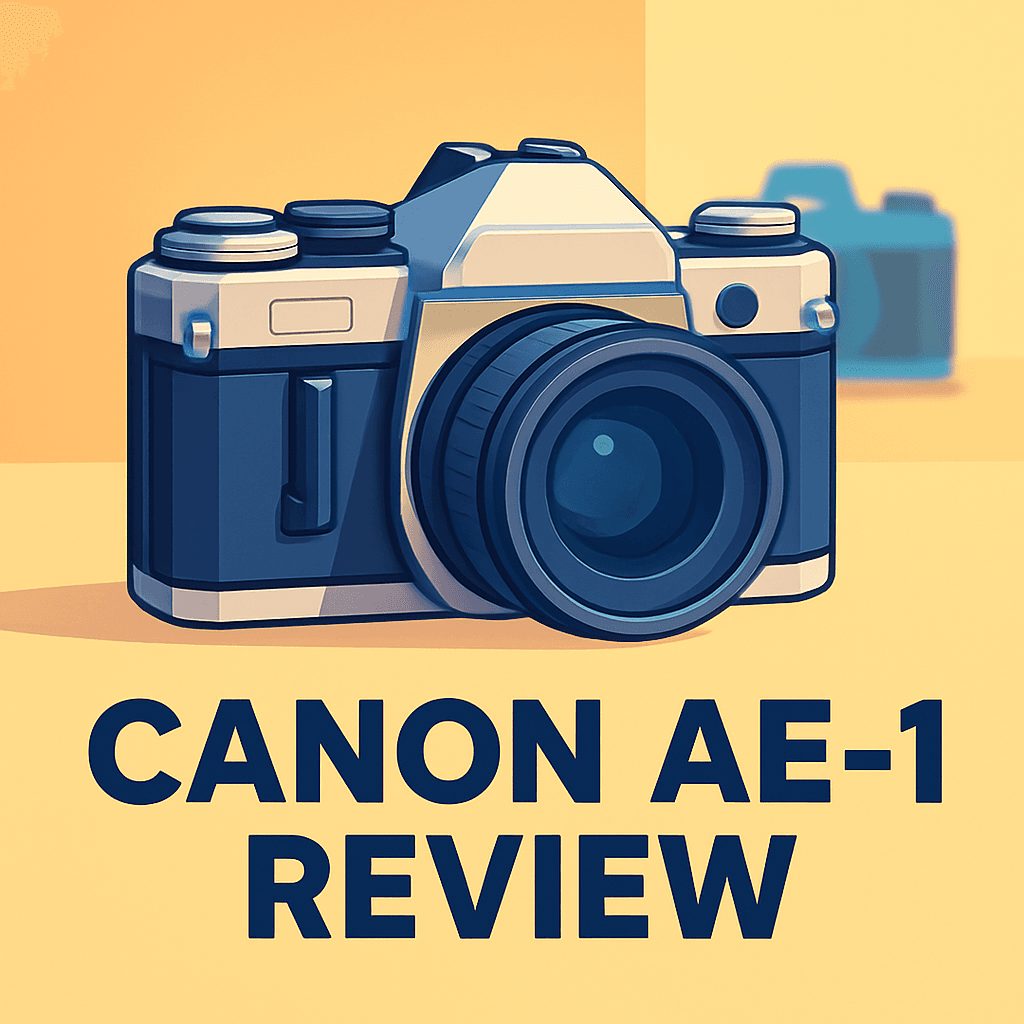
Want to know if the Canon AE-1 is the kind of 35mm SLR that’ll actually improve your images and workflow, or just a nostalgic purchase? This review takes a photographer-first look at what the camera really delivers in the real world.
Think timeless film experience with simple automation, not a modern feature-packed body. You’ll get straightforward shutter-priority convenience alongside full manual control, and access to the Canon FD lens ecosystem for real creative flexibility.
This is for shooters curious about film, FD lens users, and anyone weighing shutter-priority ease against fully manual alternatives. I took an AE-1 into the field to see how those trade-offs play out on streets, portraits, and everyday shoots.
I’ll dig into handling, exposure workflow, focusing confidence, and the practical limits you’ll hit in bright light or flash work. Make sure to read the entire review as I break down the trade-offs and who should actually buy one.

Canon AE-1 Camera
Lightweight, classic 35mm SLR designed for confident film shooters—easy shutter-priority control, dependable electronics, and crisp results. Perfect for learners and enthusiasts seeking authentic analog character and everyday portability.
Check PriceThe Numbers You Need
| Spec | Value |
|---|---|
| Sensor | 35mm film |
| Lens mount | Canon FD |
| Shutter | Focal-plane titanium |
| Shutter speed | Up to 1/1000 sec |
| Shutter priority | Yes, auto exposure |
| Aperture-priority | No (only shutter-priority) |
| Manual exposure | Yes |
| ASA/ISO range | 6–3200 |
| Viewfinder | 0.86x, fixed eye-level pentaprism |
| Focus | Manual |
| Self-timer | Yes |
| D.o.F. preview | Yes |
| Flash sync | 1/60 sec |
| Battery | 4LR44 (required for auto exposure) |
| Weight | 590g (body only) |
| Size | 87 x 42 x 141 mm (body only) |
How It’s Built
In my testing the Canon AE-1 feels like a camera you can trust to come along on real shoots. The body has a solid, slightly weighty feel that settles nicely in the hand and balances very well with the classic FD primes I use. That means less wobble when you’re tracking a subject or holding for a careful composition.
The main controls are very approachable. The shutter-speed ring is quick to change and gives a clear, confident click that helps you work fast in shutter-priority mode. Switching to manual feels natural too, so beginners can learn without fighting confusing menus or tiny buttons.
I really liked the bright viewfinder and how easily you can confirm focus and framing. The depth-of-field preview is small but positive and gives a reassuring click when you use it, which helps you judge background blur before you press the shutter. After using it for a while I felt more comfortable nailing portraits and street shots.
The self-timer is simple to engage and handy for tripod work or group photos. One thing that could be better is the battery access—it’s worth carrying a spare because the camera depends on power for its auto features. Overall the ergonomics make it a friendly, practical film camera for beginners and hobbyists.
In Your Hands
Grabbed off a shelf and taken straight into the city, the AE‑1’s shutter‑priority mode feels like a reliable partner for shooters who want to work fast. It locks in a chosen shutter and adjusts exposure quickly enough for changing light, and when you switch to manual the layout makes dialing a correction intuitive and immediate.
The viewfinder’s generous magnification turns manual focusing from a chore into a deliberate pleasure; street candids and portraits come into focus with reassuring clarity and speed. For casual action the camera keeps you honest — you won’t miss the moment if you’re practiced, but it rewards a steady hand and pre‑visualization more than reflexive tracking.
In bright, wide‑aperture outdoor work you’ll be mindful of the camera’s upper shutter ceiling and may stop down to preserve highlights, while flash work requires a conservative approach to balancing ambient light and fill. Those constraints shape how you set up a scene rather than how the camera performs — it handles exposure faithfully within its operating envelope.
Depth‑of‑field preview is genuinely useful for nailing selective focus, and the self‑timer finds regular use for group shots or careful tripod compositions. The auto‑exposure depends on its battery, so packing a spare is part of a confident shooting routine rather than an afterthought.
Run through midday wide‑aperture frames, dim interiors on higher‑speed film, backlit portraits and simple flash setups and you’ll see the same theme: predictable, photographer‑driven results. The AE‑1 rewards deliberate choices and a hands‑on workflow — it’s responsive, honest, and eminently shootable in real‑world scenarios.
The Good and Bad
- Shutter-priority AE for quick shooting
- Full manual exposure available
- Wide ASA/ISO range 6–3200 for film flexibility
- Viewfinder 0.86x magnification aids manual focus
- No aperture-priority mode
- Manual focus only
Ideal Buyer
The Canon AE‑1 is for photographers who want the feel of a classic 35mm SLR with a useful safety net. Its shutter‑priority auto exposure speeds up spontaneous shooting while still letting you fall back to full manual. If you enjoy manual‑focus work and tangible controls, this camera rewards patient, deliberate shooting.
Film shooters who value depth‑of‑field preview, a bright 0.86x viewfinder and straightforward controls will feel at home. Owners of Canon FD glass or anyone curious about that lens ecosystem get immediate upside from the AE‑1’s ergonomics and balance with common primes. Street, portraits and casual travel are where this body really earns its keep.
It is not the right tool for photographers who insist on aperture‑priority automation, modern autofocus, or very fast shutter and sync speeds. Flash‑heavy shooters who need faster than 1/60 sync or sports shooters chasing super‑fast action may want to look elsewhere. Also note the AE‑1’s auto modes depend on a 4LR44 battery, so readiness matters.
Think of the AE‑1 as a flexible, characterful companion rather than a feature‑maxed workhorse. It’s ideal as a first step into film for someone who wants useful automation without surrendering manual control. If that balance fits your shooting style, the AE‑1’s charm and FD access make it an easy recommendation.
Better Alternatives?
We’ve gone through the Canon AE-1 and what makes it a great, simple-to-use 35mm SLR. It gives you shutter-priority convenience and a solid feel on the street or in the studio, but it also has trade-offs like reliance on a battery for AE and no aperture-priority mode.
If the AE-1’s mix of automation and classic handling doesn’t quite fit your needs, there are a few other cameras I’ve used that cover different needs — from ultra-simple, fully mechanical bodies to rugged pro gear. Below are three alternatives I often reach for and why you might pick each over the AE-1.
Alternative 1:

Pentax K1000 Camera
Fully mechanical, user-friendly 35mm SLR built for photography students and purists. Manual controls teach exposure fundamentals while rugged construction delivers decades of reliable service and unmistakable film aesthetics.
Check PriceI’ve shot a lot with the Pentax K1000 and what stands out is how simple and “always ready” it feels. The shutter will fire even if the battery dies (the meter needs power), so you don’t get stranded. Compared to the AE-1, the K1000 forces you to set both shutter and aperture every time, which is great for learning exposure but slower when you want to react fast.
In real shooting, the K1000’s plain layout makes it easy to focus and frame quickly. You trade the AE-1’s shutter-priority convenience for a camera that rewards careful setup and practice. The K-mount lens pool is wide and often cheap used, so it’s a good choice if you want solid glass without paying collector prices.
Buyers who prefer the K1000 are students, teachers, and anyone wanting a no-nonsense, low-tech camera that teaches fundamentals. If you want a camera you can trust even with a dead battery, or you plan to learn manual exposure seriously, the K1000 will serve you better than the AE-1. If you crave quick auto help and faster change-ups between shots, stick with the AE-1 instead.
Alternative 2:

Nikon FM2 Camera
Precision-built manual SLR offering a lightning-fast mechanical shutter and rock-solid durability. Ideal for demanding conditions, it yields sharp, high-contrast frames with intuitive controls for experienced film photographers.
Check PriceThe Nikon FM2 feels like a tool built for action and long use. I’ve used it on fast-paced shoots where I needed a camera that won’t quit; its fully mechanical shutter means the body will still fire without batteries, and its build takes a beating far better than many older cameras. Against the AE-1, the FM2 gives you more confidence in tough conditions and often faster shutter handling.
Where the FM2 trades off is in convenience for beginners. It doesn’t have a shutter-priority auto mode like the AE-1, so you must set exposure yourself. That makes it less forgiving if you want quick automatic help, but it rewards photographers who value consistent control and higher top-end performance when shooting wide open in bright light or fast action.
If you’re an advanced shooter, a working pro on a budget, or someone who wants a camera that will keep working under stress, the FM2 is a natural pick. If you prefer quicker auto modes and an easier learning curve, the AE-1 will feel friendlier day to day.
Alternative 3:

Nikon F2 Photomic Camera
Pro-grade SLR with modular viewfinder and integrated metering for fast, accurate exposures. Renowned for toughness and versatility, this system supports professional workflows across varied shooting environments.
Check PriceThe Nikon F2 Photomic is a different class — I’ve used it on long assignments where the modular finders and rugged body mattered. Compared with the AE-1, the F2 gives you pro-level versatility: interchangeable viewfinders, strong build, and a shooting feel designed for sustained use. That makes focusing and metering comfortable for long sessions and varied jobs.
On the downside, the F2 is heavier and more complex. It’s not as compact or as friendly to a casual shooter who wants simple shutter-priority help like the AE-1 provides. Repairs and upkeep can also be more involved, and the camera can feel like overkill if you just want easy point-and-shoot style support.
Choose the F2 Photomic if you want a professional tool that adapts to different tasks and you plan to shoot a lot — studio, editorial, or field jobs where durability and finder options matter. If you want a lighter, more beginner-friendly camera with quick auto assistance, the AE-1 will usually be the easier, more pleasant daily shooter.
What People Ask Most
Is the Canon AE-1 a good camera?
Yes — it’s a well-built, easy-to-use vintage SLR with good handling and a reliable shutter-priority meter, making it great for learning film photography and casual shooting.
What are the pros and cons of the Canon AE-1?
Pros: affordable, solid build, lots of FD lenses, and simple controls; cons: meter and shutter are battery-dependent and some units have aging seals or electronics issues.
Is the Canon AE-1 worth buying for beginners?
Yes — it teaches exposure basics and is inexpensive to buy and maintain, but be aware you’ll need to learn without modern autofocus and electronic conveniences.
What lenses are compatible with the Canon AE-1?
It uses Canon FD and FL lenses natively, and you can use FD glass on mirrorless bodies with adapters, but EF lenses won’t mount without an adapter that alters focus.
How reliable is the Canon AE-1 and are there common issues to watch for?
Generally reliable if well cared for, but check for dead light seals, sticky shutter curtains, and a working light meter since electronics and foam degrade with age.
What film should you use with the Canon AE-1?
Use standard 35mm film — ISO 100–400 color films like Kodak Portra or Fuji Pro 400H and B&W like Kodak Tri-X or Ilford HP5 are safe, versatile choices.
Conclusion
The Canon AE-1 Camera still earns its place as a practical, photographer-first 35mm SLR. Its shutter-priority automation paired with full manual control makes fast shooting and deliberate work both possible. The FD lens ecosystem, a clear and confidence-inspiring viewfinder, depth-of-field preview and a handy self-timer round out a very usable package.
Those strengths come with compromises you should accept before buying. There is no aperture-priority mode, focusing is manual only, and the camera relies on battery power for its automatic functions. You’ll also encounter practical limits with the shutter and flash handling that shape what the body can do in bright light and fast-action or flash-heavy situations.
If you shoot film with an appetite for hands-on control and value straightforward automation, this camera is a compelling choice. If you want fully mechanical independence, faster sync or modern conveniences, look to the alternatives I discussed instead. For what it aims to be—a nimble, enjoyable film SLR with sensible automation—the Canon AE-1 Camera still represents strong real-world value.
Canon AE-1 Camera
Lightweight, classic 35mm SLR designed for confident film shooters—easy shutter-priority control, dependable electronics, and crisp results. Perfect for learners and enthusiasts seeking authentic analog character and everyday portability.
Check Price

0 Comments