
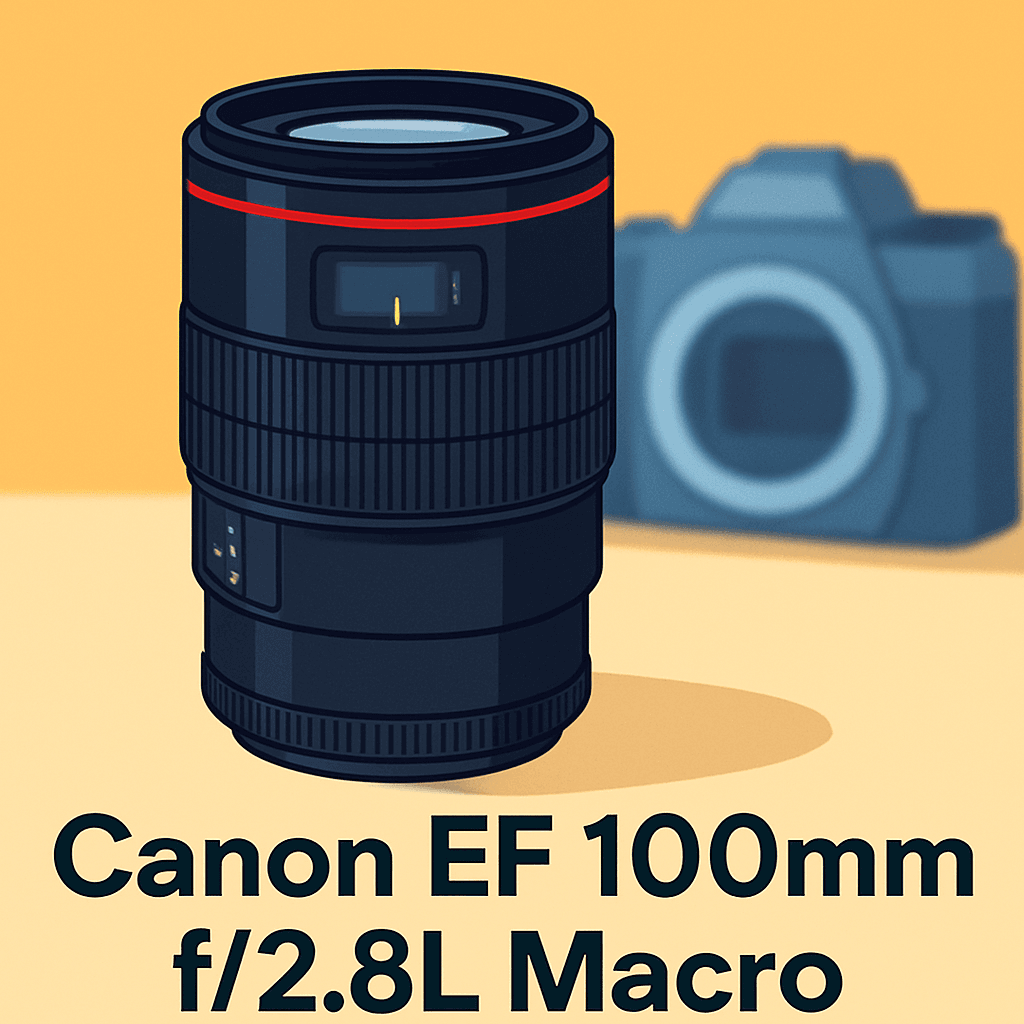
Want to nail crisp handheld close‑ups without lugging a tripod?
I took the Canon EF 100mm f/2.8L IS USM Macro into the field to see how its stabilization and pro‑level build translate to real shooting.
This lens promises life‑size close‑ups and portrait flexibility, so it’s aimed at Canon full‑frame and APS‑C shooters who need reliable handheld macro.
I’ll focus on handheld macro performance, the L‑series refinement, and how it stacks up against common alternatives in real conditions; make sure to read the entire review as I break down what actually matters when you’re shooting up close—keep reading.

Canon EF 100mm f/2.8L IS USM Macro
Premium L-series optic delivering razor-sharp 1:1 close-ups with fast f/2.8 aperture, weather-resistant build, whisper-quiet AF and built-in stabilization for steady handheld macro and stunning portrait bokeh.
Check PriceThe Numbers You Need
| Spec | Value |
|---|---|
| Focal length | 100mm |
| Maximum aperture | f/2.8 |
| Lens mount | Canon EF |
| Image stabilization | Hybrid IS (up to 3 stops) |
| Minimum focusing distance | 0.3 m (1 ft) |
| Maximum magnification | 1:1 (life-size) |
| Optical construction | 15 elements in 12 groups |
| Aperture blades | 9 rounded blades |
| Autofocus motor | Ultrasonic Motor (USM) |
| Filter size | 67mm |
| Lens weight | approx. 625g (22 oz) |
| Lens type | Macro prime lens |
| Compatible sensor format | Full-frame & APS-C (1.6x crop) |
| Lens hood | Included (ET-67) |
| Weather sealing | Yes (L-series build) |
How It’s Built
In my testing the Canon EF 100mm f/2.8L IS USM Macro feels like a proper L-series lens. It has a solid, confidence-inspiring build and weather resistance that made me comfortable shooting in damp meadows and dusty trails. For beginners that means you can keep shooting even when the conditions aren’t perfect.
The focus ring is smooth and precise, which is a relief when you’re making tiny adjustments at close range. I found manual tweaks easy to do with live view, and the supplied hood snaps on cleanly to help control flare and protect the front element. That practical protection matters when you kneel down in foliage.
Controls are placed where you can reach them without fumbling, and the mount feels durable for heavy use. Balance leans toward larger camera bodies, so handholding long macro sessions on smaller rigs can get tiring. What I really liked was the tough, pro-level finish and sealing, and what could be better is a lighter, more compact feel for extended handheld work.
Macro shoots mean dust and pollen, and in my experience a blower and soft cloth are your best friends. The front accepts commonly available filters, so grabbing a polarizer or ND for creative control is straightforward even if you’re just starting out.
In Your Hands
In the field the Canon EF 100mm f/2.8L IS USM Macro feels like a purpose-built tool. Its hybrid image stabilization noticeably reduces handshake at close distances, often turning shots that would otherwise require a tripod into workable handheld frames.
Stalking insects, flowers, textures and small products I found the lens lets you get close without sacrificing steadiness, giving more usable frames per outing. The combination of stabilized optics and responsive focus makes it easier to capture fleeting poses and subtle detail. You still need patient technique—gentle movements and timing are everything.
In the studio the lens is equally assured: the wide aperture creates subject separation while stopping down provides reliable depth-of-field control for product and focus-stacked work. Hooded use and Canon’s coatings keep contrast high under strong lights.
As a portrait and short-tele option it delivers pleasing background rendering and crisp subject isolation, and on smaller‑sensor bodies the field of view tightens in a useful way for headshots and detail work. Bokeh remains smooth at close focus and forgiving at longer distances.
At life-size magnification you’ll be making micro-adjustments constantly—switching into live view and using small body motions and controlled breathing improves hit rate. For the steadiest outcomes use stabilization for handheld work, but disable it on a solid tripod to avoid motion feedback.
The Good and Bad
- Hybrid IS (up to 3 stops) aids handheld macro with shake-and-shift correction
- True 1:1 life-size magnification; 0.3 m minimum focusing distance
- L-series build with weather sealing for professional durability
- USM autofocus for fast, accurate focusing
- More expensive than non-L and many third-party alternatives
- Heavier than Canon’s non-L 100mm macro
Ideal Buyer
The Canon EF 100mm f/2.8L IS USM Macro is built for shooters who refuse to be tethered to a tripod. If you prioritize stabilized, handheld close‑up work—flowers, tiny insects, textured products—its Hybrid IS makes the difference between a keeper and a blur.
Outdoor and on‑location photographers who face wind, damp foliage, or unpredictable weather will appreciate the L‑series sealing and rock‑solid build. That durability lets you focus on composition instead of worrying about the next splash or grit on your kit.
Canon shooters who want native EF operation, snappy USM focusing, and Canon’s coatings and color signature will feel right at home. Portrait and tele‑use is a genuine bonus, giving you a second life for headshots and detail work. On APS‑C bodies the crop tightens framing, making it even more versatile for studio and field hybrid shooters.
This lens is ideal for pros and serious enthusiasts who want one premium optic to handle both demanding macro and reliable short‑tele tasks. If your workflow is mostly tripod studio work or budget‑conscious, there are lighter, cheaper options that are more sensible choices.
Better Alternatives?
We’ve gone through what makes the Canon EF 100mm f/2.8L IS USM a go-to for handheld macro: the Hybrid IS, the solid build, and the reliable image look. If that sounds perfect, great — but not everyone needs the extra cost or L-series finish. There are solid choices that trade some of those pros for other real-world benefits.
Below are three lenses I’ve used in the field that I’d reach for instead, depending on how I shoot: studio or tripod work, tight budgets, or handheld nature runs where stabilization and value matter more than that last bit of L-series polish.
Alternative 1:

Canon EF 100mm f/2.8 Macro USM
High-performance tele-macro lens offering crisp edge-to-edge sharpness, fast USM autofocus and smooth f/2.8 bokeh; lightweight, reliable choice for detailed close-up work and flattering portrait separation.
Check PriceI’ve used the non-L Canon 100mm on long studio days and on a few field shoots. What it does better than the L is simple: it’s lighter, much cheaper, and still really sharp in the center. If you work mostly on a tripod, or in a controlled studio where you don’t need Hybrid IS or tough weather sealing, it gives you almost the same detail for far less money.
What it does worse is the stuff you feel outside the lab: no Hybrid IS means handheld close-focus work is harder, especially with moving subjects or in low light. The non-L also lacks the extra coatings and micro-contrast of the L version, so in tricky backlight or when you want the absolute punch in contrast, the L will usually look a touch cleaner.
Who should pick this: photographers on a budget, studio and product shooters who use tripods, or anyone who wants great image quality without paying for L-series durability and the built-in shake correction.
Alternative 2:

Tamron SP 90mm f/2.8 Di VC USD Macro Nikon F
Specialized short-tele lens with 1:1 magnification, vibration compensation and ultrasonic drive for precise, stable close focusing; engineered for full-frame compatibility and professional macro and portrait results.
Check PriceI’ve carried the Tamron 90mm VC into meadows and tight studio setups. Its vibration compensation is no joke — in many handheld situations it gets you very close to the same usable shots as the Canon L, especially when you’re shooting slow shutter speeds or not using a tripod. The glass is sharp, and the focus is reliable for most subjects.
Where it falls short versus the Canon L is subtle: the Tamron’s stabilization is designed more like a traditional VC and doesn’t correct the tiny motion shifts at extreme close range the L’s Hybrid IS targets. The Tamron also doesn’t have the same weather-sealed, pro-grade finish that the Canon L does, and in very contrasty backlight the Canon’s coatings and micro-contrast can pull ahead.
Who should pick this: shooters who want strong stabilization and top image quality for less money — great for nature shooters who want to handhold more often, or hybrid shooters who split time between macro and portraits but don’t need L-series weather sealing.
Alternative 3:
Tamron SP 90mm f/2.8 Di VC USD Macro Nikon F
Versatile macro optic combining true 1:1 reproduction, effective stabilization and quick, accurate focusing for tack-sharp detail capture; ideal for handheld close-ups, product photography and creamy, low-light portraits.
Check PriceUsing the Tamron over a longer trip I found it to be a very practical lens: it’s forgiving, focuses well in normal light, and the VC lets you work handheld in places I’d otherwise pack a tripod. The bokeh is pleasing and it’s a good all-rounder for flowers, products, and casual portraits — you get a lot of usable frames fast.
Compared to the Canon L, the Tamron gives up the last bit of micro-contrast and the built-in robustness. On tough days in wind or rain I trusted the Canon L more; but in everyday shooting the Tamron’s images get you most of the way there while saving weight and cash. You may also notice a bit more focus hunting at the very closest magnifications than with Canon’s USM lens.
Who should pick this: photographers who want a reliable, well-stabilized macro at a sensible price — people who shoot handheld nature, do product work without a big budget, or want one lens that handles both macro and some portrait work without the cost and weight of the Canon L.
What People Ask Most
Is the Canon EF 100mm f/2.8 L Macro good for portraits?
Yes — its 100mm focal length, sharp optics, and f/2.8 aperture give flattering compression and nice background separation for headshots and tight portraits.
Does the Canon EF 100mm f/2.8 L Macro have image stabilization?
Some versions do: the EF 100mm f/2.8L Macro IS USM includes stabilization, while older or non‑IS variants do not, so check the exact model.
What is the minimum focusing distance of the Canon EF 100mm f/2.8 L Macro?
The minimum focusing distance is about 0.30 meters (roughly 1 foot).
Can the Canon EF 100mm f/2.8 L Macro achieve 1:1 magnification?
Yes — it is a true macro lens capable of 1:1 life‑size reproduction.
Is the Canon EF 100mm f/2.8 L Macro weather-sealed?
Yes — the L-series models have dust- and moisture-resistant construction and a rubber mount seal, but they’re not fully waterproof.
Is the Canon EF 100mm f/2.8 L Macro compatible with APS-C cameras?
Yes — it mounts and works on APS-C bodies, giving an effective field of view around 160mm while retaining full macro performance.
Conclusion
The Canon EF 100mm f/2.8L IS USM Macro is the lens I reach for when I need trustworthy handheld close‑up work in unpredictable conditions, especially with moving subjects. Its hybrid stabilization, pro‑grade build and refined rendering make it a clear step up from non‑L options for field shooters. If you value stable, repeatable results and polished image character, this lens delivers.
It is not without tradeoffs; you pay a premium and carry a bit more heft than many alternatives. Studio and tripod shooters who never need in‑camera stabilization will find more value in the non‑L Canon or third‑party 90–105mm macro options, which remain perfectly capable in controlled setups. For those on a budget the Tamron 90 VC and Sigma 105 OS come close in practical image quality while trimming cost and weight, and real‑world tests show they close much of the gap.
Ultimately this is a purpose‑driven tool: worth it for pros and serious hobbyists who shoot handheld macro and want one lens that doubles for tight portraits. If you prize stabilization, weather sealing and the Canon handling experience, buy it without hesitation; the reliability in the field is hard to overstate. If price, weight or tripod‑only workflows dominate your needs, consider the alternatives.
Canon EF 100mm f/2.8L IS USM Macro
Premium L-series optic delivering razor-sharp 1:1 close-ups with fast f/2.8 aperture, weather-resistant build, whisper-quiet AF and built-in stabilization for steady handheld macro and stunning portrait bokeh.
Check Price



0 Comments