
Want to get closer to skittish insects or capture product details without crowding the subject?
I took the Canon EF 180mm f/3.5 L into the field to see if it’s as useful as it sounds in real life.
This lens is built for close-up specialists who need working distance, background control, and a pro-grade feel.
Its L-series optics, long reach and internal focusing promise precise, repeatable results when you’re on a tripod or stalking wary subjects.
There are trade-offs — it leans toward tripod-based studio and nature work rather than quick handheld shooting, and that affects how you’ll use it.
Make sure to read the entire review as I’ll dig into sharpness, handling, and real-world strengths against popular rivals — keep reading.

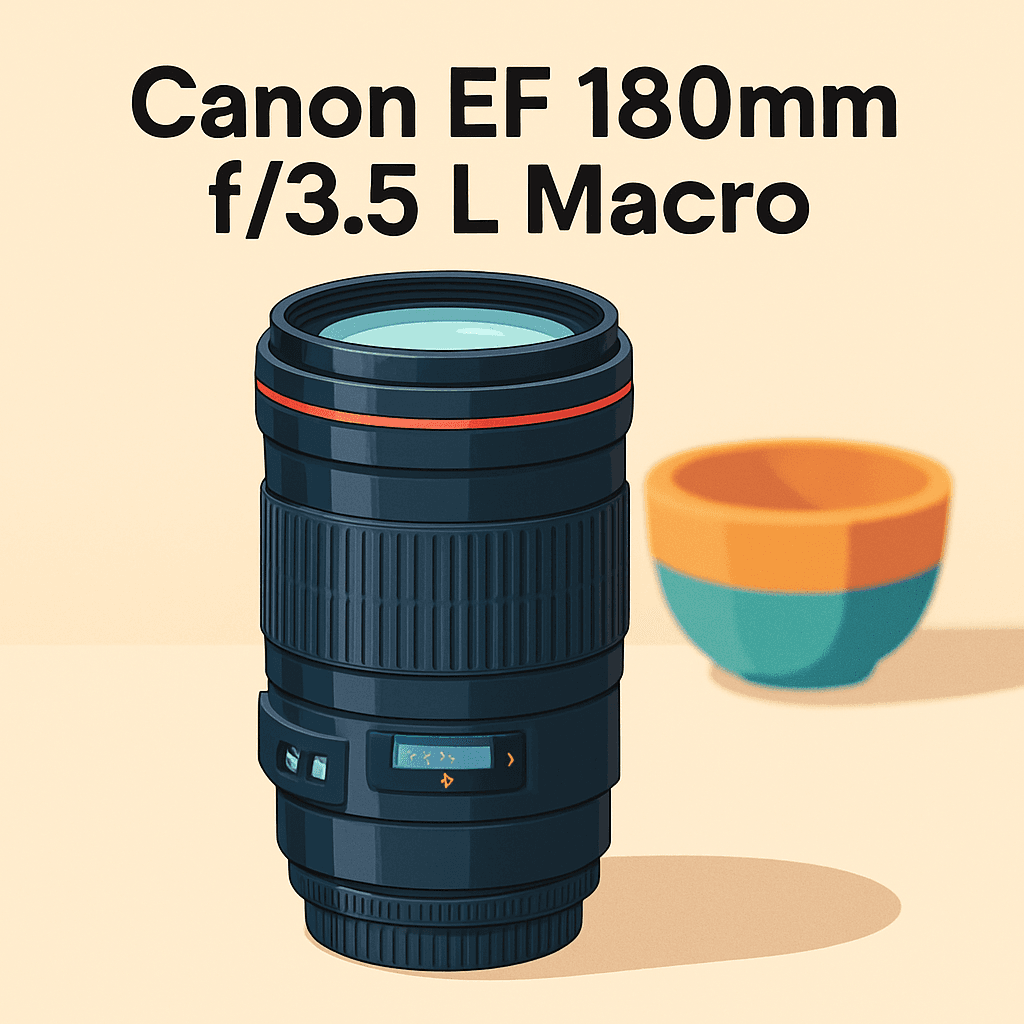
Canon EF 180mm f/3.5 L
Long-reach tele-macro delivers 1:1 magnification and razor-sharp detail with creamy bokeh. Precision optics and superior contrast make it perfect for insect, flower close-ups and flattering distant portraits.
Check PriceThe Numbers You Need
| Spec | Value |
|---|---|
| Focal Length | 180mm |
| Aperture | f/3.5 |
| Lens Type | Macro (optimized for close-up photography) |
| Maximum Magnification | 1:1 (life-size) |
| Closest Focusing Distance | 0.48m |
| Lens Mount | Canon EF |
| Filter Size | 72mm |
| Lens Construction | L-series (pro build, high optical quality) |
| Auto Focus | USM (Ultrasonic Motor) |
| Image Stabilizer | No |
| Internal Focusing | Yes (lens does not extend during focus) |
| Tripod Collar | Included (removable) |
| Focus Range Limiter | Yes |
| Weather Resistance | Yes (L-series dust & weather sealing) |
| Optics | Low-dispersion glass elements for high sharpness and contrast |
How It’s Built
In my testing the Canon EF 180mm f/3.5 L feels like a tool built to last. The body is solid without being fussy, and the weather sealing gave me confidence working in dusty trails and damp mornings. That rugged feel is one of the things I really liked about it.
The lens uses internal focusing, so it doesn’t creep in and out as you focus. I found this makes keeping your lights and reflectors where you want them much easier, and it helps keep a steady working distance from skittish subjects. For real-world macro work that stability matters a lot.
Handling is straightforward and friendly to newcomers. The focus ring is smooth and precise, though I noticed its throw is a bit short for the tiniest manual tweaks at very close distances. Still, the controls are easy to learn and responsive when you need them.
There’s a built‑in focus limiter with a simple switch that I used all the time in the field. Flipping it cuts down on focus hunting and gets you on target faster, which keeps you from missing fleeting insect moments. It’s small conveniences like that that speed up real shoots.
The tripod collar ships with the lens and makes mounting and rotating on a tripod a snap. The front element doesn’t turn during focus, so filters and macro lights stay put while you work. After using it for a while I’d say it’s a very practical, professional feeling lens for anyone serious about close‑up work.
In Your Hands
On assignment the Canon EF 180mm L feels built for the patient macro shooter — its long‑reach, true life‑size macro capability puts skittish insects and delicate flowers at a comfortable distance, letting you fit reflectors and lights between you and the subject without intrusion. Telephoto compression at close distances separates subjects from backgrounds with a pleasing, creamy rendering that makes textures and tiny details sing. Internal focusing keeps the lens balanced and predictable as you inch toward critical focus.
Because there’s no in‑lens stabilization, the lens rewards a tripod or steady monopod and thoughtful lighting choices; I reached for a flash or higher shutter speeds for hand‑held sequences. The included tripod collar transforms composition work on a ball head, while the focus limiter noticeably shortens hunting when switching between close macro and longer-range targets. In the field, prefocusing and small focus‑rail adjustments become part of a reliable workflow rather than an optional extra.
Outside the garden it doubles as a studio‑grade close‑up lens for product and floral work where controlled light and fine detail are priorities, but the relatively modest maximum aperture means you’ll plan lighting accordingly. Weather sealing and robust construction kept it working through humid mornings and dusty trail‑side shoots, reinforcing its pro feel. For shooters who embrace tripod‑based technique, the real‑world performance is quietly, insistently excellent.
The Good and Bad
- 1:1 macro at 180mm for generous working distance
- L‑series build, weather sealing, and pro handling
- Internal focusing; lens length does not change during focus
- Tripod collar included; better balance and rotation on support
- No image stabilization; handheld macro is challenging
- f/3.5 maximum aperture vs f/2.8 alternatives
Ideal Buyer
If you’re a dedicated macro shooter who needs space between lens and subject, the Canon EF 180mm f/3.5 L is built for you. Its 180mm reach keeps skittish insects and nervous wildlife at bay while letting you shape backgrounds with telephoto compression. This is a lens for patience, technique and carefully controlled framing.
Studio and product photographers who live on a tripod will appreciate what this lens brings to table. The working distance makes it easy to position lights and modifiers outside the frame, and the L‑series build gives predictable color and contrast under controlled lighting. Think product flats, flowers and fine-detail work where precision matters more than speed.
Field shooters who demand weather resistance and pro handling will also find value here. The solid construction and internal focusing mean reliable performance in dusty, humid or variable conditions. When you need a lens that endures long days in the field and delivers consistent detail, this is a practical choice.
This is not the lens for handheld flexibility or photographers who need in‑lens stabilization. If you’re comfortable using tripods, monopods or flash support and prioritize working distance and optical quality, the 180mm macro will reward your workflow. Otherwise, consider a stabilized shorter macro for hybrid shooting needs.
Better Alternatives?
We’ve already gone through what makes the Canon EF 180mm f/3.5 L Macro special: long working distance, rock-solid build, and the kind of sharpness and control that macro shooters love when they can use a tripod or flash. It’s a great tool when you need distance from skittish insects or when you want to keep lights and reflectors out of the frame.
If you want something more handheld, faster in low light, or easier to carry, there are solid alternatives. Below are a few lenses I’ve used in the field that trade the 180mm’s reach and tripod-focus workflow for stabilization, a faster aperture, or a shorter, more versatile focal length.
Alternative 1:

Canon EF 100mm f/2.8 L
Compact short-telephoto offers fast f/2.8 performance, sharp micro-contrast, and smooth background separation. Robust build and responsive focusing make it ideal for portrait work and precise close-up shooting.
Check PriceI’ve used the Canon 100mm f/2.8L as a daily go-to for both portraits and close-ups. Compared to the 180mm it feels much lighter and more nimble—easy to handhold for longer stretches. The faster f/2.8 aperture and built-in stabilization (on the Macro IS version) mean you can shoot handheld in lower light and get cleaner background blur without relying on a tripod.
Where it loses to the 180mm is working distance. At 1:1 you have to be a lot closer to your subject, so skittish bugs and flower setups that need room for lights can be tricky. You also get less telephoto compression, so the background feels slightly different—clean and shallow, but not as “pulled in” as the 180mm delivers.
This lens is for the shooter who wants one lens that does portraits and macro well, who moves around a lot, and who prefers handheld shooting. If you need a lighter kit, faster aperture, and stabilization more than long reach, the 100mm is the better everyday choice.
Alternative 2:

Tamron SP 90mm f/2.8 Di VC USD Nikon F
Image-stabilized macro optic combines steady handheld shooting with creamy bokeh and pinpoint sharpness. Fast ultrasonic motor ensures quiet, accurate AF—perfect for portraits, product photography and detailed close-ups.
Check PriceThe Tamron 90mm VC is the one I grab when I want good macro performance without the bulk or price of pro glass. In the field it shines for handheld work—its vibration compensation really helps when you’re shooting close without a tripod. You still get beautiful bokeh and very sharp detail in the frame center, which works great for product shots and portraits.
Compared to the Canon 180mm, the Tamron asks you to be closer to the subject, so it’s not ideal for skittish insects or setups that need lots of room between lens and subject. Autofocus is quick and quiet on modern bodies, but in tight 1:1 work it can be less precise than the Canon’s USM with a focus limiter and tripod technique.
Pick the Tamron if you want stabilization for handheld macro, good image quality for the price, and a lighter kit for field work. It’s a very practical option for someone who shoots mixed subjects and values mobility over the extra reach of a 180mm.
Alternative 3:
Tamron SP 90mm f/2.8 Di VC USD Nikon F
Designed for modern DSLRs, this medium-telephoto offers exceptional close-focus capability, impressive edge-to-edge resolution and vibration compensation for low-light handhelds. Durable construction suits outdoor and studio use.
Check PriceLooking at the same Tamron from a slightly different angle, I’d stress its all-around toughness and consistency. On outdoor shoots it handles flare and contrast well, and the build feels solid enough for regular field use. Edge-to-edge sharpness at close range is impressive for a 90mm, so you won’t miss much in studio product shots or detail work.
Still, the story is familiar versus the 180mm: you trade the long working distance and telephoto feel for a more compact package with stabilization. That means less ability to light subjects from behind the camera without hitting the lens, and a different look when you want that longer compression for isolating backgrounds.
This version of the Tamron is best for shooters who want a tough, reliable macro lens they can use handheld in varying light—people who split time between studio products, portraits, and outdoor close-ups. If you prize reach and a tripod-based, “keep-your-distance” workflow, stick with the 180mm; if you want versatility and VC, the Tamron is a great alternative.
What People Ask Most
Is the Canon EF 180mm f/3.5L Macro discontinued?
Yes — Canon no longer lists it as a current model, so you’ll mainly find it used or from third‑party resellers.
Does the Canon EF 180mm f/3.5L Macro have image stabilization (IS)?
No, it does not have IS, so a tripod or flash is recommended for steady macro shots.
What is the minimum focusing distance and maximum magnification of the Canon EF 180mm f/3.5L Macro?
The minimum focus distance is about 0.45 meters (17.7 inches) and it offers 1:1 life‑size magnification.
Is the Canon EF 180mm f/3.5L Macro good for insect and wildlife macro photography?
Yes — its long focal length gives a comfortable working distance and reach for skittish insects and small wildlife, though support or flash helps because it’s f/3.5 and lacks IS.
Will the Canon EF 180mm f/3.5L Macro work and autofocus on Canon mirrorless bodies with an adapter?
Yes, with Canon’s EF‑EOS R adapter it will mount and autofocus on EOS R cameras, though AF performance can be slightly slower than native RF lenses.
How does the Canon EF 180mm f/3.5L Macro compare to the Canon EF 100mm f/2.8L Macro?
The 180mm gives greater reach and working distance for skittish subjects, while the 100mm is smaller, faster (f/2.8), easier handheld and more versatile for general shooting.
Conclusion
The Canon EF 180mm f/3.5 L is a purpose-built macro tool that earns its keep through distance, durability and image character. Its pro-grade construction and internal focusing give a confidence and stability you notice the moment you mount it. In controlled light it delivers the kind of fine detail, contrast and separation that specialists demand.
That precision comes with a clear trade-off: there’s no in-lens stabilization and the maximum aperture isn’t the fastest in class, so handheld versatility is limited. Expect to work from a tripod, use flash or employ deliberate technique to get the best results. Autofocus is accurate when used with the limiter and proper workflow, but it won’t rescue sloppy shooting.
If you’re a macro or studio shooter who prioritizes working distance, weather resistance and optical bite, this lens is an easy recommendation. If you need a hybrid lens for handheld nature or run-and-gun product work, consider a stabilized 90–100mm alternative instead. Overall, the Canon EF 180mm f/3.5 L is a specialist’s luxury—expensive to carry in practice, but unmistakably rewarding where its strengths matter most.
Canon EF 180mm f/3.5 L
Long-reach tele-macro delivers 1:1 magnification and razor-sharp detail with creamy bokeh. Precision optics and superior contrast make it perfect for insect, flower close-ups and flattering distant portraits.
Check Price


0 Comments