
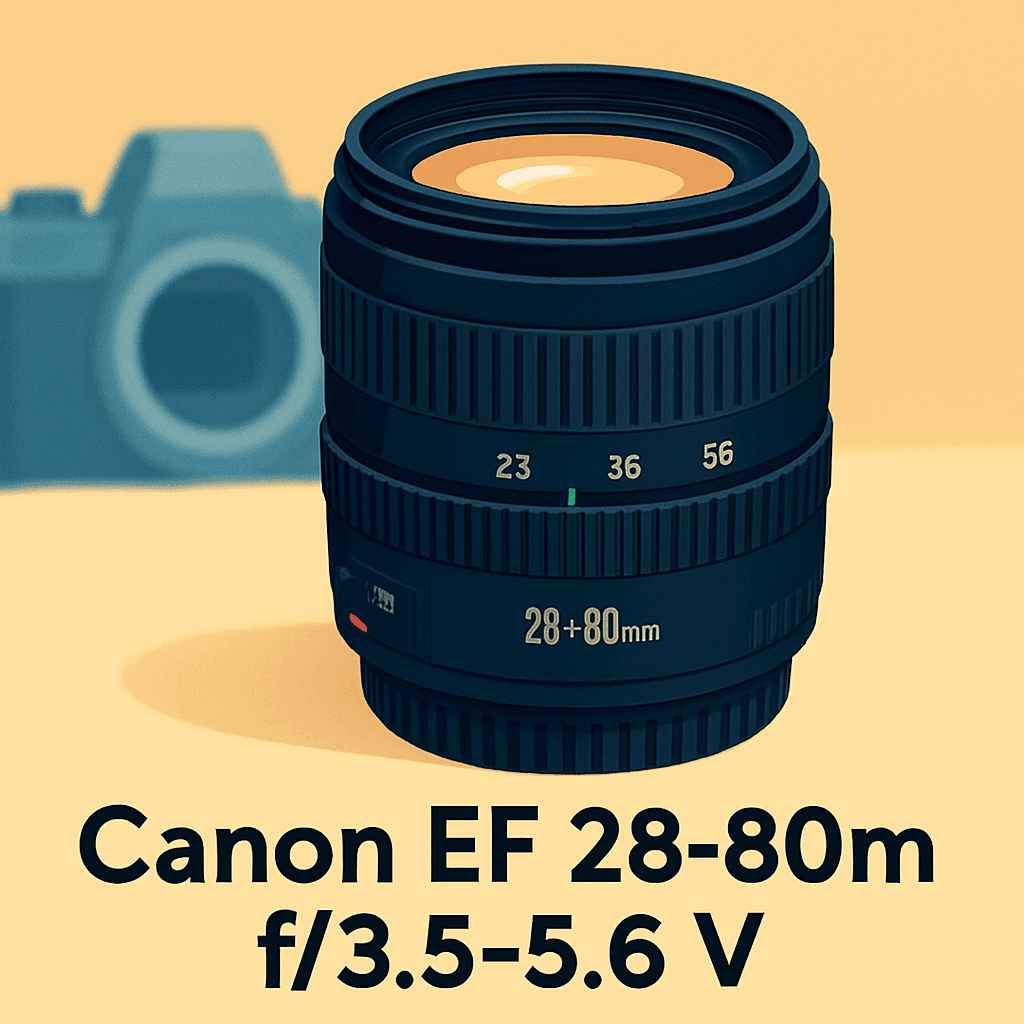
Looking for a small, do‑it‑all zoom that won’t bog down your kit? This lens promises everyday coverage without the fuss, and it’s one you’ve probably seen on older Canon bodies.
The Canon EF 28-80mm f/3.5-5.6 V USM is a compact, general‑purpose EF zoom from the film/early DSLR era. The “V USM” differs from the non‑USM “V” and my write‑up focuses on the V USM sample I tested.
Don’t expect image stabilization or a constant bright aperture; you’ll get a variable f/3.5–5.6 range, USM autofocus, and a common 58mm filter thread. It’s built for lightweight walkaround use on EF‑mount SLRs, not EF‑S or RF bodies.
If you’re an EF shooter who values portability for travel, street, and casual portraits, this review will show the real‑world payoffs and tradeoffs. I’ve carried it on shoots—keep reading.

Canon EF 28-80mm f/3.5-5.6 V USM
Compact, affordable short-tele zoom delivering reliable image quality for daily shooting. Lightweight construction, smooth and silent autofocus, ideal for portraits, travel and everyday photography with pleasant bokeh and dependable performance.
Check PriceThe Numbers You Need
| Spec | Value |
|---|---|
| Focal length | 28–80mm |
| Aperture range | f/3.5–5.6 |
| Mount | Canon EF |
| Compatibility | EF‑mount SLRs (not EF‑S or RF) |
| Autofocus | Yes |
| Focus motor | USM (Ultra‑Sonic Motor) |
| Filter size | 58mm |
| Minimum focus distance | ≈38 cm (commonly listed; may vary by variant) |
| Maximum magnification | ≈0.25× (typical) |
| Lens construction | Typically 11 elements in 9 groups (varies by variant) |
| Aperture blades | Typically 5–6 (varies by variant) |
| Focusing behavior | Front element rotates and lens extends during zoom |
| Image stabilization | No |
| Dimensions | Compact, lightweight (specific mm vary by variant) |
| Weight | Lightweight (specific grams vary by variant) |
How It’s Built
In my testing the Canon EF 28-80mm f/3.5-5.6 V USM felt like the small, everyday zoom it was meant to be. It’s an EF‑mount lens that sits happily on full‑frame Canon SLRs and is light enough to forget in a bag. That makes it an easy choice for casual walkaround shooting.
The build feels solid for its era and mine showed good assembly precision and smooth controls. I liked how the focus and zoom rings move—neither was gritty or loose, so dialing in framing felt natural. One thing that could be better is that older rubber and paint can show wear, so expect some cosmetic aging on used copies.
A practical quirk: the front element rotates and extends as you zoom and focus. In real life that means polarizers and graduated filters are harder to use and balance can shift when you zoom. My copy had a little tendency toward zoom creep if pointed down, so keep a hand on the barrel during long shoots.
Hoods and cases are often not included, so plan to buy a hood if you need flare control. After using it for a while I loved the portability and straightforward feel, but I wished Canon had made the front element stop rotating for easier filter work. Beginners will find it forgiving and easy to carry, just watch your filters and handling.
In Your Hands
The Canon EF 28-80mm V USM’s reach from modest wide to short tele makes it an ideal everyday companion for street scenes, casual portraits, and travel snapshots. It’s compact enough to sit on a shoulder strap all day without becoming a burden, so you tend to keep it on the camera more than you expect.
Because the lens uses a variable maximum aperture, you’ll notice available light and depth‑of‑field change as you zoom, so practical shooting often means nudging ISO or shutter rather than relying on a constant bright aperture. In good light it behaves predictably and delivers usable separation; under dimmer conditions you feel the compromise more clearly.
The front element rotates and extends during use, which makes framing quick but complicates polarizers and graduated filters and shifts the lens balance as you zoom. Focus and zoom rings on my sample moved smoothly with reassuring damping, and through an EF SLR viewfinder the scene reads bright at the wide end and only slightly darker toward the long end.
Close‑focus performance is pleasantly useful for tight details and environmental portraits without swapping glass, offering near‑macro convenience typical for this class. A hood makes a noticeable difference in controlling flare and retaining contrast; without it, strong backlight can produce veiling or occasional ghosts.
Optically the character is familiar: a touch of wide‑end barrel distortion and corner falloff that improves stopped down, shifting toward subtle pincushion at the long end. Color and contrast are natural and pleasing straight from camera, and my sample matched the overall behavior I’ve seen across other copies rather than showing odd anomalies.
The Good and Bad
- Compact, lightweight form factor for everyday carry
- USM autofocus on the V USM variant
- 58mm filter size, common and easy to source
- General-purpose focal range covers wide to short tele
- No image stabilization
- Variable maximum aperture (f/3.5–5.6) limits low-light flexibility and subject isolation
Ideal Buyer
If you shoot with a Canon EF‑mount SLR and want a no‑fuss, pocketable zoom for everyday use, the Canon EF 28-80mm f/3.5-5.6 V USM is aimed squarely at you. It covers a useful wide‑to‑short‑tele range in a lightweight package that invites you to leave larger, heavier lenses at home. Think walkaround practicality more than studio precision.
This lens suits photographers who prioritize portability over a fast constant aperture and who can work without image stabilization in most situations. The V USM’s smooth, quiet USM autofocus is a genuine perk for street, travel and family snapshots where speed and discretion matter. A 58mm filter thread keeps filters and accessories common and affordable.
You’ll appreciate its simple, unobtrusive character if you value low weight and straightforward handling, even with the front element that rotates and extends during use. That behavior means planning polarizers or graduated filters and watching balance on the lens, but it rarely undermines day‑to‑day shooting. For casual portraits, travel and snapshots it performs exactly as intended.
Avoid this lens if your work demands strong low‑light performance, stabilized handheld video or consistent reach beyond 80mm. If you need a constant bright aperture, in‑lens IS or extra tele reach, opt for a different EF zoom instead. Otherwise the 28‑80mm V USM is a sensible, budget‑minded companion for Canon EF shooters who prize mobility and versatility.
Better Alternatives?
We’ve gone through how the Canon EF 28-80mm f/3.5-5.6 V USM performs as a light, general-purpose zoom—good for everyday carry, quick portraits and street work but limited by its variable aperture and lack of stabilization. If that balance of size and reach worked for you, great. If you need a bit more reach, a wider angle, or image stabilization for handheld low-light work, there are sensible choices to consider.
Below are three practical alternatives I’ve used in the field. I’ll point out what each one does better or worse than the 28–80, how they handle day-to-day shooting, and what kind of photographer is likely to prefer each option.
Alternative 1:

Canon EF 28-105mm f/3.5-4.5 USM
Versatile mid-range zoom offering extended reach and consistent sharpness across the frame. Fast, quiet autofocus and solid build make it a go-to workhorse for events, landscapes, and on-location shoots.
Check PriceThe 28–105mm gives you extra reach compared to the 28–80, and that matters in the real world—portraits get more flattering compression at 85–105mm and it saves you from swapping lenses at events. In my hands it focused confidently with that USM feel, a touch quicker and firmer than the 28–80, so you pick up decisive moments more often.
What it doesn’t do better is stay as light and compact. The 28–105 is a bit bigger and feels more substantial on a smaller body, so it’s less “pocketable” as a grab-and-go lens. Optically you’ll see similar behavior: good center sharpness, a touch softer in the corners wide open, and the usual variable-aperture compromises in low light.
Pick the 28–105 if you want a one-lens solution that leans toward tele — event shooters, walkaround portrait work, and anyone who wants more framing options without carrying a second lens. If ultimate portability is your priority, the 28–80 still wins.
Alternative 2:

Canon EF 24-85mm f/3.5-4.5 USM
Wide-to-standard zoom prized for its handy focal range and balanced optics. Smooth focusing and robust construction deliver crisp, color-accurate images for travel, portraits, and everyday creative shooting.
Check PriceThe big practical win of the 24–85 is the 24mm wide end. Shooting interiors, travel scenes or tight streets, that extra width changes how often you have to step back or stitch frames. I used it for travel and found it gave a more useful field of view without sacrificing the mid-range I use for portraits.
Compared with the 28–80, the 24–85 feels slightly more useful as an all-around travel lens because of that wider perspective. It’s not a night-and-day improvement in sharpness — both show similar center/corner behavior — but you’ll find compositions that were hard with 28mm become easy at 24mm. Like the 28–80, it has no stabilization, so low-light handheld work still needs higher ISO or a tripod.
This is the lens for travelers and anyone who shoots interiors or landscapes where width matters. If you rarely need the 24mm end and prioritize the smallest, lightest kit, the 28–80 still has the edge in portability.
Alternative 3:

Canon EF-S 15-85mm f/3.5-5.6 IS USM
Versatile wide-to-tele zoom designed for APS-C bodies, combining image stabilization and fast, quiet focusing for tack-sharp results. Superb edge-to-edge clarity and flexible framing for landscapes, interiors, and travel.
Check PriceThe 15–85 IS is a different kind of upgrade: much wider on the short end and longer on the long end, plus image stabilization. On an APS-C body that 15mm is the practical equivalent of a true wide-angle and the IS makes handheld work in lower light far easier than the unstabilized 28–80. I leaned on the IS for interior and low-light travel shots and it saved many frames that otherwise would’ve needed a tripod.
Its downside is simple compatibility: it’s EF-S, so it only works on crop-sensor Canon DSLRs. It’s also larger and pricier than the 28–80, so you trade some portability for versatility and stabilization. Optically, on an APS-C body it gives very pleasing edge-to-edge sharpness in everyday shooting — noticeably better for landscapes and wide scenes than the 28–80 on a full-frame body.
If you own an APS-C Canon and want one do-it-all lens for travel, landscapes and run-and-gun shooting, the 15–85 IS is hard to beat. If you need full-frame compatibility or want the smallest possible lens, stick with the lighter 28–80 or consider a different EF zoom.
What People Ask Most
Is the Canon EF 28-80mm f/3.5-5.6 V compatible with full-frame and APS-C Canon cameras?
Yes — it’s an EF-mount lens so it works on full-frame Canon DSLRs and on APS-C bodies with the usual 1.6x crop factor.
Does the Canon EF 28-80mm f/3.5-5.6 V have image stabilization (IS)?
No — this model does not include image stabilization.
How sharp is the Canon EF 28-80mm f/3.5-5.6 V lens?
Average — the center is reasonably sharp stopped down but corners and wide-open performance, especially at the long end, are noticeably softer.
Does the Canon EF 28-80mm f/3.5-5.6 V have USM or fast autofocus?
No USM — it uses an older motor and is generally slower and noisier than modern USM or STM lenses.
What is the filter thread size of the Canon EF 28-80mm f/3.5-5.6 V?
Most versions use a 58mm filter thread, so check your specific copy before buying filters.
Is the Canon EF 28-80mm f/3.5-5.6 V a good lens for portraits and everyday use?
Yes for everyday walkaround use and casual portraits, but its slow maximum aperture limits background blur and low-light performance compared with faster primes or f/2.8 zooms.
Conclusion
The Canon EF 28-80mm f/3.5-5.6 V USM is a compact, general-purpose EF zoom that works as an easy everyday lens for Canon EF SLR users. My tested V USM copy shows the kind of straightforward utility you expect from this era of glass.
Its strengths are plain: light carry, useful focal coverage, and the punch of a USM-driven autofocus that keeps shooting simple. The common filter size makes accessory use convenient, though the front element rotates and extends which complicates polarizers and graduated filters.
Optically it behaves like vintage generalist glass — good center acutance and pleasant color and contrast out of the box. Stopped down it tightens up enough for travel landscapes and group shots, but it never masquerades as modern high-resolution glass.
Tradeoffs are equally candid. There’s no image stabilization and the variable maximum aperture limits low‑light flexibility and subject isolation, while variant-dependent details mean you should inspect any copy before buying.
If you prize portability and need a simple, affordable walkaround, this lens is a sensible choice and earns a place in a casual shooter’s bag. If steady handheld performance, wider coverage, or stronger edge-to-edge sharpness are essential, favor the stabilized or wider alternatives discussed earlier.
Canon EF 28-80mm f/3.5-5.6 V USM
Compact, affordable short-tele zoom delivering reliable image quality for daily shooting. Lightweight construction, smooth and silent autofocus, ideal for portraits, travel and everyday photography with pleasant bokeh and dependable performance.
Check Price

0 Comments