
Want a telephoto that gives you real reach without turning every outing into a workout?
The Canon EF 70-300mm f/4-5.6 USM is a stabilized EF-mount zoom that aims to balance reach, portability, and everyday versatility on full-frame and APS‑C bodies.
Having shot with plenty of telephoto zooms, I took this one into the field to see how its variable aperture, optical IS and USM autofocus translate to real shooting situations.
If you’re a wildlife, sports or travel shooter after flexible reach without a heavy carry, this review will walk you through design, handling, stabilization, AF behavior and sharpness in practical use. Make sure to read the entire review as I break down how it performs in real conditions—keep reading.
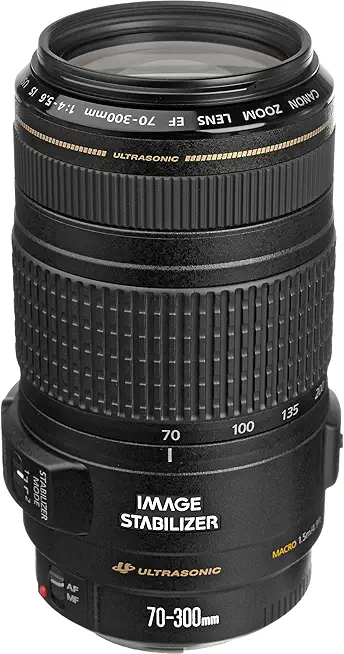
Canon EF 70-300mm f/4-5.6 USM
A compact, long-reach telephoto ideal for wildlife and sports. Smooth ultrasonic autofocus, solid optics and portable design deliver sharp images at 70–300mm, balancing performance with everyday usability.
Check PriceThe Numbers You Need
| Spec | Value |
|---|---|
| Mount | Canon EF |
| Focal length | 70-300mm |
| Maximum aperture | f/4-5.6 |
| Lens type | Telephoto zoom |
| Image stabilization | Yes, optical IS |
| Focus drive | Ring USM with full-time manual focus override |
| Minimum focusing distance | 1.2m (3.94 ft) |
| Maximum magnification | 0.31x |
| Filter size | 58mm |
| Lens construction | 17 elements in 12 groups |
| Diaphragm blades | 9 rounded blades |
| Compatible sensor types | Full-frame and APS-C (1.6x crop factor) |
| Weight | Approx. 580g (1.28 lbs) |
| Dimensions (diameter x length) | 78.5mm x 143mm |
| Lens coating | Super Spectra coating |
How It’s Built
In my testing the Canon EF 70-300mm f/4-5.6 USM feels surprisingly light and compact for a tele zoom. On an APS-C body it balances almost like a natural extension of the camera, while on a full-frame DSLR it leans a bit forward—still easy to handhold, but you’ll notice it during long walks. For everyday shooting it’s easy to carry, though I reached for a strap or monopod during longer sessions.
The zoom and focus rings are a highlight I really liked. The zoom turns smoothly with a reassuring resistance and the focus ring lets you make fine tweaks without fighting the lens, thanks to the USM with full-time manual override. The switches click positively and the metal mount feels solid, so it inspires confidence when you swap lenses out in the field.
Practical touches matter too: the front takes common filters, so swapping a polarizer or ND is quick when the light changes. The lens is short enough to tuck into most day packs, but it is longer than a prime and will eat a bit of space in smaller bags. I treated it cautiously in drizzle since it doesn’t advertise weather sealing, which is something that could be better for outdoor use.
Overall the fit and finish feel good for the price and the handling is friendly to beginners. The one-sentence takeaway from my hands-on time is simple: it’s a well-built, easy-to-use tele zoom that’s ready for most everyday shoots, with just a little caution in bad weather.
In Your Hands
The 70–300mm reach makes this Canon a true everyday telephoto, equally at home framing portraits at the short end or dialing in distant details at the long end; on crop bodies it simply feels tighter, letting you get closer without moving. Its broad range gives photographers flexibility to switch from environmental portraits to field sports without changing glass, which is where this lens earns its keep.
Optical stabilization noticeably lifts the keeper rate, especially when you’re working handheld at the long end—shots that would otherwise be soft from camera shake become usable more often than not. At the wider focal lengths IS gives extra breathing room for slower shutter speeds, while for intentional panning I found it best turned off to preserve smooth motion without resistance from the system.
The variable maximum aperture means it’s happiest in daylight and mixed-light situations; when light drops you’ll naturally trade ISO or shutter speed for reach. Close-focus capability produces near-macro style detail with a comfortable working distance, and the lens coatings hold up well in backlit scenes, keeping veiling flare and harsh ghosts largely under control unless the sun is directly in frame.
In the field the barrel balances pleasantly on typical Canon bodies and stays comfortable during extended handheld stints, with filter swaps quick and practical thanks to the compact front element. My shoot checklist—static long‑reach frames with and without IS, panning sequences, close-focus studies and wide-to-tele landscapes—covered the real-world behaviors you’ll care about when deciding if this is the one to carry.
The Good and Bad
- Versatile 70–300mm telephoto zoom on EF mount
- Optical image stabilization for handheld shooting
- Ring-type USM autofocus with full-time manual override
- Manageable weight and size for a 70–300mm zoom (approx. 580g; 78.5 x 143mm)
- Variable maximum aperture f/4–5.6 reduces light at the long end
- Minimum focusing distance of 1.2m limits true macro work and very close compositions
Ideal Buyer
If you shoot on Canon EF‑mount bodies and need flexible telephoto reach without hauling a tripod, the Canon EF 70‑300mm f/4‑5.6 USM is built for you. It brings ring USM with full‑time manual override and optical IS to both full‑frame and APS‑C shooters, so framing options scale from portraits to distant wildlife.
Think of it as a travel‑friendly workhorse: roughly 580g and compact enough to keep on a shoulder strap for day‑long shoots. The 70–300mm range covers everything from compressed 70mm portraits to tight 300mm detail, while a usable 0.31x close‑focus and common 58mm filter thread make creative and practical setups painless.
This lens suits photographers who pragmatically accept a variable f/4–5.6 aperture in exchange for reach and lower weight, and who rely on IS to rescue handheld shots at longer focal lengths. If you shoot mostly outdoors, track moderate action, or want a single lens that pulls double duty between landscapes, events and wildlife, it will usually deliver.
Avoid this lens if your work demands fast, low‑light telephoto performance—wedding receptions, pro indoor sports or birding at dusk benefit from faster constant‑aperture glass. For hobbyists, traveling pros, and editorial shooters who prize portability and versatility over extreme low‑light speed, this Canon 70‑300mm is an easy, sensible pick.
Better Alternatives?
We’ve gone through the Canon EF 70-300mm f/4-5.6 USM and what it brings to the field: a handy reach, usable stabilization, and a quiet USM focus motor. It’s a very practical lens for travel, wildlife at a distance, and portraits with a tele look, but it isn’t the only choice worth considering.
Below are a few realistic alternatives I’ve used in real shoots. I’ll point out where each one beats the Canon 70-300 USM and where it falls short, and who I’d recommend each lens to based on real-world shooting, not just specs.
Alternative 1:

Canon EF 75-300mm f/4-5.6 III
Budget-friendly long-zoom offering extended reach for hobbyists. Lightweight construction and simple controls make it easy to carry; delivers respectable sharpness for casual sports, travel, and portrait telephoto shooting.
Check PriceThe Canon EF 75-300mm f/4-5.6 III is the no-frills budget choice. Compared to the 70-300 USM, it’s much cheaper and lighter, so it’s easier to carry on long walks. In the field I’d reach for it when I needed extra reach and didn’t want to worry about weight or cost.
What it gives up versus the 70-300 USM is real-world usefulness: there’s no image stabilization, so handheld shots at 300mm are a lot harder unless you use a fast shutter or a tripod. Autofocus is slower and noisier on many bodies because it’s the older screw-driven type, and image quality is softer at the long end with more visible color fringing in high-contrast scenes.
This lens is for buyers on a tight budget or those who only shoot long reach occasionally and can work around the lack of IS (tripod users or bright-day shooters). If you want cheap reach and don’t mind trading some sharpness and AF speed, it’s a practical grab-and-go option.
Alternative 2:

Tamron SP 70-300mm f/4-5.6 Di VC USD Nikon
High-performance tele zoom with advanced image stabilization and a fast, quiet focus drive. Designed for full-frame cameras, it provides crisp detail, close-focusing capability, and steady handheld shooting.
Check PriceThe Tamron SP 70-300 Di VC USD is the option I reach for when I want better stabilization and confident autofocus. Its VC (vibration compensation) works very well in real shooting — I could hold slower shutter speeds at long focal lengths and still get usable shots more often than with the Canon 70-300 USM.
Autofocus with the USD motor is fast and quiet on my bodies, often matching or beating the Canon’s USM for locking onto subjects. Optically it’s at least equal in the 70–200mm range and often looks a bit crisper stopped down; like most 70–300s it softens a touch at 300mm wide open, but overall it felt a bit more contrasty to my eye.
Buy this if you want stronger handheld performance and quicker AF for casual sports or wildlife without spending on a pro-level zoom. Be aware some camera bodies might need a little AF fine-tuning for perfect accuracy, so if you want zero fuss on every body you own, factor that in.
Alternative 3:
Tamron SP 70-300mm f/4-5.6 Di VC USD Nikon
Premium telephoto combining stabilized optics and speedy autofocus for reliable tracking of fast subjects. Robust construction and sharp rendering across the zoom range suit enthusiasts and pros alike.
Check PriceViewed as a more premium pick, the same Tamron 70-300 I’ve used feels solid and well built in daily use. It handles rougher field work better than the Canon 75-300 and often feels slightly more reassuring than the Canon 70-300 USM when you’re pushing for longer shoots in the field.
Where it beats the Canon 70-300 USM in practical shooting is steadiness and subject tracking: the VC plus the USD motor gave me better keepers on moving subjects and in lower light. The trade-offs are weight and cost — it’s a bit heavier and usually pricier than the Canon 70-300, so it’s not the lightest travel choice.
If you’re an enthusiast or semi-pro who shoots wildlife, birds, or sports and want a single affordable telezoom that’s steady and fast enough most of the time, this Tamron is a strong alternative. If you need the absolute lightest or cheapest option, the Canon 75-300 or other budget lenses may still be better fits.
What People Ask Most
Is the Canon EF 70-300mm f/4-5.6 a good lens?
Yes — it’s a solid, affordable telephoto for hobbyists and travel, offering good reach and decent image quality, though it isn’t pro-grade in build or low-light speed.
Does the Canon EF 70-300mm f/4-5.6 have image stabilization?
Only the IS version has image stabilization; non-IS models do not, so check the specific variant before buying.
Is the Canon EF 70-300mm f/4-5.6 compatible with full-frame and APS-C cameras?
Yes — as an EF lens it works on full-frame and APS-C DSLRs, where it gives a roughly 112–480mm equivalent field of view on APS-C bodies.
How sharp is the Canon EF 70-300mm f/4-5.6 across the zoom range?
Center sharpness is good through much of the range, but it softens at the long end and in the corners wide open; stopping down improves overall detail.
Is the Canon EF 70-300mm f/4-5.6 good for wildlife and sports photography?
It’s fine for casual wildlife and slower sports in good light, but its slower aperture and variable AF speed limit performance for fast action or low-light shooting.
What’s the difference between the Canon EF 70-300mm f/4-5.6 IS and USM versions?
IS provides image stabilization while USM means a faster, quieter autofocus motor; some models combine both, so choose based on whether you need steadier handheld shots or quicker AF.
Can the Canon EF 70-300mm f/4-5.6 be used on Canon mirrorless cameras with an adapter?
Yes — with Canon’s EF-to-R or EF-to-M adapter it works on Canon mirrorless bodies with retained AF and IS, though third-party adapters to other mounts may limit functionality.
Conclusion
The Canon EF 70-300mm f/4-5.6 USM is a practical, do-it-all telephoto that balances reach, responsive autofocus and usable image stabilization in a compact package. Its ring-type USM with full-time manual override keeps focus operations fast and forgiving in the field. For shooters who prioritize versatility over a fast constant aperture, it consistently delivers solid, usable results.
The trade-offs are honest and familiar: a variable maximum aperture means you’ll make more exposure compromises as you push toward the long end. The minimum focus distance limits very close-up compositions, so it won’t replace a dedicated macro lens. Also, weather sealing isn’t stated, so planning for wet or dusty conditions is sensible.
On value, the lens sits squarely in the sweet spot for many enthusiast EOS users who want tele reach without a heavy, expensive rig. It’s particularly strong for travel, casual wildlife and field sports where balance, IS and quiet AF matter more than ultimate low-light speed. If you pair it with a modern Canon body you’ll find it a trustworthy everyday telezoom.
If you need cheaper reach, the Canon 75–300 III trades convenience for a lower price but lacks IS and the quieter USM. For those chasing better stabilization or a different price-to-performance mix, Tamron and Sigma 70–300 options deserve real-world side-by-side testing. Review the sample gallery and IS/AF comparisons to confirm this lens’s handling and output match your shooting priorities.
Canon EF 70-300mm f/4-5.6 USM
A compact, long-reach telephoto ideal for wildlife and sports. Smooth ultrasonic autofocus, solid optics and portable design deliver sharp images at 70–300mm, balancing performance with everyday usability.
Check Price




0 Comments