
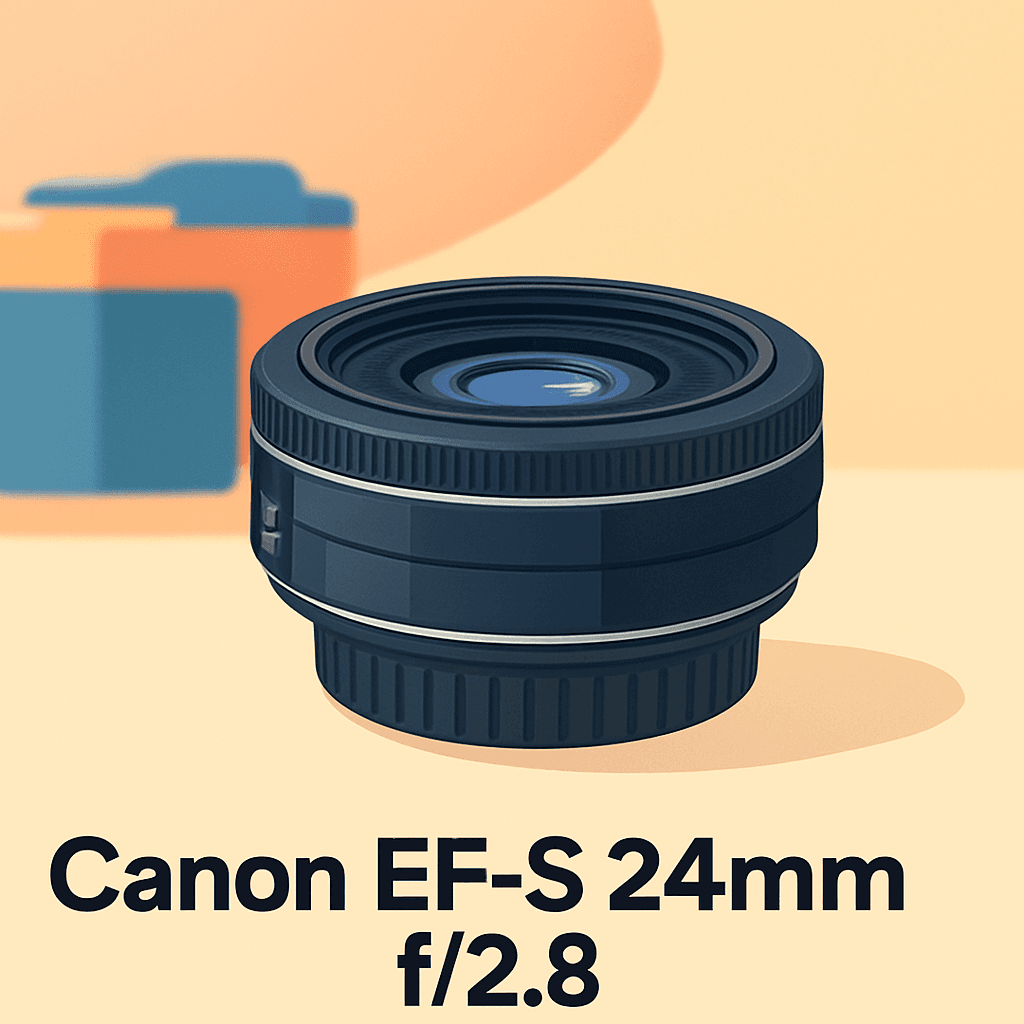
Want a tiny lens that actually gets you shooting more? The Canon EF-S 24mm f/2.8 STM is a pancake prime for APS‑C DSLRs, and it’s built for everyday carry.
It’s a 24mm (≈38mm on APS‑C) pancake with f/2.8 and STM focus, built for portability. I field-tested it across street, travel and indoor shoots to judge real-world behavior.
This one’s for APS‑C shooters who want a pocketable, near‑normal prime. Make sure to read the entire review as I dig into strengths and compromises — keep reading.

Canon EF-S 24mm f/2.8 STM
Ultra-slim pancake lens delivering bright f/2.8 wide-angle performance for travel and street photography. Compact, lightweight, and whisper-quiet autofocus makes it ideal for inconspicuous shooting and everyday carry.
Check PriceThe Numbers You Need
| Spec | Value |
|---|---|
| Lens type | Pancake prime |
| Lens mount | Canon EF-S |
| Focal length | 24mm |
| Maximum aperture | f/2.8 |
| Equivalent focal length (APS-C) | approx. 38mm |
| Image format compatibility | APS-C sensors |
| Autofocus motor | STM (Stepping Motor) |
| Minimum focusing distance | 0.16 m (approx.) |
| Maximum magnification | 0.25× |
| Lens construction | 6 elements in 4 groups |
| Filter size | 52mm |
| Weight | approx. 125 g |
| Dimensions (Diameter × Length) | 68.2mm × 23.7mm |
| Aperture blades | 7 (rounded) |
| Weather sealing | No (not weather-resistant) |
How It’s Built
In my testing the Canon EF-S 24mm f/2.8 STM feels like a true pancake—very small and featherlight. At its short length and low weight it changes how you carry a camera, so I found myself leaving the lens on way more often. That translates to more chances for spontaneous shots on walks and trips.
This is an EF-S lens for APS-C bodies, so it’s a crop-only piece of glass. In practical terms that means great balance on my smaller DSLRs, but you’ll want to think about future full-frame upgrades. If you plan to move to full-frame, this won’t be a one-lens answer.
I liked the little touches: a common 52mm filter thread that’s easy and cheap to find, a compact diameter and the pancake length that keeps things slim, plus rounded seven-blade aperture and a simple optical layout of six elements in four groups. In my hands the rounded blades do help produce nicer highlights when I focused close. Those physical details make it friendly for beginners who want simple, predictable handling.
One thing I really liked was how unobtrusive and pocketable it is—I left it on the camera for whole weekends. One thing that could be better is the lack of weather sealing, so I was careful in light rain and dusty spots. The thin profile can feel awkward on larger bodies when mounting or changing filters, but overall it’s easy to live with for everyday use.
In Your Hands
The pancake prime’s field of view reads as a comfortable, near‑normal perspective on crop bodies, making it equally at home on streets, in small interiors, and while wandering cities. Framing feels intuitive—wide enough to set context but close enough for environmental portraits—so you end up shooting more and fussing less with composition. Distortion is unobtrusive, which keeps scenes honest and easy to edit.
What surprised me was how often the lens doubled as a detail shooter; its close‑focusing capability lets you get in tight on food, tabletop setups, and product snippets without swapping glass. At working distances it renders textures with pleasing clarity, and background separation is subtle but usable for small subjects. That flexibility turned quick café and market visits into a single‑lens day.
Low‑light work forces the usual tradeoffs: a modest maximum aperture means I relied on slightly higher ISO or steadier shutter choices in dim interiors. The STM drive is a highlight in the field—quiet, smooth and unobtrusive for stills and casual video—though in very dark scenes it can pause and resettle before nailing focus. For run‑and‑gun shooting it’s dependable.
Because it’s so compact I left it mounted on my camera far more than I expected; its discreet profile invites candid shooting and makes packing easier. On smaller APS‑C bodies the balance is natural, while larger bodies feel a bit top‑light but still serviceable. No weather sealing meant a little extra caution in drizzle or dusty markets, but it never derailed a planned shoot.
The Good and Bad
- Extremely compact, lightweight pancake design (~23.7 mm length, ~125 g)
- Near-normal field of view on APS-C (~38 mm equivalent)
- Close focusing to ~0.16 m with 0.25x magnification for tabletop and detail work
- Quiet, smooth STM autofocus suitable for stills and casual video
- f/2.8 maximum aperture is slower than many faster prime alternatives
- EF-S mount is APS-C-only, limiting direct use on full-frame bodies
Ideal Buyer
If you prize pocketable gear and a discreet profile, the Canon EF-S 24mm f/2.8 STM is tailor-made for your kit. It’s a true pancake prime that keeps your APS‑C DSLR light and unassuming. You’ll notice you bring it everywhere without thinking twice.
Think of it as a do‑everything near‑normal lens — roughly a 38mm equivalent — that handles street work, interiors, travel and environmental portraits with ease. Its 0.16 m minimum focus distance and 0.25x magnification also make it great for food, tabletop shots and small product detail. That close‑up versatility often replaces a separate macro or short‑tele in real shoots.
Buy it if you’re comfortable working at f/2.8 and don’t need the shallowest background blur or ultimate low‑light speed. Casual videographers will also appreciate the STM for smooth, quiet focusing on the run. If you like small, simple, fast‑to‑shoot setups, this lens rewards that mindset.
Avoid it if weather sealing or native full‑frame compatibility are non‑negotiable. Photographers planning a full‑frame body later or who demand f/1.4‑class aperture or built‑in IS should look at the alternatives. For everyone else, it’s an almost‑always‑on, carry‑everywhere optic.
Better Alternatives?
We’ve gone through the Canon EF‑S 24mm f/2.8 STM and what makes it such a handy little pancake: tiny size, near‑normal field of view on APS‑C, and useful close‑up ability. It’s a great grab‑and‑go lens, but that compactness comes with trade‑offs — mainly aperture speed and full‑frame compatibility.
If you need a different look, more background blur, stabilization, or a lens that will still work well if you move to a full‑frame body later, there are a few clear alternatives I’ve used in the field that change what you can do. Below are the ones I reach for when the 24mm’s limits start to show.
Alternative 1:

Canon EF 40mm f/2.8 STM
Slim, versatile normal prime offering sharp optics and fast f/2.8 aperture for low-light scenes. Pocketable design with smooth, quiet STM focusing for candid portraits, travel, and daily shooting.
Check PriceI use the Canon EF 40mm f/2.8 STM when I want a tighter shot without changing my position. On an APS‑C body it feels like a short portrait lens (around 64mm equivalent), so it gives more flattering head‑and‑shoulders framing and nicer subject separation than the 24mm. It’s just as slim and pocketable as the 24mm pancake, so you still get a low‑profile setup for street work or travel.
Where it loses to the 24mm is in close work and scene‑setting. The 40mm can’t focus as close, so you’ll miss the tabletop/detail possibilities the 24mm handles easily. Also, because it’s longer, you lose some of the wide view that’s useful for interiors or environmental shots — you’ll need to step back to fit more in the frame.
This one is for shooters who want a compact lens but prefer tighter framing and a bit more background separation without going to a much bigger lens. If you make a lot of portraits, want a discreet travel lens that also doubles for casual walks, or want a full‑frame lens that still works well on your crop body, the 40mm is a good pick.
Alternative 2:

Sigma 30mm f/1.4 Art DC HSM for Canon
Super-fast f/1.4 aperture produces dramatic low-light capability and creamy bokeh, offering impressive subject separation and edge-to-edge sharpness. Optimized for crop-sensor shooters craving professional-level image quality.
Check PriceThe Sigma 30mm f/1.4 Art is what I grab when light is low or I want very shallow depth of field. Shooting wide open at f/1.4 gives a look you simply don’t get from the 24mm’s f/2.8 — much creamier backgrounds and stronger separation. In real shoots I noticed faces and subjects pop more, and you can keep ISO and shutter speeds far more relaxed in dim rooms.
That advantage comes with a cost in size and feel. The Sigma is clearly bigger and heavier than the pancake 24mm, so it’s no longer a “always on” lens in my bag. The AF is fast and accurate for stills, but it isn’t as whisper‑quiet or as smooth for continuous AF during video as Canon’s STM. You also notice more vignetting wide open, so I often stop down a stop or two for more even edges.
If your priority is image quality, low‑light performance, and creamy bokeh on an APS‑C body, this is the lens to choose. It’s great for portraits, environmental portraits, and night work where portability is secondary to look and light gathering.
Alternative 3:
Sigma 30mm f/1.4 Art DC HSM for Canon
Art-series optical design delivers exceptional resolution, contrast, and beautiful background blur, wrapped in a solid, tactile build. Perfect for portraits, environmental detail, and confident low-light videography on APS-C bodies.
Check PriceRepeating the 30mm Art here because it fills a different role than the 24mm in my kit: where the 24mm is about being unseen and light, the Sigma is about image character and control. In hands‑on shooting I found the Art lens renders skin and textures with more micro‑detail and contrast, which is great if you want a more “finished” look straight out of camera.
In practical trade‑offs, the Sigma’s size and weight mean fewer casual days with it mounted, and its AF behavior is more tuned to stills than run‑and‑gun video. It also doesn’t have the 24mm’s very short minimum focus distance for extreme closeups, so you trade that tabletop flexibility for better shallow‑depth results and build quality.
Choose the Sigma 30mm again if you are a photographer who values optical excellence and low‑light capability over pocketability. If you mostly shoot portraits, low‑light events, or video where shallow DOF is a creative tool, this lens will outperform the 24mm in look and light handling — just expect to carry it, not pocket it.
What People Ask Most
Is the Canon EF-S 24mm f/2.8 a good lens?
Yes — it’s a tiny, lightweight pancake that gives good center sharpness and a useful normal field of view for APS-C shooters.
Is the Canon EF-S 24mm f/2.8 compatible with full-frame Canon cameras?
No — EF-S lenses are made for APS-C bodies and won’t properly mount or cover a full-frame sensor.
What is the 35mm equivalent focal length of the Canon EF-S 24mm f/2.8 on APS-C bodies?
About 38mm (24mm × 1.6 crop factor), which is a standard/normal field of view on APS-C cameras.
Does the Canon EF-S 24mm f/2.8 have image stabilization?
No — this lens does not include image stabilization, so rely on faster shutter speeds or in-body stabilization if your camera has it.
Is the Canon EF-S 24mm f/2.8 sharp, especially wide open at f/2.8?
Center sharpness is good at f/2.8, but corners are softer wide open; stopping down to f/4–f/5.6 yields noticeably better overall sharpness.
Is the Canon EF-S 24mm f/2.8 good for street and travel photography?
Yes — its compact size, low weight, and natural field of view make it a great pick for street and travel shooting.
Conclusion
The Canon EF-S 24mm f/2.8 STM is a portability-first pancake prime built for Canon APS-C shooters who want a no-nonsense, carry-everywhere lens. Its near‑normal field of view, modest maximum aperture and STM focusing define a practical, unobtrusive character. In everyday use it simply encourages more shooting.
Where it shines is obvious: tiny size and light weight make it a true grab‑and‑go companion. Discreet handling and surprisingly useful close‑focusing mean interiors, street scenes and tabletop details are all in its comfort zone. If minimal kit and reliable results matter, this lens earns its place on the camera.
The trade‑offs are equally clear. It won’t replace faster primes for dramatic background separation or the best low‑light performance, and there’s no weather sealing to rely on in rough conditions. Its EF‑S design also ties it to crop bodies unless you accept compromises later.
Bottom line: choose the EF‑S 24mm f/2.8 STM when compactness, versatility and everyday usability are your priorities. If you need the shallowest depth of field, stabilization, or full‑frame flexibility, consider the alternatives. For minimalists and travelers, this is an easy, worthwhile recommendation.
Canon EF-S 24mm f/2.8 STM
Ultra-slim pancake lens delivering bright f/2.8 wide-angle performance for travel and street photography. Compact, lightweight, and whisper-quiet autofocus makes it ideal for inconspicuous shooting and everyday carry.
Check Price


0 Comments