
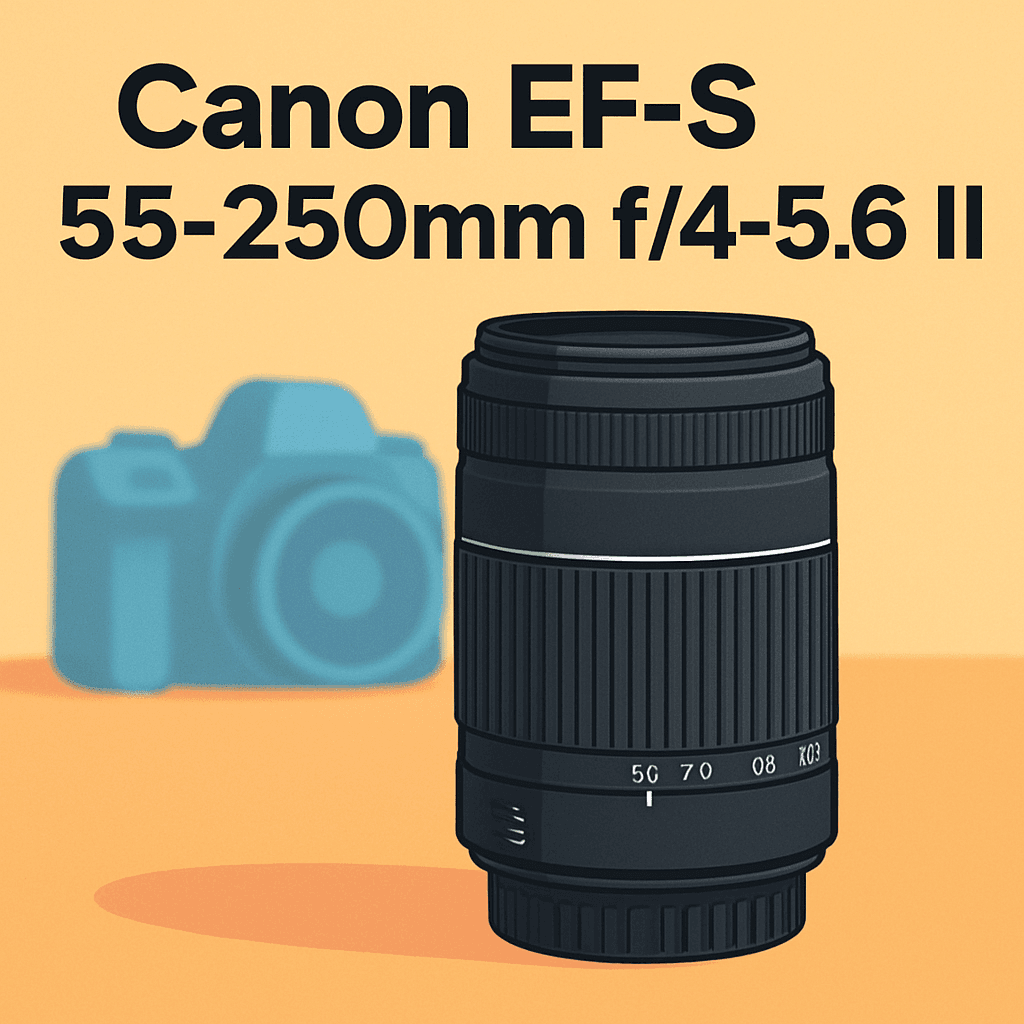
Want more reach from your Canon APS-C body without lugging a heavy tele? The Canon EF-S 55-250mm f/4-5.6 IS II promises a compact, stabilized long reach—about an 88–400mm equivalent—perfect for travel and casual wildlife.
It’s lightweight and travel-friendly, with built-in Image Stabilization and a variable f/4–5.6 aperture that shapes real-world shooting choices. Being EF-S, it’s aimed at crop-sensor shooters who want portable tele performance.
After a few shoots with it and side-by-side checks against popular rivals, I dug into how it handles, how sharp it really is, and how the autofocus behaves. I’ll cover design, handling, sharpness, AF, who should buy it, and alternatives—Make sure to read the entire review as…

Canon EF-S 55-250mm f/4-5.6 IS II
Affordable, compact telephoto zoom delivering impressive reach and sharp optics with built-in image stabilization. Ideal for hobbyists capturing sports, wildlife, and portraits from a distance without sacrificing portability or clarity.
Check PriceThe Numbers You Need
| Spec | Value |
|---|---|
| Lens Type | Telephoto Zoom |
| Mount Type | EF-S |
| Focal Length | 55-250mm |
| Equivalent Focal Length | 88-400mm (on APS-C) |
| Aperture Range | f/4-5.6 |
| Image Stabilizer | Yes |
| Lens Design | 13 elements in 10 groups |
| Minimum Focus Distance | 0.85m |
| Maximum Magnification | 0.29x |
| Weight | Approximately 390g |
| Length | 70mm |
| Diameter | 70mm |
| Filter Size | 52mm |
| Special Features | Image Stabilization, Compact Design |
| Lens Construction | Plastic barrel with metal mount |
How It’s Built
In my testing the Canon EF-S 55-250mm f/4-5.6 IS II feels lighter than it looks. The barrel is plastic but the mount is metal, so you get low weight with a trustworthy connection to the camera. That means it’s easy to tour with, but you shouldn’t treat it like a brick.
The compact size fits small Canon APS-C bodies nicely and balances well on a light camera. After using it for a while I found it disappears in a bag and never tired my neck on all-day shoots. For travel and casual photography that combination is gold.
The zoom ring has a pleasant grip and smooth throw, so framing subjects at the long end is straightforward. Manual focusing is a bit small and not for heavy studio use, but it’s fine for quick tweaks in the field. I liked how the lens feels in hand when panning and locking onto distant subjects.
One thing I really liked was the travel-friendly build that kept weight down without feeling flimsy. One thing that could be better is the surface finish — the plastic can scuff and it doesn’t feel as premium as pricier lenses. For beginners that means great portability but you should carry a simple case and watch how you toss it in your bag.
In Your Hands
The Canon EF-S 55-250mm f/4-5.6 IS II feels like a true travel tele: its image stabilization makes handheld shooting across the zoom range unexpectedly practical, and you can routinely pull off sharp shots without a tripod in daylight and even in lower-light situations when you brace. At the long end the IS still helps a lot, though steady technique matters more as reach increases; small movements are more noticeable, so a solid stance or a monopod can save shots when conditions get challenging.
Because the aperture narrows as you zoom, real-world shooting often means relying on the stabilizer and higher ISO indoors or at dusk, rather than expecting shallow depth of field at full reach. In bright outdoor light the lens opens up a lot of creative freedom for mid-tele portraits and landscape compression, but in dimmer scenes you’ll be managing exposure choices to keep shutter speeds usable.
The lens’s close-focus behavior is a pleasant surprise for travel and detail work: you can get close enough for tight framing of small subjects and textural shots without switching to a dedicated macro. It won’t replace a macro lens for true 1:1 work, but for flower studies, market stalls, and product details it’s versatile and convenient.
On the street, sideline, or during casual wildlife outings this lens rewards a light kit mindset—its compactness and balance on smaller bodies reduce fatigue and make it easy to carry all day. It’s a reliable go-to when you want extended reach without the burden of heavy glass, though photographers who routinely chase fast action should be mindful it’s optimized for portability and general-purpose use rather than specialist sports performance.
The Good and Bad
- 88–400 mm equivalent reach on APS-C in a compact, 390 g package
- Built-in Image Stabilization for handheld telephoto shooting
- 0.29x max magnification and 0.85 m minimum focus distance for close-up utility
- 52 mm filter size (cost-effective, easy to source)
- Variable aperture f/4–5.6 limits light at the long end
- EF-S mount limits compatibility to APS-C bodies
Ideal Buyer
The Canon EF-S 55-250mm f/4-5.6 IS II is aimed squarely at Canon APS-C shooters who want a long, travel-friendly telephoto without the bulk. On an APS-C body it delivers roughly an 88–400mm equivalent reach and useful built-in Image Stabilization for handheld work. It’s a practical choice when reach matters more than a constant wide aperture.
Travel photographers, weekend wildlife chasers and parents shooting school sports will appreciate the light weight and compact footprint. It’s great for mid-tele portraits, casual wildlife from a distance, and sideline daytime action when you can rely on good light or the IS. Stills shooters who prioritize portability over pro-level AF speed will get the most out of it.
This lens is not for full-frame users since it’s EF-S only, and it’s not the best pick for videographers who need the smooth, silent AF of the STM version. Action specialists who require the fastest, most decisive tracking should look toward USM-equipped telezooms instead. If quiet continuous AF or maximum AF speed are mission-critical, consider the alternatives.
For budget-minded photographers building a lightweight kit, the 55–250 IS II punches above its price for everyday reach and convenience. It’s an easy-to-pack workhorse and a smart second lens for travel and casual shoots. Buy it if you want stabilized reach on APS-C without fuss.
Better Alternatives?
We’ve already walked through the 55-250mm f/4-5.6 II and what makes it a solid, light telephoto for APS-C Canon users: good reach, easy to carry, and stabilisation that helps when you handhold at long focal lengths. If you still want that easy travel feel but with quieter video AF, or if you need more reach or faster focus for action, there are a few sensible swaps to consider.
Below I’ll point out lenses I’ve used in the field, what they do better or worse than the 55-250 IS II, and who each one suits. I’ll focus on what you actually feel shooting — handling, autofocus behavior, how often you need to bump ISO, and how much gear you end up carrying.
Alternative 1:
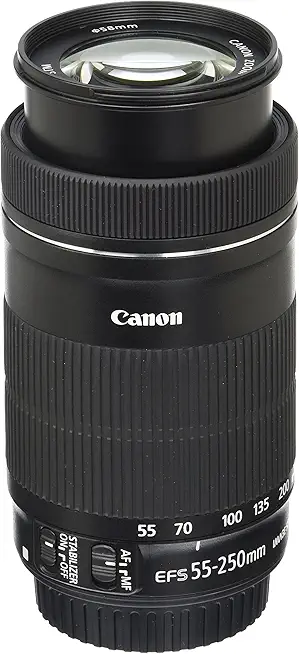
Canon EF-S 55-250mm f/4-5.6 IS STM
Lightweight telephoto zoom with silent STM autofocus and steady image stabilization for smooth video and responsive stills. Delivers sharp, versatile reach for travel, wildlife, and everyday shooting with minimal noise.
Check PriceI’ve used the STM version on walkabout shoots and video projects — the biggest, real-world win over the older IS II is the autofocus. It’s much quieter and much smoother in live view and when shooting video, so you don’t get that hunting or motor noise in your clips. For stills the image quality and stabilization feel nearly the same, so you don’t lose edge sharpness for day-to-day shooting.
What it doesn’t fix is the basic trade-offs of the 55–250 design: the variable aperture still means you’ll push ISO in low light, and it’s still an EF-S lens so full-frame owners can’t use it. Build and handling feel very similar, so if you’re after a tougher, more professional-feeling body you won’t get that here.
Pick the STM if you shoot a lot of video or hybrid content and want a light tele you can carry all day. If you mostly shoot stills and are pinching pennies, the older IS II or buying used can still make sense, but for vloggers and travel shooters the STM is the nicer, more modern choice.
Alternative 2:

Canon EF 70-300mm f/4-5.6 IS II USM
Extended-range telephoto for full-frame use offering excellent reach, refined optics, and advanced stabilization. Fast, near-silent USM focusing locks onto subjects instantly—ideal for sports, wildlife, and action shooters.
Check PriceThe 70–300 IS II USM is a step up when you need reach and speed. In real shooting I noticed it nails focus on moving subjects far better than the 55–250 — the USM drive is quicker and more decisive, so you waste fewer frames on missed focus. The extra 50mm on the long end matters for birds or sports where every bit of reach helps, and the optics feel a touch sharper at longer distances.
That improvement comes with more size, weight, and cost. It’s heavier to carry and less discreet on the street, and it’s not as grab-and-go as the 55–250. If you’re shooting all day handheld travel photos the extra bulk gets tiring; on the other hand, for weekend wildlife trips or sideline sports it’s a sensible trade.
This is the one I’d recommend to shooters who want more reach and real AF speed — especially if you own a full-frame Canon body or plan to upgrade. If you prioritize light weight and low price, stick with the 55–250; if you need better tracking and extra reach, go 70–300 USM.
Alternative 3:
Canon EF 70-300mm f/4-5.6 IS II USM
Versatile long-range zoom blending portability with crisp image quality and dependable stabilization. Responsive USM-driven autofocus ensures precise tracking, while broad focal coverage supports shooting from landscapes to distant wildlife.
Check PriceComing back to the 70–300 in a different light: I’ve also used it for landscape and nature work where I need to compress scenes or isolate distant subjects. Compared to the 55–250 you get more framing options and generally cleaner results at 300mm, so you can pull distant details without cropping as hard in post. The stabilization also felt more robust when handholding at the long end.
On the flip side, you lose some of the 55–250’s simplicity — it’s less nimble for travel, and I found myself only reaching for it when I knew I needed the extra reach or faster AF. The price and weight are the biggest real-world downsides; it’s a better fit as a purposely-chosen telephoto rather than an everyday carry.
If you’re a shooter who regularly chases birds, sports, or any fast subjects — or you want a lens that will still be useful on a future full-frame body — the 70–300 IS II USM is worth the extra cash and bulk. If you want the lightest possible tele for casual trips, the 55–250 remains the easier lens to live with.
What People Ask Most
Is the Canon EF-S 55-250mm f/4-5.6 II a good lens?
Yes for beginners and budget shooters — it gives a useful tele range and good value, but it’s basic optics compared with newer or pricier telezooms.
Does the Canon EF-S 55-250mm f/4-5.6 II have image stabilization (IS)?
No, the “II” non-IS version does not include image stabilization, so handholding at long focal lengths is harder.
Is the Canon EF-S 55-250mm f/4-5.6 II compatible with full-frame Canon cameras?
No — EF-S lenses are designed for APS-C bodies and won’t mount or cover full-frame sensors properly.
How sharp is the Canon EF-S 55-250mm f/4-5.6 II?
It’s reasonably sharp in the center through most of the range, but it softens at 250mm and toward the edges, especially wide open.
What is the minimum focusing distance and maximum magnification of the 55-250mm f/4-5.6 II?
The lens focuses to roughly 1.1 meters (about 3.6 feet) and delivers around 0.2–0.3x maximum magnification depending on focal length.
How does the Canon EF-S 55-250mm f/4-5.6 II compare to the IS and STM versions?
The IS and STM versions add image stabilization and smoother, quieter AF (STM), plus slightly improved optics and focusing speed, making them better for handholding and video.
Conclusion
The Canon EF-S 55-250mm f/4-5.6 IS II is best summed up as a compact, travel-ready tele zoom that gives APS-C shooters serious reach and usable stabilization without a heavy burden. It’s the sort of lens you grab for vacations, sidelines and casual wildlife when portability matters more than pro-level speed. In everyday stills work it delivers predictable, solid results that punch above its modest price and size.
That practicality comes with compromises, and they’re plain to see. The variable aperture and the older AF design mean you’ll push ISO or rely heavily on stabilization as you stretch the focal length, and the focus behavior isn’t as quiet or as quick as STM or USM alternatives. EF-S compatibility also limits future use to crop-sensor bodies, so buyers should be intentional about their system plans.
Ultimately, I recommend the 55-250 IS II for APS-C photographers who prioritize lightweight, stabilized reach for stills and travel photography. If you shoot a lot of video, consider the STM variant; if you need faster, more decisive AF or full-frame flexibility, look toward USM-equipped options. It’s a sensible, value-driven choice rather than a specialist’s flagship.
Canon EF-S 55-250mm f/4-5.6 IS II
Affordable, compact telephoto zoom delivering impressive reach and sharp optics with built-in image stabilization. Ideal for hobbyists capturing sports, wildlife, and portraits from a distance without sacrificing portability or clarity.
Check Price


0 Comments