
Want more reach without lugging heavy glass?
If you’re a travel shooter, parent on the sidelines, or a hobby wildlife photographer, the Canon EF-S 55-250mm f/4-5.6 IS STM promises extra reach with minimal bulk.
I took this lens into the field and found long reach, built-in stabilization, quiet STM autofocus, and a very light feel. The variable f/4–5.6 aperture favors daylight and smooth video focus over outright tracking speed.
I’ll evaluate handling on APS-C bodies, real-world stabilization, AF for stills and video, image quality across the range, and practical close-up use. Make sure to read the entire review as we compare results and show where it truly shines — keep reading.
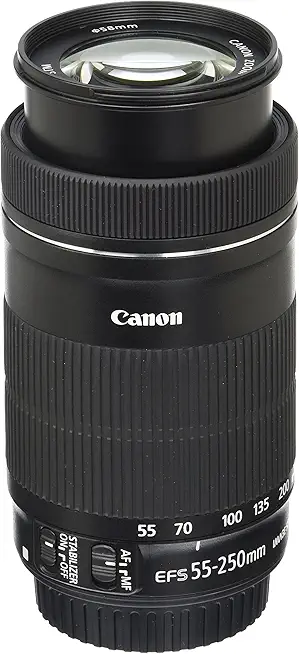
Canon EF-S 55-250mm f/4-5.6 IS STM
Compact telephoto zoom delivers sharp, stabilized reach for wildlife, sports and portraits on crop-sensor bodies. Lightweight design, smooth silent autofocus and effective image stabilization enable confident handheld shooting at long distances.
Check PriceThe Numbers You Need
| Spec | Value |
|---|---|
| Focal length | 55–250mm |
| Aperture range | f/4–5.6 |
| Image stabilizer | Yes (IS) |
| Focus motor | STM (stepping motor), quiet and smooth |
| Filter diameter | 58mm |
| Lens mount | Canon EF-S |
| Compatible cameras | Canon APS-C DSLRs |
| Minimum focusing distance | Approx. 0.85m (2.8 ft) |
| Maximum magnification | Approx. 0.29x |
| Number of diaphragm blades | 7 |
| Autofocus | Yes |
| Internal focusing | Yes |
| Optical formula | 15 elements in 12 groups, including one UD element |
| Dimensions (approx.) | 70 x 108 mm |
| Weight (approx.) | 375g |
| Field of view (35mm equiv.) | Approx. 88–400mm |
How It’s Built
In my testing the Canon EF-S 55-250mm f/4-5.6 IS STM felt refreshingly compact and easy to carry. It sits nicely on smaller Canon bodies and doesn’t pull you down on long walks. For beginners that means less gear stress and more shots taken.
The build is mostly plastic but the fit and finish punch above its price. It doesn’t feel flimsy in hand, though you can tell it’s not a pro-level shell. That translates to a lens that’s friendly for everyday use without scaring off new shooters.
One thing I really liked was the internal focusing and non-rotating front element. That makes using a polarizer or ND filter straightforward in the field. I found it a small detail that actually saves time and frustration when shooting outdoors.
The zoom ring has a nice throw but I noticed it can stiffen near the long end during quick changes. The manual focus ring is small but responsive enough for fine adjustments. For casual handheld work the handling is predictable and easy to learn.
One thing that could be better is the aperture blade shape when you stop down. In my photos stopped-down highlights can look a bit polygonal, so bokeh isn’t perfectly round in every shot. Still, overall balance and ergonomics make it a great travel and starter tele option.
In Your Hands
As a compact tele zoom on APS‑C bodies, the Canon EF‑S 55‑250mm IS STM covers everything from tight portraits and close‑ups at the short end to pulling distant subjects much closer at the long end. That reach makes it useful for family outings, backyard birds, and sideline action. It encourages working fast and light.
The lens’s image stabilization noticeably improves handheld keepers in daylight and helps composition as light fades; you’ll still want support for dim conditions. During panning the IS feels natural, locking in smoothly and recovering quickly after motion. In the viewfinder stabilization provides a reassuring steadiness when framing.
STM autofocus is whisper‑quiet and very smooth, ideal for video and for discreet stills, and it nails focus on stationary subjects with little fuss. It’s not built for furious action—expect the occasional hesitation when chasing erratic movement. For most casual sports and wildlife it performs reliably.
Close‑focus performance is surprisingly handy for flowers and small details, letting you isolate subjects with pleasant separation. At the long end the working distance narrows, so you may need to step back for comfortable framing.
Its light weight and compact footprint make it a joy on hikes and travel days, reducing fatigue and encouraging more shooting. For parents and hobbyist shooters who value quiet AF and usable stabilization, this is a practical everyday tele zoom.
The Good and Bad
- Compact and lightweight for a telephoto zoom (approx. 375 g)
- Useful 55–250mm range (≈88–400mm equiv.) for portraits to wildlife
- Built-in IS for steadier handheld shooting
- STM autofocus is quiet and smooth, beneficial for video
- Variable f/4–5.6 aperture limits low-light performance and background blur at the long end
- STM focus not as fast/confident for fast action tracking as USM/Nano‑USM designs
Ideal Buyer
If you shoot with a Canon APS-C DSLR and want reach without a heavy bag, the Canon EF-S 55-250mm f/4-5.6 IS STM fits. It’s affordable and balanced on crop bodies. The range extends an everyday kit to ≈88–400mm.
Travel and hike photographers will like its light weight and compact footprint. It stows easily and gives tele coverage without a monopod. For daylight scenes it handles portraits and distant details well.
Parents and sideline shooters get usable reach for school games and family outings. In good light the IS and STM keep shots steady and discreet. Hobby wildlife and birders will appreciate the range for cautious, non-pro-level stalking.
Video creators who need quiet, smooth AF and usable IS will find this lens handy for handheld clips. It’s not a low-light or fast-action specialist, so skip it if you need F2.8 apertures or top-tier tracking. Choose it when portability, price and silent focusing matter most.
Budget-minded enthusiasts and beginners upgrading from kit lenses will find immediate value. The common 58mm filter size and internal focusing make accessories easy to use. It’s a practical step up without a steep learning curve or expense.
Better Alternatives?
We’ve already gone through the Canon EF-S 55-250mm f/4-5.6 in detail — its light weight, quiet STM focus, and handy stabilization make it a great grab-and-go tele for APS-C bodies. If you like that balance of reach and portability, it’s hard to beat for travel, family shots, and casual wildlife in good light.
Still, every lens has trade-offs. Below I’ll lay out a few realistic alternatives you might consider depending on whether you want more reach, faster autofocus, or a lens that will also work on full-frame bodies. I’ve used these in the field and will point out what they do better and what they give up compared to the 55‑250 IS STM.
Alternative 1:
Canon EF-S 55-250mm f/4-5.6 IS STM
Affordable long-range zoom built for travel and everyday shooting. Smooth, quiet focus for video, reliable optical stabilization for handheld shots, and crisp optics that extend framing without a tripod.
Check PriceThis is essentially the same lens we just reviewed, so what it does better than itself is the same things you already know: light on your camera, easy to carry all day, and very quiet when you’re shooting video. The IS and STM combination makes it simple to get usable handheld shots at the long end in good light, and it balances nicely on small Canon APS‑C bodies.
What it does worse than the review lens? Nothing — it is the review lens. The only real differences you’ll run into are condition, price, or whether you’re buying new or used. If you see a good used copy it’s often a smart buy, but if you need more low‑light performance or faster tracking, this lens won’t close that gap.
Who should pick this one: budget-minded APS‑C shooters who want a compact tele that won’t weigh them down. It’s perfect as a second lens for travel or a first serious tele for parents and hobby wildlife shooters who mainly work in daylight.
Alternative 2:

Canon EF 70-300mm f/4-5.6 IS II USM
Professional-grade telezoom offering extended reach with quick, near-silent focusing and improved stabilization. Robust optics and responsive autofocus make it ideal for action, wildlife and high-resolution full-frame photography.
Check PriceThe 70‑300 IS II USM is the practical step up in reach and performance. On the street or in the field you’ll notice the extra 50mm at the long end and a more confident autofocus system — it locks on faster and tracks moving subjects better than the STM in the 55‑250. It also works on full‑frame bodies, which makes it a better long‑term choice if you plan to move off APS‑C.
Where it gives up ground versus the 55‑250 is size, weight and price. It’s heavier and bulkier, so it’s not as nice for long hikes or travel where every ounce counts. Also, while the AF is faster and more reliable for action, the lens still has a variable aperture and won’t match bright, fast tele primes in low light.
This one is for shooters who need more reach and better AF for wildlife, birds, or sideline sports, or for people who want a single tele that will also live on a full‑frame body someday. If you prioritize keeper rate on moving subjects over ultimate lightness, this is the upgrade to consider.
Alternative 3:
Canon EF 70-300mm f/4-5.6 IS II USM
Versatile full-frame telephoto that balances reach and sharpness with fast AF and effective image stabilization. Solid build, responsive focus and excellent contrast deliver dependable results for demanding outdoor shoots.
Check PriceComing at the same 70‑300 again from a slightly different angle: this lens tends to feel more “workhorse” than the 55‑250 when you’re shooting long days. The stabilization is tighter and the images often look a touch cleaner at 300mm compared with the 250mm end of the smaller lens. In practice that means more usable frames when you can’t get closer to your subject.
Its downsides compared to the 55‑250 are practical: you’ll carry more weight, and it’s not as unobtrusive when you want to be small and quick. The 70‑300 will also cost you more up front, so unless you need full‑frame support or the longer reach, the 55‑250 stays the smarter, lighter choice.
Pick this as an alternative if you’re moving beyond casual shooting — for example, hobby wildlife photographers who want better long‑range performance or people who expect to upgrade camera bodies later. It’s a good all‑around tele that trades some portability for reach and better real‑world AF and stabilization.
What People Ask Most
Is the Canon EF-S 55-250mm f/4-5.6 a good lens?
Yes — it’s a very good budget telephoto for Canon APS-C shooters, offering strong reach and usable image quality for hobbyists and travel photographers.
Does the Canon EF-S 55-250mm f/4-5.6 have image stabilization (IS)?
Yes, most versions include Canon’s IS, which helps steady handheld shots at longer focal lengths.
Is the Canon EF-S 55-250mm f/4-5.6 compatible with full-frame Canon cameras?
No, EF-S lenses are made for APS-C bodies and are not compatible with Canon full-frame cameras.
How sharp is the Canon EF-S 55-250mm f/4-5.6?
It’s generally quite sharp in the center, especially stopped down, though corners can be softer at the longest end.
Is the Canon EF-S 55-250mm f/4-5.6 good for wildlife and sports photography?
It’s good for casual wildlife and sports in good light thanks to its reach and IS, but its slow aperture and consumer AF limit low-light and fast-action performance.
What is the 35mm equivalent focal length of the Canon EF-S 55-250mm f/4-5.6?
On Canon APS-C bodies (1.6x crop) it gives roughly an 88–400mm equivalent field of view.
Conclusion
The Canon EF-S 55-250mm f/4-5.6 IS STM is a compact, stabilized tele zoom that meaningfully extends an APS-C kit’s reach while staying light and unobtrusive. Its quiet STM autofocus and steady IS make it a dependable companion for travel, family events, handheld video, and low-profile street work where silence matters. It balances nicely on smaller Canon bodies and is easy to carry all day.
That practicality comes with trade-offs: the variable-aperture design and modest AF architecture limit low-light performance and high-speed subject tracking compared with faster USM-class lenses. The mostly plastic construction and APS-C-only compatibility keep it squarely in the value segment rather than the pro tier. For many shooters that trade-off is acceptable given the convenience, and the lens often earns more keepers in the field than pricier glass.
If you prioritize affordability, low weight, and quiet, steady performance for everyday telephoto needs, this lens is hard to beat. Buy it as a smart, budget-conscious reach extender and plan to trade up only when you outgrow its speed or build. If you need faster AF, more reach or full-frame flexibility, consider stepping up to a higher-tier telephoto for stronger build and tracking.
Canon EF-S 55-250mm f/4-5.6 IS STM
Compact telephoto zoom delivers sharp, stabilized reach for wildlife, sports and portraits on crop-sensor bodies. Lightweight design, smooth silent autofocus and effective image stabilization enable confident handheld shooting at long distances.
Check Price



0 Comments