
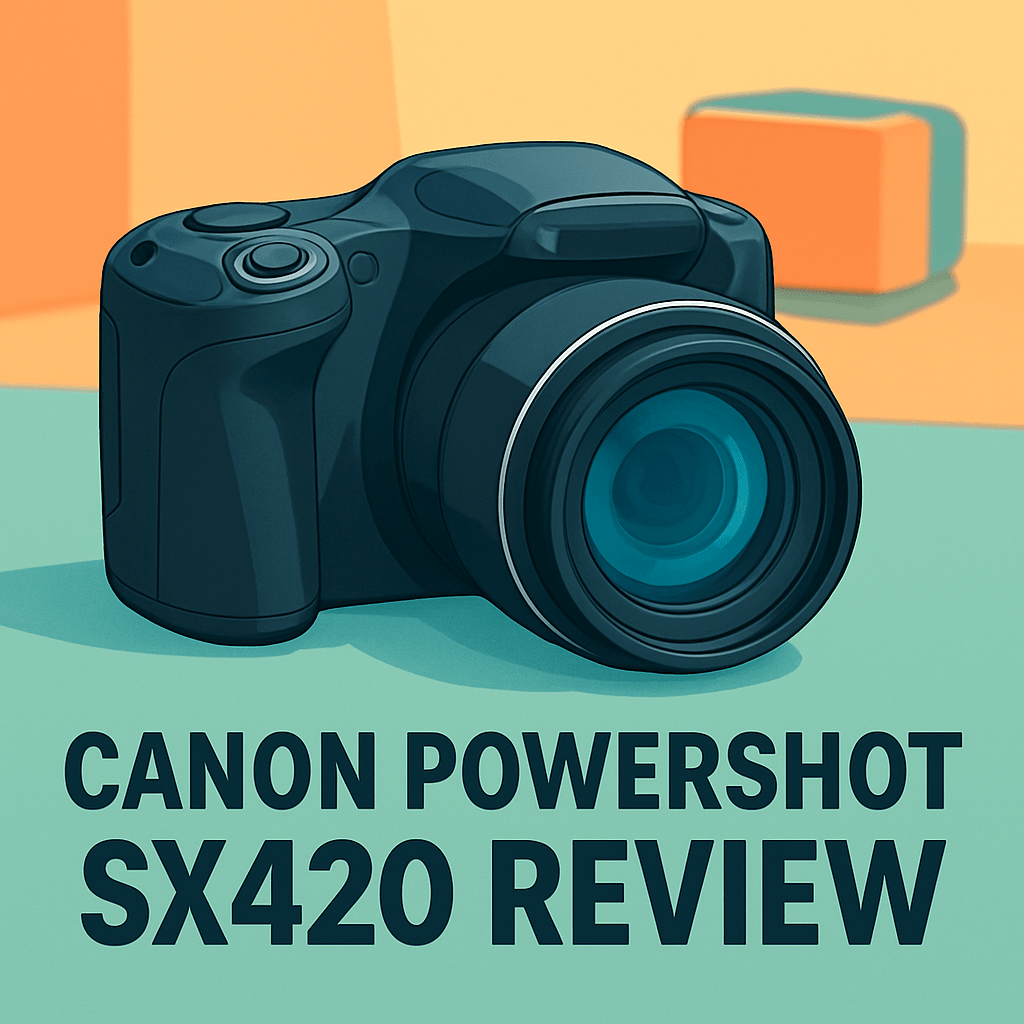
Want to capture distant action without lugging a bag of lenses?
This canon powershot sx420 review is from a photographer who took the camera on real shoots to see how that promise holds up in the field.
It pairs 42x optical reach with a compact point-and-shoot body, so you’re getting serious reach without fuss.
Perfect for travelers, families and anyone upgrading from a phone who wants far more reach in a small package.
It’s best in daylight; it struggles in dim light and with video, so the real question is reach versus image quality.
Make sure to read the entire review for handling, image quality and zoom trade-offs — keep reading.

Canon PowerShot SX420 Camera
Compact travel-ready shooter with impressive 42x optical reach, built-in stabilization, and simple controls for everyday photography. Lightweight design, easy Wi‑Fi sharing, and full HD video capture keep memories sharp.
Check PriceThe Numbers You Need
| Spec | Value |
|---|---|
| Optical zoom | 42x |
| Digital zoom | 4x |
| Image sensor | 1/2.3-inch CCD |
| Effective pixels | 20.0 MP |
| Lens focal length | 24–1008mm (35mm equivalent) |
| Maximum aperture | f/3.5 (wide) – f/6.6 (tele) |
| ISO range | 100–1600 (expandable to 6400) |
| Image stabilization | Intelligent IS |
| LCD screen | 3.0-inch, fixed, 230K-dot |
| Video | Full HD 720p at 25 fps |
| Built-in flash | Yes |
| Storage | SD/SDHC/SDXC (not included) |
| Connectivity | USB 2.0, mini HDMI |
| Dimensions | 104.4 x 69.1 x 85.1 mm (W x H x D) |
| Weight (including battery and card) | Approx. 325g |
How It’s Built
In my testing the Canon PowerShot SX420 Camera surprised me with how un-fussy it feels in your hands. It’s a compact superzoom that doesn’t fight you, so you actually use the reach instead of fending off soreness. For travel and family days it’s easy to stash and pull out when something interesting shows up.
I found the grip comfortable and the balance pretty good even when I zoomed way in. That made longer shoots less tiring and kept shots steadier without a tripod. I really liked that it stays light and manageable compared with lugging around interchangeable lenses.
The fixed LCD is basic and I noticed its coarse preview under bright sun, which makes it harder to judge focus and exposure on the spot. There’s no EVF, so framing in harsh light can be frustrating — this is the one area I wish were better. On the plus side it has simple ports for offloading photos and uses standard memory cards.
Buttons and menus stick to a point-and-shoot vibe, which is great for beginners who don’t want a learning curve. The controls feel a bit plastic and there’s a slight creak if you squeeze the body, but nothing that affects shooting. The built-in flash is handy for quick fill indoors, even if it won’t light up distant subjects.
In Your Hands
The Canon PowerShot SX420 Camera shines when you can lean on its impressive long reach and shoot in good light, where travel scenes, landscapes, and distant details come alive with surprising clarity for such a compact body. That strength comes with the familiar trade-off: the small sensor means the camera prefers bright conditions, and indoors or at dusk you’ll quickly rely on the flash or higher sensitivity settings to get usable shots.
Optical stabilization is a genuine ally when you’re framing subjects far away, and it noticeably improves keeper rates compared with unstabilized compacts. Even so, a steady stance and bracing against solid surfaces make a big difference at full tele; handheld extremes still demand care to avoid softness from camera shake and atmospheric shimmer.
Autofocus is brisk in daylight, locking onto subjects with little fuss, but it slows and hunts as light falls or when working at the long end of the zoom. The camera is tuned for thoughtful, single-frame shooting rather than high-speed action, and buffer pauses are apparent if you try to push burst sequences aggressively.
Keep sensitivity low for the cleanest files—raise it only when necessary and expect a faster climb into grain and softer fine detail as ISO climbs. Color rendition is generally pleasant for skin tones and travel photos, though highlight and shadow latitude tighten in contrasty scenes.
Video is serviceable for short travel or family clips, with stabilization helping handheld pans, but it’s not a tool for high-detail or smooth-motion filmmaking. Battery life will comfortably handle a day of casual shooting, though heavy zooming and frequent clips will send you hunting for a spare or a recharge sooner rather than later.
The Good and Bad
- 42x optical zoom covers 24–1008mm equivalent for extreme versatility
- Intelligent IS aids handheld shots at long focal lengths
- 20 MP resolution can deliver pleasing daylight detail
- Compact and lightweight for a superzoom (approx. 325 g)
- Small 1/2.3-inch CCD sensor; limited high-ISO and dynamic range
- 720p video at 25 fps only; not suited for high-detail or smooth-motion video
Ideal Buyer
If your priority is reach over low‑light finesse, the Canon PowerShot SX420 Camera delivers with a 42x optical zoom tucked into a compact, easy‑carry body. That trade‑off—extreme telephoto reach versus a small 1/2.3‑inch CCD, modest ISO headroom and only 720p video—defines who will love this camera and who won’t. In bright daylight and for distant subjects it’s a joy; in dim interiors or for cinematic video it exposes the class limitations.
It’s ideal for travelers who want to capture wildlife, architecture and city details without hauling lenses or a heavy kit. Families and casual shooters will appreciate the simple controls, useful Intelligent IS and quick built‑in flash for fill light. Phone photographers looking to leap into true optical reach will find this an affordable, fuss‑free bridge camera.
Skip the SX420 if you need clean high‑ISO files, wide dynamic range, a high‑resolution touchscreen or an EVF for reliable outdoor framing. Videographers who demand Full HD at 60p, 4K or advanced codecs should look elsewhere for smoother motion and edit flexibility. Serious hobbyists craving RAW capture, deep manual control or superior low‑light performance will be better served by larger‑sensor compacts or interchangeable‑lens systems.
Better Alternatives?
We’ve gone through the Canon PowerShot SX420 and seen where it shines — great reach in a small, easy-to-carry body — and where it stumbles, like low‑light performance and only basic video. If you liked the SX420 for travel or casual wildlife shots but want slightly different trade‑offs (more reach, better video, or an EVF), there are a few nearby choices worth considering.
Below are three real‑world alternatives I’ve used. I’ll point out what each one does better and worse than the SX420, how they actually feel in the field, and the kind of shooter who’ll get the most from each camera.
Alternative 1:

Canon PowerShot SX540 Camera
Superzoom compact offering 50x optical magnification, responsive autofocus, and stabilized optics for distant subjects. Intuitive controls, Wi‑Fi connectivity, and crisp Full HD video make it ideal for travel and wildlife.
Check PriceI’ve used the SX540 as a day‑trip camera and the most immediate win over the SX420 is reach — that extra 50x zoom gives you noticeably more reach for birds, boats, or city detail. In real shoots it means fewer crops and a better chance to fill the frame without having to crop hard. The SX540’s autofocus and stabilization feel a touch snappier, so you get usable shots more often at long distances.
Where it’s not as strong is in low light: the small sensor class still limits high‑ISO performance, so indoors or at dusk you’ll see similar noise and softness as the SX420. Video is better — Full HD is crisper than the SX420’s 720p — but it still won’t match cameras with larger sensors or 4K. Handling and menus are very Canon‑friendly and you get Wi‑Fi, which the SX420 lacks in usefulness.
Pick the SX540 if you want a simple upgrade in reach and sharper Full HD clips while sticking with a compact, easy camera. It’s great for travelers and casual wildlife shooters who want more zoom without learning a new system, but not for people who need cleaner low‑light files or pro video features.
Alternative 2:

Panasonic LUMIX FZ80 Camera
Versatile bridge camera with an enormous 60x zoom and 4K photo/video capability, letting you extract high-resolution stills from motion. Electronic viewfinder, advanced shooting modes, and reliable stabilization for adventure.
Check PriceThe Panasonic FZ80 brings the biggest changes I noticed: much more zoom (60x) and 4K video/photo modes. In the field that 60x lets you grab shots of subjects you simply can’t with the SX420 — distant wildlife and faraway details are easier to nail. The 4K modes are genuinely useful for getting sharp stills from quick action or for nicer video cropping in post.
On the downside, the small sensor still dictates image noise in low light, and Panasonic’s processing can look over‑sharpened compared with Canon’s softer, more natural look. The FZ80’s autofocus can be less predictable with fast, erratic subjects, so while it’s great for static distant subjects and travel, it can miss fast birds in flight more than I’d like. The EVF is a big plus for shooting in bright sun — something the SX420 lacks.
This camera is for shooters who want the longest reach and modern video tools — explorers, road‑trippers, and anyone who values 4K and an EVF for composing in bright light. If you care most about low‑light detail or very natural JPGs straight from camera, the SX420 might still be a better fit, but the FZ80 gives you much more flexibility for action and distant subjects.
Alternative 3:
Panasonic LUMIX FZ80 Camera
Beginner-friendly long-range performer delivering vivid 4K video and flexible zoom to capture landscapes, wildlife, and action. Built-in electronic viewfinder, scene presets, and quick autofocus help novices shoot confidently.
Check PriceSeen from a beginner’s view, the FZ80 feels easier to get good shots with than the SX420 because of its scene presets, 4K Photo mode, and the EVF. I found new shooters can point, choose a scene, and come away with usable images more often — the EVF helps composition when the sun makes the rear screen hard to read, and the 4K Photo trick is forgiving when timing is tricky.
That said, the same limitations show up: in dim indoor scenes the FZ80’s small sensor can’t produce cleaner files than the SX420 — noise and loss of fine detail are still present. The camera’s menus and processing may feel busier than Canon’s straightforward approach, and if you prefer very natural color straight from the camera, you might notice Panasonic’s punchier rendering.
If you’re new to long‑zoom cameras or you want a forgiving tool that helps you land sharp stills and usable video without much fuss, the FZ80 is a great pick. But if you want the simplest, most predictable point‑and‑shoot experience for daylight travel shots, the SX420 keeps a nice, honest balance between simplicity and reach.
What People Ask Most
Is the Canon PowerShot SX420 good?
It’s a solid budget superzoom for casual travel and telephoto shots, but image quality and speed are behind modern smartphones and interchangeable-lens cameras.
Is the Canon PowerShot SX420 worth buying?
Yes if you want an inexpensive point-and-shoot with lots of zoom and don’t need advanced features or strong low-light performance; otherwise consider a newer compact or mirrorless camera.
How much optical zoom does the Canon PowerShot SX420 have?
It has 42x optical zoom, roughly equivalent to a 24–1008mm focal range.
Does the Canon PowerShot SX420 shoot Full HD 1080p video?
Yes, it records Full HD 1080p video, typically at 30 frames per second.
Does the Canon PowerShot SX420 have Wi‑Fi or NFC?
No, the SX420 does not include Wi‑Fi or NFC for wireless transfer or remote control.
How is the low light performance of the Canon PowerShot SX420?
Low-light performance is weak due to a small 1/2.3″ sensor and limited ISO range, so images get noisy—use a tripod or extra light for better results.
Conclusion
The Canon PowerShot SX420 Camera delivers the kind of long, grab-and-shoot reach that travel and family shooters crave. It’s compact, easy to use, and rewards bright-day shooting and distant subjects with satisfying results.
What it does well is simple: extended optical reach, steadied handling, and approachable controls that keep shooting fast and painless. Where it shows its age is in low light, video capability, and the basic rear screen—limitations tied to its small-sensor, point-and-shoot design. Don’t expect advanced raw flexibility or modern video chops.
Value is straightforward: affordable convenience and reach over cutting-edge image quality or pro features. If you want more dynamic range, cleaner high-ISO performance, or modern video features, this isn’t the camera to chase.
My recommendation: buy the Canon PowerShot SX420 Camera if your priority is a pocketable superzoom for travel, distant subjects, and quick family snaps. Pass if you need low-light fidelity, a high-resolution viewfinder, or serious video tools; in that case look to models with larger sensors or newer video features. For a final decision, review sample galleries of daylight tele shots, indoor flash frames, and a low-light scene to judge noise and stabilization for yourself.
Canon PowerShot SX420 Camera
Compact travel-ready shooter with impressive 42x optical reach, built-in stabilization, and simple controls for everyday photography. Lightweight design, easy Wi‑Fi sharing, and full HD video capture keep memories sharp.
Check Price


0 Comments