
Want a lens that’ll make your GFX the go-to for portraits, travel and everyday work?
I’ve taken the Fujifilm GF 63mm f/2.8 R WR into the field to find out.
It’s a standard prime with weather resistance, a linear AF motor and an aperture ring.
If you want compact, reliable autofocus and pleasing background separation, this one targets you.
This review covers design, handling, autofocus, sharpness and real-world usability so you’ll know what to expect.
Make sure to read the entire review — I’ll show when the lens truly pays off, so keep reading.
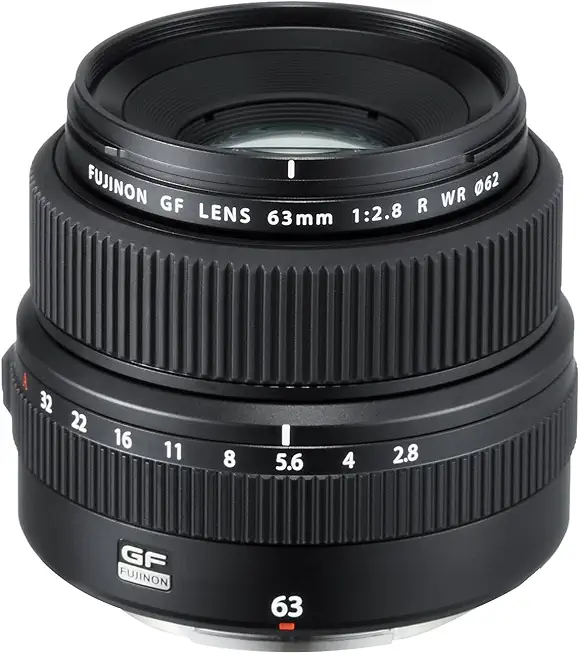
Fujifilm GF 63mm f/2.8 R WR
Compact medium-format short-tele prime offering crisp edge-to-edge sharpness, natural contrast and smooth bokeh. Lightweight, weather-sealed design makes it ideal for travel, portraits and landscape work in challenging conditions.
Check PriceThe Numbers You Need
| Spec | Value |
|---|---|
| Mount | Fujifilm G-mount |
| Focal Length | 63 mm |
| Maximum Aperture | f/2.8 |
| Format Compatibility | Medium format (Fujifilm GFX series) |
| Optical Construction | 9 elements in 8 groups |
| Minimum Focus Distance | 0.63 ft / 19 cm |
| Diaphragm Blades | 9 (rounded) |
| Filter Size | 62 mm |
| Weather Resistance | Yes (WR – weather resistant) |
| Lens Coating | Nano-GI and HT-EBC coatings |
| Dimensions (Diameter × Length) | Approx. 78 mm × 90 mm |
| Weight | Approx. 405 grams |
| Autofocus | Yes — linear motor |
| Aperture Ring | Yes — click mechanism; removable click |
| Image Stabilization | No internal stabilization (handled by camera body) |
How It’s Built
In my testing the Fujifilm GF 63mm f/2.8 R WR feels like a well-made tool in hand, with a precise finish that resists fingerprints. The metal barrel and weather sealing gave me real confidence shooting in rain and wind without worrying about drops. I really liked how light and portable it is for a medium-format lens—easy to carry all day.
The aperture ring clicks firmly yet can be de-clicked smoothly when you want silent stepless control, and the clicks have a satisfying weight. In my testing the focus ring has a nice damping for quick autofocus fine-tunes, but the throw is a bit short for very precise manual pulls. That’s not a deal breaker, but serious manual-focus work takes more practice.
On GFX bodies the lens balances nicely and feels like an extension of the camera, though smaller bodies show a touch of front weight. The filter thread and matching hood are simple to use and helpful in bright or splashy conditions, and finding filters is easy since the size is common. After using it for a while I found it beginner-friendly: easy to learn, easy to carry, and built so you won’t fear a sudden shower.
In Your Hands
As a standard medium-format prime the Fujifilm GF 63mm f/2.8 R WR feels like a true everyday lens—equally at home on portraits, environmental scenes, street work, travel and product detail. Its close-focus ability lets you pull in fine textures and tight details that elevate editorial and product shots, though it never replaces a dedicated macro for extreme reproduction.
The lens lacks in-body stabilization of its own, so most handheld shooting benefits from a camera that offers stabilization or from practical field techniques like bracing, mindful shutter choices and selective use of higher ISO or tripods for critical frames. In practice you’ll find it forgiving for casual handheld work but worth steadying when you need pixel-level sharpness.
Thanks to modern coatings it behaves well in challenging light; flare and ghosting are controlled more often than not, preserving contrast and color in backlit situations with only occasional veiling at extreme angles. Colors hold their saturation and mid‑tone contrast remains pleasing, so images retain punch straight from the camera.
Rendering is neutral yet pleasing—the rounded diaphragm produces smooth, natural out-of-focus areas and specular highlights that don’t distract. Background separation is convincing for portraits and subject isolation improves noticeably at closer working distances, giving a versatile balance between clarity and creamy background falloff.
The Good and Bad
- Weather-resistant construction (WR)
- Linear motor AF
- Aperture ring with click mechanism and removable click
- Nano-GI and HT-EBC coatings
- No in-lens image stabilization
- f/2.8 maximum aperture limits subject separation versus faster lenses
Ideal Buyer
If you shoot with the Fujifilm GFX system and want a go‑anywhere standard prime, the Fujifilm GF 63mm f/2.8 R WR is built for you. It balances medium‑format reach with a compact footprint, making it ideal for day‑to‑day assignments where image quality matters but bulk doesn’t. It’s weather‑resistant and feels reassuring in the field.
Portrait, environmental editorial, travel and product shooters will appreciate the focal length’s versatility. Close‑focus ability lets you pull fine detail without carrying a dedicated macro. Street and documentary photographers will like its discreet size and handling.
Photographers who prize tactile controls and predictable exposure will love the aperture ring with clickable/de‑click option. The linear‑motor autofocus is quiet and precise, great for stills and clean focus pulls in video. If you favor faster primes for extreme subject separation, expect to trade that for the 63mm’s f/2.8 top speed.
Buyers comfortable relying on in‑body stabilization and working at f/2.8 will find this lens a near‑perfect everyday tool. Landscape shooters who need corner‑to‑corner micro‑detail or those chasing true macro reproduction might look elsewhere. For most GFX users wanting weather‑sealed, portable, high‑quality glass, the 63mm hits a rare sweet spot.
Better Alternatives?
We’ve gone through what the Fujifilm GF 63mm f/2.8 does best — a very usable, weather-sealed standard prime that balances size, sharpness and everyday portrait work. If that lens still isn’t exactly what you need, there are a few other GF options that change the picture by shifting field of view, aperture speed, or special-purpose use.
Below are three practical alternatives I’ve shot with in the real world. I’ll point out where each one shines compared to the 63mm, where it falls short, and the kind of shooter who’ll be happiest with it.
Alternative 1:

Fujifilm GF 45mm f/2.8 R WR
Versatile wide-normal prime crafted for environmental portraits, landscapes and architecture. Fast aperture enables low-light shooting and subject separation while weather-resistant construction and precise optics deliver consistent, detailed results.
Check PriceThe GF 45mm is noticeably wider than the 63mm, so what it does better is give you more scene context — great for environmental portraits, street work, and landscapes where you want the subject and surroundings together. I often reach for it when I need a “walkaround” lens that stays light on a gimbal or on long shoots, because it’s smaller and easier to carry all day.
Where it falls short versus the 63mm is subject separation and a slightly different portrait look. Faces aren’t as isolated at f/2.8 as with the tighter framing of the 63mm, and if you step in too close you can see a little more perspective distortion on faces. For tight headshots or when you want strong background blur, the 63mm feels more natural.
Who should pick it? Choose the 45mm if you do a lot of travel, street, or environmental portrait work and want a compact, weather-sealed lens that gives context. If you need a single, lighter lens to cover people plus places, it’s a very practical swap for the 63mm.
Alternative 2:

Fujifilm GF 80mm f/1.7 R WR
Ultra-fast portrait optic that produces creamy, isolating bokeh and exceptional subject rendering. High contrast and pinpoint sharpness combined with robust weather sealing make it perfect for low-light and studio assignments.
Check PriceThe GF 80mm f/1.7 is a different animal — much faster and longer than the 63mm, so it beats the 63mm at subject isolation and low-light work. Wide open the bokeh is very creamy and it gives a classic portrait look that really separates the subject from the background. I’ve used it for headshots and editorial work where that dreamy separation matters.
But it also has trade-offs: it’s larger, heavier, and you must be careful with focus because the depth of field is very thin at f/1.7. That makes it less useful as an everyday carry lens compared to the versatile 63mm. It’s also a more specialized choice — you give up some flexibility for that extra speed and compression.
Who should pick it? Go for the 80mm if your work is portrait-heavy, studio-based, or editorial and you want very shallow depth and beautiful background roll-off. If you shoot events or need a single all-purpose lens, the 63mm will usually be the more practical choice.
Alternative 3:
Fujifilm GF 80mm f/1.7 R WR
Cinematic portrait lens with gorgeous background separation and rich micro-contrast. The bright aperture yields dreamy out-of-focus highlights, precise skin-tone rendition and dependable weather-resistant build for professional use.
Check PriceLooking at the 80mm from a cinematic or editorial angle, it gives richer micro-contrast and more flattering skin tones than the 63mm in many lighting setups. For video and portrait sequences I liked how the lens renders highlights and how it separates subjects from busy backgrounds — you get a very polished, “film-like” look that’s hard to match with the 63mm.
On the downside, that same character makes it less forgiving: focus needs to be precise and it’s not as nimble for quick-moving subjects or for general-purpose shooting. The 63mm is easier to use across a wider range of scenes; the 80mm really pays off when you prioritize image character over versatility.
Who should pick it? This is the lens for photographers and videographers after a cinematic portrait look — wedding detail shots, commercials, editorials, or anyone who wants dreamy backgrounds and rich skin rendering. If you want one go-to lens that does everything, stick with the 63mm; if your main goal is mood and subject isolation, the 80mm is hard to beat.
What People Ask Most
Is the Fujifilm GF 63mm f/2.8 a good lens for portraits?
Yes — on GFX medium format it’s a great portrait lens, offering flattering subject separation and excellent detail for head-and-shoulder and environmental portraits.
How sharp is the Fujifilm GF 63mm f/2.8?
Very sharp across the frame, with excellent detail at f/2.8 and even better microcontrast when stopped to f/4–f/5.6.
What is the 35mm equivalent focal length of the Fujifilm GF 63mm f/2.8?
It’s roughly equivalent to a 50mm lens on full-frame (35mm) cameras.
Does the Fujifilm GF 63mm f/2.8 have image stabilization?
No, the lens has no optical stabilization — use a GFX body with in-body image stabilization or a tripod for low-light work.
Is the Fujifilm GF 63mm f/2.8 weather-sealed?
Yes, it’s a WR (weather-resistant) lens with dust- and moisture-sealing for use in light rain and cold conditions.
Which Fujifilm GFX cameras is the GF 63mm f/2.8 compatible with?
It works with all G-mount Fujifilm GFX cameras, including GFX 50/50S/50R models and the GFX 100/100S/100 II series.
Conclusion
The Fujifilm GF 63mm f/2.8 R WR is a quietly confident everyday lens for GFX shooters. It pairs weather-resistant build and modern coatings with a tactile aperture ring and speedy linear-motor AF, all in a surprisingly portable package. Those design choices add up to a lens that simply gets out of the way and lets you work.
Optically it delivers the clarity, contrast, and background separation most medium-format shooters want, and its close-focus ability expands its usefulness beyond simple portraits. The compromises are real: the f/2.8 maximum and lack of in-lens stabilization mean you’ll sometimes lean on camera techniques or faster glass for extreme subject isolation or handheld low-light work. Even so, its balance of handling, reliability, and image character makes it a stronger everyday pick than many specialist primes.
Choose the 63mm when you want a neutral, versatile standard prime that handles portraits, travel and detail work without fuss. If you need wider context or the lightest walkaround option, look shorter; if you crave headshot separation, the longer faster option is the better match; and for macro-heavy work, the dedicated close-focus lens wins. For most GFX users who want one dependable, all-purpose prime, the 63mm is the sweet-spot choice.
Fujifilm GF 63mm f/2.8 R WR
Compact medium-format short-tele prime offering crisp edge-to-edge sharpness, natural contrast and smooth bokeh. Lightweight, weather-sealed design makes it ideal for travel, portraits and landscape work in challenging conditions.
Check Price


0 Comments