
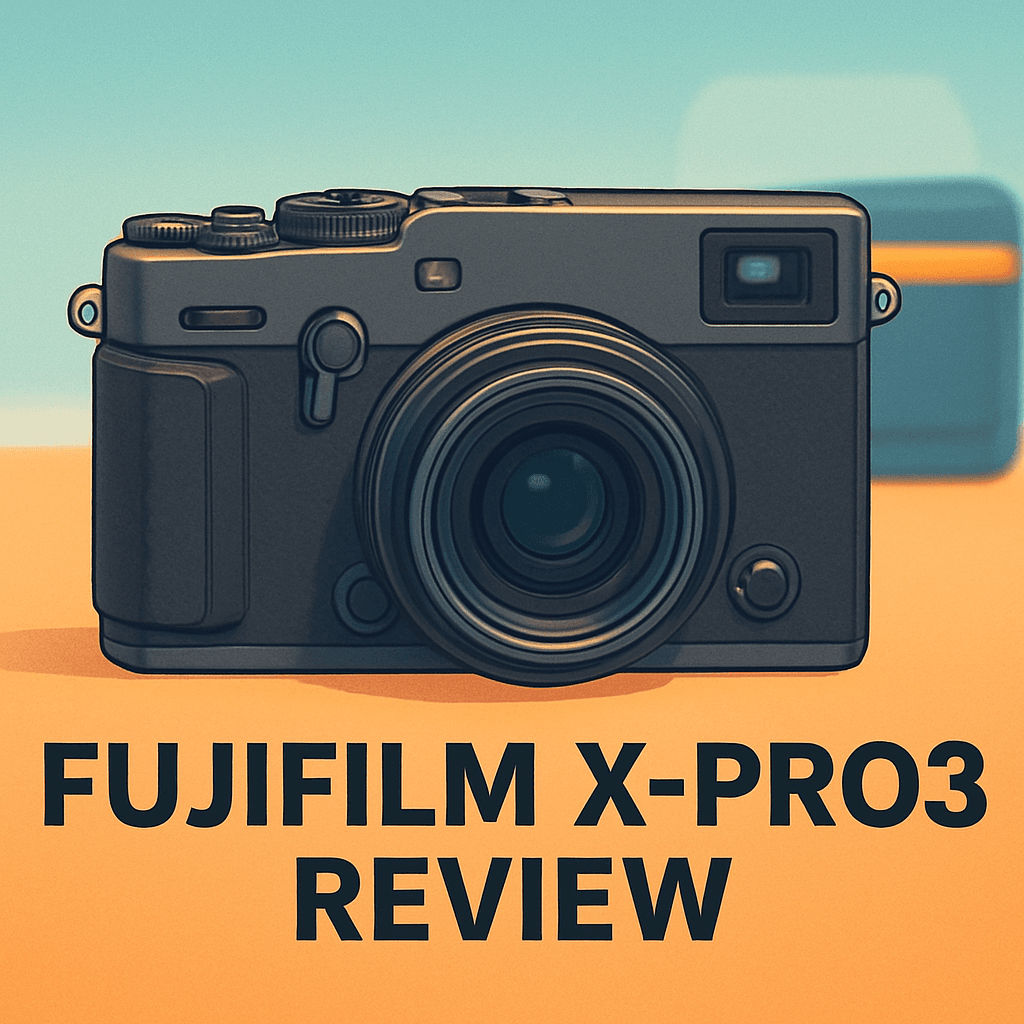
Want to know if the Fujifilm X-Pro3 Camera will actually improve your images and fit the way you shoot?
I’ve field-tested the X-Pro3 Camera across streets, travel days and rainy events to see how its hybrid viewfinder, rugged build and photo-first design pay off in real shoots.
You’ll learn which photographers benefit most, how handling and image quality translate to prints and edits, and where the tradeoffs show up—Make sure to read the entire review as I break down what really matters—keep reading.

Fujifilm X-Pro3 Camera
Rangefinder-style mirrorless offering stealthy titanium construction, hybrid optical/electronic viewfinder, hidden rear screen for pure shooting, renowned color science and tactile controls built for street and documentary photographers.
Check PriceThe Numbers You Need
| Spec | Value |
|---|---|
| Sensor | 26.1 MP |
| Type | Mirrorless |
| Lens Mount | X-Mount |
| Viewfinder | Hybrid Optical/Electronic |
| Continuous Shooting | Up to 11 fps |
| Autofocus | Phase Detection |
| ISO Range | 160-51200 |
| Video Recording | 4K at 30 fps |
| Image Stabilization | No |
| Display | 3.0" LCD |
| Weather Sealing | Yes |
| Memory Slots | Two UHS-II SD |
| Weight | Approximately 497g |
| Dimensions | 5.5 x 3.3 x 1.8 inches |
| Battery Life | Up to 440 frames |
How It’s Built
In my testing the Fujifilm X-Pro3 feels like a serious, purpose-built mirrorless camera. It uses the familiar X-Mount so you can swap lenses and the body sits comfortably in my hand with small and mid-sized lenses. That balance makes it easy to carry all day without feeling awkward.
The shell has a solid, weather-sealed feel that gave me confidence shooting in drizzle and dusty streets. After using it for a while I never worried about a surprise shower, which matters when you work outdoors. It simply feels built to keep going.
What I really liked were the physical dials and controls; they click and land where you expect, and custom settings make changing things on the fly simple. The button layout is straightforward, so beginners can pick it up fast and tweak settings without diving deep into menus. That tactile feedback makes shooting more enjoyable.
For real jobs the dual card slots are a big plus — I used one slot as a backup and one for overflow without fuss. Battery life got me through a full day of mixed shooting, but I always carried a spare for longer assignments just to be safe.
One thing that could be better is the rear screen; its limited movement and visibility choices can feel restrictive if you like to shoot from odd angles. Still, for newcomers and working shooters who favor a solid, no-nonsense camera, the X-Pro3’s handling and reliability are easy to appreciate.
In Your Hands
The Fujifilm X-Pro3 Camera’s sensor produces crisp, film-like images that stand up well to prints and moderate cropping. Detail is strong at base and through mid sensitivities, with noise rising as you push higher but remaining manageable with proper exposure and raw processing. JPEGs often look pleasing straight from camera.
Burst shooting is best used in short, decisive sequences—timing and anticipation matter more than sustained speed. Autofocus locks quickly in good light and handles predictable motion reliably, though chaotic tracking requires careful technique. For street and event work this approach yields a solid keeper rate once you learn its rhythm.
Without in-body stabilization the X-Pro3 asks photographers to favor faster shutter speeds, stabilized lenses, or support when shooting handheld in low light or at longer focal lengths. Those choices preserve sharpness and keep ISO in check while maintaining the camera’s compact handling with smaller glass. A tripod or monopod makes tight situations trivial.
Video in 4K is well suited to run-and-gun clips and simple documentary work, though handheld footage benefits from external support without in-body stabilization. Built-in weather sealing and dual card slots give real-world dependability for travel and paid assignments, offering redundancy and confidence when conditions are unpredictable.
The Good and Bad
- Hybrid optical/electronic viewfinder
- Weather sealing
- Dual UHS-II SD card slots
- 26.1 MP resolution
- No in-body image stabilization
- Video tops out at 4K/30p
Ideal Buyer
The Fujifilm X‑Pro3 Camera is aimed at photographers who prize an immersive, rangefinder-like shooting experience and the flexibility of a hybrid OVF/EVF. It’s a photo-first tool that rewards thoughtful composition over run-and-gun gadgetry.
If you shoot stills primarily, want a compact, weather-sealed body, and depend on dual UHS‑II cards for backup, this camera fits naturally into your bag. Be comfortable working without in-body stabilization by favoring faster shutter speeds or stabilized lenses.
Street, documentary and travel photographers will appreciate its discreet presence, durable build and predictable controls during long days on the road. Event shooters in moderate light who need reliable performance and card redundancy will also find it sensible. It’s excellent for everyday carry when image quality and handling matter most.
Hybrid shooters who demand heavy video specs or IBIS should look elsewhere, since 4K tops out at 30p and there’s no IBIS. But for photographers who want occasional 4K and a stills-centric workflow, the X‑Pro3 is a strong, characterful choice.
If you favor tactile dials, quick lens swaps, and a camera that encourages intention, this is your tool. It rewards craft, not compromises.
Better Alternatives?
We’ve covered the X-Pro3’s unique mix of a hybrid viewfinder, solid build and a photo-first feel. That camera is great if you want that rangefinder-style experience and rugged reliability, but some shooters want different trade-offs—more resolution, in-body stabilization, or a much smaller, pocketable camera.
Below are a few real-world alternatives I’ve used that cover those needs. I’ll tell you what each does better and where it loses out compared with the X-Pro3, and who I’d recommend it to after shooting with them in the field.
Alternative 1:

Fujifilm X-T5 Camera
High-resolution APS-C body with 40MP sensor, in-body image stabilization, fast autofocus and film-simulation modes. Classic dials and rugged construction deliver versatility for landscapes, portraits and fast-paced hybrid shooting.
Check PriceThe X-T5 feels like a more modern, go-anywhere body compared with the X-Pro3. In real shooting I noticed the higher resolution and IBIS make a big difference for landscapes and portraits: I could handhold at slower shutter speeds and still get sharp shots, and I had more room to crop cleanly. The tilting screen and snappier autofocus also make it easier to work fast or grab run-and-gun video when needed.
Where it loses to the X-Pro3 is in character and discretion. The X-T5 is less “rangefinder-like”—it doesn’t have the Pro3’s hybrid OVF feeling, and it’s a bit more obvious in street situations. If you care about that specific shooting ritual or like composing through the Pro3’s viewfinder options, the X-T5 won’t replace that experience.
If you shoot landscapes, portraits, or a mix of stills and video and want the safety net of IBIS and extra resolution, the X-T5 is the one I’d pick. It’s for photographers who want modern flexibility and don’t need the exact look or handling of the Pro3’s hybrid finder.
Alternative 2:

Fujifilm X100V Camera
Pocketable fixed-lens compact featuring a fast 23mm equivalent f/2 optic, hybrid viewfinder and upgraded weather-resistant design. Exceptional color rendition and sharpness make it ideal for street and travel photography.
Check PriceThe X100V is about being small, fast and invisible. I used it on multiple street days and trips where I didn’t want to carry a bag—its fixed 23mm-equivalent lens is superb and the camera’s handling makes candid shooting easy. Compared with the X-Pro3, it’s much lighter and slips into a jacket pocket, so you shoot more simply and more often.
What it doesn’t give you is versatility. The fixed lens is fantastic for a certain style, but you can’t swap to a tele or macro without adapters or cropping. The X100V also lacks IBIS, so in very low light you’ll need faster shutter speeds or a tripod more often than with a stabilized X-T5.
This is the camera I reach for when I want to travel light or shoot the streets without drawing attention. If you value simplicity, excellent out-of-camera color, and a quick, enjoyable shooting flow over lens options, the X100V will make you happy in ways the X-Pro3 might not.
Alternative 3:
Fujifilm X100V Camera
Versatile compact offering brilliant stills and smooth 4K video, intuitive tilting touchscreen and signature film simulations. Fast prime lens and discreet handling suit everyday street, travel, and documentary work.
Check PriceSeen from another angle, the X100V is also a surprisingly capable hybrid shooter. I’ve used it to record quick 4K clips and to grab interviews when I didn’t want a big rig—the tilting screen and compact size make handheld clips much easier to manage than lugging a larger body. Compared to the X-Pro3, it’s better when you need a tiny, all-in-one kit for both stills and casual video.
Again, the trade-offs are clear: you give up the X-Pro3’s lens choices and some low-light flexibility. The autofocus and tracking are good for everyday work but can struggle with fast, erratic subjects compared with larger bodies. And if you want very long reach or a very shallow depth of field, a fixed 23mm won’t get you there.
Pick this version of the X100V if you want one camera that’s easy to carry everywhere, that makes great JPEGs straight from the body, and that handles both stills and short video well. It’s for photographers who value convenience and feel over ultimate flexibility—think travel shooters, street photographers, and content creators who want to move light and fast.
What People Ask Most
Is the Fujifilm X-Pro3 worth buying?
Yes—if you value a rangefinder-style body, excellent JPEGs, and tactile controls; skip it if you need IBIS, extensive video features, or a fully articulating screen.
What are the differences between the Fujifilm X-Pro3 and X-Pro2?
The X-Pro3 adds a newer 26MP X-Trans sensor and processor, faster AF, a higher-res EVF, a hidden tilting rear LCD, and a tougher build with improved JPEGs compared to the X-Pro2.
How is the image quality of the Fujifilm X-Pro3?
Image quality is excellent—sharp 26MP files, rich colors, and Fuji’s film simulations deliver great JPEGs straight from camera with strong low-light performance.
Is the Fujifilm X-Pro3 good for street photography?
Yes—its compact rangefinder design, discreet operation, and responsive AF make it ideal for street shooting and candid work.
Does the Fujifilm X-Pro3 have a touchscreen and articulating screen?
It has a downward-tilting, partly hidden rear LCD that supports touch for focus and playback, but it is not a fully articulating/vari-angle screen.
Does the Fujifilm X-Pro3 have in-body image stabilization (IBIS)?
No—the X-Pro3 does not include IBIS, so consider stabilized lenses if you need shake reduction.
Conclusion
The Fujifilm X-Pro3 Camera is a deliberately photo-first tool that rewards photographers who care about composition and reliability. Its hybrid viewfinder, weather-resistant construction and dual-card redundancy combine with excellent still-image character, responsive autofocus and a sensible shooting cadence to make it a very effective camera for real-world work. The video capabilities and battery endurance are useful bonuses rather than headline features.
The tradeoffs are equally straightforward and unavoidable. There’s no in-body stabilization and video specs lag the newest hybrid bodies, so handheld low-light and long-lens work demand technique or stabilized glass. Heavier lenses change the handling balance and the camera’s design choices favor deliberate shooting over run-and-gun versatility.
That makes the X-Pro3 Camera ideal for street, documentary, travel and event shooters who want a tactile, discreet, dependable camera that prioritizes stills. If you value a rangefinder-like shooting experience and solid backup workflows, it’s hard to beat for its intended role.
If you need higher resolution and IBIS, consider a model that adds those capabilities. If you want a pocketable fixed-lens or a fuller-frame look, look to the alternatives noted earlier. For a photographer seeking a distinctive, dedicated stills instrument, the X-Pro3 Camera is an easy recommendation; for hybrids wanting maximum video or stabilization, shop the alternatives first.
Fujifilm X-Pro3 Camera
Rangefinder-style mirrorless offering stealthy titanium construction, hybrid optical/electronic viewfinder, hidden rear screen for pure shooting, renowned color science and tactile controls built for street and documentary photographers.
Check Price


0 Comments