
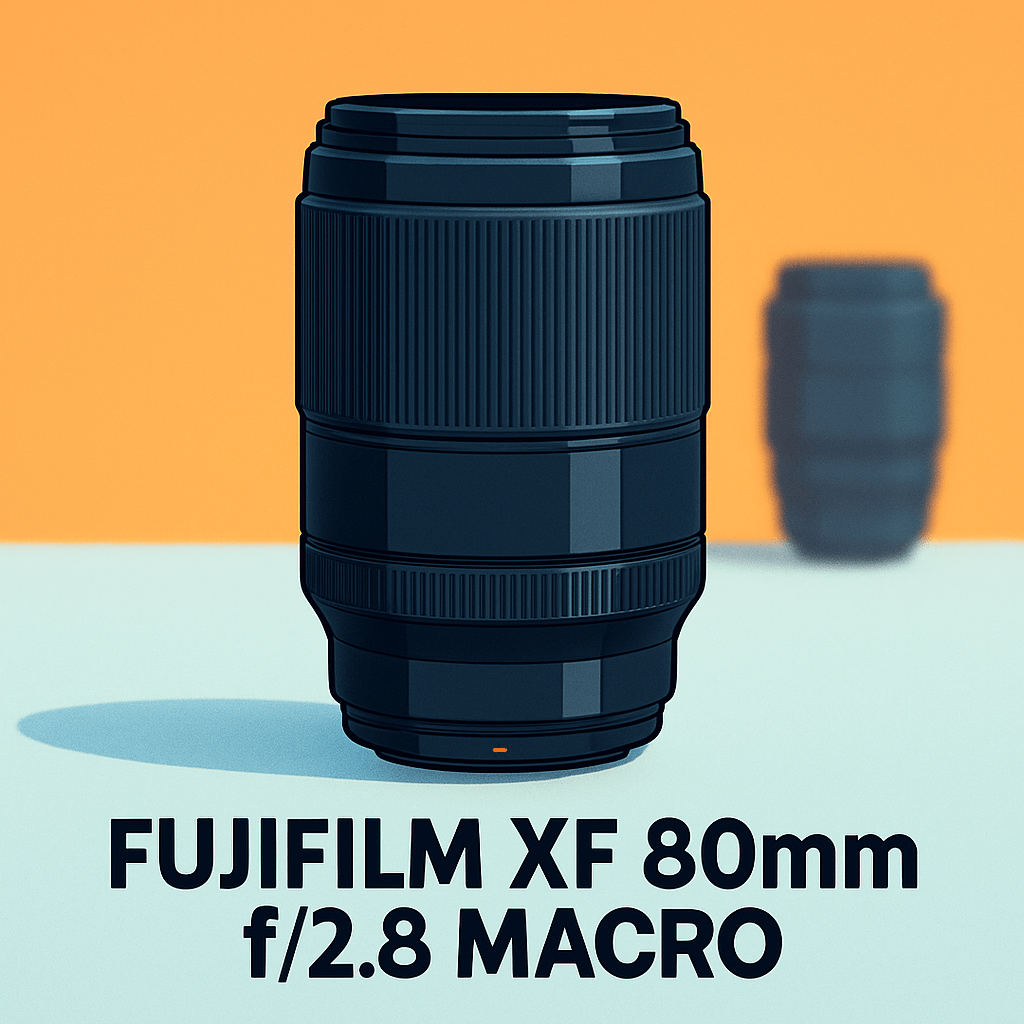
Want to make tiny subjects look epic without lugging a studio setup? If you’re shooting Fujifilm X, the Fujifilm XF 80mm f/2.8 Macro promises stabilized, weather-resistant, life-size close-ups that translate to real-world images.
I’ve field-tested it across humid meadows and rainy city shoots, so you’ll get practical takeaways rather than spec sheets. You’ll see how 1:1 magnification, in-lens stabilization, and rugged build matter when subjects won’t cooperate.
This one’s for macro specialists and field shooters who value true life-size reproduction, steadier handheld frames, and weather sealing over pure pocketability. You’ll care most about working distance, reliable autofocus, and durability when the conditions get real.
I’ll walk through handling, optics, autofocus behavior, and how it stacks up against popular rivals with sample images and usable tips — Make sure to read the entire review as…

Fujifilm XF 80mm f/2.8 Macro
Premium 80mm macro delivers life-size close-ups, stunning edge-to-edge sharpness and creamy background separation. Smooth autofocus and stabilization ensure handheld shooting confidence for portraits, product, and nature detail work.
Check PriceThe Numbers You Need
| Spec | Value |
|---|---|
| Focal length | 80mm |
| Maximum aperture | f/2.8 |
| Lens mount | Fujifilm X-mount |
| Image stabilization | Optical Image Stabilization (OIS) |
| Minimum focusing distance | 25 cm |
| Maximum magnification | 1:1 (life-size macro) |
| Weather resistance | Yes (WR – Weather Resistant) |
| Autofocus motor | Linear Motor (LM) |
| Lens construction | 15 elements in 12 groups |
| Diaphragm blades | 9 rounded |
| Filter diameter | 62 mm |
| Aperture range | f/2.8 to f/22 |
| Dimensions | Approx. 75 mm diameter x 130 mm length |
| Weight | Approx. 750 g |
| Compatible sensor format | APS-C (Fujifilm X-series) |
How It’s Built
In my testing the Fujifilm XF 80mm f/2.8 Macro feels like a purpose-built tool for X-series shooters. The X-mount integration is seamless and the lens has a reassuringly solid, weather-sealed finish that makes me comfortable shooting outdoors. That means you can chase insects or misty flowers without freaking out about a light shower.
What I liked most was the in-lens stabilization paired with the sealed build—handheld close-ups became much less fussy than I expected. The rounded diaphragm really helps render pleasing out-of-focus areas, so subjects pop against soft backgrounds. For beginners, that translates to nicer-looking shots with less fiddling.
Handling is honest: the focus ring is smooth and the autofocus motor feels quick and precise during my field work. What could be better is the overall bulk; it’s noticeably heavier and a bit front-heavy on smaller bodies, so plan for a supportive strap or occasional tripod on long shoots. Carrying it all day is doable, but not feather-light.
I also appreciated the common filter compatibility for polarizers and macro lights during my tests. In short, this lens is built for serious close-up work—robust and stabilized—just expect a bit more weight in your bag.
In Your Hands
As a dedicated macro prime, the Fujifilm XF 80mm f/2.8 Macro delivers true life‑size reproduction that lets you fill the frame with tiny subjects and reveal textures you’d otherwise miss. Its relatively short working distance means you can get intimate with flowers, insects, and surface details, but you’ll want to be mindful of lighting and subject disturbance when composing at those close ranges.
Optical stabilization makes a real difference for handheld close‑ups, letting you squeeze usable shots from slower shutter speeds during quick field sessions. For critical 1:1 work or moving subjects, however, a tripod and deliberate lighting or flash will yield the sharpest, most repeatable results.
The weather‑resistant construction invites use in damp meadows and windy coastal spots without second guessing, and the lens mates well with Fujifilm X bodies—feeling balanced though noticeably more substantial than the smallest primes. That additional heft gives confidence on a gimbal or tripod but is worth planning for on longer hikes.
Depth of field is always the story in macro: you’ll often stop down to expand focus, which pushes choices around shutter speed and ISO or necessitates flash and focus stacking. The lens also plays nicely outside strict macro work, producing tight selective‑focus detail shots when you want to isolate a subject with pleasing out‑of‑focus rendering.
The Good and Bad
- True 1:1 (life-size) magnification for dedicated macro
- Optical Image Stabilization (OIS) for handheld shooting
- Weather Resistant (WR) construction for outdoor reliability
- Linear Motor (LM) autofocus for precise focusing
- Size and weight (approx. 130 mm length, 750 g) add bulk to a compact X-system kit
- 62 mm filter size may require dedicated macro lighting/filters if users don’t already own this thread size
Ideal Buyer
The Fujifilm XF 80mm f/2.8 Macro is for photographers who put field-ready 1:1 reproduction ahead of pocketability. If you chase tiny details—flowers, insects, product textures—and need to shoot in breeze or drizzle, the in-lens OIS and WR construction were made with you in mind. It’s a tool for committed close-up work, not casual snapping.
X-mount shooters who want native autofocus convenience and stabilized handheld performance will find the lens especially appealing. Use it for mixed assignments where you switch between deliberate macro framing and quicker selective-focus detail shots. The linear-motor AF and 1:1 magnification keep workflow fast when timing matters.
This is also for shooters who accept a bit more heft in exchange for reliability and capability. At roughly 750 grams and a longer profile it balances well on mid-sized X bodies and gives you confidence in tough conditions. Expect longer sessions when you carry it, but fewer limits on what you can capture.
Not ideal? If your priority is the smallest, lightest kit or extreme magnifications beyond 1:1 without adapters, look elsewhere. Lighter 60mm options or 2:1 specialist macros suit travel or tower-stacked studio work better. Choose the XF 80mm when stabilization, weather-sealing and true life-size capture are non-negotiable.
Better Alternatives?
We’ve already gone through the XF 80mm f/2.8 Macro and what makes it a go-to for Fujifilm shooters who want a solid, weather‑resistant 1:1 macro with in-lens stabilization. It’s a great, practical tool for field work — but no single lens fits every need or budget.
Below are a few real-world alternatives I’ve used. I’ll point out what each one does better or worse than the XF 80, and which kind of shooter is likely to prefer it.
Alternative 1:

Fujifilm XF 60mm f/2.4 Macro
Compact short-telephoto excels at close-up and everyday shooting, offering crisp micro-detail reproduction, pleasing bokeh and lightweight handling—ideal for table-top, floral, and casual portraiture with subtle compression.
Check PriceI’ve used the XF 60mm a lot when I wanted something small and light to carry all day. Compared to the 80mm it’s easier on the bag and quicker to shoot with on a mirrorless body. Optically it gives very nice detail and pretty out-of-focus background when you’re not at extreme close distances. It’s a much better choice if you want a lens that doubles as a short portrait lens and a casual macro tool.
Where it loses to the XF 80mm is in close-up power and field toughness. The 60mm only reaches about half life‑size without accessories, so you need extension tubes or close-up gear to get that true 1:1 framing. It also lacks the in-lens stabilization and the weather sealing of the 80mm, so I’m less confident using it in wind, rain, or on long handheld macro sessions.
Pick the 60mm if you want a light, wallet-friendly lens that’s handy for table-top shots, flowers, and portraits. It’s for shooters who value portability and a general-purpose lens more than the rugged, stabilized 1:1 performance of the XF 80.
Alternative 2:

Venus Optics Laowa 65mm f/2.8 2X Ultra Macro APO Fujifilm X
Specialized ultra-macro reaches 2:1 magnification for extreme close-ups, paired with apochromatic optics to minimize color fringing and deliver astonishing micro-detail for insects, textures, and precision product photography.
Check PriceThe Laowa 65mm 2× is a different animal. I’ve used it for tiny subjects and for focus stacking work where every millimeter of detail matters. It out-resolves the XF 80 when you want insane magnification — 2:1 means you can shoot textures, insect eyes, or tiny electronics with detail you won’t get from the 80mm. The APO elements also cut down on purple/green fringes on high-contrast edges, which helped in my macro stacks.
What it gives up is convenience. The Laowa is manual focus only, has no stabilization, and it’s not weather sealed. In the field that makes it harder to use on live insects or handheld runs; I found myself on a tripod with controlled lights far more often with the Laowa. The working distance at high magnification is very short, so lighting and avoiding spooking subjects are real challenges.
This one is for the specialist: product shooters, scientists, or macro hobbyists who want more than 1:1 and are comfortable working on a tripod, using focus stacking, and controlling light. If you need extreme detail rather than fast AF or rugged weather performance, the Laowa delivers.
Alternative 3:
Venus Optics Laowa 65mm f/2.8 2X Ultra Macro APO Fujifilm X
Compact 65mm optic combines true 2x reproduction and razor-sharp APO elements, enabling handheld exploration of tiny subjects with smooth manual focus action and unmatched resolution for scientific and creative macro work.
Check PriceI’ll repeat a few hands-on notes because this lens can behave very differently depending on how you use it. In tighter studio setups it’s a monster for detail; out in the field it can still be used handheld for short sessions, but you give up the steadying help of OIS and the speed of autofocus you get with the XF 80. When I tried handheld shots at lower magnifications the Laowa was fine, but I switched to a tripod as soon as I pushed toward 2×.
Compared to the Fujifilm 80mm, the Laowa’s strengths are pure detail and magnification. Its weaknesses are workflow—manual focus, difficult lighting setup, and the lack of weather sealing or stabilization. I found it brilliant for controlled creative work and less suited to quick, on-the-go nature shots where the 80mm’s OIS and WR kept me shooting through imperfect conditions.
Choose this Laowa variant if your priority is maximum resolution and magnification for creative or scientific macros and you don’t need AF or in-lens stabilization. If you plan to shoot handheld or need weather toughness and quick AF, stick with the XF 80 instead.
What People Ask Most
Is the Fujifilm XF 80mm f/2.8 Macro a true 1:1 macro lens?
Yes — it delivers a true 1:1 (life-size) reproduction ratio for full-size macro detail.
What is the minimum focus distance and working distance of the Fujifilm XF 80mm f/2.8 Macro?
The minimum focus distance is about 0.25 meters (25 cm) to the sensor plane, and the working distance from the front of the lens to the subject is only a few centimeters, so you’ll be fairly close to your subject.
Does the Fujifilm XF 80mm f/2.8 Macro have image stabilization?
Yes — it features built-in Optical Image Stabilization (OIS) to help with hand-held macro and low-light shots.
Is the Fujifilm XF 80mm f/2.8 Macro weather-sealed?
Yes — the lens is weather-resistant, with seals to protect against dust and moisture for outdoor use.
Is the Fujifilm XF 80mm f/2.8 Macro good for portrait photography?
Yes — on APS-C Fujifilm bodies it behaves like a ~120mm equivalent, giving great compression and subject isolation for tight portraits and headshots.
How does the Fujifilm XF 80mm f/2.8 Macro compare to other macro lenses (e.g., 60mm or 90mm) for Fujifilm X series?
The 80mm balances reach and working distance better than the 60mm and offers OIS and weather sealing, while a longer 90mm-style macro gives more distance to subjects and slightly shallower depth of field but may lack Fujifilm’s combination of OIS/WR.
Conclusion
The Fujifilm XF 80mm f/2.8 Macro is the sort of lens that tells you what it’s built for: life-size close-ups with sensible stabilization and weatherproofing so you can work outside. It delivers the kind of confidence in the field that separates casual close-ups from professional macro work. Optically it rewards careful shooting with crisp, three-dimensional detail and a smooth rendering that complements tight compositions.
It isn’t a lightweight, pocketable option, and you will feel its presence on smaller bodies during long sessions. You trade compactness for a lens that stays steady handheld and keeps hunting at bay when you need the shot. For field shooters that added bulk buys real capability: reliable AF, in-lens stabilization and a weather-sealed build that reduces worry in changing conditions.
If your priority is a robust, stabilized 1:1 macro that behaves like a tool rather than a delicate studio specialist, this lens is an easy recommendation. If you prize minimal weight or extreme magnification over convenience, there are lighter or specialist alternatives to consider. For me the Fujifilm XF 80mm f/2.8 Macro is worth the compromise and earns its place in a serious X-system kit as a practical, dependable macro workhorse.
Fujifilm XF 80mm f/2.8 Macro
Premium 80mm macro delivers life-size close-ups, stunning edge-to-edge sharpness and creamy background separation. Smooth autofocus and stabilization ensure handheld shooting confidence for portraits, product, and nature detail work.
Check Price


0 Comments