
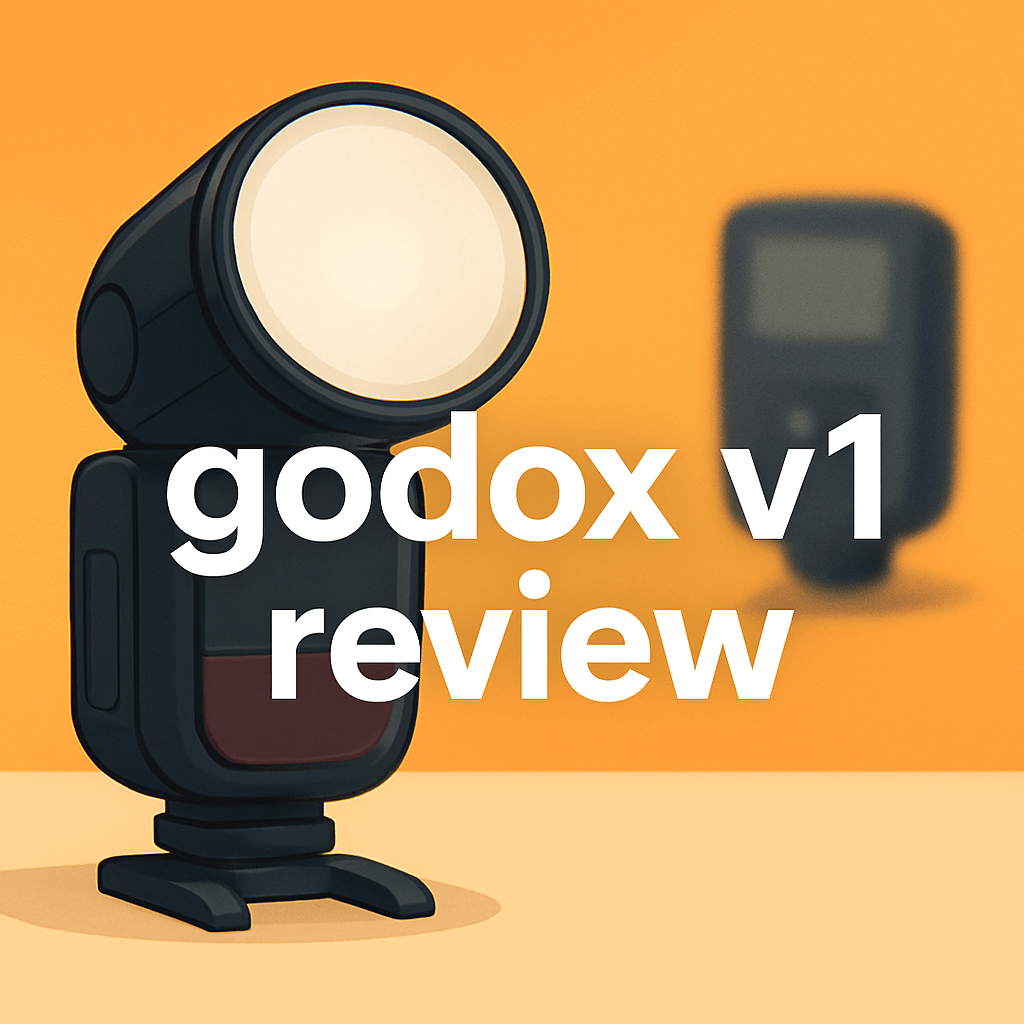
Want to make your on-camera flash look more natural and easier to use on portraits and events?
This godox v1 review is a hands-on, photographer-first look at the Godox V1 Flash—I’ve field-tested it on real shoots and paid attention to what matters in the field.
You’ll want the rest of this review if you care about round-head light that wraps nicely, magnetic modifiers that swap in seconds, HSS and TTL for tricky lighting, and a built-in 2.4GHz system that plays well off-camera across major mounts—keep reading.

Godox V1 Flash
Round-head monolight delivering soft, natural-looking light with powerful TTL, high-speed sync, and rapid recycle. Magnetic modifiers attach easily; portable lithium battery keeps shoots running all day.
Check PriceThe Numbers You Need
| Spec | Value |
|---|---|
| Flash Type | Round-head on-camera flash |
| Power Output | Guide Number 36 (ISO 100, 105mm) |
| Battery | Rechargeable lithium-ion |
| Wireless | Built-in 2.4GHz Godox X system |
| TTL | Yes, automatic exposure |
| HSS | Yes, up to 1/8000s |
| Recycle Time | Approx. 1.5 seconds |
| Color Temperature | Approx. 5500K |
| Tilt | Up to 90° |
| Rotation | 360° |
| Magnetic Mount | Yes, for modifiers |
| Modifier Compatibility | Magnetic filters, diffusers, softboxes |
| Flash Modes | Manual, TTL, Multi, Wireless Slave |
| Control | LCD screen, intuitive buttons |
| Compatibility | Canon, Nikon, Sony, Fuji, Olympus, Panasonic TTL systems |
How It’s Built
In my testing the Godox V1 Flash feels like a proper on-camera workhorse. The round head really changes the beam — light wraps softly around faces and the falloff is much more natural than boxy heads, which in practice means fewer harsh shadows and easier bounce.
The magnetic mount is the feature I loved most. I could slap on a diffuser or gel in a second during a reception, and it held firm through handheld movement, making modifier swaps painless.
The head pivots and spins so you can bounce in tight rooms without monkeying with stands; in my shoots that saved time and kept subjects comfortable. Controls are simple and the LCD is readable in dim venues, but the flash can feel a bit front-heavy with larger softboxes — something to watch if you shoot handheld all night.
Battery being a single rechargeable pack made power management predictable compared with juggling AAs; in my testing it meant fewer surprises mid-shoot. For beginners, the V1’s layout and quick modifier workflow make it easy to learn, and you’ll be swapping diffusers fast after a short practice.
In Your Hands
In the field the Godox V1 balances speed with flattering, round‑headed light and a compact footprint that won’t slow you down. TTL handles shifting exposures at receptions and run‑and‑gun location work, while Manual gives predictable control for portrait shaping. Multi is a fun, reliable tool for creative stroboscopic effects.
High‑speed sync opens daylight options—letting you use wide apertures and tame strong backlight—though you’ll trade some flash headroom when you engage it. In practice HSS rescued several sunlit backlit portraits and helped separate subjects from blown highlights on bright shoots.
TTL proved fast and consistent for event pacing, cutting the need to dial settings between frames and keeping guests in the moment. I still reach for Manual when skin tones or a specific mood need repeatable results, and the V1 responds cleanly in either workflow.
Output feels moderate: excellent for ceiling or wall bounce and close‑in direct fill, but in very large spaces you’ll manage placement, modifiers, or distance to maintain punch. The unit’s recycle cadence keeps up with wedding and reportage work, letting you capture quick interactions without lengthy waits.
Color comes out pleasantly neutral, so gels match ambient warmth predictably. The built‑in Godox radio simplifies one‑light off‑camera setups and the magnetic modifiers plus full tilt/rotation make swaps and bounce quick under pressure; field reliability held up through long receptions. Be sure to choose the V1 version that matches your camera system for full TTL support.
The Good and Bad
- Round head for pleasing beam pattern and natural wrap
- Magnetic mount for fast, flexible modifier workflow
- HSS up to 1/8000s for daylight control and wide-aperture shooting
- Built-in 2.4GHz Godox X system for off-camera integration
- GN 36 indicates moderate power; may require careful bounce strategy in large venues
- Specs provided do not cite weather sealing or advanced thermal details; manage expectations accordingly
Ideal Buyer
If you shoot weddings, receptions, or fast-paced events, the Godox V1 is built for your cadence. TTL and HSS up to 1/8000s keep exposures quick and predictable, which matters for backlit portraits and wide-aperture daylight control. The roughly 1.5‑second recycle and single‑pack lithium battery mean fewer interruptions on long days and faster sequences between moments and sets.
Portrait shooters who chase flattering, wraparound light will like the V1’s round head and soft falloff. Magnetic modifiers swap in seconds, letting you change diffusion, grids, or gels between setups with minimal fuss or delay. The 90° tilt and 360° rotation make bounce and off‑axis shaping fast, and the head’s balance keeps the camera comfortable for handheld work.
On‑location creators and hybrid shooters benefit from a compact flash that plays well both on and off the camera via Godox’s 2.4GHz X system. Choose your mount — Canon, Nikon, Sony, Fuji, Olympus, or Panasonic — and share modifiers and triggers across bodies. Multi‑system studios and freelancers will appreciate the cross‑brand availability and workflow speed, while those who need a massive guide number may look elsewhere.
Better Alternatives?
We’ve just gone through the Godox V1 review and covered why its round head, magnetic modifiers, TTL/HSS, and 2.4GHz system make it a favorite for portraits and events. That kit hits a great balance of soft light, quick modifier swaps, and affordable off-camera options.
If you’re still deciding, there are a few solid alternatives that trade some of the V1’s strengths for other real-world benefits — like tougher build, more reach, or a smaller footprint. Below are three flashes I’ve used in the field and how they compare to the V1.
Alternative 1:

Profoto A10 Flash
Pocket-sized strobe offering studio-grade output, precise TTL metering, and ultra-fast recycling. Built-in transmitter syncs seamlessly with compatible systems; durable build and intuitive controls for on-location professionals.
Check PriceIn real shoots the Profoto A10 feels more refined than the V1. The build and controls are very solid, and its TTL/flash-to-flash consistency is something I trusted on jobs where color and repeatability mattered — think boutique weddings or fashion shoots where every frame needs to match. The Profoto radio also talks to studio heads cleanly, so mixing on-camera and studio strobes is much simpler than with the V1.
What it does worse than the V1 is mostly cost and ecosystem flexibility. The A10 and Profoto accessories are pricey, and if you rely on speed and cheap magnetic modifiers like the V1’s system offers, you’ll miss that workflow. In day-to-day shooting the A10 also felt like it gives you fewer pops per charge compared to the V1’s battery in long event runs, so plan for spares on long days.
Buyers who will prefer the A10 are working pros who already use Profoto studio gear or who want rock-solid consistency and a premium feel. If you value reliability and simpler integration with studio lights over the V1’s bargain-friendly ecosystem and modifier speed, the A10 is worth it.
Alternative 2:

Metz mecablitz 64 AF-1 Flash
High guide-number performance provides exceptional reach and control with reliable TTL and high-speed sync. Swivel head, customizable flash profiles, robust battery life, and quick recycle meet demanding event and portrait needs.
Check PriceThe Metz 64 stands out in the field for one clear thing: power and reach. When I needed to light across a large hall or get a stronger punch for backlit scenes without cranking ISO, the Metz did that job with less climbing of ISO and fewer adjustments than the V1. It also feels solid and has dependable battery life, so it’s a workhorse at receptions and long events.
Where it falls short versus the V1 is the light quality and modifier workflow. The Metz has a more traditional rectangular head that throws a harder beam, so you’ll often reach for a softbox or big diffuser to get the same flattering wrap the V1’s round head gives you straight out of the box. It’s also larger and heavier on-camera, and there’s no quick magnetic modifier ecosystem — swaps take longer and need adapters.
If you’re an event or wedding shooter who needs raw power and long runtime more than fast modifier swaps, the Metz is a good fit. Pick it if you regularly shoot in big rooms, need extra reach, and don’t mind carrying a bit more weight or using traditional modifiers.
Alternative 3:

Metz 44 AF-1 Flash
Compact, versatile unit delivering punchy output with balanced color, autofocus-friendly sync, straightforward menus, and dependable battery performance—ideal for enthusiasts and wedding photographers needing portable power.
Check PriceThe Metz 44 is a compact, reliable flash that I liked for run-and-gun shooting. It gives a nice, punchy output and consistent color without fuss, and it’s lighter on the camera than the bigger Metz. For portraits and smaller receptions it performs very well and is easy to tuck into a bag as a backup or secondary light.
Compared to the V1, the 44 doesn’t deliver the same round-head wrap that makes skin tones look softer right away. You can get good results with diffusers, but you’ll spend more time shaping the light. It also lacks the V1’s magnetic modifier quick-swap convenience, so your workflow is a little slower if you like switching looks fast between frames.
This flash is best for enthusiasts and photographers who want a portable, dependable unit without spending top-dollar. If you want simple power, good color, and a smaller package — and you don’t need the V1’s magnetic modifier speed or its exact round-head look — the Metz 44 is a sensible, budget-friendly choice.
What People Ask Most
Is the Godox V1 worth buying?
Yes — it offers a round-head, consistent light quality, TTL/HSS and a strong rechargeable battery at a much lower price than high-end brands, making it excellent value for portraits and events.
How does the Godox V1 compare to the Profoto A1?
It delivers a very similar round-light look and features for a fraction of the cost, though the Profoto A1 has slightly tighter build quality and color consistency if you need the absolute top-end system.
What is the battery life of the Godox V1?
Expect roughly 400–500 full-power pops per charge, and many more flashes at lower power, enough for a full day of shooting in most situations.
What is the guide number/power of the Godox V1?
The V1 has a guide number of about 28 meters (92 feet) at ISO 100 and 105mm, which is plenty for most on- and off-camera uses.
How fast is the recycle time on the Godox V1?
Recycle time is around 1.5 seconds at full power and nearly instantaneous at lower power settings.
Can the Godox V1 be used off-camera wirelessly with the Godox X system?
Yes — it has a built-in 2.4GHz Godox X radio and works reliably off-camera with TTL/HSS when paired with Godox triggers like the X1/XPro.
Conclusion
After extensive hands-on use, the Godox V1 Flash is a photographer’s tool that prioritizes pleasing light and fast workflow. The round head delivers flattering beam and falloff that makes skin tones look better straight out of camera. Magnetic modifiers and intuitive controls turn modifier swaps and adjustments into muscle memory.
On the job it feels purpose-built: TTL/HSS versatility and built‑in 2.4GHz integration let you move between on-camera, off-camera and high‑speed scenarios without breaking pace. The rechargeable battery and head articulation make bounce and run‑and‑gun shoots genuinely easier. Recycle cadence and control layout keep you in the moment rather than wrestling gear.
This is not a brute‑force unit — it favors portability, predictability and modifier flexibility over outright reach. That tradeoff is exactly what event, wedding and portrait shooters need when speed and light quality trump throwing power. If you work mostly indoors or with close-to-midrange setups, the V1 is likely the smarter, more efficient choice.
Be mindful of ecosystem limits: plan a compatible trigger for master control and don’t expect unspecified features like weather sealing. Overall, the Godox V1 is a high‑value, field‑ready flash that earns a firm recommendation for photographers who value beautiful, fast-to-shape light without the premium price.
Godox V1 Flash
Round-head monolight delivering soft, natural-looking light with powerful TTL, high-speed sync, and rapid recycle. Magnetic modifiers attach easily; portable lithium battery keeps shoots running all day.
Check Price


0 Comments