
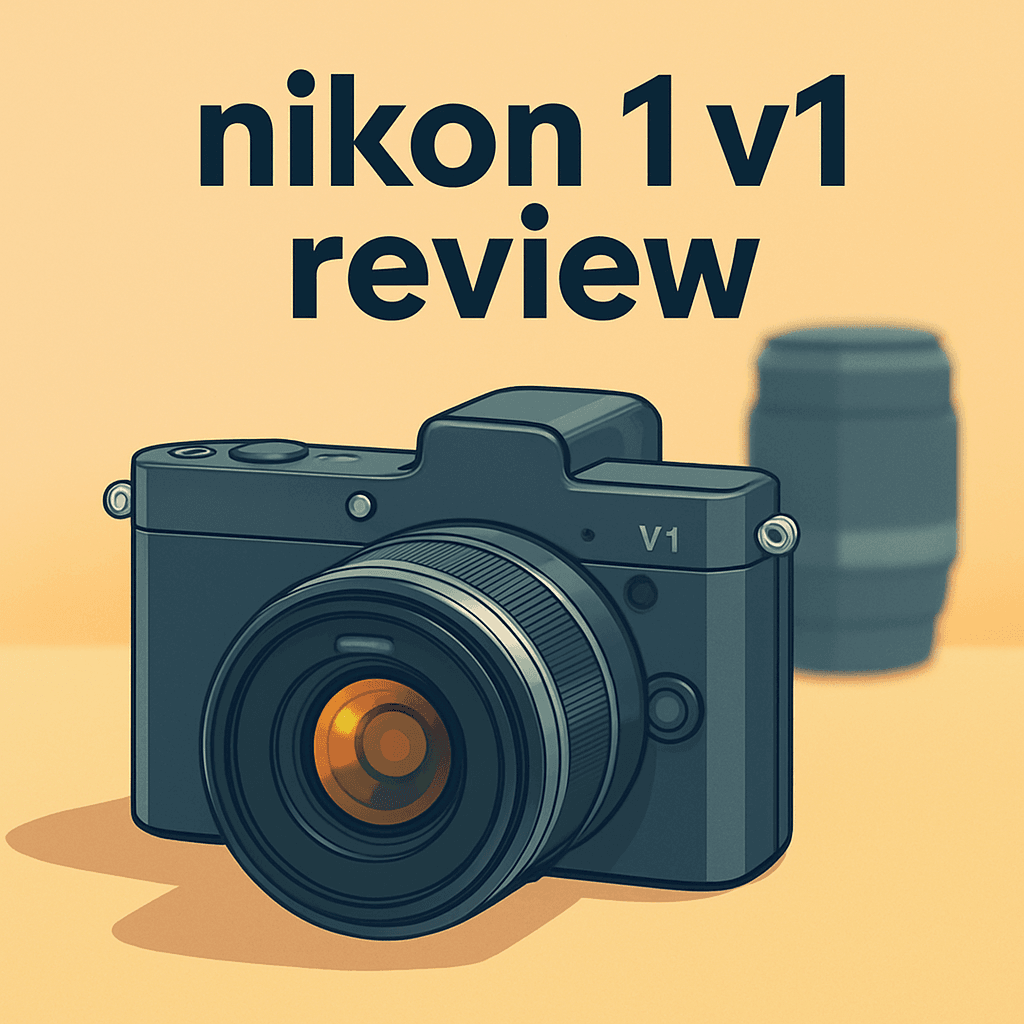
Want a compact camera that can actually catch fast action without a DSLR’s bulk? I’ve field-tested the Nikon 1 V1 across shoots and it’s shown what to expect in real light.
It pairs hybrid autofocus with an integrated electronic viewfinder, ultra-fast burst options and Full HD video in a pocketable body. Those features translate to real-world speed and framing benefits.
If you shoot sports, street, travel or candid events and you value speed and an EVF over big-sensor low-light performance, this one’s aimed at you. It’ll keep your kit light and nimble.
There are trade-offs though: the smaller sensor means less high‑ISO headroom, there’s no built‑in flash and the fastest burst modes impose focus limits. Those realities shape how you’ll use the camera day to day.
I’ll focus on hands-on outcomes — handling, keeper rates and when the V1 truly shines versus where it stumbles. Make sure to read the entire review as I break it down.

Nikon 1 V1 Camera
Compact, high-speed hybrid offering lightning-fast autofocus, rapid continuous shooting and a bright electronic viewfinder; delivers crisp raw files and responsive handling, ideal for action, travel, and candid street photography.
Check PriceThe Numbers You Need
| Spec | Value |
|---|---|
| Sensor | 10.1 MP |
| Sensor size | CX-format (13.2 x 8.8 mm) |
| Lens mount | Nikon 1 |
| Viewfinder | Integrated electronic |
| LCD | 3.0", approx. 921k dots |
| Autofocus | Hybrid (phase & contrast), 135 AF points |
| Continuous drive | Up to 10 fps (fixed AF); 60 fps (fixed focus) |
| Mechanical shutter speeds | 1/4000 to 30 s |
| ISO | 100–3200, expandable to 6400 |
| Video | Full HD 1080p at 60i / 30p |
| Audio | Built-in stereo mic; external stereo mic input |
| Flash | No built-in flash; accessory shoe compatible |
| Storage | SD / SDHC / SDXC |
| Dimensions | 113 x 76 x 44 mm |
| Weight (body only) | Approx. 294 g |
How It’s Built
In my testing the Nikon 1 V1 feels like a real pocket-friendly camera you won’t mind carrying all day. It’s small and light, so it disappears into a bag or hangs at your side during travel and street shoots. That makes staying ready for moments much easier in real life.
I found the balance with the smaller kit lenses to be very comfortable in-hand. Throw on a longer zoom and the front gets a bit heavy, but still manageable for short bursts. One thing I really liked was the built-in electronic viewfinder — it makes steady, eye-level framing a breeze outdoors.
The rear LCD is crisp and useful, though I did struggle with reflections in bright sun at times. In those situations the EVF saved the day for composition and focus confirmation. For beginners this means you can rely on the eye-level view when the screen gets washed out.
One downside is the lack of a built-in flash, so you’ll need an accessory on the shoe for fill or low-light snaps. In my shooting that meant planning ahead or embracing natural light; it’s not a dealbreaker but worth knowing before you go to an event.
After using it for a while I appreciated the compact design and dependable controls, but I wished the grip and buttons were a touch bigger for larger hands. For travel and candid work this body is a very friendly tool if you plan your lighting and lens choices.
In Your Hands
In the field the Nikon 1 V1 is all about speed: a responsive mechanical shutter and two burst approaches let you choose a focused AF-driven cadence for tracking or an ultra-fast fixed-focus option for explosive sequences. The AF burst is the keeper-maker for moving subjects, while the fixed-focus mode suits predictable distance scenarios. Matched to the scene, it nails sports, kids, and decisive street moments.
For run-and-gun work I rely on the AF burst and the hybrid AF’s quick lock in good light; for those split-second freezes I pre-focus and use the ultra-fast option with steady distance. Anticipation and pre-focusing noticeably raise keeper rates.
The camera’s smaller-format sensor prefers solid light—daylight and well-lit interiors give clean, crisp files, while low-light situations demand noise management and exposure discipline. Protect highlights and be conservative with shadows to preserve usable detail.
Video is practical for storytelling, rendering motion smoothly and offering usable onboard stereo audio, with an external mic input when sound quality matters. High-speed bursts can tax card throughput and the buffer, so shoot in short sequences and manage cards between runs. In workflows where speed is king, that discipline keeps captures flowing.
The Good and Bad
- Integrated electronic viewfinder for steady, eye-level composition
- Hybrid AF system with 135 AF points
- Extremely fast burst options: 10 fps (fixed AF), 60 fps (fixed focus)
- Compact and lightweight body
- No built-in flash (requires accessory for on-camera flash)
- Smaller CX-format sensor versus larger formats, affecting low-light performance and dynamic range expectations
Ideal Buyer
The Nikon 1 V1 is ideal for photographers who want pro-caliber speed in a tiny package. Its hybrid AF, 135 AF points and integrated EVF make it great for snappy subject acquisition and steady eye-level framing.
Think action shooters who value decisive moments over ultra-high resolution — sports club photographers, motorsport sidelines, dog and bird chasers, and street shooters who want minimal weight. The camera’s 10.1MP CX sensor still delivers clean files for web and modest prints when shot at base ISO. Fast burst modes let you capture fleeting sequences that larger, heavier rigs can’t follow as easily.
Buyers should be comfortable planning around the native ISO ceiling of 3200 and the smaller CX sensor’s limits in low light. There’s no built-in flash, so pack an accessory strobe for fill or learn to work with natural light. Video shooters will like the onboard stereo mic and external mic input for quick run-and-gun work.
The V1 isn’t the best choice for photographers who need deep high‑ISO headroom, built‑in flash convenience, or continuous AF tracking at the maximum frame rates. If you need wider dynamic range or a huge lens ecosystem, consider larger‑sensor alternatives.
Better Alternatives?
We’ve gone through what the Nikon 1 V1 does well — a compact body, a bright EVF, and those crazy-fast burst modes that make it great for action in good light. But that camera also brings trade-offs: the small CX sensor, limited high-ISO range, and the odd lens ecosystem mean some shooters will want something different depending on the job.
Below are three real-world alternatives I’ve used. I’ll point out what each one does better and where it falls short compared to the V1, and who I think would prefer each camera. I’ll keep this practical — how they feel and perform on shoots, not just spec lists.
Alternative 1:

Sony NEX-7 Camera
Professional-grade APS-C performance packed into a compact body, featuring high-resolution imaging, sharp OLED electronic viewfinder, customizable controls and fast, accurate autofocus—delivering studio-quality detail and exceptional low-light capability.
Check PriceI’ve shot landscapes and portraits with the NEX-7 and the first thing you notice is image quality — the APS-C sensor delivers richer files and cleaner high-ISO shots than the V1. In plain terms: you get more detail and nicer tones in low light, so you can push exposures harder without the noise becoming a problem. That makes it a better pick for travel, portraits, and scenes where you want to crop or print larger.
Where the NEX-7 loses to the V1 is in pure action speed and tiny package convenience. The V1’s burst modes and hybrid AF were designed for snatching quick sequences; the NEX-7 feels a little slower to lock on in the fastest moving sports moments. It’s also a bit bulkier in the hand and I found the hit rate on fast-moving subjects lower than the V1’s very specific high-speed modes.
Who should pick the NEX-7? If you want better image files, cleaner low-light performance, and a more traditional “photo-first” control layout, this is the one. It’s a good choice for enthusiasts who shoot people, travel, and landscapes more than nonstop action. If you need the absolute fastest frame rates in a tiny body, stick with the V1.
Alternative 2:

OM System E-M10 Mark IV Camera
Stylish, lightweight Micro Four Thirds camera with five-axis stabilization, responsive touchscreen, and refined image processing; offers a vast lens ecosystem, steady handheld shooting, and user-friendly controls perfect for travel and vlogging.
Check PriceI’ve used the E-M10 Mark IV a lot for travel and handheld video. The big practical win over the V1 is the in-body stabilization — five-axis IBIS makes low-light handheld shots much easier and lets me use slower shutters without blur. For run-and-gun travel, that stability changes how often I need a tripod, and video looks steadier straight out of camera.
On the downside versus the V1, the E-M10 Mark IV doesn’t match the V1’s unique ultra-fast burst behavior for slicing through a very fast action sequence. Its autofocus is quick for everyday subjects but you won’t get the same extreme high-frame capture pattern that the V1 offers. Also, while the E-M10’s image quality is generally very usable, the Micro Four Thirds sensor still sits between the tiny CX and larger APS-C files in character — better than the V1 in many real scenes, but not always as clean as APS-C bodies.
Who should buy the E-M10 Mark IV? If you shoot handheld a lot — travel, street, vloggers, or anyone who hates lugging tripods — this is a great pick. Choose it for steady photos and videos, easy handling, and a huge range of small lenses. If your priority is the fastest possible burst capture in bright light, the V1 still has the edge.
Alternative 3:
OM System E-M10 Mark IV Camera
Beginner-friendly yet capable, this compact system combines effective stabilization, swift autofocus, creative in-camera modes, and seamless wireless connectivity to quickly share striking images—an ideal upgrade for smartphone photographers and hobbyists.
Check PriceIn hands-on use as a camera for people upgrading from phones, the E-M10 Mark IV feels warmly familiar: easy menus, a nice touchscreen, and good automatic modes. Compared to the V1, it’s simpler to get nice-looking shots straight away and the wireless sharing options are more convenient when you want to post images quickly. The stabilization also helps novices avoid blurry photos when light gets low.
Where it falls short next to the V1 is the V1’s edge for action photographers who can squeeze out advantage from its hybrid AF and special burst modes. The E-M10 Mark IV’s autofocus is fast for everyday shooting, but it does not deliver the same series-capture strategy the V1 can in sports or wildlife bursts. You’ll trade a bit of speed for much easier handling and steadier handheld results.
Who is this for? If you’re a hobbyist or moving up from smartphone photography, the E-M10 Mark IV is a friendly, capable step. It’s ideal for people who want a compact camera that makes sharp, steady pictures with little fuss and who value Wi‑Fi and easy sharing. If you need razor-fast action frames and the smallest possible body, the Nikon 1 V1 still makes a strong case.
What People Ask Most
Is the Nikon 1 V1 worth buying?
If you want a compact, fast-shooting camera on a tight budget or secondhand deal, it can still be useful; if you need the best image quality or modern features, newer mirrorless cameras are a better buy.
How does the image quality of the Nikon 1 V1 compare to DSLRs and mirrorless cameras?
Its 1-inch sensor gives good-looking photos in good light but generally shows more noise and less dynamic range than APS-C or full-frame DSLRs/mirrorless cameras.
How good is the autofocus performance on the Nikon 1 V1?
The V1’s hybrid AF is very fast and snappy for its class, especially in good light and for action, but it can struggle more in low light compared with larger-sensor systems.
What are the pros and cons of the Nikon 1 V1 (Nikon 1 V1 review)?
Pros: compact body, very fast burst and autofocus, good ergonomics; Cons: smaller sensor with limited low-light performance, aging features and limited lens selection without adapters.
Is the Nikon 1 V1 compatible with Nikon F-mount lenses and adapters?
You can use Nikon F-mount lenses with the FT1 adapter, but expect reduced autofocus speed and some functional limitations compared with native Nikon 1 lenses.
What video recording capabilities and frame rates does the Nikon 1 V1 offer?
The V1 records full HD (1080) video plus higher-frame-rate and ultra-slow-motion modes at lower resolutions, making it flexible for standard video and creative slow-motion clips.
Conclusion
The Nikon 1 V1 is a rare, well‑executed niche camera: a compact, EVF‑equipped body that pairs a 135‑point hybrid AF with uniquely fast burst modes. In practice it delivers an immediacy for fast‑moving subjects that larger, slower systems simply don’t in the same pocketable package. If speed in a tiny package is your priority, the V1 earns its keep.
But that specialty comes with clear trade‑offs. The smaller CX sensor and conservative ISO ceiling temper low‑light performance and dynamic range, and the lack of a built‑in flash forces accessory dependence. High‑speed shooting also means choosing between fixed AF or fixed focus, so you must plan shots more than you might on other bodies.
Buy the V1 if you want ultra‑fast, grab‑and‑go action capture with a useful EVF and simple, clean video options. Pass if you need larger‑sensor image quality, in‑body stabilization, or continuous AF tracking at top frame rates. The alternatives listed deliver broader versatility for those needs.
In short, the V1 is a smart, opinionated tool for sports, street and travel photography in good light. It’s not a one‑camera‑for‑everything, but for shooters who prioritize speed, size and reliable eye‑level framing it’s hard to beat. Pick it when burst performance and portability outweigh high‑ISO headroom and flash convenience.
Nikon 1 V1 Camera
Compact, high-speed hybrid offering lightning-fast autofocus, rapid continuous shooting and a bright electronic viewfinder; delivers crisp raw files and responsive handling, ideal for action, travel, and candid street photography.
Check Price



0 Comments