
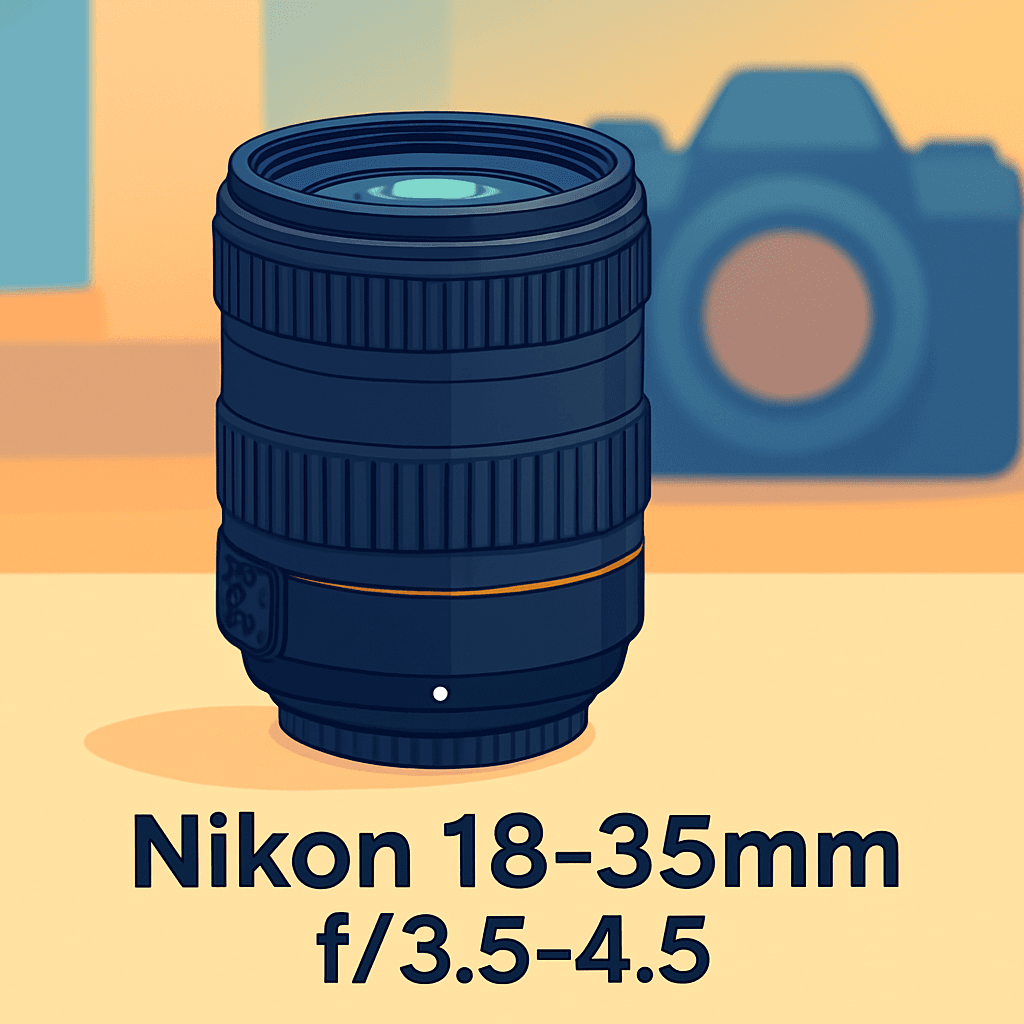
Wondering if an older Nikon wide-angle zoom can still be the lens you’ll reach for to improve your images?
I took the Nikon 18-35mm f/3.5-4.5D ED IF AF Nikkor on landscape, street and interior shoots to see how it behaves. It’s for Nikon F‑mount shooters wanting a practical full‑frame wide.
I’ll show what it actually delivers in the field and who should consider it. Make sure to read the entire review as the verdict might surprise you.

Nikon 18-35mm f/3.5-4.5D ED IF AF Nikkor
Lightweight, reliable wide-angle zoom for full-frame shooters, delivering crisp optics, fast autofocus, and excellent chromatic aberration control thanks to ED glass. Versatile for landscapes, architecture, and everyday use.
Check PriceThe Numbers You Need
| Spec | Value |
|---|---|
| Lens type | Zoom |
| Focal length | 18–35mm |
| Maximum aperture | f/3.5–4.5 |
| Lens mount | Nikon F mount |
| Lens format | FX / Full-frame compatible |
| Optical design | Includes ED (Extra-low Dispersion) glass elements |
| Internal focusing (IF) | Yes |
| Minimum focus distance | Approximately 0.28 m (28 cm) |
| Maximum magnification | About 1:5.3 |
| Filter size | 72 mm |
| Diaphragm blades | 7, rounded aperture |
| Dimensions (diameter × length) | Approx. 84 mm × 94 mm |
| Weight | Approximately 620 g |
| Focus drive | Screw-drive autofocus (no built-in motor) |
| Compatible camera types | Best on Nikon DSLRs with built-in AF motor (e.g., D7xxx, D90, D7000 series) |
How It’s Built
In my testing the Nikon 18-35 feels like a classic workhorse — not flashy, but solid and well put together. The mount gives a reassuring click and the barrel has a friendly heft that tells you it’s built to last. What that means for you is confidence when shooting in the field; it won’t feel toy-like in your hand.
I really liked the internal focusing. The lens doesn’t change length as you focus and the front element doesn’t twist, so using a polarizer or ND filter is easy and predictable. For beginners that removes one less thing to worry about when composing or balancing exposures.
The control layout is simple and intuitive in my use — zoom and focus rings are where you expect them and the zoom action is smooth enough for quick framing. The focus ring has a relatively short throw, which makes quick adjustments simple but less ideal for pixel-peeping close work. Carrying it on a mid-size Nikon felt balanced and not tiring for long walks.
One thing I’d change is adding better weather protection or a quieter focus mechanism. I found it dependable for landscapes and interiors, but in wet or dusty conditions I’d be a little cautious. Overall it’s an approachable lens that’s easy to learn on and reliable in real shooting situations.
In Your Hands
On the wide end this zoom becomes a go-to for dramatic landscapes, tight interiors and architecture where you want sweeping perspective without getting too close to subjects. In the mid-range it settles into a versatile travel and documentary tool that feels natural for street work and environmental storytelling. Toward the long end it handles environmental portraits and reportage with comfortable framing and a familiar, slightly wider-than-normal look.
The variable aperture means exposure changes as you zoom, so you learn to anticipate light shifts during a shoot; it won’t give the shallowest background blur but it does deliver practical subject separation when you position yourself. In low light you’ll lean more on higher ISO or steadier support at the long end, while wide-open settings excel for available-light interiors. Stopping down for landscapes tightens rendering and helps overall contrast.
Close-focusing ability lets you get in tight for detail and foreground interest that enrich landscapes and product-style shots, though it’s not a macro substitute. Because focus is internal, the lens maintains its balance and filter orientation when working close, which makes using a polarizer or neutral-density filter straightforward in the field. That steadiness also helps when composing on a tripod or shooting shallow scenes.
Autofocus is most reliable on bodies with an internal focus motor, where acquisition is competent if not ultra-rapid; on bodies without that motor you’ll switch to manual focus and rely on the smooth focusing ring. Flare and contrast hold up reasonably well with careful framing and a hood; keep it a touch more stopped down for edge-to-edge landscape work and don’t hesitate to use filters to control reflections and exposures on bright days.
The Good and Bad
- FX/full-frame compatibility
- Internal Focusing (benefits for handling and filter use)
- ED glass elements
- Manageable dimensions and weight for a full-frame wide zoom
- Screw-drive autofocus requires a Nikon body with an in-body AF motor for AF use
- Variable maximum aperture (f/3.5–4.5)
Ideal Buyer
The Nikon 18-35mm f/3.5-4.5D ED IF AF Nikkor is for Nikon shooters who use full-frame bodies and want a practical, no-nonsense wide-angle zoom. It suits photographers who value a compact FX-capable range without the extra bulk or price of modern pro zooms. It’s a lens for image-makers who prioritize handling and field performance over headline specs.
This lens really shines on Nikon bodies with an in-body AF motor — think D7xxx and D7000 series — where the screw-drive autofocus is serviceable and predictable. Owners of motorless entry-level bodies will still enjoy precise manual focus, but should expect no AF. The screw-drive can be audible in quiet situations, yet remains reliable for stills work.
Landscape, interior, and architectural shooters will appreciate the internal focusing, steady handling, and the common 72mm filter thread for polarizers and NDs. Travel photographers and environmental portraitists who need a compact wide-angle with near-macro capability to ~0.28 m will find the balance appealing. The ED glass rewards stopping down for mid-frame and corner performance on landscapes.
This isn’t the right lens if you demand a constant fast aperture, ultra-wide DX coverage, or the silent convenience of AF-S. If low-light speed or modern autofocus is critical, consider the Sigma 18–35mm f/1.8 or contemporary AF-S zooms that trade the 18–35D’s simplicity for greater speed and convenience.
Better Alternatives?
We’ve already gone through the Nikon 18-35mm f/3.5-4.5D ED IF AF Nikkor — what it does well and where it shows its age. If you liked its full-frame coverage and simple handling, that’s great; but many shooters ask whether there’s a better fit for very wide interiors, faster low-light work, or more modern autofocus on newer bodies.
Below I’ll walk through three practical alternatives I’ve used in the field. I’ll explain what each one does better and worse than the Nikon 18-35, and who would actually prefer each option in real shooting situations.
Alternative 1:

Nikon AF-S DX NIKKOR 10-24mm f/3.5-4.5G ED
Ultra-wide zoom designed for APS-C cameras, offering dramatic perspectives, consistent edge-to-edge sharpness, and smooth, quiet focusing. Ideal for interiors, expansive landscapes, and creative architectural compositions.
Check PriceI’ve used the 10-24mm on DX bodies for real estate and travel work — its strength is obvious: you can get much more in the frame at 10mm than you ever can with the 18mm on the Nikon 18-35. That makes it a go-to for tight interiors, dramatic architecture shots, and very wide landscape scenes where that extra field of view matters. It’s also AF-S, so it autofocuses on entry-level Nikon bodies that don’t have a screw-drive motor.
Compared to the Nikon 18-35mm f/3.5-4.5D ED IF AF Nikkor, the 10-24 does edges and interior spaces better simply because it’s wider. It’s not faster — it has the same f/3.5–4.5 class — and on a full-frame camera it isn’t usable without heavy vignetting, so you lose the 18-35’s FX compatibility. You’ll also see more barrel distortion at the widest end, though it’s easy to correct in RAW for most clients.
If you shoot on DX bodies and you photograph houses, interiors, tight city streets, or anything that benefits from an ultra-wide look, this is the better lens. If you need a full-frame wide zoom or want shallower depth of field in low light, stick with something like the 18-35 on an FX body or look at faster alternatives.
Alternative 2:

Sigma 18-35mm f/1.8 Art DC HSM Nikon
Bright constant-aperture zoom that delivers prime-like low-light performance and creamy bokeh. Robust construction with fast, accurate HSM focusing makes it a favorite for run-and-gun video, portraits, and low-light shooting.
Check PriceI’ve shot concerts, interviews, and street work with the Sigma 18-35 f/1.8 on Nikon bodies and it feels more like a set of fast primes in one barrel. The constant f/1.8 changes the game compared with the Nikon 18-35mm f/3.5-4.5D ED IF AF Nikkor — you can handhold at much lower light, get much softer backgrounds, and freeze motion better without pushing ISO.
In practice the Sigma is sharper and more contrasty in everyday shooting, especially when you want subject separation. The trade-offs are clear: it’s designed for APS-C bodies (so it’s a DX/“DC” lens), heavier, and more expensive. Unlike the Nikon 18-35, it won’t give you full-frame coverage, and it doesn’t have image stabilization, so you’ll still need to mind shutter speed when you’re stopped down.
Choose the Sigma if you shoot on DX cameras and want the look of fast primes without swapping glass — wedding shooters doing reception work, filmmakers needing shallow depth and low-light speed, or portrait shooters who want a natural wide-to-normal range will love it. If you need FX coverage or a lighter, simpler lens for landscapes, the Nikon 18-35 remains a solid pick.
Alternative 3:
Sigma 18-35mm f/1.8 Art DC HSM Nikon
Professional-grade APS-C zoom blending prime-like depth with versatile framing; an ultra-fast aperture provides subject separation and creative control while Art-series optics deliver outstanding contrast and edge-to-edge clarity.
Check PriceThe Sigma again, but looking at it from a different angle: when I used it for portraits and video, the smooth bokeh and fast aperture gave a look that the Nikon 18-35 simply can’t match. Where the Nikon is practical and light for full-frame landscapes and interiors, the Sigma gives you creative control — you can isolate subjects and shape backgrounds in ways the 18-35’s f/3.5–4.5 just won’t allow.
What it doesn’t do better is versatility for full-frame shooters. The Nikon 18-35mm f/3.5-4.5D ED IF AF Nikkor keeps working on FX bodies and is smaller to carry for long landscape days. The Sigma is a bit bulkier and focused on image quality and speed on DX — if your work needs full-frame edges or the lighter lens weight of the Nikon, that matters.
So pick this version of the Sigma if you’re an APS-C shooter who values image quality and low-light performance above all else — studio or on-location portrait shooters, indie filmmakers, and event photographers who want prime-like rendering from a zoom. If your kit is centered on full-frame cameras or you need the simpler AF-D ergonomics of the Nikon 18-35, then the original lens still makes more practical sense.
What People Ask Most
Is the Nikon 18-35mm f/3.5-4.5 a DX or FX lens?
It’s a DX lens made for Nikon crop-sensor cameras; you can mount it on FX bodies but you’ll usually get heavy vignetting or need to use crop mode.
How sharp is the Nikon 18-35mm f/3.5-4.5?
Center sharpness is decent for general use, but corners are softer wide open and it improves noticeably when stopped down to around f/5.6–8.
Does the Nikon 18-35mm f/3.5-4.5 have Vibration Reduction (VR) / image stabilization?
No, this lens does not include VR, so use faster shutter speeds or a tripod for low-light shots.
Is the Nikon 18-35mm f/3.5-4.5 good for landscape and architecture photography?
Yes on DX bodies it offers useful wide angles for landscapes and architecture, but expect to stop down for the best edge-to-edge sharpness and minimal distortion.
What is the 35mm equivalent focal length of the Nikon 18-35mm f/3.5-4.5 on crop-sensor cameras?
On Nikon DX (1.5x crop) it’s roughly equivalent to 27–52.5mm on full-frame.
Is the Nikon 18-35mm f/3.5-4.5 compatible with all Nikon DSLRs and will autofocus work?
It mounts on any Nikon F‑mount DSLR, but autofocus only works on bodies with an AF motor if the lens lacks a built-in motor; AF-S versions (with an internal motor) will autofocus on all Nikon DSLRs.
Conclusion
The Nikon 18-35mm f/3.5-4.5D ED IF AF Nikkor is the kind of lens that makes sense the moment you pick it up: straightforward, purposeful, and built around practical field use rather than headline-grabbing specs. In real shooting it rewards landscape and interior photographers with predictable handling and useful optical character, and the internal focusing keeps filters and balance behaving the way you expect. I appreciate its no-nonsense ergonomics and the way it lets you work quickly without fuss.
It isn’t without compromises, and those matter depending on how you shoot. The screw‑drive autofocus and variable aperture are reminders that this is an older design, so if you need the quiet quickness of modern AF systems or faster shutter-speed options in low light you’ll notice the limits. Sharpness and control are very good for many assignments but not quite on par with today’s specialty fast or ultra-wide zooms.
Bottom line: if you own a Nikon body with an in‑body motor and want a practical, full‑frame-capable wide zoom that handles predictably in the field, this lens is an honest, high‑value choice. If your priorities are ultra‑wide coverage, modern AF convenience, or the shallowest depth of field, consider one of the newer alternatives instead. For what it is, it delivers dependable value and solid real-world performance.
Nikon 18-35mm f/3.5-4.5D ED IF AF Nikkor
Lightweight, reliable wide-angle zoom for full-frame shooters, delivering crisp optics, fast autofocus, and excellent chromatic aberration control thanks to ED glass. Versatile for landscapes, architecture, and everyday use.
Check Price



0 Comments