
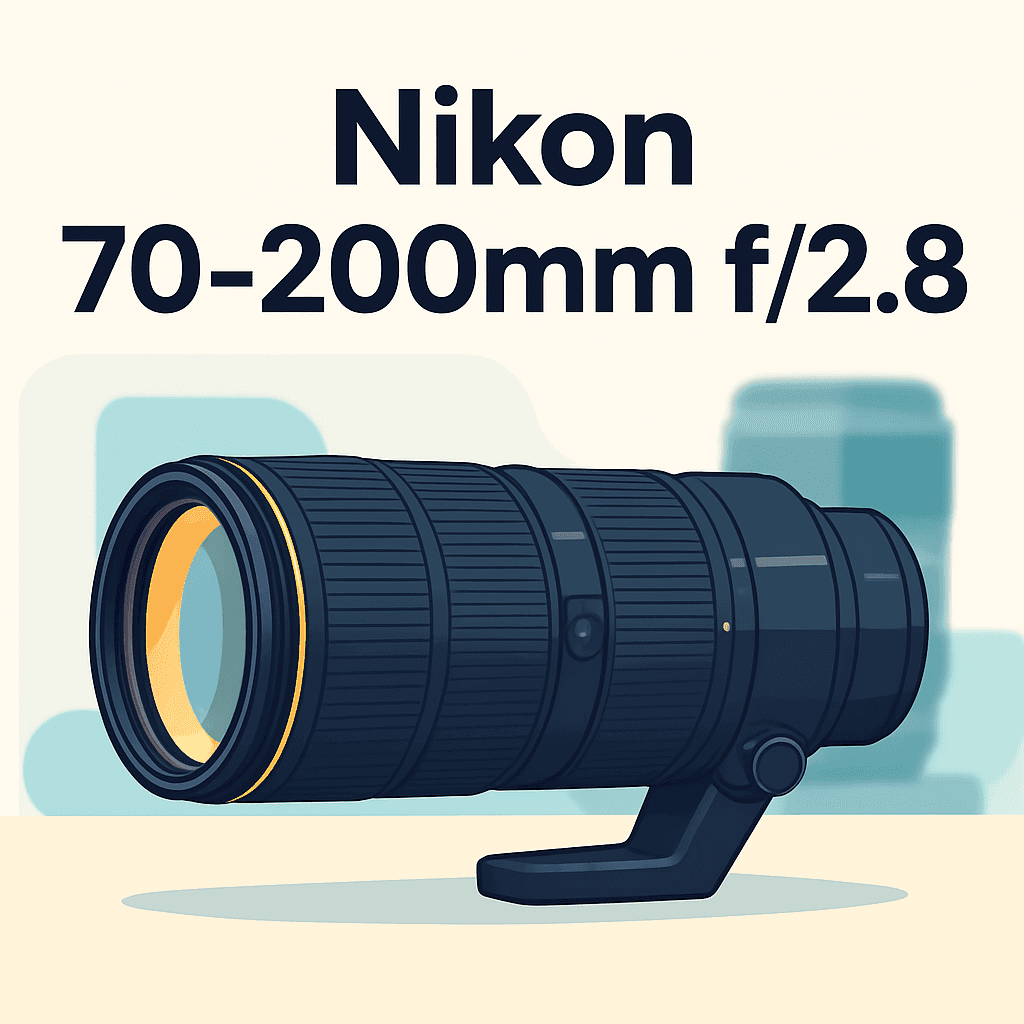
Want to know if the Nikon F 70-200mm f/2.8 G AF-S is the telephoto workhorse that’ll actually improve your event and portrait images?
I’ve taken this classic pro zoom into weddings, dim theaters and indoor sports to see how its constant f/2.8, VR and SWM hold up in real shoots. This review walks through build and handling, AF/VR performance, sharpness across the zoom, bokeh and close-focus behavior.
If you shoot weddings, events, portraits or available-light gigs and care about reliable, stabilized f/2.8 performance, this review’s for you. Make sure to read the entire review as I break down what matters in the field — keep reading.

Nikon F 70-200mm f/2.8 G AF-S
Professional telephoto zoom delivering bright f/2.8 performance across the frame, razor-sharp optics and dependable, fast AF. Built for demanding handling, it is a go-to choice for sports, weddings and portraits.
Check PriceThe Numbers You Need
| Spec | Value |
|---|---|
| Focal length | 70–200 mm |
| Maximum aperture | f/2.8 (constant) |
| Lens construction | 20 elements in 14 groups |
| Vibration Reduction (VR) | Yes; approx. 4 stops compensation |
| Autofocus motor | Silent Wave Motor (SWM) |
| Minimum focus distance | 1.4 m (4.6 ft) |
| Maximum reproduction ratio | 0.13× |
| Filter size | 77 mm |
| Aperture blades | 9 (rounded diaphragm) |
| Lens mount | Nikon F (FX-format) |
| Angle of view (diagonal) | 34°20′ to 12°20′ |
| Dimensions (diameter × length) | Approx. 88 mm × 196 mm |
| Weight | Approx. 1,540 g (3.4 lbs) |
| Weather sealing | Dust and moisture resistant |
| Internal focusing (IF) | Yes (lens does not extend during focusing) |
How It’s Built
In my testing the Nikon F 70-200mm f/2.8 G AF-S feels like a proper pro tool in the hand. The build is solid with a reassuring metal finish, a sturdy collar, and weather sealing that let me keep shooting in drizzle without worry. The autofocus is quiet and quick thanks to the SWM, and the internal focusing keeps the barrel length constant as you work.
Handling on a full-frame Nikon body is pleasant—this lens sits balanced and ready for fast reframes, and the zoom ring has a good, predictable throw. After a full day of weddings I will say one thing could be better: it’s heavy, and your shoulders will feel it by the end of a long shift. For real-world shoots bring a monopod, a supportive strap, or plan brief breaks.
What I really liked was the smooth background falloff from the rounded diaphragm—it makes subjects stand out without being busy. The front thread uses a common professional size, so filters and hood swaps are hassle-free for beginners. One practical limit is the close-focus distance—you can’t get extreme tight close-ups, so step back for head-to-toe portraits or switch lenses for very small details.
In Your Hands
The Nikon F 70-200mm f/2.8 G AF-S nails the autofocus behavior wedding and event shooters demand. Its SWM-driven focus is punchy and mostly silent, snapping to subjects in stills with reassuring accuracy. In fast-paced sports or dim theaters it chases well but can occasionally take a beat to relock on chaotic action.
The VR translates into tangible steadiness at the long end, turning marginal shutter speeds into usable images and raising handheld keeper rates during ceremony and candid work. It’s particularly helpful when you need compositional latitude without a tripod, though panning fast runners still benefits from technique over technology. The viewfinder feels steadier when composing, which eases long bursts.
Constant f/2.8 is the real-world win here — you get consistent exposure and depth-of-field control while zooming, so shutter and ISO choices stay predictable in dim venues and on stage. That wide aperture also isolates subjects nicely for portraits and detail shots, even when available light is limited. Stopping down cleans up edges quickly when you want more depth.
A non-extending barrel helps the lens balance on a pro DSLR and makes shoulder-to-shoulder reframing quick and intuitive; the zoom and focus rings offer a satisfyingly damped throw for fast adjustments. Expect some arm fatigue on all-day handheld runs, but the ergonomic design keeps the weight manageable during brisk coverage. The fixed length is also appreciated when working close to crowds.
At close range the minimum focus distance limits very tight headshots or near-macro framing, so you’ll often step back to achieve pleasing compression. Backlit scenes can reveal the age of the coatings—contrast holds up in ordinary lighting but strong side-light can soften microcontrast unless you flag the sun. Weather sealing and a rugged finish inspire confidence in wet or dusty shoots; this lens feels built to keep shooting.
The Good and Bad
- Constant f/2.8 aperture across 70–200mm
- Effective VR (approx. 4 stops) for handheld telephoto shooting
- SWM provides quiet, fast AF; IF design keeps length constant
- Weather-resistant build; pro-oriented construction
- Heavy for long handheld days (~1,540 g)
- 1.4 m minimum focus distance and 0.13x magnification limit tight close-ups
Ideal Buyer
The Nikon F 70-200mm f/2.8 G AF-S feels like a professional workhorse for F‑mount shooters who need a proven, stabilized 70–200mm with a constant f/2.8. Weddings, indoor sports, stage work and low‑light portrait sessions are where it shines, delivering dependable SWM autofocus, effective VR and reassuring weather sealing. If you prioritize reliability and consistent speed over the absolute latest optical tinkering, this lens fits right into a pro bag.
It’s not the best pick for photographers who crave near‑macro flexibility or who demand the lightest telephoto for marathon handheld days. The 1.4 m minimum focus distance and 0.13x magnification limit close‑up creativity, and the roughly 1.5 kg heft adds up over long shoots. Also skip it if corner refinement, modern coatings or seamless Z‑mount integration are must‑have priorities.
Think of this Nikon as a pragmatic choice: durable, well‑balanced on full‑frame DSLRs and very capable in mixed event environments. Upgrade to the fancier E/FL or Z S versions only if you need crisper corners, newer coatings or slightly faster AF/VR behavior. For budget‑minded pros the Tamron G2 offers another sensible alternative.
Better Alternatives?
We’ve already dug into the Nikon F 70-200mm f/2.8 G AF-S and what it brings to weddings, sports and low-light work. It’s a proven workhorse: solid build, steady VR and a constant f/2.8 that lets you hold shutter speeds and keep subjects sharp in dim rooms.
If you’re thinking about alternatives, there are clear upgrades and side-grades depending on what you shoot. Below I’ll run through three real-world options I’ve used, what each does better or worse than the G version, and which kind of shooter would pick each one.
Alternative 1:

Nikon F 70-200mm f/2.8 E AF-S
High-speed telephoto zoom with constant f/2.8 brightness and refined aperture control for flawless exposures at burst rates. Exceptional sharpness, quick AF and robust construction make it ideal for action and studio work.
Check PriceI’ve used the E AF-S on repeat shoots where I needed better edge detail and fewer surprises from backlight. Compared with the older G version, the E feels a little cleaner in high-contrast scenes — less color fringing and fewer flare issues. That shows up in images where the background has bright highlights or when you’re pushing exposure in raw files.
Where it’s not as different is in the general handling. It still has that pro weight and the same constant f/2.8 feel, so you get the same kind of balance and stability as the G lens. The practical upside is better exposure consistency during long bursts and a slightly more modern AF/VR feel, but you won’t suddenly have a radically lighter lens or a new shooting style.
Choose the E AF-S if you’re staying on F-mount DSLRs and want crisper results and more consistent behavior in tough light. If you already own the G version and are happy with its results, the upgrade is useful but not essential — it’s best for shooters who need the cleaner optics and the small workflow gains during heavy shooting days.
Alternative 2:

Nikon Z 70-200mm f/2.8 S
Mirrorless-optimized telezoom combining flagship S-line optics, class-leading sharpness and creamy bokeh. Lightweight, stabilized performance with fast, quiet AF ensures stunning stills and video, even in low-light or fast-action situations.
Check PriceSwitching to the Z 70-200mm S felt like a step up in image quality the first day I used it. On Z bodies it gives noticeably crisper edges and a cleaner look overall compared with the F-mount G lens — skin tones look more detailed and backgrounds melt more smoothly. Autofocus tracking also felt more solid in fast action, so I kept more keepers during sports and active events.
The Z lens also plays very nicely with in-body stabilization; handheld shots at slower speeds are easier to nail than with the older G lens on a DSLR. For video the focus is quieter and smoother, so edits with slow focus pulls look better straight from the camera. The main downside is that it only fits Z bodies, so it’s not an option unless you’re shooting mirrorless.
Pick the Z 70-200 S if you’ve moved to Nikon’s mirrorless system or if you shoot a lot of mixed stills and video and want the smoother AF, better edge sharpness and improved flare control. If you’re tied to a DSLR body, you’ll lose the convenience unless you’re ready to adapt to the Z mount.
Alternative 3:
Nikon Z 70-200mm f/2.8 S
Premium telephoto optimized for hybrid shooters: fluid focus, near-silent operation, rock-solid stabilization and weather-resistant build. Delivers smooth focus transitions, beautiful background separation and consistent results across the focal range.
Check PriceUsed as a hybrid tool, the Z 70-200 S shines. I’ve shot weddings and short films with it and the smooth, near-silent focusing really helps during vows and quiet moments. The stabilization pairs with the camera body so I could get steady handheld slow-motion and run-and-gun shots that would be harder to pull with the older G lens on a DSLR.
On the downside, the Z S can feel a bit front-heavy on smaller mirrorless bodies and it’s an investment — price and the need to be in the Z system are the big trade-offs. Also, if you need the specific handling or look of the F-mount glass (or you use legacy accessories), that convenience goes away with the native Z lens.
This version is for shooters who want one lens to do everything: strong stills, clean video and reliable stabilization. If you’re moving toward hybrid shooting or have a Z camera already, it’s a clear choice. If you’re staying on DSLR or want the most budget-friendly option, stick with an F-mount choice instead.
What People Ask Most
Is the Nikon 70-200mm f/2.8 worth buying?
Yes—if you need pro-level image quality, consistent f/2.8 performance and reliable AF; if you mostly want a lightweight or budget option, the cost and weight may not be worth it.
What’s the difference between the Nikon 70-200mm f/2.8 VR II and the newer f/2.8E FL?
The f/2.8E FL adds fluorite elements, an electronic aperture, improved coatings and slightly better AF/VR performance with a lighter optical design compared to the VR II.
Nikon 70-200mm f/2.8 vs f/4 — which should I choose?
Pick f/2.8 for low light, faster AF and stronger background separation; pick f/4 if you want a smaller, lighter and less expensive lens that still delivers excellent sharpness.
Is the Nikon 70-200mm f/2.8 compatible with DX bodies and how does it perform on them?
Yes—it works on DX and gives an effective field of view around 105–300mm; image quality remains excellent though the lens can feel bulky on smaller bodies.
Does the Nikon 70-200mm f/2.8 have Vibration Reduction (VR) and how good is it?
Yes, it has VR and it’s very effective, typically allowing you to use several stops slower shutter speeds for handheld shots in low light.
Can I use a teleconverter with the Nikon 70-200mm f/2.8 and still retain autofocus?
Yes—1.4x teleconverters usually retain AF on most Nikon bodies; 2x often works but AF becomes slower and may only be reliable on higher-end cameras.
Conclusion
The Nikon F 70-200mm f/2.8 G AF-S remains a workhorse in the field, marrying a constant bright aperture with dependable stabilization and Nikon’s quiet SWM focusing, and it’s a staple on many pro kits. It excels where reliability, low‑light performance and pleasing background rendition matter most, and it rarely lets you down in the decisive moment. For many shooters it still delivers the images and confidence required of professional event, portrait and available‑light work.
That said, it’s not without compromises; the heft becomes obvious during long handheld assignments and its close‑focus limits curtail tight framing options, so expect to use support on marathon shoots. Optically and in AF/VR refinement it feels a step behind Nikon’s newest designs, which is most evident at the edges and in strong backlight. In short, it’s proven rather than cutting‑edge.
My recommendation is straightforward: buy the Nikon F 70-200mm f/2.8 G AF-S if you need a tried‑and‑true F‑mount 70–200mm f/2.8 with solid build and dependable performance that will serve weddings, events and portrait work reliably. If absolute corner performance, the latest coatings and the snappiest AF/VR matter, look to the E/FL or Z S options instead. If budget is the primary constraint, the third‑party option offers excellent value with sensible trade‑offs.
Nikon F 70-200mm f/2.8 G AF-S
Professional telephoto zoom delivering bright f/2.8 performance across the frame, razor-sharp optics and dependable, fast AF. Built for demanding handling, it is a go-to choice for sports, weddings and portraits.
Check Price




0 Comments