
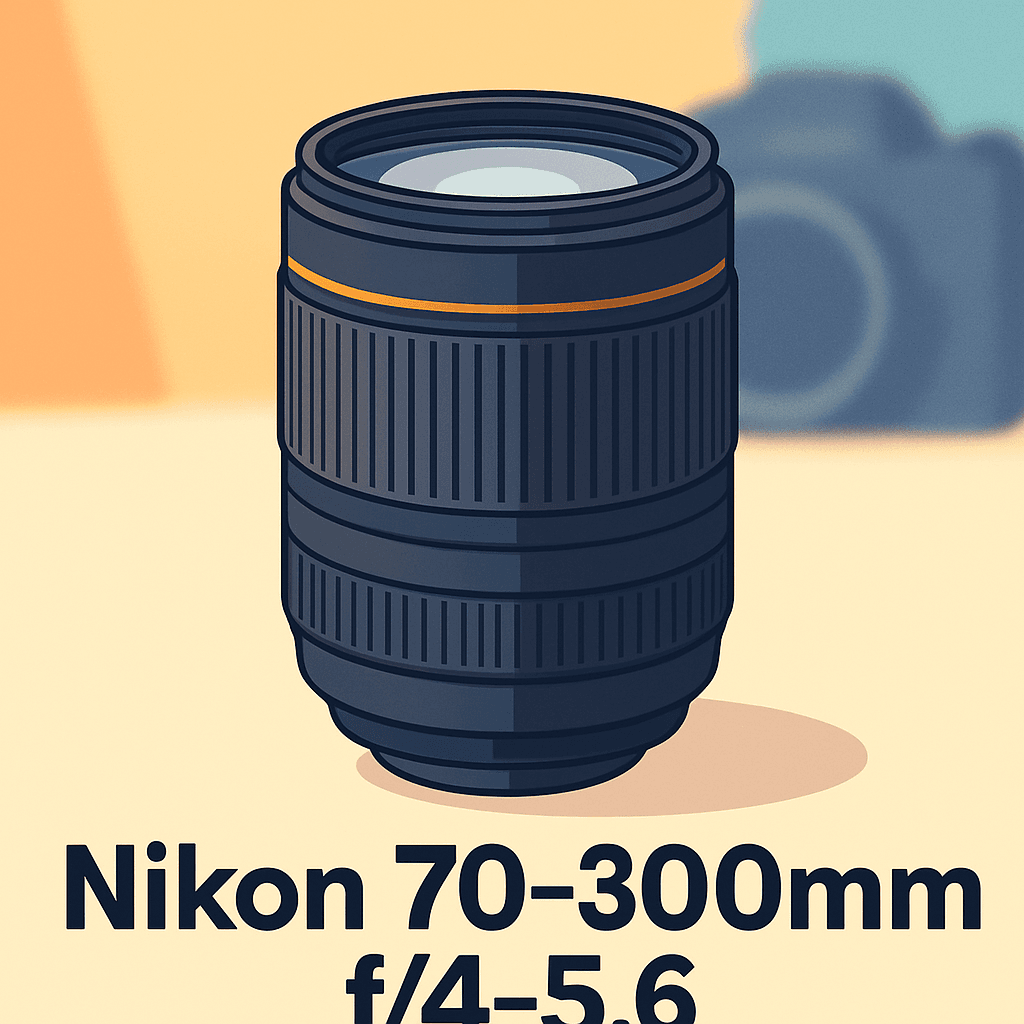
Want to add real telephoto reach to your Nikon DSLR without hauling a huge lens kit?
This review focuses on the Nikon 70-300mm f/4-5.6G — the classic non‑VR, screw‑drive F‑mount version — and I’ve spent weeks with it in the field to see what it really does.
Expect a lightweight, long‑reach zoom with a variable aperture and no image stabilization; it’s best for outdoor, daylight work where you can rely on faster shutter speeds and steady technique.
If you’re after practical payoffs — hiking travel shots, sideline sports, or distant wildlife without a heavy bag — this review will show when that simple formula works and when it doesn’t. Make sure to read the entire review as I unpack handling, sharpness, and autofocus in real‑world shooting.

Nikon 70-300mm f/4-5.6G
Affordable, compact telephoto delivering impressive reach for landscapes, wildlife, and sports. Lightweight design and sharp optics provide reliable performance for hobbyists and travel photographers seeking long-telephoto capability without the bulk.
Check PriceThe Numbers You Need
| Spec | Value |
|---|---|
| Focal Length | 70–300mm (telephoto zoom) |
| Aperture Range | f/4–5.6 (variable) |
| Lens Mount | Nikon F (for DSLR) |
| Autofocus | Yes (screw-driven AF, not AF-S/AF-P) |
| Image Stabilization | No (no VR) |
| Filter Size | 62mm |
| Minimum Focus Distance | 1.5 m |
| Elements/Groups | 13 elements in 9 groups |
| Weight | Approx. 425 g |
| Length | Approx. 116 mm (retracted) |
| Maximum Diameter | Approx. 74 mm |
| Diaphragm Blades | 9 (rounded) |
| Teleconverter Compatibility | No (autofocus not supported with teleconverters) |
| Zoom Operation | Rotating zoom ring (not push-pull) |
| Focus Limiter | No |
How It’s Built
In my testing the Nikon 70-300mm f/4-5.6G feels like a classic, no-nonsense tele zoom — compact and surprisingly light in the hand. It doesn’t scream premium, but it’s solid and straightforward to use. It’s easy to carry.
Balance is friendly on most Nikon DSLRs; it sits well on a typical body without feeling top‑heavy. The rotating zoom ring is one of my favorite bits — smooth and precise for framing. The focus ring is small and a touch stiff, so manual focus isn’t silky but it works.
In my testing I missed one modern convenience: there’s no stabilization, so handheld work at long reach needs faster shutter speeds or support. AF is screw‑driven by the camera and, with no focus limiter, can hunt in mixed scenes. In practice you brace or use a monopod in low light.
The lens won’t let you get very close, so plan to stand back for portraits and small wildlife — which suits this focal range. I liked its simple, user‑friendly build; what could be better is a quieter, faster AF motor and built‑in stabilization. For beginners, that means learning to steady the camera and work with distance.
In Your Hands
The Nikon 70‑300mm f/4‑5.6G’s variable aperture means exposure and background separation shift noticeably as you zoom toward the tele end; at the short end you get deeper depth of field and in bright daylight it’s forgiving, while at the long end background blur improves but available light drops. Without in‑lens stabilization, overcast conditions force you to raise ISO or accept faster shutter compromises to keep shots usable.
Handheld keeper rates are solid in steady daylight but decline as you push to the longest reaches, with more discarded frames in shade or at dusk. Bracing against rails, tucking an elbow, or switching to a monopod noticeably improves consistency—my field work almost always includes a monopod for long sessions to steady framing and reduce fatigue.
The screw‑driven autofocus is predictable on bodies with an internal motor, snapping into focus cleanly in good light but slowing and occasionally hunting as contrast drops. It is mechanically audible and, without a focus limiter, can shift between near and far subjects in mixed scenes, so deliberate framing and single‑point AF frequently help maintain accuracy.
A relatively long close‑focus point keeps this lens from extreme close‑ups, so it performs best when you have some space—portraits at a respectful distance or small wildlife where you can’t get too close. For tight detail or macro work you’ll want a dedicated short‑focus optic.
The 70–300 reach offers real framing flexibility; shifting from wide to tele changes perspective and compresses backgrounds at the long end, making it easy to isolate subjects against smooth falloff. That compression is especially flattering for environmental portraits and distant subjects.
Because autofocus with teleconverters isn’t supported, extending reach means relying on your feet, careful cropping, or a different lens when AF is critical. In practice this lens shines for daytime sidelines at outdoor sports, wildlife and zoo work in good light, and portraits that benefit from telephoto compression.
The Good and Bad
- 70–300mm telephoto reach in a compact, lightweight (~425g) package
- Nikon F-mount compatibility across a wide range of DSLRs
- 62mm filter size; affordable and common filters/easy to pack
- 9 rounded blades for smooth aperture shape and potentially pleasing out-of-focus highlights
- No image stabilization (no VR)
- Screw-driven autofocus (not AF-S/AF-P); no focus limiter
Ideal Buyer
If you shoot with a Nikon F‑mount DSLR that uses a body‑driven focus motor, the Nikon 70-300mm f/4-5.6G is a pragmatic way to extend reach without breaking the bag. It suits photographers who prioritize long telephoto reach, compact size and light weight over in‑lens stabilization or the latest AF motors. Think hobbyists, travel shooters and owners of older Nikon bodies who want a usable 300mm on a budget.
This lens really earns its keep outdoors in good light — sideline sports, park wildlife and long‑distance portraits where compression counts. With no VR and a variable f/4–5.6 you’ll depend on faster shutter speeds, bracing or a monopod as daylight fades, and the 1.5m minimum focus distance limits close‑up work. If you’re comfortable working inside those constraints, it’s a straightforward, effective tool.
Choose the 70-300G if you value simplicity, affordability and a modest footprint (roughly 425g, 62mm filters) and can accept screw‑drive AF and no teleconverter AF support. Skip it if you need whisper‑quiet, lightning‑fast AF for video, dedicated stabilization, or tighter close‑focus. For many Nikon DSLR owners who mainly shoot outdoors, it’s a practical, workaday telephoto that delivers real-world results.
Better Alternatives?
We’ve already gone through the older Nikon 70–300mm f/4–5.6G — the non‑VR, screw‑drive version — and saw where it shines and where it struggles in the field. It gives you real reach in a light package, but the lack of stabilization and the older focus system mean you have to work a bit harder for sharp handheld shots at 200–300mm.
If those limits bother you, there are a few natural upgrades and alternatives that I’ve actually used. Below I’ll walk through three lenses I’ve taken into the same situations — trails, sideline sports, and quick wildlife runs — and tell you what each one does better or worse compared to the original 70–300G, and who should pick which.
Alternative 1:

Nikon 70-300mm f/4.5-5.6E AF-P VR
Advanced telephoto with fast, near-silent stepping motor and effective vibration reduction for stable stills and smooth video. Precise aperture control and quick autofocus make it ideal for action and wildlife shooters.
Check PriceIn real use the AF‑P 70–300E feels like a night-and-day upgrade for everyday shooting. The stepping motor focuses much faster and almost silently, which helps when I’m tracking birds or shooting kids at a park — I get more keepers and less missed focus compared to the screw‑drive G. The VR also makes handheld shots usable at slower shutter speeds; I’ve walked away with sharp images at 1/125s where the old G would usually give me motion blur.
Where it’s not perfect is compatibility and feel. I’ve had to check older Nikon bodies before relying on it because some very old DSLRs don’t play nicely with AF‑P electronics. Also, manual focus feel is different — it’s electronic rather than the mechanical ring you get on the G — so if you like the old tactile MF control, this is a change.
Who should buy it: photographers who want a modern, easy-to-use telephoto for travel, wildlife, or casual sports and who shoot on newer Nikon bodies. If you want quieter, faster AF and real stabilization for handheld long shots, this is the one I reach for first.
Alternative 2:

Nikon 70-300mm f/4.5-5.6G AF-S VR
Versatile, VR-equipped telephoto offering crisp image quality and reliable silent-wave motor autofocus for tracking moving subjects. Built for everyday use, it balances performance, stabilization, and portability for enthusiast photographers.
Check PriceThe AF‑S 70–300 I’ve used sits in the middle ground: it gives you a built‑in focus motor so it autofocuses cleanly on bodies without the screw drive, and the focus feels more natural than the older G. In the field I noticed quicker, more predictable focus from single shots and fewer surprises when switching subjects, which helps on family events or casual sports where you can’t always pre‑focus.
It’s not as modern as the AF‑P in terms of raw AF speed or the latest stabilization behavior, and optical improvements over the G are modest — you’ll see a small bump in edge performance, but it won’t blow the older G away unless you pixel-peep. If a version you try lacks VR, remember you’ll still have the same handheld limitations as the original; if yours does include VR, that makes a clear difference for slower shutter use.
Who should buy it: shooters who want reliable autofocus without needing the newest camera bodies, and who value a more mechanical, familiar focus feel than AF‑P. It’s a good pick for hobbyists who want better AF reliability and handling over the very old screw‑drive experience.
Alternative 3:
Nikon 70-300mm f/4.5-5.6G AF-S VR
Long-reach lens combining powerful stabilization and smooth AF for capturing distant action with clarity. Compact construction and strong optical performance deliver punchy contrast and pleasing background separation for portraits and sports.
Check PriceTaken as a sport/portrait lens, the AF‑S 70–300 handles balance and close focus better than the old screw‑drive G because of internal focusing. On panning shots and quick portrait sessions it felt steadier on the camera and didn’t shift length while I focused, which keeps my framing consistent when subjects move toward or away from me.
Its weaker points are similar to what I mentioned earlier: unless you have a VR version, it won’t rescue shots in low light, and AF speed still lags behind the AF‑P on very fast action. If you need the absolute fastest acquisition at long reach, AF‑P is the better tool. Optical sharpness is solid for portraits and sideline work, but at 300mm it’s not a match for higher-end telephotos.
Who should buy it: photographers who want a compact long-reach lens that balances well on the body and gives pleasant background separation for portraits and sports. It’s a practical choice when you want dependable handling and decent optics without stepping up to heavier pro glass.
What People Ask Most
Is the Nikon 70-300mm f/4-5.6 a good lens?
Yes — it’s a solid, budget-friendly telezoom for hobbyists and travel, offering useful reach and decent image quality for the price, though it’s not pro-grade.
Does the Nikon 70-300mm f/4-5.6 have VR (vibration reduction)?
It depends — the original AF 70-300 lacks VR, while the later AF-S/VR versions do include Vibration Reduction.
Will the Nikon 70-300mm f/4-5.6 autofocus on a D3500/D5600?
Only if it’s the AF-S version with an internal focus motor; the older screw-drive AF model will not autofocus on those bodies.
How sharp is the Nikon 70-300mm f/4-5.6?
Center sharpness is decent when stopped down around 100–200mm, but corners and performance at 300mm (especially wide open) are noticeably softer than higher-end telephotos.
Is the Nikon 70-300mm f/4-5.6 good for wildlife or bird photography?
It’s fine for larger, slow-moving wildlife and casual birding, but for small or fast birds you’ll want a longer, faster lens with stronger AF and reach.
Is the Nikon 70-300mm f/4-5.6 worth buying used?
Yes — a used AF-S/VR copy can be excellent value if it’s in good condition, but inspect for optical issues and prefer the AF-S/VR variant for better usability.
Conclusion
The Nikon 70-300mm f/4-5.6G is what it is: a classic screw‑drive, non‑VR telephoto zoom that delivers serious reach in a compact, easy-to-carry package. In the field it rewards straightforward handling and sensible framing more than headline-grabbing optics, and its rendering can be pleasing when the light is with you. I came away impressed by how portable and predictable it feels on an everyday DSLR body.
That usefulness comes with clear trade‑offs. The lack of in‑lens stabilization and the older screw‑drive autofocus mean you must lean on faster shutter speeds, bracing or a monopod and a camera with a good body motor for best results. Close‑up work and low‑light action are where the lens shows its limits, and you won’t get AF support with teleconverters.
Bottom line: this is a practical, value-minded choice for shooters who prioritize reach and light weight over the latest AF and stabilization tech. In my testing it performed reliably for outdoor sports, park wildlife and long‑distance portraits when shot in good light and with sensible technique. If you need quieter or faster AF, built‑in stabilization, or stronger tele‑end optics, consider the alternatives listed earlier.
If your shooting is mostly daylight telephoto work and you value simplicity and affordability, the Nikon 70-300mm f/4-5.6G is a defensible, workhorse choice. Otherwise, flip to the Alternatives section to match the lens to the way you actually shoot.
Nikon 70-300mm f/4-5.6G
Affordable, compact telephoto delivering impressive reach for landscapes, wildlife, and sports. Lightweight design and sharp optics provide reliable performance for hobbyists and travel photographers seeking long-telephoto capability without the bulk.
Check Price

0 Comments