
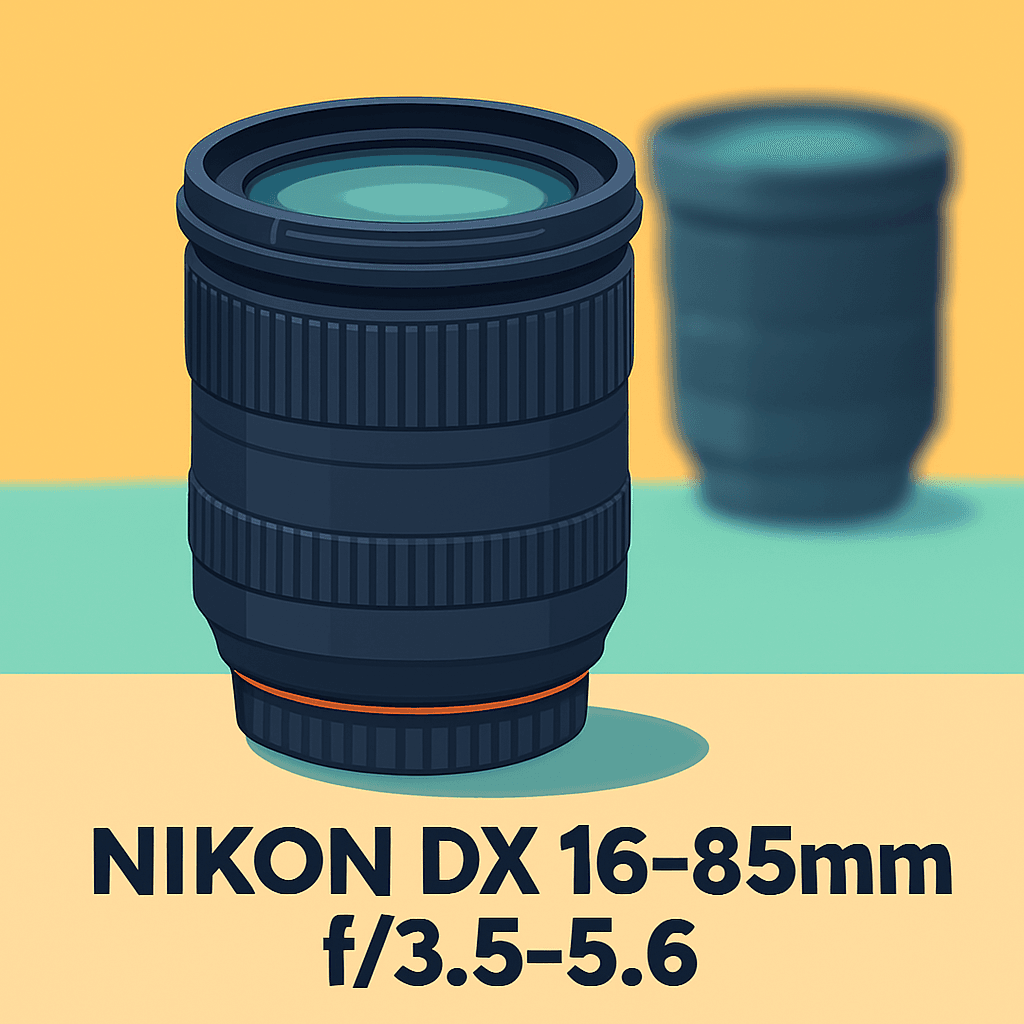
Want one lens that can handle landscapes, street scenes, and portraits on your Nikon DX body?
Meet the Nikon AF-S DX NIKKOR 16-85mm f/3.5-5.6G, an F‑mount DX zoom from wide to short tele.
It brings VR, AF‑S, ED glass and rounded aperture blades for practical image benefits.
It’s aimed at DX shooters wanting more width than 18mm kit lenses and more reach than shorter zooms.
Travelers, street shooters and everyday photographers will like the flexibility and stabilization.
I’ve used it on assignments and travel, so this comes from real-world shooting.
You’ll get hands-on observations about how it behaves in the field.
I’ll cover design, AF, sharpness, and real-world use, plus direct comparisons.
Make sure to read the entire review — keep reading to find out what it really delivers.

Nikon AF-S DX NIKKOR 16-85mm f/3.5-5.6G
Everyday travel zoom delivers versatile wide-to-tele coverage in a compact package. Balanced sharpness, smooth autofocus and responsive handling make it ideal for landscapes, street scenes and casual portrait work.
Check PriceThe Numbers You Need
| Spec | Value |
|---|---|
| Focal Length | 16-85mm |
| Aperture Range | f/3.5-5.6 |
| Format Compatibility | Nikon DX (APS-C) |
| Lens Mount | Nikon F |
| Image Stabilization | VR (Vibration Reduction) |
| Lens Construction | 16 elements in 12 groups |
| Minimum Focus Distance | 1.3 feet (0.38 meters) |
| Maximum Reproduction Ratio | 0.24x |
| Autofocus Motor | Silent Wave Motor (AF-S) |
| Filter Size | 67mm |
| Angle of View | 83° to 18° |
| Dimensions (DxL) | Approx. 78 x 88 mm |
| Weight | Approx. 420 grams |
| Aperture Blades | 7 (rounded) |
| Special Elements | ED (Extra-low Dispersion) glass elements |
How It’s Built
In my testing the Nikon AF-S DX NIKKOR 16-85mm f/3.5-5.6G feels compact and well balanced on typical DX bodies. It doesn’t pull the camera forward or make your setup top-heavy, so it’s comfortable for walking around all day. That matters when you’re out shooting travel or street and don’t want to get tired fast.
The zoom and focus rings are smooth with just the right amount of resistance. I found zooming through the range quick and predictable, and the manual focus ring is precise enough for casual close-ups and portraits. For beginners this means you can switch between auto and manual without fighting the lens.
VR is integrated in a way that actually helps you see a steadier frame in the viewfinder. In real shooting I could handhold at slower shutter speeds and still get usable shots at the longer end. One thing I really liked was how much that steadiness improved my keeper rate.
The build feels solid for everyday use, though it leans more toward dependable travel-grade materials than heavy-duty pro metal. After using it for a while I noticed it’s not fully sealed, so I’d be cautious in dust or rain—one thing that could be better for outdoorsy shooters.
Filters and accessories are easy to find thanks to the common thread size, so adding a polarizer or ND is straightforward. For beginners this lens is a forgiving, versatile tool—just keep it dry and it’ll serve as a great all-around companion.
In Your Hands
On the camera this zoom proves itself a true walk-around tool: the wide end gives you expansive landscapes and tight interiors with room to breathe, the mid-range is ideal for street work and environmental portraits, and the short-tele reach tightens compositions for flattering headshots and detail studies. Each focal region feels purposeful rather than gimmicky, so you find yourself keeping the lens on the body through a full day of shooting.
The lens’s variable aperture means exposure changes as you move through the range, so in bright conditions it behaves very predictably, while in dimmer situations you rely more on higher ISO or support. That trade-off is familiar to travel and documentary shooters—versatility over low-light speed.
Stabilization is a clear practical benefit; it calms the viewfinder and steadies hand-held framing, especially when you’re reaching toward the long end. For casual telephoto shots and wandering around cities, VR turns marginal shutter speeds into usable keepsakes more often than not.
Close-focusing opens creative doors beyond simple snapshots, letting you capture food, small products, and tighter details with satisfying subject isolation. It won’t replace a macro but offers genuine utility for everyday close-ups.
In real-world backlit scenes the coatings hold contrast well and colors stay neutral and consistent across the zoom, while the rounded aperture blades produce smoothly rendered out-of-focus areas. Expect some wide-angle corner softness and the familiar edge distortion at extremes, and you may notice a touch of focus breathing when racking focus, but overall the rendering is pleasing and reliable for portfolio work.
The Good and Bad
- Versatile 16–85 mm range covering wide to short tele on DX
- VR (Vibration Reduction) for handheld shooting
- Lightweight and compact for a stabilized zoom (approx. 420 g; 78 x 88 mm)
- Close-focus capability (0.38 m) with 0.24x max reproduction for near-macro uses
- Variable, relatively slow maximum aperture (f/3.5–5.6)
- DX-only; not designed for full-frame coverage
Ideal Buyer
If you shoot on Nikon DX bodies and want one do-it-all lens, the Nikon AF-S DX NIKKOR 16-85mm f/3.5-5.6G is aimed squarely at you. Its 16–85mm reach gives wider-than-kit flexibility and useful short-tele compression, while VR and AF‑S make it a steady, fuss-free companion for both hobbyists and aspiring pros. Think of it as the travel bag’s backbone: more framing choices without changing glass.
Travelers, street shooters, hobbyist documentary photographers and everyday shooters will appreciate the balance of range, weight and stabilization. Close-focus to 0.38 m and a 0.24x reproduction ratio means you can handle near-macro food or product shots without carrying a separate lens. Lightweight build and 67mm filter thread keep it practical for polarized or ND use on the road.
Don’t buy it if you regularly work in low light or need a constant f/2.8 aperture for subject isolation and faster shutters. Pro shooters covering weddings, events or indoor sports will likely favor the faster 17–55mm f/2.8 or the newer 16–80mm f/2.8–4 for improved sharpness and low‑light headroom. For everyone else who values versatility, the 16–85 strikes a compelling middle ground.
Better Alternatives?
We’ve covered the Nikon 16‑85 in detail — how it handles, what it does well, and where it asks for compromises. It’s a great all‑round walkaround zoom with VR and useful reach, but depending on your needs you might want something faster, sharper, or with more reach.
Below are a few real-world alternatives I’ve used. I’ll point out what each one really gives you on the street, at events, or on trips — and where the 16‑85 still holds the edge.
Alternative 1:

Nikon AF-S DX NIKKOR 16-80mm f/2.8-4E
Premium mid-range zoom combines a bright variable aperture and refined optics to excel in low light and capture fine detail. Smooth focus, lightweight construction and punchy contrast suit pro shooters.
Check PriceIn the field the 16‑80 f/2.8‑4E feels like a meaningful step up from the 16‑85. You get noticeably better low‑light performance and subject separation at the wide end — that f/2.8 matters when you’re indoors or chasing portraits at dusk. I also found images looked punchier and a touch sharper, especially in the center, so fine details hold up better when you push ISO and crop.
Where it loses to the 16‑85 is mainly cost and a bit of size — it’s pricier and feels a touch more serious in the bag. The extra polish in coatings and VR makes flare and contrast better, but you do give up a little of the 16‑85’s ultra‑simple, get‑everywhere reach feel; the handling is a bit different and the lens can be less forgiving if you just want a cheap, light one‑lens travel kit.
If you are someone who shoots in mixed light — travel, city dusk, restaurant interiors, or you want cleaner results without swapping to primes — the 16‑80 is worth the upgrade. It’s for shooters who want better low‑light ability and crisper images while still keeping a single walkaround zoom.
Alternative 2:

Nikon AF-S DX NIKKOR 17-55mm f/2.8G
Constant-aperture standard zoom delivers professional-grade sharpness and creamy background separation. Robust build, fast focusing and consistent performance make it a go-to for event, wedding and low-light assignments.
Check PriceThe 17‑55 f/2.8 is what I turn to when I need reliable low‑light performance and a consistent look from end to end. Compared to the 16‑85 it delivers creamier backgrounds and lets you work at faster shutter speeds in dim rooms. In real shoots I noticed richer contrast and more usable images straight out of camera when the light dropped — important for weddings, parties, and run‑and‑gun indoor work.
But it’s not without trade‑offs. The 17‑55 is heavier and there’s no VR, so handheld slow‑shutter shooting at the long end is harder than with the stabilized 16‑85. You also lose the wider 16mm edge and the longer 85mm reach, so it’s less flexible as a single travel lens — you’re trading range for constant speed and image quality.
Choose the 17‑55 if you shoot events, weddings, or any work where low light and consistent performance matter more than ultimate range or travel weight. It’s for pros and serious amateurs who want predictable results in varying indoor conditions and don’t mind a heavier lens or adding a monopod for long handheld shots.
Alternative 3:
Nikon AF-S DX NIKKOR 17-55mm f/2.8G
Delivers reliable, edge-to-edge clarity with a dependable constant brightness for challenging conditions. Predictable bokeh, quick autofocus and resilient construction provide confidence for photographers shooting fast-paced events and portraits.
Check PriceI’ll add a slightly different take on the 17‑55 since I’ve used it on long event days: it gives you confidence. Autofocus feels quick and steady, and the build stands up to heavy use. Compared with the 16‑85 the 17‑55’s constant f/2.8 makes framing and exposure more predictable, so you spend less time adjusting settings and more time nailing moments.
On the downside, the 17‑55 still won’t replace the 16‑85 for travel convenience — you’ll miss the wider angle for landscapes and the extra tele for tight portraits from a distance. And because it lacks VR, I found myself compensating with higher ISO or support in low light, where the 16‑85’s stabilization often saved a shot without raising ISO.
If your work is fast paced — portraits, school events, corporate gigs — and you want a no‑surprises lens with solid bokeh and quick AF, the 17‑55 is a solid pick. It’s aimed at photographers who prioritize consistent image quality and handling over single‑lens travel flexibility.
What People Ask Most
Is the Nikon DX 16-85mm f/3.5-5.6 a good lens?
Yes — it’s a versatile, well-built walkaround lens that outperforms typical kit zooms, though it’s not a fast lens for low-light work.
Does the Nikon 16-85mm f/3.5-5.6 have VR (vibration reduction)?
Yes, it includes Nikon’s VR image stabilization to help with handheld shots.
Can the Nikon DX 16-85mm f/3.5-5.6 be used on full-frame (FX) Nikon cameras?
You can mount it on FX bodies but it will vignette and usually force the camera into DX crop mode, so it won’t cover full-frame cleanly.
How sharp is the Nikon 16-85mm f/3.5-5.6 across the zoom range?
Centers are generally sharp, especially stopped down and around mid focal lengths, but corners soften at 16mm and 85mm, particularly wide open.
What is the 35mm equivalent focal length of the Nikon DX 16-85mm f/3.5-5.6?
On a DX camera it’s roughly 24–127.5mm equivalent (16–85mm × 1.5 crop factor).
Is the Nikon 16-85mm f/3.5-5.6 weather-sealed or well-built?
It’s solidly built with a durable mount but not fully weather-sealed, so it can handle light use in the elements but not heavy rain or harsh conditions.
Conclusion
The Nikon AF-S DX NIKKOR 16-85mm f/3.5-5.6G is, in plain terms, a capable and sensible walk‑around zoom for DX shooters who value flexibility and stabilization over outright speed. It pairs useful focal coverage with Nikon’s VR and AF-S technologies to deliver reliable results in everyday shooting. In the field it feels like a thoughtful compromise rather than a headline performer.
Its biggest strengths are practical: steady handheld framing, pleasing rendering for casual portraits and landscapes, and a close‑focus habit that widens its usefulness beyond a simple kit lens. Handling and balance on typical DX bodies make it comfortable for long days of travel and street work. For photographers who prioritize convenience and versatility, it often hits the sweet spot.
The trade‑offs are clear and important. If low‑light performance, ultimate edge‑to‑edge sharpness or a constant fast aperture are your priorities, newer faster zooms or the dedicated constant‑aperture options outperform it. Consider alternatives such as the 16–80mm f/2.8–4, the 17–55mm f/2.8, or the longer‑reach 18–140mm depending on whether you need speed, top image quality, or reach.
Bottom line: buy the 16–85 if you want a reliable, VR‑equipped do‑everything lens for travel and everyday DX use. Skip it if you demand pro‑level low‑light speed or the absolute best optical resolution. It’s a practical, well‑rounded tool for photographers who favor versatility over specialization.
Nikon AF-S DX NIKKOR 16-85mm f/3.5-5.6G
Everyday travel zoom delivers versatile wide-to-tele coverage in a compact package. Balanced sharpness, smooth autofocus and responsive handling make it ideal for landscapes, street scenes and casual portrait work.
Check Price


0 Comments