
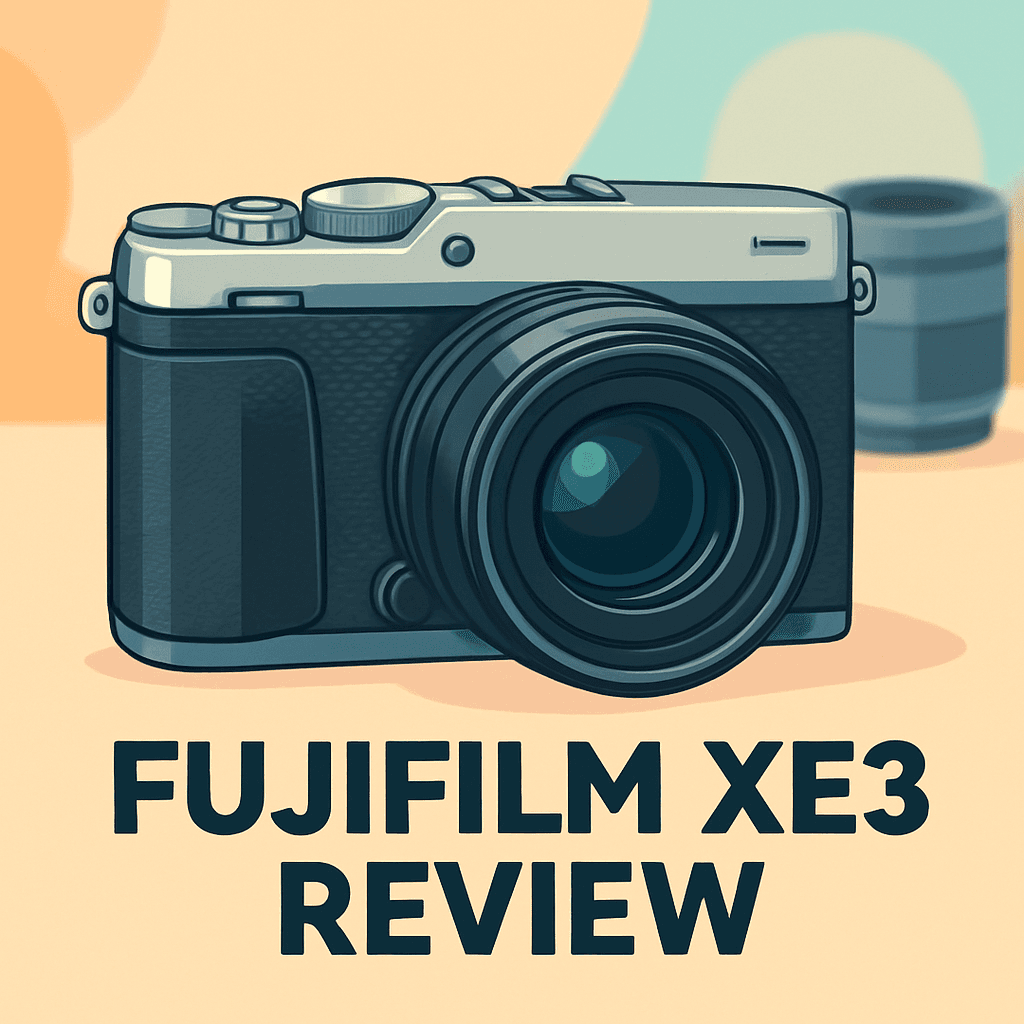
Want to lift your street and travel photos without lugging a bulky camera?
I took the Fujifilm X-E3 Camera into city streets, dim cafés, and quick portrait sessions to see how it behaves in real-world shooting. This hands-on look favors usability over lab charts and focuses on practical payoffs.
You’ll learn about ergonomics, speed and workflow, image quality, and autofocus behavior, plus where it fits against newer options for creators who don’t need cutting-edge AF or video. Make sure to read the entire review as I reveal where the X-E3 truly shines and where you might want to upgrade — keep reading.

Fujifilm X-E3 Camera
Compact rangefinder-style mirrorless with crisp APS-C sensor, fast autofocus and classic film-simulation color profiles. Portable metal build, intuitive dials and built-in wireless connectivity for effortless street and travel photography.
Check PriceThe Numbers You Need
| Spec | Value |
|---|---|
| Sensor | 24.3 MP X-Trans CMOS III |
| Format | APS-C |
| Lens Mount | Fujifilm X-mount |
| Autofocus | Fast Hybrid AF |
| Continuous Shooting | Up to 8 fps |
| ISO Range | 200–51200 |
| Shutter Speed | Up to 1/4000 sec |
| Video | 4K at 30 fps |
| LCD | 3.0″ Touchscreen |
| Viewfinder | 2.36M-dot OLED EVF |
| Body Style | Rangefinder-style |
| Weight | Approximately 337 g |
| Build | Magnesium alloy body |
| Memory Slots | 1× SD card slot |
| Connectivity | Wi‑Fi, Bluetooth |
How It’s Built
In my testing the Fujifilm X-E3 felt like the kind of camera you actually want to carry. The rangefinder-style body is compact and light, so I left it on a strap more than I expected. I really liked the solid metal finish and the satisfying click of the dials — it makes shooting feel deliberate and fun.
The electronic viewfinder is surprisingly clear with very little lag, and it held up well in bright sun and low light. The touchscreen is responsive and tap-to-focus is a big help when you’re starting out or shooting quickly on the street. One thing that could be better is the eyepiece feel; taller users and eyeglass wearers may find it a bit cramped.
There’s a single card slot, and in my hands-on use that mattered. For casual travel it’s fine, but I wouldn’t rely on it for one-off paid gigs without a backup plan. The X-mount pairs beautifully with small primes — the camera balances nicely and stays discreet — while big zooms can make it feel front-heavy.
Wireless setup via Wi‑Fi and Bluetooth was straightforward, though transfers sometimes took a beat. The grip is comfy for small to medium hands and the controls work with gloves if they aren’t bulky. Overall it’s beginner-friendly and built to be carried, with one clear trade-off to keep in mind.
In Your Hands
In the Fujifilm X-E3 Camera the whole shooting experience feels deliberately tactile and responsive: power-up is quick, the shutter fires with a satisfying, immediate feel, and frame-to-frame cadence keeps you in the moment. Its burst capability is most useful for quick street bursts and catching fleeting expressions, but it isn’t intended as a sports specialist for long, sustained action sequences. The camera rewards decisive shooting—compose, press, and move on—rather than long chases.
The top shutter speed and ISO behavior mean you can shoot wide-open in many daylight situations, though very bright conditions occasionally demand neutral-density support or stopped-down apertures. High-ISO images retain pleasing color and texture until noise becomes noticeable in very dim interiors, so I’ll nudge exposure and processing before pushing sensitivity for client work. Video is capable and clean for casual hybrid use, but it’s not aimed at heavy-duty cinema or high-frame-rate needs.
Because there’s no in-body stabilization you depend on stabilized lenses, faster shutter speeds, or a tripod for steady low-light results, which shapes lens choices for travel and street kits. Wireless pairing is straightforward and reliable for moving selects to a phone on the go, making social sharing and quick edits simpler than fussing with cables in the field.
The single card slot keeps the body compact but calls for disciplined file management and backup habits on paid gigs or long trips. Heat and fatigue are rarely issues for typical shooting days, though extended video clips or very long burst sessions can warm the camera and invite short breaks between takes.
The Good and Bad
- Compact, lightweight rangefinder-style body that’s discreet for street and travel
- Magnesium alloy build feels solid for its size
- 24.3 MP X-Trans CMOS III delivers detailed APS-C image quality
- 2.36M-dot OLED EVF and 3.0″ touchscreen provide flexible, high-quality viewing and control
- No in-body image stabilization; relies on stabilized lenses or supports for slow-shutter work
- Older-generation autofocus with less advanced subject and eye detection and tracking
Ideal Buyer
The Fujifilm X-E3 is built for street and travel shooters who prize discretion and tactile control. Its rangefinder silhouette and light weight let you carry it all day. That makes it ideal for documentary work, city walks, and candid portraits.
Fuji color fans will love the JPEG character and film simulations straight from the camera. Pair it with compact primes and you get sharp results and pleasing bokeh without a bulky kit. If you favor photography over video, the X-E3 rewards thoughtful shooting.
Hybrid creators needing casual 4K at 30p will find it useful for quick clips and social posts. You should be comfortable working without IBIS and with a single SD card for noncritical shoots. For travel editors and bloggers building a lightweight kit, the tradeoffs feel worth it.
It’s not the right tool for action shooters or wedding pros who need top-tier AF and card redundancy. Video-first creators wanting higher frame rates or advanced tracking should look elsewhere. Those who shoot long handheld low-light sessions will miss in-body stabilization.
Choose the X-E3 if you want classic Fuji handling, strong color from the camera, and a minimalist kit. Consider the X-E4, X-T30 II, or Sony a6400 if you need modern AF, more video flexibility, or dual-card safety. This camera rewards photographers who prioritize feel and portability over the latest specs.
Better Alternatives?
We’ve gone through the X-E3’s strengths and limits, so now let’s look at a few cameras that make sense if you’re thinking about an upgrade or just want a different shooting feel. These alternatives focus on better autofocus, nicer controls, or a different balance between size and handling.
I’ve used all of these in real shoots — street walks, low‑light cafes and quick travel sets — and I’ll point out what they do better and where the X-E3 still holds its own.
Alternative 1:

Fujifilm X-E4 Camera
Sleek, ultra-compact mirrorless offering a high-resolution APS-C sensor, responsive touchscreen and enhanced autofocus. 4K video capability, creative film emulations and lightweight body make it ideal for vlogging and everyday use.
Check PriceThe X-E4 feels like a modern, slimmer version of the rangefinder idea behind the X-E3. In real use I noticed snappier autofocus and cleaner high‑ISO shots compared with the X-E3, and the touchscreen is more responsive for quick tap-to-focus on the street. Video is a little more usable too, so if you mix in casual 4K clips the X-E4 gives you better results without adding much bulk.
Where it is worse than the Fujifilm X-E3 Camera is mainly in controls and handling. The X-E4 is thinner and loses some of the tactile dial feel that I liked on the X-E3, so when I wanted to change settings fast with gloves on, the X-E3 felt more familiar. Like the X-E3 it also lacks in-body stabilization and has a single card slot, so low‑light handheld work still depends on lenses or a tripod.
If you prefer very small kits, do a lot of street work and want modern AF and a great touchscreen for vlogging or quick hand-held clips, the X-E4 is the pick. If you love physical dials and a slightly chunkier grip for fast manual changes, you might still prefer the X-E3.
Alternative 2:

Fujifilm X-T30 II Camera
Versatile enthusiast camera with a 26MP APS-C sensor, speedy subject tracking and refined controls. Delivers detailed 4K footage, rich color profiles and a compact form for hybrid photo-video creators.
Check PriceThe X-T30 II brings a more traditional Fuji control layout and a friendlier grip than the X-E3, and in practice that makes it faster to operate for most shooting situations. Autofocus is noticeably better for moving subjects, and I found it more reliable for quick street bursts or kids running around. The EVF and handling make it easier to stay on target during a shoot.
Compared to the Fujifilm X-E3 Camera, the X-T30 II gives you improved tracking and a slightly more confident feel, but it isn’t as pocketable. It still lacks in-body stabilization and keeps the single card slot, so those same trade-offs apply. If you care about the smallest possible size, the X-E3 will still win on discretion.
This model is for photographers who want modern AF and real-world handling that speeds up their workflow — travel shooters who prefer tactile dials and a better grip, or hybrid users who shoot both stills and quick 4K clips. If you want to keep a tiny, rangefinder-like setup, stick with the X-E3 or the even slimmer X-E4.
Alternative 3:
Fujifilm X-T30 II Camera
Compact powerhouse designed for enthusiasts seeking fast AF and expressive color rendering. Features advanced autofocus, intuitive touchscreen interface and elegant retro styling, perfect for travel photographers and content creators alike.
Check PriceSeen as a compact powerhouse, the X-T30 II builds on the strengths of the X-E3’s image quality but adds quicker, more confident autofocus and a touch interface that responds well in the field. I liked its color straight out of camera — very Fuji — but the upgraded AF meant fewer missed moments when shooting moving subjects or during short bursts on the street.
Where it comes up short versus the Fujifilm X-E3 Camera is in size and simplicity. The X-T30 II is heavier and more camera-like, which some shooters prefer but others don’t. It also keeps the same limitations of no IBIS and a single card slot, so for long handheld low-light jobs you’ll still need to plan for lenses or support gear.
Choose the X-T30 II if you want stronger autofocus and more forgiving handling than the X-E3 while keeping a compact package. It’s a good fit for travel shooters who want faster AF, creators who switch between photos and casual video, and anyone who appreciates Fuji colors but wants smoother tracking in real shooting situations.
What People Ask Most
Is the Fujifilm X-E3 worth buying?
Yes—if you want a compact, stylish APS-C camera with excellent JPEGs, Fujifilm film simulations and strong stills performance; skip it if you need 4K, IBIS or advanced video features.
How does the Fujifilm X-E3 compare to the X-T20/X-T30?
It matches the X-T20 for core image quality and features but lacks the X-T30’s newer AF performance and extra refinements; the X-E3 is more rangefinder-styled and compact.
Does the Fujifilm X-E3 have in-body image stabilization (IBIS)?
No, the X-E3 does not have IBIS, so stabilization depends on lenses or external support.
Can the Fujifilm X-E3 shoot 4K video?
No, it records up to 1080p (Full HD) and does not offer 4K recording.
How good is the autofocus on the Fujifilm X-E3?
The AF is solid for stills and everyday subjects with fast phase-detect points, but it isn’t as capable as newer Fujifilm models for fast action or advanced face/eye tracking.
What is the battery life of the Fujifilm X-E3?
Expect roughly 300–350 shots per charge under typical use, so bring a spare battery for long shoots.
Conclusion
The Fujifilm X-E3 Camera is compact, tactile, and immediately enjoyable to use. It delivers the classic Fuji color and files that many shooters prefer. For street, travel, and everyday work it feels purposefully dialed-in and quick.
Those virtues come with clear tradeoffs you must accept up front. There is no in-body stabilization and only a single card slot for backups. Autofocus lags behind newer models, so fast-action or tracking shooters will notice.
If you shoot primes, value discreet handling, and love Fujifilm colors, it fits. Its JPEGs and output are still compelling for client work and personal projects. Battery and simple workflows keep it practical for long days on the street.
If you need the fastest AF, or more video flexibility, look elsewhere. The X-E4 and X-T30 II modernize AF and image processing in meaningful ways. Sony’s a6400 still leads for subject tracking and a broader lens ecosystem.
Value comes from pairing the X-E3 Camera with compact primes and a light kit. It rewards photographers who prioritize composition, color, and an analog shooting rhythm. For its age, it remains a satisfying tool with a distinctive personality.
Buy it if you crave Fuji color, compactness, and tactile controls. Consider it if you want a capable travel/street body but value savings over features. Skip it if demanding AF, high-frame-rate video, or dual-card redundancy are non-negotiable.
Fujifilm X-E3 Camera
Compact rangefinder-style mirrorless with crisp APS-C sensor, fast autofocus and classic film-simulation color profiles. Portable metal build, intuitive dials and built-in wireless connectivity for effortless street and travel photography.
Check Price


0 Comments