
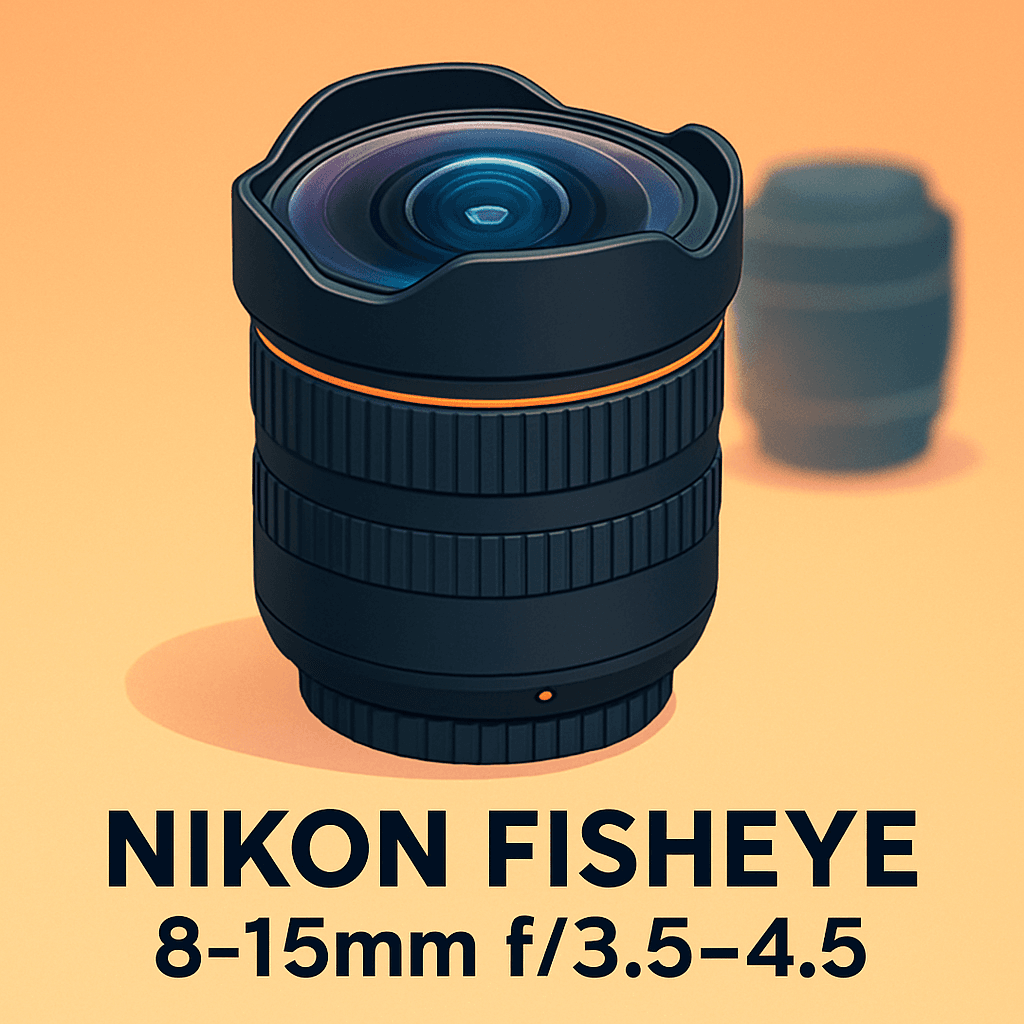
Want one lens that gives you two iconic fisheye looks without swapping glass mid-shoot?
The Nikon 8-15mm f/3.5-4.5 AF-S Nikkor is a fisheye zoom for Nikon F-mount that delivers both circular and full-frame diagonal fisheye perspectives, so you can pivot styles fast in the field.
It’s aimed at FX and DX shooters who want creative flexibility, with real-world payoffs for landscapes, architecture, and experimental portraits; I’ve pushed it through several shoots and seen that versatility matter.
This review will walk through handling, autofocus, sharpness across the range, FX vs DX coverage, plus pros, cons, and alternatives. Make sure to read the entire review as it’ll show when this lens really shines — keep reading.

Nikon 8-15mm f/3.5-4.5 AF-S Nikkor
Versatile ultra-wide zoom delivers dramatic fisheye perspectives across full-frame and DX bodies. Smooth autofocus, excellent edge-to-edge sharpness and robust build—perfect for landscapes, architecture and creative wide-angle effects.
Check PriceThe Numbers You Need
| Spec | Value |
|---|---|
| Focal length | 8-15mm |
| Maximum aperture | f/3.5-4.5 |
| Lens mount | Nikon F |
| Format compatibility | Full-frame (FX) and APS-C (DX) |
| Angle of view | 180° at 8mm (circular fisheye on FX); full-frame fisheye at 15mm |
| Lens construction | 14 elements in 11 groups |
| Nano Crystal Coat | Yes (reduces ghosting and flare) |
| Minimum focus distance | 0.16 m (approx 6.3 in) |
| Maximum reproduction ratio | 1:4.6 |
| Autofocus | Silent Wave Motor (AF-S) |
| Diaphragm blades | 7, rounded |
| Filter thread | None |
| Dimensions (diameter × length) | approx. 83 × 82.5 mm |
| Weight | approx. 485 g |
| Weather-sealing | Yes (dust and moisture resistant) |
How It’s Built
In my testing the Nikon 8-15mm f/3.5-4.5 AF-S Nikkor feels solid and well put together. The barrel has a reassuring weight that makes it feel like a real tool, and the finish resists fingerprints during long shoots. That gives you confidence when you’re out chasing dramatic wide-angle shots.
The zoom and focus rings are smooth with a bit of damping, so small adjustments are easy and predictable. On a full-frame body the lens balances nicely and feels natural at the shoulder, while on smaller crop bodies it’s still comfortable and won’t tip your setup. For beginners that means you can focus and frame without fighting the lens.
I appreciated the weather sealing in real use — I shot it in light mist and on windy beaches and had no worry about dust or light spray. The coatings also helped keep contrast when I pointed it toward bright skies, so flare surprises were less common. Those little protections matter when you’re outdoors most of the time.
A practical downside is the lack of a front filter thread, so you can’t screw on protection or creative filters and need to be careful with the exposed front element. I really liked the solid build and close-focus feel, but I wish Nikon had added a way to attach a protective filter. For beginners, bring a cap and a pouch and you’ll be fine.
In Your Hands
Autofocus with the Nikon 8-15mm f/3.5-4.5 AF-S Nikkor feels modern and dependable — it locks quickly in good light and stays impressively quiet, which is a boon for run-and-gun video. In dimmer scenes the lens can hunt a touch more than a faster prime, but it tends to settle without fuss once contrast is present.
The Nano Crystal Coat shows up in real shoots: shooting toward bright highlights, contrast holds up and flare is noticeably subdued compared with older fisheyes. Pointing dead into a blazing sun can still introduce mild veiling or haloing, but the coating keeps images usable and contrast-rich in most backlit situations.
The close-focusing ability is where this lens gets playful — you can press in on a subject and let the extreme perspective exaggerate scale while keeping a surprisingly clear background relationship. That near-focus character is excellent for creative portraits, product work, or foreground-led landscapes where distortion becomes an artistic tool.
Switching between the circular and diagonal fisheye looks is seamless in the field, and that flexibility changes how you approach a scene without swapping glass. Composing through a near-180° view takes practice — watch for stray feet, tripods, and unintended foreground objects when framing wide.
Optically, ED glass helps keep color fringing and softness toward the edges under control, though the inherent curvature and mild vignetting are part of the fisheye signature and often desirable. The lens has no stabilization, so handheld work benefits from bracing or faster shutter choices to keep everything crisp.
The Good and Bad
- Dual look in one lens: circular fisheye at 8mm (FX) and full-frame fisheye at 15mm (FX)
- AF-S autofocus
- Nano Crystal Coat for ghosting/flare reduction
- Weather-sealed (dust and moisture resistant)
- Variable maximum aperture (f/3.5–4.5)
- No front filter thread
Ideal Buyer
The Nikon 8-15mm f/3.5-4.5 AF-S Nikkor is ideal for Nikon F‑mount shooters who want both circular and diagonal fisheye looks without swapping lenses. FX users get true 180° circular coverage at the wide end on FX bodies, and a full‑frame diagonal fisheye at 15mm for dramatic, horizon‑bending views. DX owners gain a compact, compatible ultra‑wide that keeps creativity portable and easy to handle on crop bodies.
Photographers who value fast, quiet AF and a weather‑sealed build will appreciate this lens in demanding field use. It’s a natural fit for action and skate photographers, interior and architectural shooters, creative portrait work, night‑sky captures, and filmmakers after extreme perspective. The close focus and dual projection invite playful foreground dramatics and on‑the‑fly framing flexibility.
This isn’t for someone who needs a very bright prime, extensive front‑filter workflows, or maximum low‑light reach. If low‑light speed or filter‑based effects are top priorities, consider dedicated primes or supplemental lighting instead. Choose the Nikon 8‑15mm if you want single‑lens fisheye versatility with modern AF, robust build, and quick switching between projections when shooting on location.
Better Alternatives?
We’ve already gone through the Nikon Fisheye 8-15mm f/3.5-4.5 and what makes it special: one lens that gives you both a circular 180° look and a full-frame diagonal fisheye, plus decent build and AF. If that zoom-style flexibility is what you need, it’s hard to beat for quick switching between looks in the field.
But not every shooter wants that exact mix of features. Below are three alternatives I’ve used that trade the 8-15mm’s versatility for other strengths — like lower cost, a brighter aperture, or cleaner edge detail — and what kind of buyer would pick each one over Nikon’s zoom.
Alternative 1:

Nikon 8mm f/3.5 EX DG
Compact 180-degree fisheye prime produces immersive, sweeping panoramas with bold curvature and rich contrast. Solid construction and precise manual focusing make it ideal for interiors, action, and expressive creative shots.
Check PriceI’ve used the Nikon 8mm f/3.5 when I wanted a pure circular fisheye with the fewest moving parts. Compared with the Nikon 8-15mm, this 8mm prime is simpler and smaller, and it gives you that full circular frame on full-frame bodies without thinking about focal length. The images have bold curvature and a strong look that’s great for creative shots and space-constrained interiors.
Where it loses to the 8-15mm is in versatility and modern handling. The 8mm is an older design and relies more on manual focus feel; it doesn’t have the AF-S quiet motor or the zoom flexibility, and its coatings and flare resistance aren’t as strong as the newer 8-15mm. In practice that means you’ll need to be a bit more careful shooting into bright light and when you need fast, silent autofocus for action or run-and-gun work.
Pick the 8mm if you want a dedicated circular fisheye look, a lighter package, and a lower price. It’s especially good for creators who like manual control, video shooters who want a steady circular frame, and anyone who only needs the 180° circular perspective and not the zoom options of the 8-15mm.
Alternative 2:

Nikon 15mm f/2.8 EX DG
Bright wide-angle prime with fast f/2.8 aperture for low-light and night-sky photography. Delivers punchy, distortion-rich perspectives with strong microcontrast and durable optics for professional creative work.
Check PriceThe Nikon 15mm f/2.8 is a great option when you want a bright diagonal fisheye and better low-light reach than the 8-15mm’s variable f/3.5–4.5. I used it for night shots and low-light interiors where that extra stop of aperture made a real difference — you can shoot at lower ISO or use faster shutter speeds for moving subjects.
Compared to the 8-15mm, the 15mm gives you a fixed look: no circular fisheye option, and no zoom to change how dramatic the curve feels. The prime can feel a bit more limited in framing, and older copies I shot with didn’t match the 8-15mm for coatings or autofocus smoothness. But the 15mm often feels punchier and more direct for single-purpose work where you want consistent results.
Choose the 15mm if you mostly shoot in low light, do astro or nightscapes, or if you prefer a single, bright diagonal fisheye that’s lightweight and simple to use. It’s for photographers who want the best low-light performance without paying for the zoom features they won’t use.
Alternative 3:
Nikon 15mm f/2.8 EX DG
Lightweight ultra-wide prime offering stunning edge-to-edge detail and controlled coma for astrophotography. Fast aperture and rugged design provide reliable performance for architecture, landscapes, and inventive visual storytelling.
Check PriceOn a different shoot I tested the same 15mm for architecture and night sky work and found its strengths in clean edges and controlled coma. Where the 8-15mm is tuned for flexibility, this 15mm prime tends to render stars and fine details a little more calmly across the frame, which helps when you’re composing wide nightscapes or tight interior shots with straight lines.
That said, you give up the 8-15mm’s dual-purpose nature and autofocus polish. The 15mm can be less forgiving around bright lights and sometimes shows more vignetting at wide apertures, so you’ll stop down more for even illumination. In real use, the 8-15mm wins for one-lens convenience; the 15mm wins when you need that single-purpose performance.
Go for this 15mm variant if you’re an astro or landscape shooter who prioritizes edge-to-edge detail and wants a rugged, fast prime for planned shoots. It’s for photographers who prefer to trade the 8-15mm’s switching power for a lens that’s tuned for a few specific jobs and performs reliably there.
What People Ask Most
Does the Nikon 8-15mm f/3.5-4.5 produce a circular fisheye at 8mm and a full-frame fisheye at 15mm?
Yes — on a full-frame (FX) body 8mm gives a circular fisheye while 15mm produces a full-frame fisheye, with the look transitioning between those focal lengths.
Is the Nikon 8-15mm f/3.5-4.5 compatible with both FX (full-frame) and DX (crop) Nikon bodies?
Yes — it was designed for FX but works on DX bodies, where it simply covers the frame and behaves like an ultra-wide fisheye without the circular option.
How sharp is the Nikon 8-15mm f/3.5-4.5 across the frame and at different focal lengths?
Center sharpness is very good across the range, but corners can be soft at 8mm and wide-open; stopping down to f/5.6–f/8 tightens up the image across the frame.
Can you use front or screw-on filters with the Nikon 8-15mm fisheye lens?
No — the bulbous front element prevents standard screw-on filters, so you need rear gelatin filters or a special holder system for filtering.
Is the Nikon 8-15mm f/3.5-4.5 good for landscape and astrophotography?
Yes — it’s excellent for dramatic landscapes and wide-field astrophotography, especially when stopped down and carefully focused at infinity.
Is the Nikon 8-15mm f/3.5-4.5 worth buying compared to the Nikon 10.5mm or other fisheye lenses?
If you shoot on FX and want both circular and full-frame fisheye options the 8-15mm is more versatile and higher quality, but the 10.5mm can be a cheaper, lighter DX-only alternative.
Conclusion
The Nikon 8-15mm f/3.5-4.5 AF-S Nikkor is the most practical fisheye solution Nikon makes. It gives you two distinct fisheye projections in one lens, so you can change your creative approach without changing glass. Quiet AF, effective coatings, and weather resistance make it a dependable tool in the field.
Those strengths come with clear tradeoffs. The maximum aperture is modest compared with dedicated primes, which matters in low light and when you want very shallow depth of field. The lack of a front filter thread also forces compromises for protective and creative filtering workflows.
In practice the lens rewards photographers who like to experiment with perspective. Close-focusing options and the quick shift between circular and diagonal projections open creative possibilities from tight interiors to nightscapes. Video shooters will appreciate the silent AF and the lens’s ability to deliver bold, memorable framing.
If you shoot Nikon F and want a single, well-made lens that covers both fisheye looks with modern autofocus and rugged build, this is the one to buy. If your priority is the very brightest aperture or the lowest possible cost, a single-purpose prime may suit you better. For most shooters seeking versatility and finishing polish, the Nikon 8-15mm f/3.5-4.5 AF-S Nikkor is an excellent, practical choice.
Nikon 8-15mm f/3.5-4.5 AF-S Nikkor
Versatile ultra-wide zoom delivers dramatic fisheye perspectives across full-frame and DX bodies. Smooth autofocus, excellent edge-to-edge sharpness and robust build—perfect for landscapes, architecture and creative wide-angle effects.
Check Price

0 Comments