
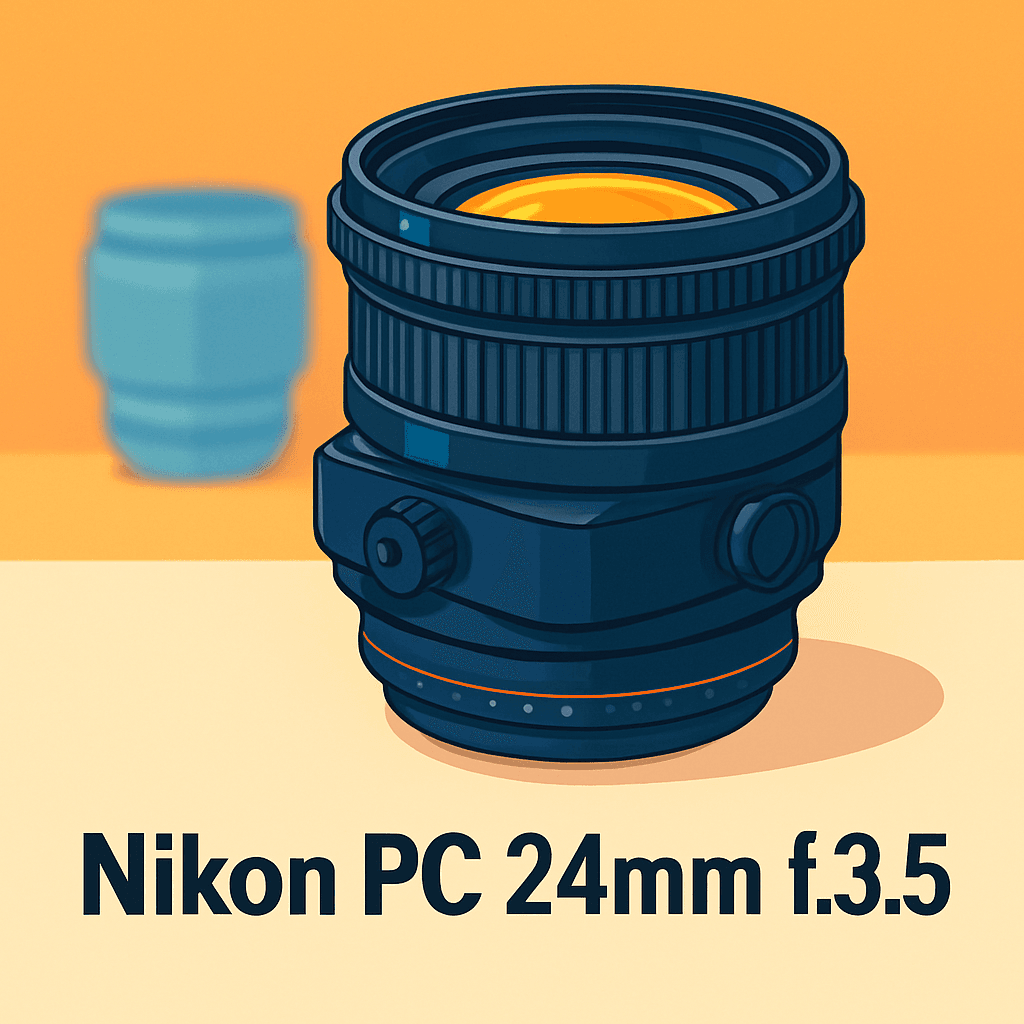
Want to fix converging verticals and get tack‑sharp foreground‑to‑background in tight spaces?
After field‑testing the Nikon F 24mm f/3.5 PC‑E on real shoots, I’m sharing practical impressions you can use. It’s a tilt‑shift tool that gives you real control over perspective and plane‑of‑focus.
It’s made for architects, interior shooters, landscape photographers and product artists who need straight lines, dramatic near‑to‑far clarity, or seamless panoramas. I’ll walk through handling, optical behavior, and workflows so you know when it shines or slows you down — make sure to read the entire review as I show what really matters in the field, keep reading.

Nikon F 24mm f/3.5 PC-E
Ultra-wide tilt-shift optic delivering precise perspective control and exceptional corner-to-corner sharpness. Built for architecture and landscape work, its smooth shift/tilt mechanisms enable distortion-free compositions and creative focus control.
Check PriceThe Numbers You Need
| Spec | Value |
|---|---|
| Focal Length | 24mm |
| Aperture | f/3.5 |
| Lens Mount | Nikon F-mount |
| Lens Type | Tilt-shift |
| Maximum Aperture | f/3.5 |
| Minimum Aperture | f/32 |
| Manual Focus | Yes |
| Lens Elements | 10 elements |
| Lens Groups | 8 groups |
| ED Glass | Yes |
| Closest Focus | 0.21m |
| Angle of View | 84° |
| Dimensions | 88mm x 103mm |
| Weight | Approx. 620g |
| Filter Size | 77mm |
How It’s Built
In my testing the Nikon F 24mm f/3.5 PC-E feels built like a professional tool. It has a solid, metal presence that lets you know it’s not a toy. That reassuring heft matters when you’re working on ladders or in tight interiors.
The tilt and shift controls are the highlight for me. They move with a smooth, precise action and the locks feel secure so your setup stays put. I really liked how repeatable the markings are for returning to a previous move.
Focus is manual and the ring is deliberate, which suits careful composition work. I found live view essential for pixel-level focus, especially with tilt applied. On a body with a grip the combo balances nicely; handheld it’s doable but you’ll want a tripod for serious architecture work.
Filter handling is practical but worth a check before you head out. Heavy duty filter holders can interfere when you push the and pull the lens, so plan your filters ahead. The one thing that could be better is the axis-rotation workflow; it works fine but feels fiddly with gloves on.
Overall the build inspires confidence in the field. Knobs and rails held up to real use without loosening, and the scales stayed readable after a lot of adjustments. If you want a rock-solid, precise tilt-shift lens this one delivers.
In Your Hands
Focusing is deliberate but precise; live view magnification and focus peaking on modern bodies make critical focus straightforward at this wide angle. The ring allows reliable, repeatable racking for tilt work, so you can return to marked positions without guesswork.
Wide apertures are handy for composing and confirming focus while you set tilt or shift, but stopping down noticeably improves edge-to-edge clarity for architecture and landscape. Very small stops introduce a gentle softening, so I avoid the extremes for pixel-critical output.
The shift control makes keeping verticals straight effortless when the camera stays level, which is invaluable for exteriors and tight interiors. Heavy shifts warrant closer corner checks—on a tripod the controls feel precise enough for repeatable corrections during a shoot.
Tilting to align the plane of focus produces natural near-to-far sharpness without constant focus stacking, especially for foreground-led scenes. Wind and moving foliage remain the main challenges, so timing and a sturdy tripod are part of the landscape workflow.
For product work the tilt is superb for laying focus across curved surfaces and the close-focus capability invites tight detail shots; lateral shift stitches produce wide, rectilinear panoramas when exposure and white balance are held steady. Optically the lens renders pleasing microcontrast with manageable flare and some corner falloff at strong shifts that is straightforward to address in capture and post.
The Good and Bad
- 24mm ultra-wide FOV (84°) ideal for architecture and interiors
- Tilt-shift capability for perspective control and plane-of-focus creativity
- Close focusing to 0.21m expands creative and product options
- Wide aperture range down to f/32 for maximum depth-of-field control
- Manual focus only; requires deliberate focusing and technique
- Modest maximum aperture (f/3.5) limits low-light speed and subject isolation
Ideal Buyer
If your work lives in cities, museums or high-end real estate, the Nikon F 24mm f/3.5 PC-E will become a primary tool. Its true 24mm field of view with precision shift lets you hold the camera level while keeping verticals honest. That combination is hard to beat for architects and interior photographers who deliver images with clinical geometry.
Landscape shooters who want both expansive vistas and surgical control will also appreciate it. Use tilt to stretch the plane of focus through foreground detail, and shift to stitch rectilinear panoramas without the keystone headaches. The lens rewards careful composition and planning with panoramic frames that stitch cleanly.
Product and tabletop photographers seeking exacting perspective or selective focus will find the close 0.21m working distance and tilt mechanics invaluable. You can align the focus plane to a product surface and preserve precise geometry for catalogs and advertising. This is a tool for craftspeople who sculpt focus as much as light.
Ultimately this is for deliberate shooters who embrace manual focus and measured setups. If you value repeatable shift/tilt movements, a 77mm filter workflow and Nikon F compatibility, the lens pays dividends in professional workflows. Fast-action, shallow-depth run-and-gun shooters should look elsewhere.
Better Alternatives?
We’ve gone through the Nikon 24mm f/3.5 PC-E and what it brings to architecture, landscapes, and product work. It’s a strong wide-angle tilt–shift tool, but that doesn’t mean it’s the only way to get perspective control or the right look for every job.
Below are a few practical alternatives I’ve used in the field. I’ll say how each one beats the 24mm, where it falls short, and what kind of photographer is likely to pick it over the 24mm.
Alternative 1:

Samyang Nikon F 24mm f/3.5 Tilt Shift
Affordable manual tilt-shift lens offering wide-angle coverage with accurate planar adjustments for architectural, landscape, and panoramic imagery. Compact, sturdy construction with crisp rendering and precise manual control for perspective correction.
Check PriceI’ve shot interiors and exteriors with the Samyang 24mm T/S and the thing that stands out is price versus performance. It gives you the same basic wide view and shift/tilt options as the Nikon 24mm, but at a fraction of the cost. In day-to-day shooting it delivers very good center sharpness and lets you fix keystones and stitch panoramas without breaking the bank.
Where it doesn’t match the Nikon is in refinement. The movement detents and knobs feel a bit coarser, and the corners can be softer or show more falloff when you push big shifts. It’s also fully manual in a way that means the lens won’t hand aperture or focus info to some bodies, so metering or EXIF can be less convenient on modern cameras.
If you’re on a budget or need a backup tilt–shift for occasional architectural or landscape work, this is a smart pick. It’s for shooters who accept a manual, hands‑on workflow and want the look and control of a tilt–shift lens without the higher price or the last bit of mechanical polish.
Alternative 2:

Nikon F 45mm f/2.8 PC-E Micro
True short-macro perspective-control optic combining life-size reproduction with tilt/shift capability for product, still-life, and macro applications. High-resolution rendering, precise micrometer adjustments, and stable build for studio work.
Check PriceI use the Nikon 45mm PC-E when I’m in the studio or doing product and macro work. Compared with the 24mm, the 45mm gives you much better close-focus performance, higher microcontrast, and an f/2.8 option that lets you pull subjects out of the background in a pleasing way. The tilt here is incredibly useful for placing the focus plane across small products or for tight still-life compositions.
The obvious downside versus the 24mm is field of view. The 45mm won’t save you in tight interiors or when you need sweeping architectural perspectives. It also changes how you work with lines and geometry—shift effects are subtler at 45mm, so you can’t replicate the same dramatic wide-angle correction or wide stitched panoramas.
This lens is for studio shooters, product photographers, and anyone who needs macro-capable perspective control. If your work is close, detail-oriented, or you want a repeatable, smooth feel for tilt and shift, the 45mm is worth choosing over the 24mm.
Alternative 3:
Nikon F 45mm f/2.8 PC-E Micro
Versatile studio lens marrying micro-photography with perspective correction—allows exact control over focus plane and framing at close distances. Exceptional contrast, flat-field performance, and smooth, repeatable actuation.
Check PriceComing at the same 45mm from a slightly different angle, I’ve found this lens really shines when you need a flat field and very precise control over the focus plane. For product shots where every edge must be sharp or for macro slices where you want the subject in perfect focus from front to back, the PC-E 45mm is a tool I reach for before the 24mm.
It still can’t replace the wide reach of the 24mm for architecture or panorama work. You’ll be standing further back and you’ll miss that wide perspective on interiors. Also, because it’s tuned for close detail and studio work, it feels less natural on location where quick framing and a wide view matter.
Pick this if your work lives in the studio, if you do a lot of product or macro work, or if you already have a wide lens and want a dedicated perspective-control lens for close subjects. It’s for photographers who value smooth, repeatable adjustments and top-end close-up image quality more than ultra-wide coverage.
What People Ask Most
Is the Nikon PC 24mm f/3.5 a tilt-shift (perspective control) lens?
Yes — it’s a perspective-control (PC) lens that offers independent tilt and shift movements for controlling perspective and the plane of focus.
What are the tilt and shift ranges of the Nikon PC 24mm f/3.5?
The lens provides roughly ±8.5° of tilt and about ±11.5 mm of shift, with the ability to rotate the tilt/shift axis for different orientations.
Does the Nikon PC 24mm f/3.5 have autofocus?
No — it is manual-focus only, which is normal for tilt-shift lenses and gives you precise control when composing shifts and tilts.
Is the Nikon PC 24mm f/3.5 compatible with full-frame (FX) and DX Nikon cameras?
Yes — it was designed for FX full-frame use and will work on DX bodies, but the crop factor reduces the effective coverage and shift utility on DX cameras.
Is the Nikon PC 24mm f/3.5 good for architectural and landscape photography?
Yes — it’s an excellent choice for architecture and landscapes because the wide angle plus shift control lets you correct converging lines and retain composition without heavy post-cropping.
How sharp is the Nikon PC 24mm f/3.5 and what is its overall image quality?
It’s very sharp, especially when stopped down, with good contrast and low distortion for its focal length; expect some edge softness if you push extreme shifts or tilts.
Conclusion
The Nikon F 24mm f/3.5 PC-E is a specialist’s tool for photographers who demand exacting control over perspective and plane of focus. It does one job very well. In the field it earns its keep by letting you fix converging lines and craft selective focus in ways standard wide lenses cannot.
Its tilt-and-shift capability is the standout — precise, repeatable, and creatively liberating for architecture, interiors and landscape panoramas. Micro‑adjustments feel solid and repeatable on a tripod. Close‑focusing adds unexpected versatility for product and detail work.
That precision comes at a cost: manual focusing, deliberate setup and a modest maximum aperture slow you down in low light and run‑and‑gun situations. There is a learning curve, and you pay in speed. The size and handling favor careful, tripod‑based workflows over handheld spontaneity.
If straight verticals, stitched panoramas and Scheimpflug control are central to your work, this lens is worth the investment. If you need faster glass or a different focal-length approach, consider the more affordable tilt‑shift alternatives or the PC‑E 45mm/85mm options instead. In short: buy it for controlled architectural and landscape precision; skip it if speed and convenience are your priority.
Nikon F 24mm f/3.5 PC-E
Ultra-wide tilt-shift optic delivering precise perspective control and exceptional corner-to-corner sharpness. Built for architecture and landscape work, its smooth shift/tilt mechanisms enable distortion-free compositions and creative focus control.
Check Price


0 Comments