
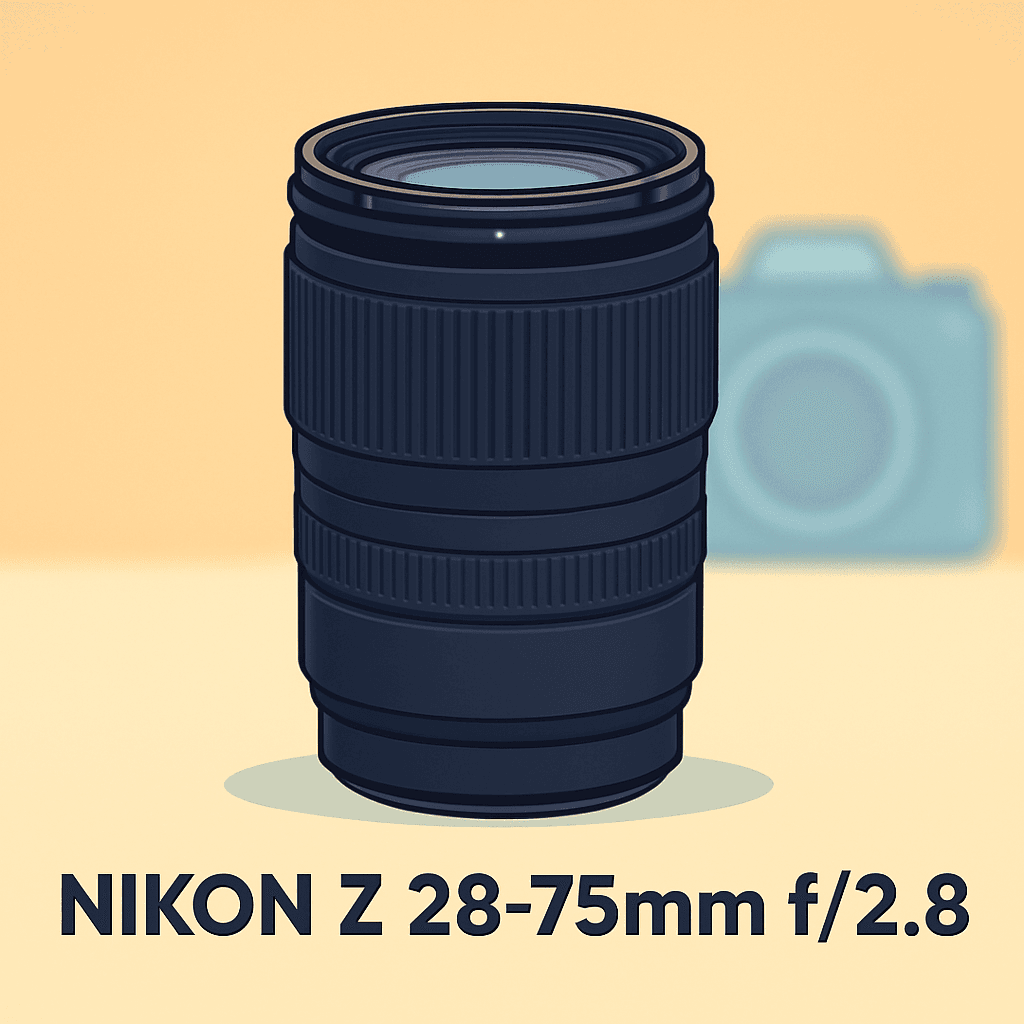
Looking for pro-level f/2.8 speed without lugging a giant, heavy zoom? Would a compact standard zoom change how you’ll shoot events and travel?
The Nikon NIKKOR Z 28-75mm f/2.8 promises fast, consistent f/2.8 performance in a much smaller package. It’s positioned between bulky pro glass and lighter everyday zooms.
If you’re after shallow depth-of-field and reliable low-light performance without a heavy lens, this could be your sweet spot. It’s also appealing for walkaround shooting and tight packing on trips.
After field-testing it on assignments, I’ve found real strengths and obvious compromises. It’s trading some pro features for portability, which matters depending on how and where you shoot.
I’ll cover handling, autofocus, sharpness, and practical pros and cons in this review. Make sure you’re reading the entire review as I break it down — keep reading.

Nikon NIKKOR Z 28-75mm f/2.8
Lightweight, fast-aperture standard zoom delivering crisp images and creamy background separation across everyday focal lengths. Ideal for low-light shooting, portraits, and travel photography when you need agility without sacrificing image quality.
Check PriceThe Numbers You Need
| Spec | Value |
|---|---|
| Mount | Nikon Z |
| Focal length | 28-75 mm |
| Maximum aperture | f/2.8 (constant) |
| Lens construction | 15 elements in 12 groups |
| Minimum focus distance | 0.19 m (7.5 in) |
| Maximum magnification | 0.2x |
| Filter size | 67 mm |
| Diaphragm blades | 9 (rounded) |
| Image stabilization | No (depends on camera body) |
| Focus type | Autofocus with manual override |
| Angle of view (full-frame) | 75° to 32° |
| Aperture range | f/2.8 to f/22 |
| Weight | Approx. 470 g (16.6 oz) |
| Dimensions (diameter × length) | Approx. 73 × 106 mm (2.9 × 4.2 in) |
| Weather sealing | No (not fully weather-sealed) |
How It’s Built
In my testing the Nikon NIKKOR Z 28-75mm f/2.8 feels purpose-built for Z bodies. It’s noticeably smaller and lighter than the big pro zooms, so it sits nicely on my camera and doesn’t pull forward when I’m handholding. That balance makes it easy to shoot for hours without a neck ache.
The finish is a mix of metal and high-quality plastic that feels solid in the hand. I wouldn’t call it pro-level tank build, but it held up to regular field use without any drama. For beginners that means confidence without lugging around something heavy.
The zoom and focus rings have good, predictable resistance. Autofocus has manual override and the focus ring turns smoothly enough for quick fine tuning. That tactile control helped me nail focus in both stills and video work.
One thing I really liked was how compact and well-balanced it is on smaller Z bodies — it made this lens a go-to for street and event days. One thing that could be better is the weather protection; it’s not fully sealed, so I took care around spray and dust.
In practice that means it’s a great everyday lens you can carry all day, and adding common filters is straightforward for video or landscapes. Just treat it a bit gentler in bad weather and you’ll get a lot of use out of it.
In Your Hands
The Nikon NIKKOR Z 28-75mm f/2.8 covers a very practical swath from wide-normal to short-tele, making it an excellent everyday lens for street work, portraits, and events. The constant f/2.8 aperture gives predictable exposure and reliable control over depth of field as you zoom, so subject separation and low-light shooting feel consistent from frame to frame. Zoom action is smooth and intuitive, which keeps compositions fluid when the moment moves fast.
Its close-focusing ability is a genuine surprise for a standard zoom — you can get tight on details and pick out texture with attractive background separation without switching lenses. It isn’t a dedicated macro tool, but the working distance and rendering at close range make it excellent for detail work, product shots, or environmental portraits that need intimacy.
On-camera handling is a highlight: compact, well-balanced, and comfortable to carry all day, it encourages shooting on the move rather than crawling back to a tripod. Because there’s no in-lens stabilization, the lens pairs best with bodies that offer IBIS; handheld use remains very practical with steady technique and sensible shutter speeds.
Finally, adding filters for landscape or video is straightforward thanks to a common filter sizing, and the lens responds well to everyday field care. It isn’t fully weather-sealed, so simple precautions—hood, covers, and quick clean-ups after dusty or wet shoots—keep it working reliably on location.
The Good and Bad
- Constant f/2.8 aperture across 28–75 mm
- Compact and lightweight for an f/2.8 zoom (approx. 470 g; 73 × 106 mm)
- Very close focusing (0.19 m) with 0.2x magnification for detail-oriented shooting
- 9 rounded diaphragm blades for potentially smoother bokeh
- No optical image stabilization (VR)
- Not fully weather-sealed
Ideal Buyer
If you crave f/2.8 speed without a bulky pro zoom, the Nikon NIKKOR Z 28-75mm f/2.8 is made for you. It pares down size and mass while keeping that constant aperture and a useful zoom range for everyday shooting. Think grab-and-go versatility with genuine professional light-gathering and depth-of-field control.
Travel shooters, documentary photographers, and wedding guests-turned-pros will love its balance of reach and low-light punch. Its 0.19 m close-focus and 67 mm filter thread make detail work, creative close-ups, and filters easy to use. Pair it with an IBIS-equipped Z body and handheld shooting becomes a breeze even at slower shutter speeds.
Avoid this lens if you need a wider 24 mm view, built-in optical stabilization, or full weather sealing for rough conditions. Studio pros and landscape shooters who demand edge-to-edge ultimate sharpness and pro tactile controls may prefer the heavier NIKKOR Z 24–70mm f/2.8 S. Also skip it if you routinely need reach beyond 75 mm or uncompromising pro-level build.
This lens is an excellent primary for photographers who want f/2.8 performance in a lighter, more portable package without hauling a big kit. It’s perfect as a daily carry or second lens for long shoots where weight and quick handling matter. Buy it when speed, close-focus capability, and compactness outscore maxed-out specs and weatherproofing.
Better Alternatives?
We’ve gone over the Z 28–75mm f/2.8 and what makes it useful: a true f/2.8 look in a smaller, lighter package than a full pro zoom. It’s great when you want that shallow depth of field and low-light reach without hauling a heavy lens all day. But it isn’t perfect — it starts at 28mm, doesn’t have in-lens stabilization, and the build isn’t as rugged as Nikon’s pro S-line glass.
If you want different trade-offs — more pro build, wider angle, more reach, or a smaller packable option — there are solid alternatives. Below are three lenses I’ve used in real shoots that cover those needs, with straight talk on what each does better and worse compared to the 28–75, and who will like each one.
Alternative 1:

Nikon NIKKOR Z 24-70mm f/2.8 S
Professional-grade standard zoom engineered for exceptional edge-to-edge sharpness, fast low-light performance, reliable autofocus, and weather-sealed durability—built to handle weddings, events, and demanding commercial assignments with consistent, outstanding results.
Check PriceThe 24–70mm f/2.8 S is the obvious step up if you want pro-level performance. In the field I noticed better edge-to-edge sharpness and more contrast than the 28–75, so shots look cleaner across the frame without needing to stop down as much. The extra 4mm on the wide end is more useful than you think for interiors and environmental portraits — you get a noticeably wider view for tight rooms and landscape context.
Where it’s worse is the size and weight. It’s heavier and feels more like a professional tool on a rig. You also give up the 28–75’s slightly closer close-focus feel — that smaller lens gets you in tighter for detail work. The S version is built tougher and weather-sealed, though, so it’s the better choice if you shoot weddings or in rough conditions and need dependable handling all day.
Pick the 24–70 f/2.8 S if you’re a working pro or serious enthusiast who wants the best sharpness, consistent AF, and the wider 24mm view, and you don’t mind extra bulk. If you value portability more than ultimate edge performance, the 28–75 still makes a lot of sense.
Alternative 2:

Nikon NIKKOR Z 24-70mm f/4 S
Compact, constant-aperture standard zoom offering superb resolving power, accurate color rendition, and close-focusing capability. Perfect for travel, landscapes, and everyday shooting when portability and consistent performance matter.
Check PriceThe 24–70mm f/4 S trades f/2.8 speed for a much smaller, lighter lens and it’s one of my go-to travel options. Compared to the 28–75, it gives you 24mm at the wide end which I use a lot for streets and landscapes, and it stays sharp across the frame in everyday shooting. It’s easier to carry all day and slides into a small bag without weighing you down.
What it doesn’t do as well is low-light and subject separation. At f/4 you won’t get the same creamy backgrounds or as much breathing room in dim rooms, so you’ll rely more on higher ISO or slower shutter speeds. The 28–75 wins when you need that extra stop for portraits in low light or faster-moving subjects in dim venues.
This lens is for someone who shoots travel, landscapes, street, or everyday work and values small size and consistent image quality over f/2.8 speed. If you want lighter gear and wider coverage than the 28–75, the 24–70 f/4 S is a very practical swap.
Alternative 3:
Nikon NIKKOR Z 24-70mm f/4 S
Versatile, lightweight zoom tailored for run-and-gun creators and videographers: smooth, quiet autofocus, dependable sharpness across the frame, and a compact footprint that makes it ideal for handheld and gimbal work.
Check PriceUsed as a video or run-and-gun lens, the 24–70 f/4 S shines because it’s light, balanced, and focuses quietly and smoothly. On gimbals or handheld shoots I found it less fatiguing than the 28–75 and the focus transitions look cleaner for interviews and walk-and-talks. The small size makes rigging with cages and mics easier, so you can build a compact setup fast.
On the downside, filmmakers who need the shallowest look in tight light will miss that f/2.8 stop — the 28–75 gives a creamier background at the same focal lengths. Also, neither lens has in-lens stabilization, so if you don’t have a body with IBIS you’ll need to rely on gimbals or higher shutter speeds. Still, for many video shoots the f/4 S is the more practical tool.
If you’re a content creator, run-and-gun videographer, or anyone who spends long hours handheld, the 24–70 f/4 S is a great alternative to the 28–75 — you trade a bit of low-light and background blur for a much more nimble, video-friendly package.
What People Ask Most
Is the Nikon Z 28-75mm f/2.8 a good lens?
Yes — it’s a very capable, versatile fast zoom that delivers strong image quality and value for most photographers.
How sharp is the Nikon Z 28-75mm f/2.8?
Very sharp in the center across the range; edges can be a bit softer wide open but improve noticeably when stopped down.
How does the Nikon Z 28-75mm f/2.8 compare to the Nikon Z 24-70mm f/2.8?
The 28-75 is lighter and cheaper with similar center sharpness, while the 24-70 offers wider 24mm coverage, tougher build, and slightly better edge-to-edge performance.
Does the Nikon Z 28-75mm f/2.8 have image stabilization?
No — the lens has no built-in stabilization, so you should rely on in-body stabilization in Z cameras or faster shutter speeds.
Is the Nikon Z 28-75mm f/2.8 weather-sealed?
It has basic dust and moisture resistance but lacks the heavy-duty weather sealing of Nikon’s professional pro zooms, so avoid shooting in heavy rain.
Is the Nikon Z 28-75mm f/2.8 worth the price?
For most shooters, yes — it offers f/2.8 speed and excellent real-world performance at a much lower cost than Nikon’s pro 24-70.
Conclusion
The Nikon NIKKOR Z 28-75mm f/2.8 is one of those lenses that asks you to choose portability over pro-level frills, and it does that trade very well. In everyday shooting it delivers the speed and subject separation you expect from an f/2.8 zoom while remaining comfortable to carry and easy to balance on mirrorless bodies. For photographers who value a light, fast standard zoom for street, travel, and events, it is an immediately useful tool.
There are clear compromises to consider before committing. The lens forgoes in‑lens stabilization and full weather protection, and it doesn’t extend into the widest focal lengths some shooters prefer. That reality pushes you toward IBIS-equipped bodies, protective workflow habits, and an acceptance of a slightly narrower framing palette.
On balance this is a smart, pragmatic choice for anyone who wants f/2.8 performance without the bulk and cost of a pro-grade standard zoom. If ultimate edge-to-edge resolution, 24mm coverage, or built-in stabilization are deal breakers, look toward the heavier pro options. Otherwise, the Nikon NIKKOR Z 28-75mm f/2.8 is a recommendable, high-value grab-and-go lens with only a few realistic caveats.
Nikon NIKKOR Z 28-75mm f/2.8
Lightweight, fast-aperture standard zoom delivering crisp images and creamy background separation across everyday focal lengths. Ideal for low-light shooting, portraits, and travel photography when you need agility without sacrificing image quality.
Check Price

0 Comments