
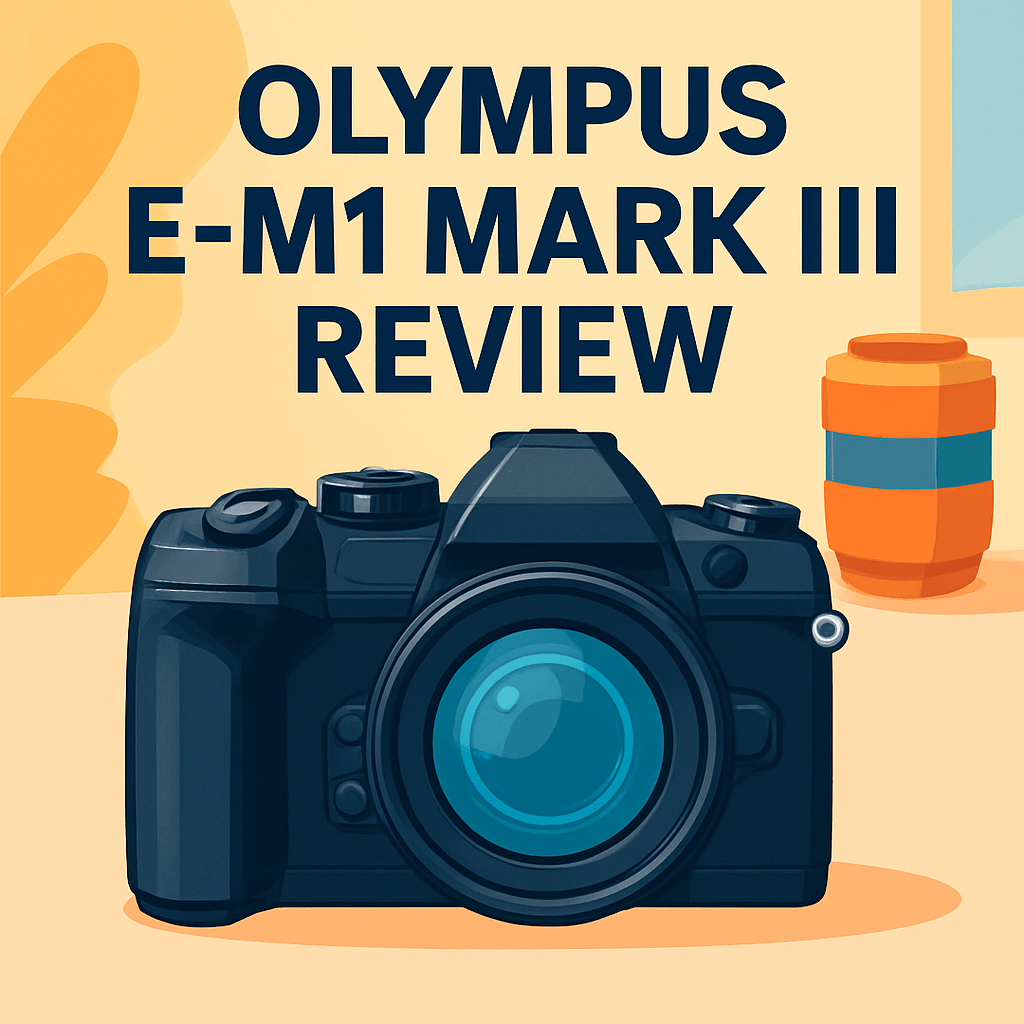
Want to lift your image quality without hauling a full-frame rig?
This olympus e-m1 mark iii review looks at the OM System OM-D E-M1 Mark III Camera. It’s a Micro Four Thirds camera with serious IBIS, fast bursts, and High-Res capture.
I put it through fast-action, handheld low-light, travel weather, and detail-focused High‑Res shoots to see how it performs in real shoots.
If you shoot travel, wildlife, events, or landscapes, you’ll want to know how it handles in the field. Make sure to read the entire review as I break down handling, AF, stabilization limits, burst experience, and practical tradeoffs—keep reading.

OM System OM-D E-M1 Mark III Camera
Professional-grade Micro Four Thirds body delivering pro autofocus, rugged weather-sealing, and industry-leading in-body stabilization for crisp handheld images. Ideal for action, wildlife, and travel photographers seeking reliability and speed.
Check PriceThe Numbers You Need
| Spec | Value |
|---|---|
| Sensor | 20 MP Live MOS |
| Sensor Format | Micro Four Thirds |
| Image Stabilization | 5-axis in-body (IBIS) |
| Autofocus | Fast contrast-detect and phase-detect hybrid AF |
| ISO Range | 64–25,600 (expandable) |
| Continuous Shooting | Up to 18 fps (with AF/AE tracking) |
| Video Recording | 4K UHD up to 30 fps |
| Body Construction | Weather-sealed magnesium alloy |
| Viewfinder | 2.36M-dot OLED electronic viewfinder |
| LCD Screen | 3.0-inch vari-angle touchscreen, 1.04M dots |
| Battery Life | Approx. 420 shots per charge (CIPA) |
| Shutter Speed | 1/8000 to 60 seconds |
| Storage Media | Dual UHS-II SD card slots |
| Weight | Approx. 580 grams (body only) |
| Special Modes | Pro Capture, High-Res Shot (up to 50 MP composite image) |
How It’s Built
In my testing with the OM System OM-D E-M1 Mark III Camera the first thing that stands out is how solid and ready-for-anything it feels. The magnesium-alloy, weather-sealed body gave me real confidence on wet trails and windy overlooks, so I wasn’t worried about a little spray or dust. That makes it a great pick for travel or outdoor shoots where you don’t want to babysit your gear.
It’s compact and well balanced with typical Micro Four Thirds lenses, so carrying it all day wasn’t a workout. I liked the grip and button layout — everything falls to hand without fumbling, which helps when you’re reacting to a moment. One thing that could be better is battery endurance on long days, so plan to keep a spare or two handy.
Controls and menus are sensible from a working photographer’s view, with tactile dials and useful custom buttons. Dual card slots are a real professional touch; I used one for RAW and the other for backups and it made workflow simple and stress-free for a wedding day newbie or a seasoned pro.
The EVF is clear and responsive, so manual focus and tracking feel natural in both bright sun and low light. The vari-angle touchscreen is great for low- or high-angle shots and quick touch-AF, which is handy for vloggers and beginners learning composition tricks.
After using it in light rain and chilly mornings I can say the sealing holds up for typical field use — just don’t go swimming with it. For beginners, the sturdy build and friendly handling make it easy to learn on, and a couple of spare batteries will keep your shoots trouble-free.
In Your Hands
In real shoots the OM-D E-M1 Mark III’s Micro Four Thirds sensor delivers images with pleasing micro-contrast and a level of detail that holds up for travel prints and tight crops better than you might expect from a small-body system. I pushed the camera on backlit scenes and dim interiors and found RAW files retain recoverable highlights and shadows when handled with restraint, making it a solid performer in a practical Micro Four Thirds camera review.
The five-axis IBIS is the feature that changes how you work in the field — it encourages handheld slow-shutter shooting for static subjects and generally lets you trust slower speeds without a tripod. It won’t perform miracles at extreme reach or when you’re panning wildly, but for landscapes, street work, and low-light walkabouts it removes a lot of hesitation.
Shooting action with the E-M1 Mark III feels deliberate and responsive: continuous bursts with AF/AE tracking are confidence-inspiring, shutter feedback is satisfying, and the EVF keeps you locked on the subject without long blackout interruptions. Buffer behavior is steady for most editorial and event sequences, and keeper rates were especially good for predictable motion.
For handheld video the stabilization does heavy lifting, producing steady clips with consistent exposure and usable detail, though the frame-rate ceiling limits slow-motion choices. High-ISO performance is respectable — clean through moderate settings, with color and shadow tones holding up until noise and detail loss become obvious at extreme sensitivity. The flexible shutter range makes it easy to freeze bright-day action or use stabilization to shorten tripod time on longer exposures.
Pro Capture proved invaluable for peak-action moments, reliably grabbing the fraction of a second that would otherwise be missed. In day-to-day workflow the body felt stable and mature: negligible lockups, smooth battery swaps mid-event, and fast card writes that keep you shooting when it counts in this olympus e-m1 mark iii review.
The Good and Bad
- Rugged, weather-sealed magnesium alloy build
- 5-axis in-body stabilization for confident handheld shooting
- Up to 18 fps with AF/AE tracking for action sequences
- High-Res Shot composite mode up to 50 MP for detail-focused work
- 4K video capped at 30 fps (no 60p in spec)
- High-Res Shot is composite-based, best for static scenes (motion can cause artifacts)
Ideal Buyer
This camera is built for photographers who prize rugged, weather-sealed portability on the road and in the field. The OM System OM-D E-M1 Mark III is compact enough to carry all day yet robust enough to shrug off a drizzle or a dusty trail.
Action and wildlife shooters will appreciate the 18 fps burst with AF/AE plus class-leading 5-axis IBIS for confident handheld frames. It nails unpredictable motion more often than not in the field. You get keeper rates that justify the system’s compact size.
Event and documentary shooters will like the responsive controls, thoughtful ergonomics, and dual UHS‑II card slots for backup or workflow separation. Reliable handling and quick battery swaps make it a practical tool for multi-hour assignments.
Landscape and product photographers who can lock the scene will exploit the High‑Res Shot composite to deliver 50 MP images with extra micro-detail. Just be mindful that moving leaves or people will betray the composite process.
Hybrid creators who prioritize stills but want capable 4K30 video and rock-solid stabilization will find a strong balance here. The camera favors photographers first, with video as a handy second discipline. If you need 60p or the absolute latest AF, consider stepping up, but expect reliable stills performance from this Micro Four Thirds workhorse.
Better Alternatives?
We’ve already gone deep on the OM‑D E‑M1 Mark III — how it handles fast bursts, its IBIS, High‑Res Shot workflow, and day‑to‑day shooting in weather. That camera is a strong, well‑rounded tool, but depending on what you shoot most, there are other bodies that lean harder in one direction or another.
Below are three real‑world alternatives I’ve used on shoots. I’ll say what each one does better and where it gives ground to the E‑M1 Mark III, and who I’d recommend each for.
Alternative 1:

OM System OM-1 Camera
Flagship mirrorless powerhouse with a stacked sensor and advanced AI-driven subject detection that locks focus in challenging conditions. Exceptional stabilization and high-speed capture enable confident shooting across photo and video workflows.
Check PriceThe OM System OM‑1 is the obvious step up from the E‑M1 Mark III in day‑to‑day shooting. In my hands the autofocus is faster and more reliable on erratic subjects — faces, birds, and small fast animals stick more often. The IBIS feels just as strong or a touch better in practice, so handheld low‑light shots and slow‑shutter landscapes are easy to pull off with less fuss.
Where the OM‑1 gives ground is mostly cost and a couple of workflow quirks. It’s pricier, so you pay for that improved AF and the newer processor. Also, some of the menu and computational features are more aggressive by default — you’ll want to tweak settings to match your style. On some electronic high‑speed modes it can show more rolling‑shutter than the Mark III, so for certain fast electronic‑shutter bursts I still prefer the Mark III’s behavior.
Pick the OM‑1 if you’re a shooter who needs the absolute best autofocus and subject detection in the Micro Four Thirds world — wildlife and fast sports shooters will see the biggest jump. If price matters or you prefer the exact feel and menu approach of the Mark III, then the Mark III still holds strong value.
Alternative 2:

Panasonic LUMIX G9 Camera
Speed-focused enthusiast camera offering lightning-fast burst rates, responsive autofocus, and ergonomic handling for long shooting sessions. Durable construction and versatile video capabilities make it perfect for sports and wildlife shooters.
Check PriceThe Panasonic LUMIX G9 shines when you need a big, comfortable camera for long days and heavy glass. I’ve shot whole matches and long hikes with it on a long tele and appreciated the deeper grip and noticeably longer battery life compared with the Mark III. Its burst handling and buffer are generous, so long runs of frames are less stressful when you’re chasing action.
On the downside, the G9’s subject tracking for erratic movement isn’t as reliable as Olympus’ best tracking — I’ve lost focus on fast, unpredictable birds more often on the G9 than on the Mark III. Colors straight from camera are pleasing, and JPEGs can look great, but if you rely on spot‑on AF in messy light the Mark III will get you more keepers.
Choose the G9 if you do long shoots with big lenses, need better battery life, and want a very comfortable grip for sports or event work. It’s a great pick for people who value handling and run‑time over the last few percentage points of AF tracking performance.
Alternative 3:
Panasonic LUMIX G9 Camera
Capture ultra-detailed images with a high-resolution mode and stable handheld performance thanks to strong in-body stabilization. Intuitive controls, deep grip, and weather-sealed design support demanding outdoor and studio work.
Check PriceViewed from a detail‑first angle, the G9’s high‑resolution mode and solid IBIS make it a real alternative to the Mark III’s High‑Res Shot. In practice I’ve used the G9 for studio product work and calm landscape sessions where that extra resolution paid off for big prints. Handheld high‑res shots are possible if you’re careful, and the body gives a confidence‑in‑hand that helps when composing tight detail shots.
Compared to the E‑M1 Mark III, the G9’s high‑res workflow can feel a bit different: the Mark III’s High‑Res Shot is very easy to use and worked well for me in both tripod and controlled handheld setups. The G9 can produce slightly larger files in some modes, but it’s less forgiving with small motion and requires more deliberate technique. Again, AF tracking and the keeper rate on erratic subjects lean in favor of the Mark III.
Go for the G9’s high‑res strengths if you’re mainly a landscape, studio, or product shooter who values large final files and ergonomics for long handheld sessions. If you need the most reliable tracking for wildlife or sports, the OM‑D E‑M1 Mark III (or the OM‑1) will still give you more consistent results in the field.
What People Ask Most
Is the Olympus OM-D E-M1 Mark III worth buying?
Yes — it’s a great buy if you want a compact, weather-sealed pro Micro Four Thirds body with class-leading stabilization and versatile features; skip it if you need full-frame low-light or top-tier video performance.
What are the main differences between the E-M1 Mark III and the E-M1 Mark II?
The Mark III adds a newer processor, improved autofocus and subject detection, better IBIS and handheld high-res modes, plus refinements in handling and features over the Mark II.
How is the autofocus performance on the E-M1 Mark III?
Autofocus is fast and reliable for most stills, with better eye/animal detection than previous models, though it won’t outpace the highest-end full-frame trackers in extreme low light.
Is the E-M1 Mark III good for wildlife and sports photography?
Yes — its fast burst modes, strong AF and stabilization make it excellent for many wildlife and sports situations, but the smaller sensor limits high-ISO performance and background separation compared with full-frame bodies.
How good is the image stabilization on the E-M1 Mark III?
It’s excellent and among the best you’ll find, delivering multiple stops of handheld advantage (exact benefit varies by lens and shooting conditions).
What is the battery life of the Olympus E-M1 Mark III?
Battery life is solid for daily use and generally gets you through a full day of mixed shooting, but bring a spare for long bursts, extended shoots, or heavy video use.
Conclusion
The OM System OM-D E-M1 Mark III is a stills-first workhorse that performed like a field-ready tool on every shoot I threw at it. Its stabilization, responsive burst shooting with AF/AE tracking, and rugged, weather-sealed handling make it a confident choice for travel, action and landscape photographers. The camera’s High-Res composite and Pro Capture features add practical muscle when detail or split-second timing matters.
It isn’t without compromises, and those matter depending on your priorities. Video-minded creators will feel the ceiling, the high-resolution mode requires static subjects to shine, and full-day outings benefit from planning extra battery power. Those caveats don’t negate the camera’s core strengths, but they should steer realistic expectations.
If your work puts stills and reliability first — handheld low-light freedom, decisive tracking, card redundancy and rugged portability — the E‑M1 Mark III delivers strong, dependable value. If cutting-edge AF, longer run times or a video-first feature set matter more, consider the OM‑1, a G9 body, or a GH5 II respectively as alternatives.
After extensive real-world use, my verdict is clear: the E‑M1 Mark III is a balanced, mature Micro Four Thirds choice that rewards photographers who prioritize stabilization, speed and build quality over headline specs. It’s a lens-friendly, go-anywhere camera I’d reach for on many pro shoots.
OM System OM-D E-M1 Mark III Camera
Professional-grade Micro Four Thirds body delivering pro autofocus, rugged weather-sealing, and industry-leading in-body stabilization for crisp handheld images. Ideal for action, wildlife, and travel photographers seeking reliability and speed.
Check Price

0 Comments