
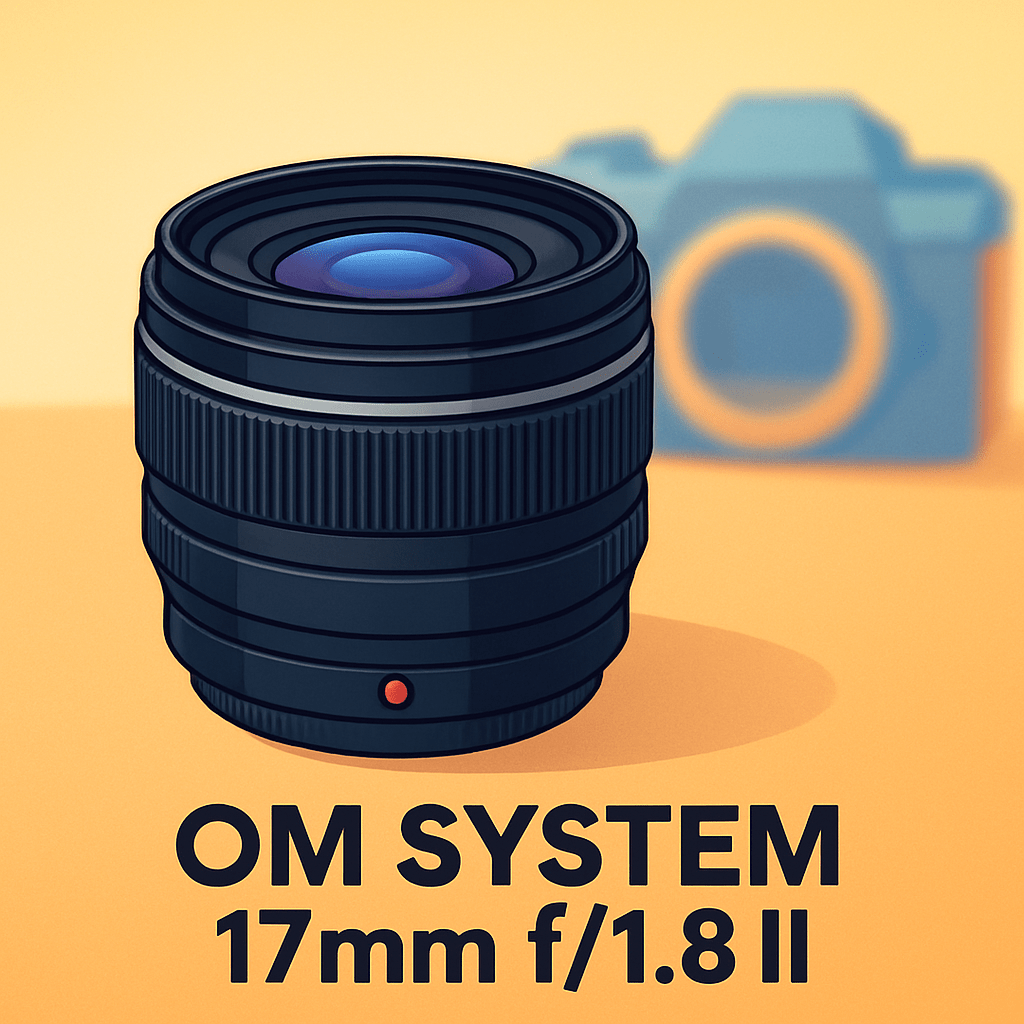
Want sharper low-light shots without lugging a big lens?
It’s the OM System M.Zuiko Digital 17mm f/1.8 II, a compact, fast Micro Four Thirds prime with about a 65° view and bright f/1.8 aperture.
Its quiet STM autofocus and roughly 120 g weight make it ideal for discreet street, travel, and everyday carry; you’ll get easier low-light shooting and less bulk.
After shooting it in the field, I found clear trade-offs: no weather sealing and limited close-focus, so it’s not a macro lens. Make sure to read the entire review—keep reading.

OM System M.Zuiko Digital 17mm f/1.8 II Micro Four Thirds
Bright f/1.8 II prime delivers punchy, edge-to-edge sharpness in a compact, lightweight package; ideal for street, travel, and low-light portraits with fast autofocus and pleasing background separation.
Check PriceThe Numbers You Need
| Spec | Value |
|---|---|
| Focal length | 17mm |
| Maximum aperture | f/1.8 |
| Lens mount | Micro Four Thirds |
| Angle of view | Approx. 65° |
| Optical design | 10 elements in 7 groups |
| Minimum focusing distance | 0.25 m |
| Maximum magnification | 0.12x |
| Aperture blades | 7, rounded |
| Filter size | 46mm |
| Dimensions (diameter x length) | Approx. 56mm x 43.5mm |
| Weight | Approx. 120 grams |
| Autofocus | Stepper motor (STM) system for quiet and smooth focus |
| Weather sealing | No (not fully weather-sealed) |
| Compatible camera sensor format | Micro Four Thirds system |
| Lens coating | Super multi-coating to reduce flare and ghosting |
How It’s Built
In my testing the OM System M.Zuiko Digital 17mm f/1.8 II is tiny and very light, so it practically disappears on a small Micro Four Thirds body. That compact footprint makes it a true grab-and-go lens for street walks and travel days. It also uses a common 46mm filter thread, so slipping on a polarizer or ND is straightforward.
Construction feels solid for its size, with a multi-element optical layout and super multi-coating that really helps control flare and ghosting in backlit shots. The rounded seven-blade aperture gives a nice change in out-of-focus shapes as you stop down, and I noticed smoother background transitions in real scenes. Overall it feels more refined than its small size would suggest.
Handling is exactly what you want on a small body — balanced, discreet, and easy to carry all day. The focus ring is smooth with just enough resistance for precise manual tweaks, and autofocus is quiet so you can shoot without drawing attention. After using it for a while I found framing and focus adjustments to feel natural and confidence-inspiring.
One clear limitation is the lack of weather sealing, so I avoid heavy rain or dusty conditions unless it’s under a cover. What I really liked was how unobtrusive and portable it is for everyday use; what could be better is adding some weather protection for tougher shoots. For beginners that means great handling right away, but plan to shield it when the weather turns.
In Your Hands
On the street and on the road the OM System M.Zuiko Digital 17mm f/1.8 II feels like a true everyday companion, framing subjects with a modestly wide view that keeps people in their environment without making backgrounds feel distant. It’s equally at home on quick travel days, environmental portraits, and low-key documentary work, where the focal perspective balances context and subject presence. The lens’s compact footprint makes it easy to carry all day and to shoot discreetly when moments unfold fast.
The bright aperture gives meaningful exposure flexibility and reliable subject isolation, so handheld low-light shooting becomes routine rather than a special setup. Backgrounds roll away smoothly enough for casual portraits, while the shallow depth helps pull attention to faces and details without isolating them from their surroundings. For filmmakers, the quiet focusing and steady rendering aid discreet capture in mixed lighting scenarios.
Super multi-coating pays dividends in backlit and night situations, holding onto contrast and color where cheaper coatings would wash out highlights; I found flare largely tame except when the sun sat just at the frame edge. Nighttime point lights retain character without obvious ghosting, which keeps cityscapes and neon-lit streets looking clean. Stopping down brings more pronounced geometric highlight shapes and modest sunstars, so choose aperture to taste for rendering.
Close-focus capability is useful for intimate near-subjects but this is not a macro tool, so get creative with framing rather than relying on magnification. Field behavior is friendly: corner shading is present wide open but subsides when stopped down, distortion is well controlled for architectural lines, and color fringing is minimal in normal use. Bokeh is generally pleasing when wide open, with a subtle shift toward defined shapes as you stop down, making it versatile for everyday visual storytelling.
The Good and Bad
- Bright f/1.8 aperture for low light and subject isolation
- Very compact and lightweight (approx. 120 g; 56 x 43.5 mm)
- Quiet, smooth STM autofocus (useful for video and discreet shooting)
- Super multi-coating to help reduce flare and ghosting
- No weather sealing (consider environmental limitations)
- Maximum magnification 0.12x and 0.25 m MFD — limited for close-up/macro work
Ideal Buyer
The OM System M.Zuiko Digital 17mm f/1.8 II is ideal for photographers who prize portability and quick, low‑light performance. Its modestly wide field (about 65°) and bright f/1.8 aperture make it a go‑to for street, travel, and environmental portrait work.
Shooters who need quiet, unobtrusive autofocus for video or discreet street work will appreciate the smooth STM drive. The lens balances naturally on small Micro Four Thirds bodies for true everyday carry.
It’s best suited to users who can live without weather sealing and don’t rely on macro magnification. If you frequently work in heavy rain, dust, or need tight close‑ups, you may prefer a different tool.
Owners of the original 17mm who want slightly refined handling and snappier AF will find a sensible, low‑impact upgrade here. Photographers who favor low‑light flexibility and subject isolation over extreme close‑ups get the most from this optic.
Travel shooters building a light kit will like the roughly 120 g weight and common 46 mm filter compatibility for easy stacking. Beginners seeking a forgiving, intuitive walkaround lens will enjoy its balance, while pros chasing ultimate corner resolution or weather sealing should compare alternatives.
Better Alternatives?
We’ve gone over the OM System 17mm f/1.8 II: a tiny, quick, and usable 17mm prime that’s great for street, travel, and low-light work. It’s a very balanced lens for everyday shooting, but it isn’t the only way to get a similar look or different handling from a Micro Four Thirds prime.
Below are a few real-world alternatives I’ve used. I’ll point out what each lens does better and where it gives up ground compared to the OM System 17mm f/1.8 II, and who would most likely prefer each option.
Alternative 1:

Panasonic Leica DG Summilux 15mm f/1.7 Micro Four Thirds
Ultra-wide 15mm prime offers bright f/1.7 performance with Leica-engineered optics, delivering superb clarity, smooth bokeh, and reliable low-light capability—perfect for landscapes, architecture, and environmental portraits.
Check PriceI’ve shot the Panasonic Leica 15mm in streets and landscapes. Compared to the OM System 17mm II, it gives a slightly wider view and a touch more pop in contrast and micro-contrast — images feel a bit more three-dimensional. That extra reach from f/1.7 vs f/1.8 is small on paper, but in real low-light shots it buys you a little more flexibility and a slightly cleaner look.
The trade-offs are clear in the field: the Summilux is bigger, heavier, and pricier. It’s not as pocketable as the 17mm II, and its corners can look softer wide open on some scenes, so I often stop it down for landscapes. Autofocus works well, but the package doesn’t feel as featherlight or as stealthy for all-day street carry.
Buy this if you want a richer, more “Leica-like” rendering and a slightly wider view for environmental portraits, architecture, and landscape work — and if you don’t mind paying more and carrying a bit more weight. If compactness and maximum stealth are your top goals, the OM System 17mm II will probably suit you better.
Alternative 2:

Olympus M.Zuiko Digital 17mm f/1.8 Micro Four Thirds
Lightweight 17mm prime combines fast aperture and natural rendering for everyday shooting; produces crisp images, soft background separation, and responsive autofocus in a compact, travel-friendly form.
Check PriceThis is the original Olympus 17mm f/1.8 I’ve used for years. Optically it’s very close in look to the OM System 17mm II — nice center sharpness and pleasant overall rendering. Where it beats the OM System is price on the used market; you can often find one for much less and get most of the same image character.
Where it lags is in the small handling and AF updates Olympus added to the II version. The II feels a bit smoother in autofocus during video and locks a touch quicker on some bodies. If you shoot a lot of run-and-gun video or need the absolute smoothest AF, the II has the edge. Otherwise, the older 17mm still delivers solid photos and a compact footprint.
Pick the original Olympus 17mm if you want nearly the same look as the OM System lens but at a lower cost, especially used. It’s a great choice for budget-minded street and travel shooters who care more about image quality per dollar than having the very latest AF refinements.
Alternative 3:
Olympus M.Zuiko Digital 17mm f/1.8 Micro Four Thirds
Versatile pancake-style prime delivers consistent sharpness, speedy AF, and excellent low-light handling; a go-to choice for street photographers seeking unobtrusive, high-quality optics in a small footprint.
Check PriceUsed as a pancake-style prime, the Olympus 17mm feels almost invisible on a small MFT body — I’ve carried it on long walks and barely noticed it. Compared to the OM System 17mm II, the original Olympus is equally discreet and just as versatile for street shooting. Both give similar framing and shallow depth at f/1.8, but the OM System II can feel slightly more refined in hand and during continuous AF on some cameras.
In practice, the Olympus pancake is perfect for photographers who want to stay unnoticed and move fast. Its AF is quick enough for most street work, and its size makes it a true “always-on” lens. The downside versus the OM System II is that you miss the tiny handling and AF smoothing upgrades — not dealbreakers, but noticeable if you shoot lots of video or very fast-moving scenes.
Choose the Olympus pancake 17mm if your priority is the smallest, lightest setup for street and travel and you value discretion over the latest AF tweaks. If you want the smoothest AF behavior and a slightly improved feel in the hand, lean toward the OM System 17mm f/1.8 II.
What People Ask Most
Is the OM System 17mm f/1.8 II weather-sealed?
Yes — the lens has dust-, splash- and freeze-resistant sealing for use in most adverse conditions.
How sharp is the OM System 17mm f/1.8 II across the frame?
Very sharp in the center at f/1.8 with some corner falloff wide open that improves to excellent by f/2.8–f/4.
Is the OM System 17mm f/1.8 II compatible with Olympus and Panasonic Micro Four Thirds cameras?
Yes — it uses the Micro Four Thirds mount and works fully with Olympus and Panasonic bodies, including autofocus and exposure features.
What is the full-frame equivalent focal length of the OM System 17mm f/1.8 II?
On Micro Four Thirds the 17mm focal length equals about 34mm on full-frame.
How does the OM System 17mm f/1.8 II compare to the original 17mm f/1.8?
The II version improves sharpness, coatings and sealing while keeping a compact size, so it’s a noticeable but not radical upgrade.
Is the OM System 17mm f/1.8 II good for low-light photography and astrophotography?
Yes — f/1.8 gives strong low-light performance and it’s well suited for astrophotography, though stopping down slightly helps corner performance and coma.
Conclusion
The OM System M.Zuiko Digital 17mm f/1.8 II Micro Four Thirds is a compact, fast prime that delivers the portability, low-light capability and quiet autofocus many photographers want. In the field it behaves like a trustworthy everyday lens — punchy center rendering, pleasant out-of-focus character and quick, unobtrusive AF. For street, travel and documentary work it simply gets out of the way and lets you shoot.
It isn’t without compromises: there’s no weather sealing and its close-focus abilities won’t replace a macro when you need extreme near work. The aperture design and stopping-down behavior can shape highlights in ways you’ll notice if bokeh is your primary concern. If you already own the original 17mm, the II feels like an iterative polish — smoother AF and a few handling refinements rather than a radical optical leap.
Overall I recommend this lens to photographers who prioritize portability, low-light performance and discreet operation over all-weather ruggedness or macro capability. If you want a different field of view or a markedly different rendering character, explore the alternatives; otherwise this is a compact, capable choice that punches above its size. Choose based on how it feels on your body and whether the AF and handling tweaks matter enough to you.
OM System M.Zuiko Digital 17mm f/1.8 II Micro Four Thirds
Bright f/1.8 II prime delivers punchy, edge-to-edge sharpness in a compact, lightweight package; ideal for street, travel, and low-light portraits with fast autofocus and pleasing background separation.
Check Price


0 Comments