
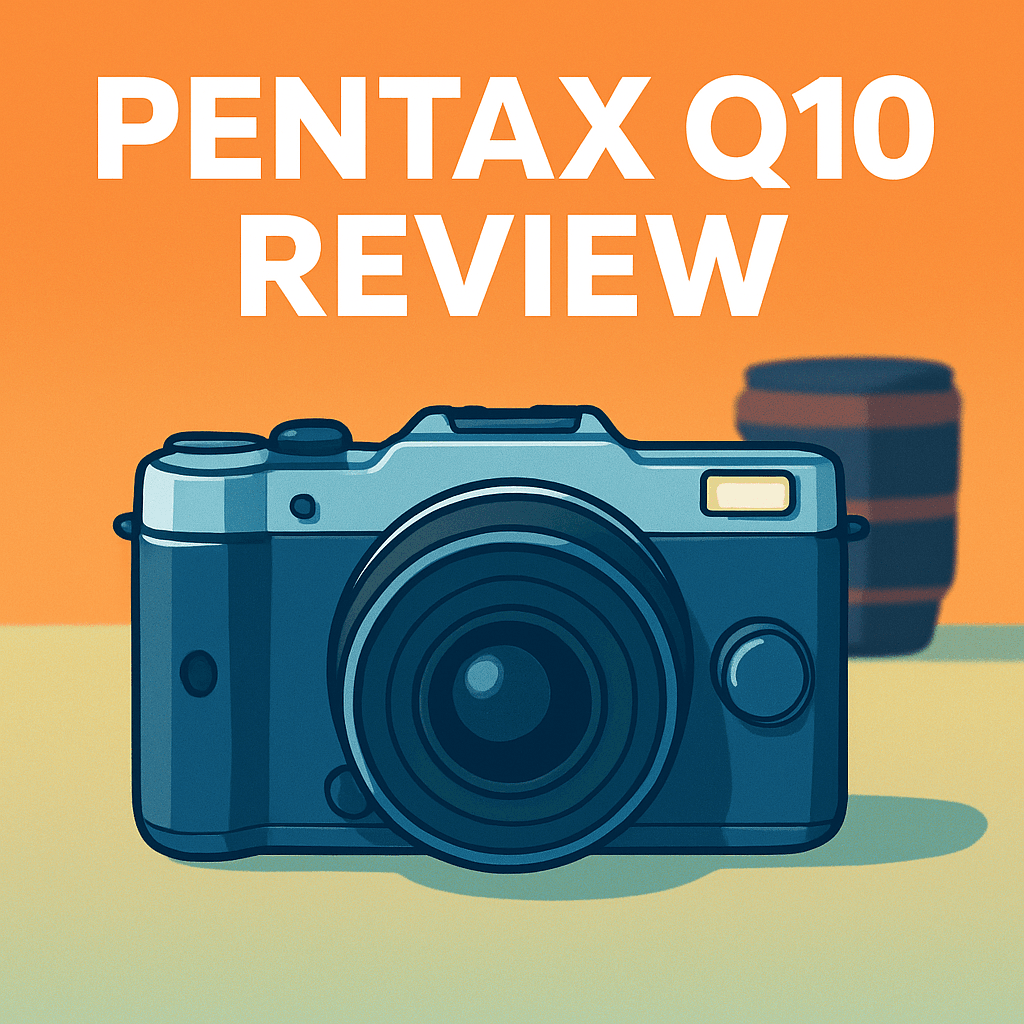
Looking for a pentax q10 review that tells you whether this tiny camera can upgrade your travel and street photography?
The Pentax Q10 Camera is an ultra-compact, interchangeable-lens system built around the Q‑mount and a 1/2.3″ 12.4 MP CMOS sensor, designed to be carried everywhere. Its main appeal is true pocketability paired with small, lightweight lenses.
You should expect excellent convenience and fun handling in good light, but also some tradeoffs compared with modern mirrorless systems when it comes to low‑light performance and autofocus sophistication. This review focuses on real-world payoffs, not just specs.
Having taken one into the field alongside similar compacts, I’ll walk through design and handling, real-world performance, image quality, autofocus, pros and cons, who it’s for, and tangible alternatives. Make sure to read the entire review as I break down whether the Q10 is the right tiny camera for you—keep reading.

Pentax Q10 Camera
Ultra-compact interchangeable-lens camera offering pocketable design, sharp image quality, intuitive controls, and fun creative filters — ideal for travel photographers who want DSLR-like versatility without the bulk.
Check PriceThe Numbers You Need
| Spec | Value |
|---|---|
| Sensor | 12.4 MP (1/2.3" type) CMOS |
| Lens mount | Pentax Q-mount |
| ISO range | 100 to 6400 |
| Autofocus | Contrast-detect AF system |
| Continuous shooting speed | Up to 5 fps |
| Shutter speed range | 1/8000 to 30 seconds |
| Image stabilization | Digital image stabilization |
| Video recording | 1080p Full HD at 30 fps |
| LCD screen | 3.0" fixed TFT LCD, 460,000 dots |
| Viewfinder | No built-in electronic viewfinder |
| Storage media | SD/SDHC card slot |
| Battery | Rechargeable lithium-ion battery |
| Body dimensions | Approx. 103 x 58 x 34 mm |
| Weight | Approx. 200 grams (including battery and card) |
| Built-in flash | Yes, pop-up flash |
How It’s Built
In my pentax q10 review I’ve carried the Pentax Q10 Camera everywhere to test how pocketable it really is. It’s tiny and light, so it slips into a jacket pocket or small bag and actually gets used instead of gathering dust.
The Q-mount and tiny lenses are the main draw in my testing. What I really liked was swapping compact lenses without adding bulk. For beginners that makes exploring different focal lengths far less intimidating.
You compose entirely on the fixed LCD and that can be a pain in bright sun. What could be better is the lack of any electronic viewfinder, which forces awkward angles or squinting. In practice you learn to brace your arms or press the camera to your face for steadier shots.
Buttons and dials are small but usable; in my hands most controls were reachable with a little practice. The pop-up flash is genuinely handy for quick fill on close subjects when you don’t want to change lenses or carry extra gear.
It uses a standard SD card and a rechargeable lithium pack, so swapping media and power in the field is straightforward. Battery life wasn’t stellar in my testing, so bring a spare and you’ll avoid interrupted shoots.
In Your Hands
Out in the street the Pentax Q10 Camera feels eager but modest — it fires up quickly and settles into a smooth, responsive rhythm for everyday shooting. Its burst capability is handy for brief, casual action, though it never pretends to be a high-speed sports tool.
The shutter gives you surprising creative leeway, so you can confidently stop fast motion in bright conditions or experiment with long exposures for night scenes without extra triggers. That flexibility encourages playful aperture and motion choices on the fly.
Low-light work reminds you of the camera’s compact-sensor heritage: daylight shots are where it shines, while higher sensitivities call for restraint. Practical tactics — faster lenses, firm bracing, or the pop-up flash for close fill — make the difference between usable frames and noisy disappointments.
Digital stabilization helps steady casual handheld frames, but it’s a software fix that can trade a bit of fine detail or field of view for steadiness. For deliberate low-light or subject motion, rely on support or faster shutter decisions rather than expecting stabilization to do all the work.
Full HD video is straightforward and serviceable for quick clips, though contrast-based autofocus can search in tricky lighting. In the field you’ll be managing cards and battery swaps and composing on a fixed rear LCD, so a spare battery and some framing practice from odd angles pay off.
The Good and Bad
- Extremely compact and light (103 x 58 x 34 mm; ~200 g with battery/card)
- Interchangeable-lens Q-mount system with very small lenses
- Fast maximum shutter speed of 1/8000s for bright conditions and fast glass
- 1080p Full HD video at 30 fps for simple on-the-go clips
- Small 1/2.3″ sensor limits low-light performance and dynamic range
- No built-in EVF; composing solely on a fixed 3″ 460k-dot LCD can be challenging in bright light
Ideal Buyer
The Pentax Q10 Camera is for shooters who put ultra-compact, interchangeable-lens portability above all else. If stuffing a camera in a jacket pocket matters more than chasing cutting‑edge specs, this little system delivers. Think tiny footprint, easy carry, and lenses to match.
Travelers and street photographers who mostly shoot in good light will love the minimal kit. The small body and whisper-light lenses make spontaneous shooting less of a commitment. You trade low‑light headroom for freedom of movement.
Beginners and enthusiasts learning exposure and shutter control benefit from the Q10’s wide 1/8000–30s range. It lets you experiment with very fast shutter speeds and basic long exposures without bulky gear. That hands-on learning beats a phone when you want creative control.
Casual content creators who need simple 1080p30 clips and easy walk‑around video are a good fit. Be ready to work with contrast‑detect AF and digital stabilization rather than modern tracking. For quick social clips and family moments it’s more than capable.
Finally, pick the Q10 if you adore compact Q‑mount glass and are comfortable composing on a fixed rear LCD. If you accept small‑sensor limits, slower AF and no EVF, you’ll get an incredibly pocketable system. Bring a spare battery and an open mind.
Better Alternatives?
We covered the main points in this pentax q10 review — the tiny body, the small 1/2.3″ sensor, the Q‑mount lenses and the charm of an ultra‑compact interchangeable system. That small size is the Q10’s whole idea: carry it everywhere and still swap lenses, but remember that comes with limits in low light, autofocus speed, and video features.
If you want more image quality, better autofocus, or stronger video, you’ll need to trade up in size and weight. Below are three real-world alternatives I’ve used a lot, how they shoot differently from the Q10, and what kind of buyer each one suits.
Alternative 1:

Fujifilm X-E4 Camera
Sleek rangefinder-style mirrorless body housing an advanced APS-C sensor, delivering rich color, film-simulation profiles, fast autofocus, and 4K video in a lightweight package for creative enthusiasts.
Check PriceThe Fujifilm X‑E4 feels like a big step up from the Q10 when you care about image look and color straight out of camera. Its larger APS‑C sensor and Fuji’s film simulations give photos richer tones and cleaner files in low light — in practice that means less noise and more detail when you’re shooting indoors or at dusk compared with the Q10’s small sensor. I noticed portraits and street shots just had nicer skin tones and color depth without heavy editing.
Where the X‑E4 is better is obvious in autofocus and video — it locks on faster, keeps focus on faces more reliably, and records 4K if you need sharper clips. The tradeoffs are that the body and lenses are bigger and heavier than the Q10 kit, so you lose that pocketable convenience. Also, if you depend on in‑body stabilization, the X‑E4 doesn’t have it, so you’ll still need steady hands or stabilized lenses for low‑light handheld shots.
Buyers who will like the X‑E4 are people who want much better image quality and nicer color straight away, and who don’t mind carrying a slightly bigger setup. It’s great for street shooters who want film-like colors, travelers who want strong stills and 4K video, and enthusiasts ready to trade a tiny body for much better low‑light performance.
Alternative 2:

Sony Alpha A6100 Camera
Fast, versatile mirrorless offering responsive real-time autofocus, detailed 24MP imaging, 4K video capability, and compact handling—perfect for hybrid shooters capturing action and everyday moments.
Check PriceThe Sony A6100 is a clear jump up from the Q10 for autofocus and action work. In real shoots the eye‑detect and tracking actually hold subjects steady when you move or when people walk toward you — something the Q10’s contrast AF struggles with. Image files are cleaner at higher ISO, so grabbing photos at a party or indoors is easier without blowing out noise like you might on the Q10.
Video and hybrid use are stronger on the A6100 too — 4K and smooth AF in recording let you shoot short films or vlogs that look much more modern than the Q10’s 1080p clips. The downside is size and lens weight: the Sony setup is still a lot bigger than the Q10’s tiny bodies and pancakes, and it won’t slide into a coat pocket. Also, like the Q10, it usually relies on lens stabilization rather than in‑body steadying.
If you need quick, reliable focus for portraits, street, or fast everyday moments and you want better video, the A6100 suits you. It’s a good pick for hybrid shooters, vloggers on a budget who want 4K, or anyone who found the Q10’s AF and low‑light limits frustrating but still wants a relatively small mirrorless camera.
Alternative 3:
Sony Alpha A6100 Camera
Beginner-friendly interchangeable-lens solution with blazing autofocus, long battery performance, intuitive controls, high-speed continuous shooting, and reliable low-light sensitivity—ideal for vlogging, travel, and family photography.
Check PriceUsed as an entry-level workhorse, the A6100 shines where the Q10 feels limited. Its autofocus is forgiving for beginners — point, half‑press, and it finds eyes and faces with ease. Continuous shooting and buffer feel more capable in real life, so you catch fleeting moments at family events or kids at play far more often than with the Q10’s more modest burst abilities.
Where it’s worse than the Q10 is in sheer portability and simplicity. The Q10 wins when you want the absolute smallest kit to stash in a pocket; the A6100 asks for a small bag. You also trade some of the Q10’s quirky delight of tiny Q‑mount lenses for larger Sony lenses. Battery life in daily use tends to feel better on the A6100, though, so you can shoot longer without swapping cells.
This version of the A6100 is ideal for first‑time interchangeable‑lens owners who want something that “just works” for travel, vlogging, and family days out. If you liked the Q10’s ease and wanted to keep things simple but need much better autofocus, low‑light behavior, and longer shooting time, this Sony will fit that gap well.
What People Ask Most
Is the Pentax Q10 any good?
Yes — it’s a well-built, pocketable interchangeable-lens camera that’s fun to shoot with and excellent for street and travel work where size matters.
How is the image quality of the Pentax Q10?
Images are sharp with nice color at low ISO thanks to good optics, but detail and dynamic range are limited compared with larger-sensor cameras.
What sensor does the Pentax Q10 have and how does it perform in low light?
It uses a small compact sensor smaller than APS-C, so low-light performance and high-ISO noise are noticeably worse than on larger-sensor mirrorless or DSLRs.
Does the Pentax Q10 shoot RAW and can it record HD video?
Yes — it can shoot RAW files and records HD video (Full HD), making it flexible for both stills and basic movie work.
What lenses are compatible with the Pentax Q10?
The Q10 uses Pentax Q-mount lenses and a set of tiny, high-quality primes and zooms, and you can also use many vintage lenses with adapters (with limited autofocus).
Is the Pentax Q10 still worth buying?
It’s worth buying as a quirky, ultra-compact interchangeable camera or collector’s piece, but not if you need top image quality or strong low-light performance.
Conclusion
In this pentax q10 review the Pentax Q10 Camera comes across as a deliberately small, joyfully portable interchangeable‑lens system built around a compact 12.4 MP sensor and basic 1080p30 video. Its entire personality is about slipping into a pocket and getting shots without fuss. That single-minded focus is both its charm and its constraint.
Strengths are obvious: exceptional pocketability, the flexibility of Q‑mount lenses, a very wide shutter range, and useful on‑camera flash and burst options for quick grab‑shots. Weaknesses are equally clear — the small sensor, contrast‑only AF, fixed rear LCD, and digital stabilization limit low‑light shooting, tracking and modern video workflows. In short, it works brilliantly in daylight and planned shots, less so when conditions get demanding.
If you prize the tiniest possible interchangeable kit for travel or street work and can live with modest low‑light and AF performance, the Pentax Q10 Camera is a distinctive, fun choice. If you need stronger image quality, better high‑ISO behavior, faster autofocus or advanced video, be ready to trade size for capability with a modern APS‑C or MFT mirrorless body instead.
Pentax Q10 Camera
Ultra-compact interchangeable-lens camera offering pocketable design, sharp image quality, intuitive controls, and fun creative filters — ideal for travel photographers who want DSLR-like versatility without the bulk.
Check Price

0 Comments