
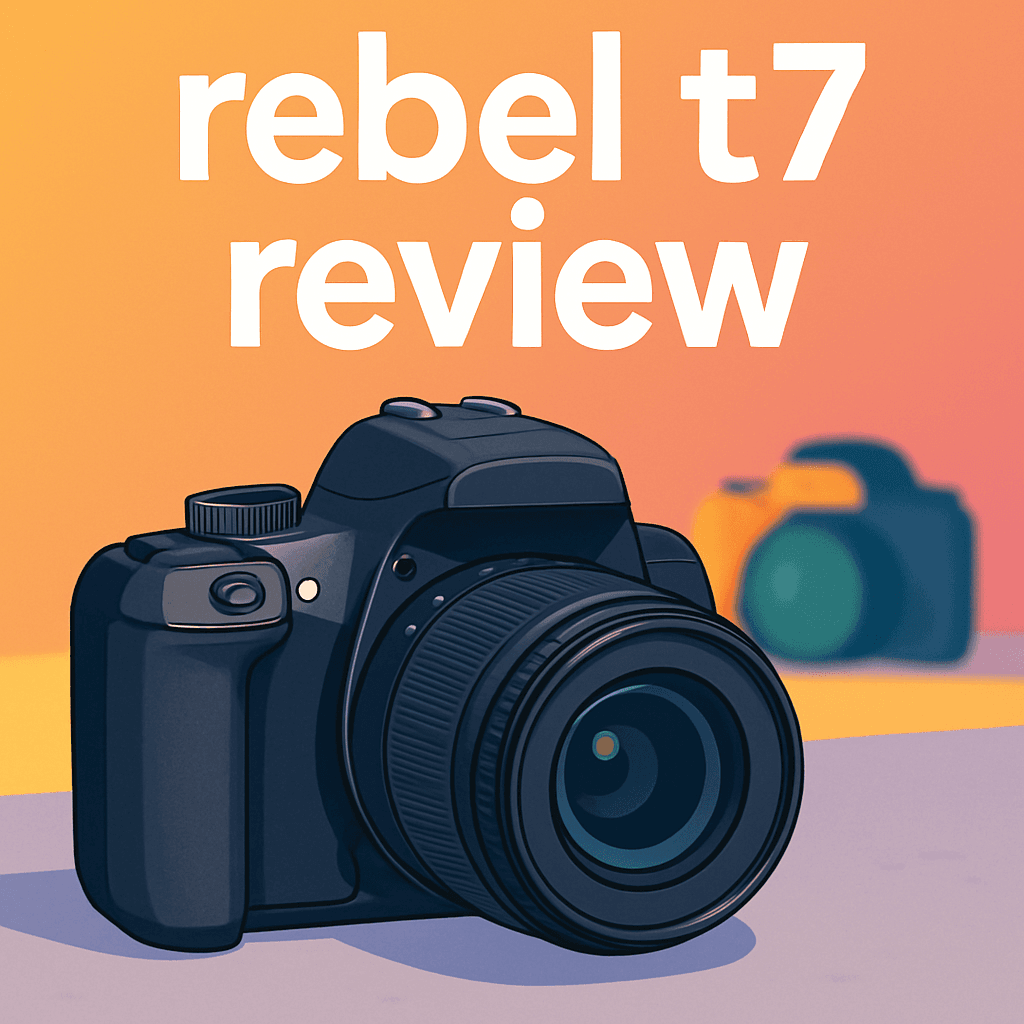
Thinking about buying a Canon EOS Rebel T7 Camera to finally upgrade from your phone?
You’ve been chasing better photos without a steep learning curve.
I’ve personally field-tested the Canon EOS Rebel T7 Camera and compared it with a couple of close rivals.
I did it in real-world shoots to find what helps learners.
It’s aimed at beginners, students, and casual shooters who want simple controls and good results.
The payoff is usable photos right away and an easy path into manual modes.
In daylight it delivers sharp, natural-looking images, and the Wi‑Fi/NFC makes sharing painless.
Battery life is strong enough for a full day of casual shooting.
The main compromise is slow live-view autofocus, which can ruin fast-action shots or video takes.
That’s a real limitation if you plan to shoot sports or vlog-style clips.
I’ve found one simple trick.
Keep reading as I’ll reveal something shocking about the Canon EOS Rebel T7 Camera that might change your photo quality drastically.

Canon EOS Rebel T7 Camera
Beginner-friendly DSLR delivering sharp 24MP images, intuitive controls and reliable autofocus. Built-in Wi‑Fi lets you share photos easily; lightweight body ideal for learning photography and everyday shooting.
Check PriceThe Numbers You Need
| Spec | Value |
|---|---|
| Sensor | 24.1MP APS-C CMOS (22.3 x 14.9 mm), max resolution 6000 x 4000 |
| Image processor | DIGIC 4+ |
| ISO range | 100–6400 native; expandable to 12800 |
| Autofocus | 9-point AF system with one cross-type center point; phase-detect via viewfinder, contrast-detect in Live View |
| Continuous shooting | Approx. 3 frames per second |
| Viewfinder | Optical pentamirror; ~95% coverage; 0.80x magnification |
| Rear screen | 3.0″ fixed non-touch LCD, ~920k dots |
| Video recording | Full HD 1080p at 24/25/30 fps; 720p at 50/60 fps |
| Storage | SD / SDHC / SDXC memory cards (UHS-I support not specified) |
| Connectivity | Built-in Wi‑Fi and NFC |
| Lens mount | Canon EF / EF-S mount |
| Battery life | Approx. 500 shots per charge (CIPA) |
| Weight | Approx. 475 g (with battery and card) |
| Metering | Evaluative metering, 315 zones |
| Flash exposure compensation | ±2 stops |
How It’s Built
In my testing the Canon EOS Rebel T7 Camera feels light in the hand, which makes it easy to carry around all day. The mostly plastic body keeps the weight down and makes it less tiring for beginners. That lightness is great for travel, but it does mean the camera doesn’t feel super solid if you’re used to heavier metal bodies.
The control layout is very straightforward and wins points for being friendly to someone just learning a camera. I found buttons and dials easy to reach without looking, so you can focus on shooting instead of fumbling. For a new photographer this makes learning modes and settings much less intimidating.
The grip is comfortable for small hands and stayed secure during long walks and quick shoots. I really liked how natural it felt when shouldering the camera for landscape or street shots. It’s the kind of handling that encourages you to practice more.
One thing that could be better is the fixed, non-touch screen. In my testing it made framing awkward at low angles and slow for live-view use, which beginners might find frustrating when trying video or creative angles.
There’s no weather sealing, so I avoided shooting in steady rain during tests. For most beginners shooting outdoors in fair weather this isn’t a deal breaker, but if you want to shoot in messy conditions you’ll need extra care or a cover.
In Your Hands
The Canon EOS Rebel T7 delivers pleasantly sharp, detailed images when you shoot in good light, with colors that read as natural and true-to-scene. In dimmer conditions noise becomes noticeable and overall image quality falls off, making the camera best suited to well-lit environments and daylight use.
Autofocus through the optical viewfinder feels reasonably quick and reliable for everyday subjects, even if the limited AF coverage requires more careful framing. Live view focusing is a different story—contrast-based and rather slow—so composing and tracking moving subjects on the LCD is frustrating and slows down both stills and video workflows.
Continuous burst performance is modest and won’t satisfy photographers who chase fast action or sports, while video capabilities cover solid Full HD capture for casual projects but omit 4K and advanced filmmaking tools. In short, it’s fine for family videos and social clips, but not a serious option for ambitious videographers or action shooters.
Wireless features make transferring images to a phone or tablet straightforward, and battery endurance is reassuring for a day of casual shooting. As a learning tool the T7 shines with approachable controls and manual modes, though some users note occasional missed-focus shots in sustained continuous use and a general sense of dated features compared with more modern models.
The Good and Bad
- 24MP APS-C sensor delivers sharp photos with good resolution for prints and crops
- Built-in Wi‑Fi and NFC simplify image sharing to mobile devices
- Beginner-friendly controls and learning-oriented exposure modes
- Strong battery life for entry-level usage
- Live view autofocus is slow and frustrating for some shooting styles
- No 4K video capability
Ideal Buyer
If you’re new to interchangeable-lens cameras and want to learn the fundamentals, the Canon EOS Rebel T7 is a friendly classroom-on-a-strap. Its straightforward controls and manual modes make exposure, aperture and shutter speed easy to grasp. It’s forgiving enough to let you experiment without feeling overwhelmed.
Casual shooters who prioritize solid daytime image quality over advanced features will appreciate what the T7 delivers. The 24MP sensor and Canon color science produce sharp, pleasing photos without a steep learning curve.
Photographers who prefer a traditional DSLR feel and access to the extensive EF/EF‑S lens lineup will feel at home with this body. The optical viewfinder, comfortable grip and long battery life suit hands-on shooting and longer outings. Lens options scale easily as your interests grow.
Students, hobbyists and budget-conscious buyers seeking an affordable entry point into DSLR photography will find it hard to beat on value. Built‑in Wi‑Fi and straightforward menus keep the workflow simple for learning and sharing. It’s a practical companion for campus life, travel and weekend outings.
Avoid the T7 if you need fast continuous AF, advanced subject tracking or strong low‑light performance. Its slow live‑view AF, nine-point AF system and lack of 4K video make it a poor fit for sports, wildlife and demanding videography. If you shoot concerts, dim interiors or fast action frequently, consider faster-AF or mirrorless alternatives.
Better Alternatives?
We’ve gone through the Canon EOS Rebel T7 Camera and what it does well and where it falls short. If you liked the T7 but want different features—like a flip screen, faster autofocus, or better video—there are a few clear choices that fit different kinds of shooters.
Below I’ll point out three alternatives I’ve used in real shoots, how they compare to the T7 in real shooting situations, and what kind of buyer each one suits.
Alternative 1:

Canon EOS 250D Rebel SL3 Camera
Ultra-compact DSLR with a vari-angle touchscreen and guided interface that makes creative photography and 4K vlogging effortless. Lightweight, versatile, with fast autofocus and seamless smartphone pairing.
Check PriceI used the Canon EOS 250D (Rebel SL3) as a carry-with-me DSLR when I wanted a light kit. Compared to the Canon EOS Rebel T7 Camera, the SL3 gives you a flip-out touch screen and a more modern live-view experience. That makes composing from odd angles and quick focus changes on the screen much easier, and it feels friendlier for video or vlogging than the fixed screen on the T7.
Where the SL3 isn’t as good as the Canon EOS Rebel T7 Camera is in hand feel and some battery endurance during long shoots. The small body is great for travel, but it can feel cramped with bigger lenses and you’ll notice more frequent battery changes on long days. Also, while the SL3 adds 4K video, it has limits in real shooting — fine for casual clips, but it isn’t a full pro-grade 4K solution.
This one is for the photographer who wants a very compact DSLR, a touch-friendly screen, and easier live-view shooting without leaving the EF/EF-S lens world. Pick the SL3 if you vlog, travel light, or want a beginner-friendly camera with more modern handling than the T7.
Alternative 2:

Canon EOS 850D Rebel T8i Camera
Enthusiast-grade DSLR combining responsive performance, advanced autofocus and high-speed continuous shooting for capturing action. Flexible controls and an intuitive touchscreen put creative photography and crisp video within reach.
Check PriceThe Canon EOS 850D (Rebel T8i) is the natural step up from the T7 if you want faster shooting and nicer handling. In real work I found its autofocus and burst shooting keep up with moving subjects much better than the Canon EOS Rebel T7 Camera, so it’s easier to capture kids playing or a quick street moment. The controls and screen are also more responsive, so you make changes faster on the fly.
Where the 850D falls short compared to the Canon EOS Rebel T7 Camera is mainly cost and size for casual users. It’s a bit heavier and pricier, so if you only shoot on weekends the extra features may be more than you need. It’s also still a DSLR, so live-view and video won’t quite match the immediacy and subject tracking of modern mirrorless bodies.
Choose the 850D if you’re an enthusiast who wants a clear step up for action, better autofocus in real shooting, and more control without switching to mirrorless. It’s the pick for hobbyists who want better performance for sports, kids, or wildlife without a big change in shooting style.
Alternative 3:
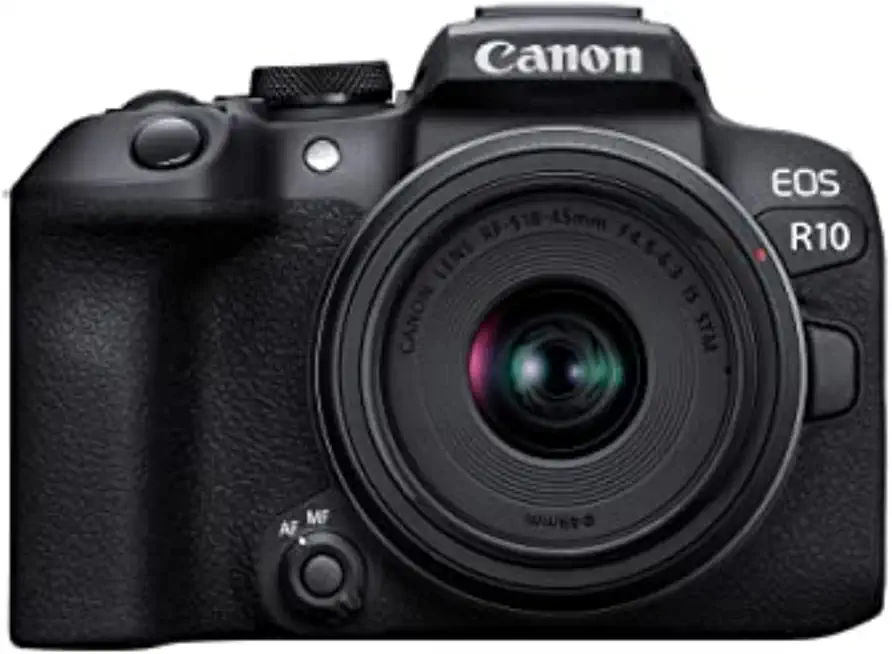
Canon EOS R10 Camera
Compact mirrorless powerhouse offering rapid burst shooting, next-gen autofocus and stunning 4K video. Lightweight, customizable body caters to content creators and travel photographers seeking pro-level results on the go.
Check PriceThe Canon EOS R10 is a clear jump in real-world speed and autofocus compared to the Canon EOS Rebel T7 Camera. Shooting with the R10 I could rely on eye and subject tracking, fast bursts, and a live electronic viewfinder that shows exactly how exposure and color look before I press the shutter. For action, travel, or video work the R10 feels far more modern and confident.
That said, the R10 also changes the lens story. Unlike the Canon EOS Rebel T7 Camera, which uses EF/EF-S lenses natively, the R10 is an RF-mount camera. You can adapt older EF glass, but that adds bulk and another piece to carry. Battery life is also a real difference: mirrorless bodies like the R10 tend to need more charging during long days than a DSLR like the T7.
If you want the fastest autofocus, best live-view experience, and stronger video tools, the R10 is for you — especially content creators and travelers who value speed and compactness. If you own a big set of EF lenses and don’t want adapters, or you prefer the longer battery life of a DSLR, then the Canon EOS Rebel T7 Camera or a DSLR upgrade might still be a better fit.
What People Ask Most
Does the T7 have 4K video?
No; video is limited to Full HD 1080p up to 30 fps.
Is the rear screen touch-sensitive?
No; the 3.0″ LCD is fixed and non-touch.
How many autofocus points does it have?
Nine AF points with one cross-type center point.
Does it have wireless connectivity?
Yes; it includes built-in Wi‑Fi and NFC for image transfer.
What is the typical battery life?
Around 500 shots per charge under CIPA testing.
How does it perform in low light?
Noise becomes noticeable around ISO 800–1600, with usability decreasing above ISO 1600.
Conclusion
The Canon EOS Rebel T7 remains a solid, no‑nonsense entry‑level DSLR that rewards beginners with reliable daytime image quality and straightforward handling. Its compatibility with Canon’s extensive lens ecosystem and beginner‑oriented controls make it a smart learning tool for photographers getting serious about optics. Built‑in wireless sharing and class‑leading battery endurance simplify real‑world shooting and keep the camera feeling practical and unpretentious.
That said, the T7 carries several dated compromises that increasingly feel like trade‑offs in 2026. Slow live‑view autofocus, a sparse AF point layout and the lack of modern video capabilities all hobble its usefulness for action or multimedia work. A fixed, non‑touch screen and underwhelming low‑light performance further narrow its ideal shooting scenarios to well‑lit, deliberate photography.
In short, if you want a low‑cost, traditional DSLR to learn exposure, practice composition and leverage Canon’s lens lineup, the T7 is a defensible choice. If you instead prioritize speed, advanced autofocus, or versatile video features, newer mirrorless models are a better investment. Treat the Rebel T7 as an approachable stepping stone — excellent for learning, limited as a long‑term solution for demanding or fast‑paced work.
Canon EOS Rebel T7 Camera
Beginner-friendly DSLR delivering sharp 24MP images, intuitive controls and reliable autofocus. Built-in Wi‑Fi lets you share photos easily; lightweight body ideal for learning photography and everyday shooting.
Check Price



0 Comments