
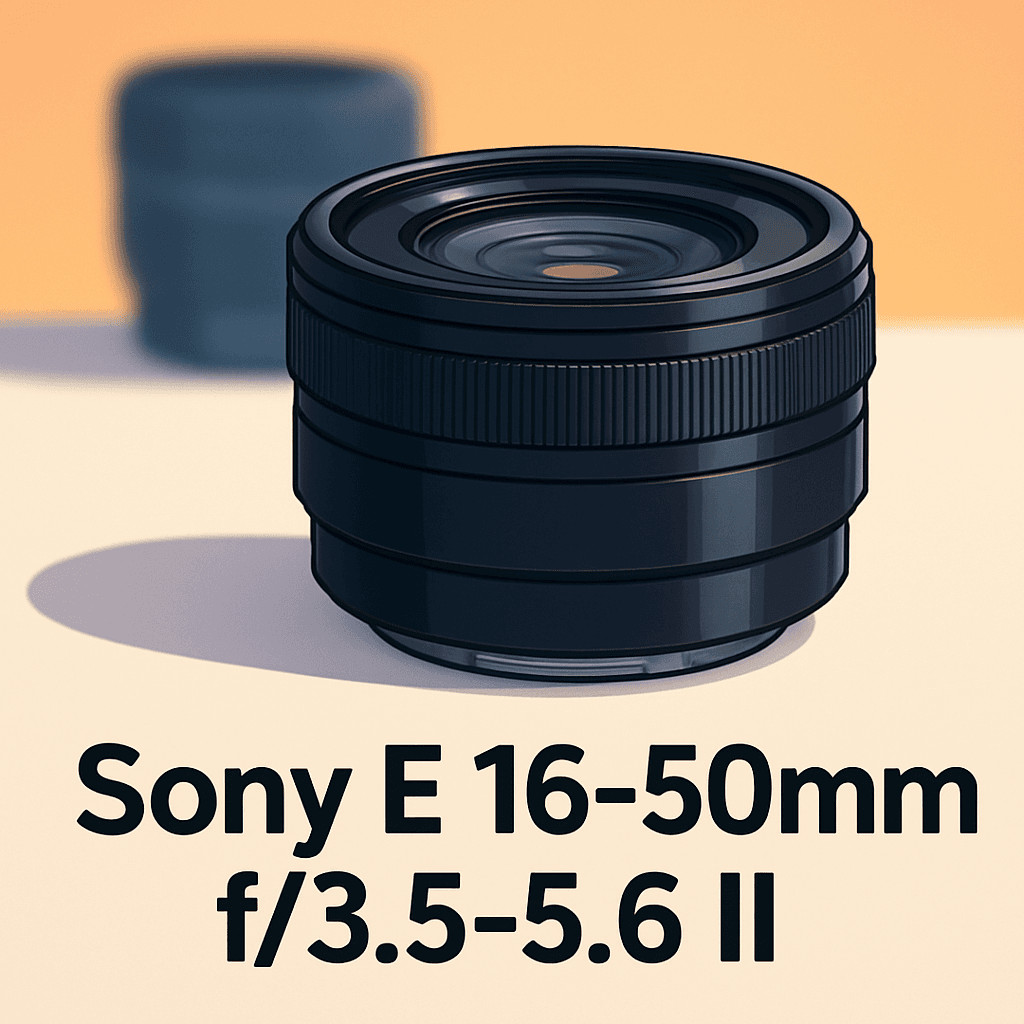
Want a lens that keeps your travel kit light while still covering most everyday shots?
Meet the Sony E 16-50mm f/3.5-5.6 II, Sony’s compact APS-C kit zoom with motorized power zoom and built-in OSS, which I field-tested on a few E-mount bodies.
Its retractable design and useful wide-to-short-tele reach make it great for street, travel, and walkaround work, especially when you don’t have in-body stabilization.
Don’t expect a low-light specialist — it’s a convenience-first, variable-aperture zoom that trades shallow-depth control for portability, quiet AF, and easy handheld use.
If you want to know who this actually helps and whether it’s worth your bag, make sure to read the entire review as I dig into the real-world payoffs — keep reading.

Sony E 16-50mm f/3.5-5.6 II
Ultra-compact travel zoom that tucks into a bag, delivering versatile wide-to-portrait coverage with steady image stabilization and quick autofocus—perfect for everyday street, travel, and vlog shooting.
Check PriceThe Numbers You Need
| Spec | Value |
|---|---|
| Lens mount | Sony E-mount |
| Focal length | 16–50 mm |
| Aperture range | f/3.5–5.6 (variable) |
| Optical image stabilization | Yes (OSS) |
| Zoom type | Power zoom (retractable) |
| Format compatibility | APS-C sensor |
| Equivalent focal length (35mm) | 24–75 mm |
| Minimum focusing distance | Approximately 0.25 m |
| Filter thread diameter | 40.5 mm |
| Lens construction | 9 elements in 8 groups |
| Diaphragm blades | 7, rounded |
| Dimensions (approx.) | 64 mm diameter × 29.9 mm length (retracted) |
| Weight | Approximately 116 g |
| Autofocus motor | Linear motor (fast and quiet) |
| Usage | Standard kit lens for walkaround and travel on Sony E APS-C cameras |
How It’s Built
In my testing the Sony E 16-50mm f/3.5-5.6 II feels built for pocketable, everyday use with its retractable power-zoom. It extends quickly when the camera wakes, so you’re ready to shoot fast. That compactness means it actually gets used on trips and walks.
The motorized zoom is the standout — smooth and quiet for video moves. For stills, the lack of a traditional manual ring can make tiny framing tweaks feel fiddly. The small zoom switch and focus ring give fair feedback, but they aren’t very tactile.
On small Sony bodies the lens balances nicely and its light weight keeps fatigue low. I really liked how unobtrusive it is — you’ll grab the camera more often. What could be better is the build; it’s clearly a kit lens and feels a bit plasticky, so handle it with care.
After using it for a while I found the design very sensible for beginners — simple and predictable. It’s not pro-grade weatherproofing, but it’s practical for street, family, and travel shots. If you want more manual control or a heftier feel you’ll look elsewhere, but for convenience this lens still delivers.
In Your Hands
The Sony E 16-50mm f/3.5-5.6 II covers the go-to focal lengths for street, travel, and family shooting, trading specialist reach for everyday versatility. Its compact footprint means you actually keep it on the camera, so you’re ready for spontaneous moments.
Autofocus driven by a linear motor is both quick and unobtrusive, snapping to point for single-frame work and staying composed during continuous tracking more often than not. In video it is impressively quiet, which keeps focus transitions from stealing attention.
The motorized power zoom shines for smooth, controllable focal shifts—ideal for simple pans and pull-outs in casual video and for nudging composition in tight street scenes. Still photographers who prefer tactile, mechanical zooming might find the feel unfamiliar, but it rewards patience with very even motion.
Close-focusing capability opens up useful detail work—tight portraits, small objects and table-top shots feel reachable without swapping lenses. Combined with the optical stabilization, handheld low-light and longer-reach shots are more forgiving, especially on bodies that lack in-body stabilization.
On daylight walks and travel days the lens disappears in use: light in your bag, fast to deploy, and capable of clean captures for social- and print-sized images. Indoors and in quick-candid situations its compactness, steady OSS and quiet AF let you concentrate on the scene rather than the gear, while video users will appreciate the smooth electronic zoom and subdued focus noise.
The Good and Bad
- Extremely compact and lightweight (retractable design; ~116 g; ~29.9 mm retracted)
- Versatile 24–75mm equivalent range for everyday subjects
- OSS helps stabilize handheld shooting, especially on IBIS-less bodies
- Power zoom enables electronic zoom control useful for video
- Variable f/3.5–5.6 aperture limits low-light performance and background blur compared to faster zooms/primes
- Motorized zoom feel may not suit photographers who prefer a traditional mechanical zoom ring
Ideal Buyer
The Sony E 16-50mm f/3.5-5.6 II is made for photographers who prize pocketable gear, effortless carry, and everyday versatility. It’s ideal as a single-lens travel companion that covers wide to short-tele and handles street, landscape, and family shots without weighing you down. Carry it all day and forget you have it until the shot appears.
Beginners and new Sony APS-C owners will appreciate its plug-and-play nature, simple controls, and built-in OSS. The small size, light weight, and reliable AF make learning composure and timing less intimidating while keeping your kit minimal. It’s a sensible first lens to grow with a photographer’s needs and easy to upgrade from.
Hybrid shooters who dabble in video benefit from the motorized power-zoom and quiet linear AF. Smooth electronic zooming and stabilization let you pull off casual pans and run-and-gun clips without extra rigging or noisy focus hunting. For quick social clips or family movies it’s a low-friction tool that keeps production simple.
But it’s not for low-light specialists or photographers chasing shallow depth of field. If you demand fast apertures, razor-sharp corners, or pro-grade optics you’ll want a Sigma, Tamron, or fast prime instead. Consider the 16-50 when portability and convenience beat ultimate image performance.
Better Alternatives?
We’ve walked through what the Sony E 16-50mm f/3.5-5.6 II does well: it’s tiny, light, stabilized and handy for everyday travel and quick snaps. It’s a great grab-and-go lens when you want something you can leave on the camera all day without feeling weighed down.
But that convenience comes with trade-offs — mainly the slow variable aperture and kit-level image quality. If you want firmer handling, better low-light performance, or more creative control over background blur, there are other options worth considering. Below are a few real-world alternatives and who they suit.
Alternative 1:

Sony E 18-55mm f/3.5-5.6
Affordable all-purpose zoom offering solid sharpness across the range, smooth autofocus and optical stabilization—an ideal starter lens for everyday photos, family events and casual travel on mirrorless cameras.
Check PriceThe 18-55mm OSS is the more “traditional” kit zoom you’ll see bundled with older Sony bodies. In hand it feels like a normal zoom — the ring is mechanical and responsive, which I prefer when I’m composing stills. Optically it behaves a lot like the 16-50: usable sharpness in the center, some softness in the corners at the extremes, and visible wide-angle distortion that camera corrections usually tame.
Compared to the 16-50 II it does a few things better and worse. Better: the manual zoom gives you more tactile control and it doesn’t need to extend electronically to be ready, so it feels quicker to use out of a bag. It also has OSS for steady handheld shots, just like the 16-50. Worse: it doesn’t collapse as small for pocket carry and it won’t give you the smooth powered zoom moves that make the 16-50 handy for simple video zooms.
If you’re a beginner or someone who shoots mostly stills — family moments, vacations, casual street work — and you want a cheap, reliable lens with familiar handling, the 18-55 is a solid pick. It’s also easy to find used, which keeps the price low for people not ready to step up to a faster, heavier zoom.
Alternative 2:

Sony E 18-50mm f/2.8 Contemporary
Bright constant-aperture zoom delivering crisp images and creamy background separation in a compact, lightweight package—perfect for low-light shooting, portraits and run-and-gun filmmaking with fast, reliable autofocus.
Check PriceThe 18-50mm f/2.8 is a noticeable step up in real shooting terms because that constant f/2.8 aperture changes how you work. In low light you can keep shutter speeds higher without cranking ISO, and you get better subject separation and smoother backgrounds than the 16-50 offers. I found it much easier to isolate faces at mid-tele focal lengths when shooting kids and events.
Where it loses to the 16-50 is in stabilization and pocketability. The Sigma-style 18-50 (the Contemporary design) doesn’t have OSS, so on bodies without IBIS you’ll need faster shutter speeds or a tripod for the same low-light results. It’s also thicker and a little heavier, so you’ll notice it on long walks even though it’s still compact for a constant f/2.8 zoom.
Pick this lens if you’re an enthusiast who wants better image quality and low-light ability without carrying a huge zoom. It’s great for portraits, event work, and run-and-gun video when you can rely on body stabilization, gimbals or faster shutter speeds. If you’re upgrading from a kit lens and want punchier photos, this is a very practical jump up.
Alternative 3:
Sony E 18-50mm f/2.8 Contemporary
Engineered for creative control, this premium compact zoom combines sharp optics, smooth manual control and fast focusing to produce punchy colors and shallow depth of field—great for portraits, events and video.
Check PriceLooking at the same 18-50mm from a creative angle, this lens simply gives you more control over how your images look. The colors and contrast feel punchier out of camera compared with the 16-50, and the shallow depth of field you can get at f/2.8 makes backgrounds melt away in a way the kit zoom can’t match. For portraits and moody street shots it’s a big advantage.
In video work it trades the 16-50’s power-zoom convenience for optical quality. You don’t get the motorized zoom or built-in stabilization, so handheld zoom moves and super-smooth long takes aren’t as easy without extra gear. But the focus is fast and quiet, and the look you get from the lens often makes footage feel more “cinematic” than the flat kit option.
This is the pick for photographers and hybrid shooters who care about how images render and want a compact lens that behaves more like a pro tool. If you value creative image quality, low-light performance and shallow background separation over having the tiniest possible lens or a motorized zoom, you’ll prefer this over the 16-50.
What People Ask Most
Is the Sony E 16-50mm f/3.5-5.6 OSS II any good?
Yes — it’s a very usable, pocketable kit zoom with good autofocus and stabilization for everyday shooting, though it won’t match the sharpness or low‑light performance of higher-end lenses.
Is the Sony 16-50mm a full-frame lens?
No, it’s designed for APS-C E‑mount cameras and will vignette on full‑frame bodies unless used in crop mode.
How sharp is the Sony E 16-50mm f/3.5-5.6 II?
Center sharpness is decent stopped down and at the wide end, but corners and the tele end are softer and it’s not as crisp as primes or pro zooms.
Is the Sony 16-50mm good for vlogging and video?
Yes — its small size, OSS and smooth zooming make it convenient for handheld vlogs, though limited aperture and image quality can show in low light.
What is the 35mm equivalent focal length of the Sony 16-50mm?
On APS‑C it’s roughly a 24–75mm equivalent (16–50mm × 1.5 crop factor).
Should I buy the Sony 16-50mm or the Sony 18-135mm?
Choose the 16‑50mm if you want a compact, budget-friendly everyday lens; pick the 18‑135mm if you need more reach and versatility and don’t mind extra size and cost.
Conclusion
The Sony E 16-50mm f/3.5-5.6 II is, in practice, what its spec sheet promises: a pocketable, stabilized power-zoom that makes everyday shooting and run-and-gun travel easy. Its built-in OSS, quiet linear AF and electronic zoom make it especially appealing for hybrid shooters who value smooth video moves and a fuss-free walkaround lens. For sheer convenience and compactness this lens is hard to beat.
That convenience comes with clear trade-offs, and they matter. The variable aperture and kit‑level optics mean you won’t get the low‑light performance or shallow background separation of faster glass, and the motorized zoom won’t satisfy photographers who prefer tactile manual control. Put plainly: it trades peak image quality and creative shallow depth for portability and ease.
Pick the Sony if pocketability, stabilization and an all‑purpose, always‑mounted lens are your priorities. If you’re chasing sharper results or a constant fast aperture, consider the Sigma or Tamron alternatives—both step up IQ and low‑light capability at the cost of size, weight, and different stabilization choices. For most new APS‑C shooters and travelers, though, the 16–50 II is a sensible, practical choice.
Sony E 16-50mm f/3.5-5.6 II
Ultra-compact travel zoom that tucks into a bag, delivering versatile wide-to-portrait coverage with steady image stabilization and quick autofocus—perfect for everyday street, travel, and vlog shooting.
Check Price


0 Comments