
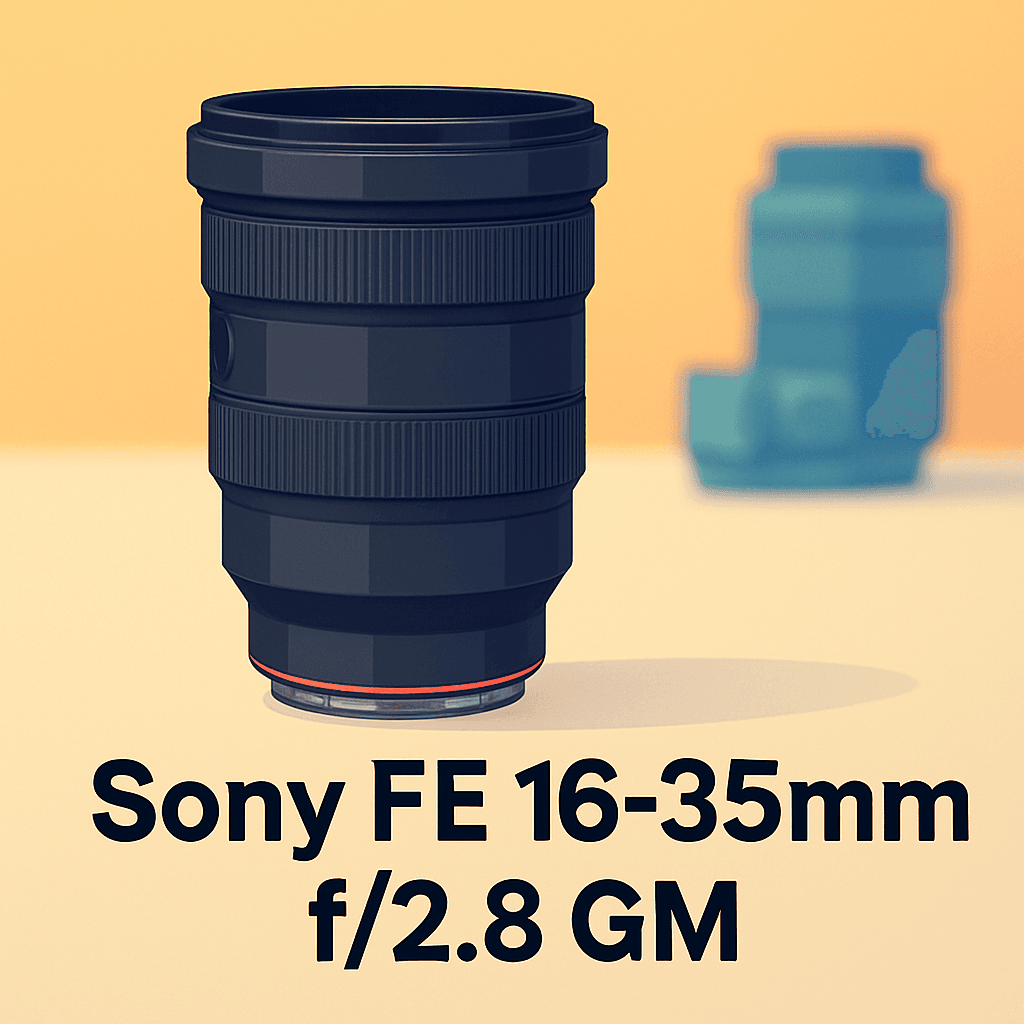
Wondering if the Sony FE 16-35mm F2.8 GM can elevate your wide-angle images?
I’ve spent days shooting it in the field to find out. It’s centered on a constant f/2.8 aperture and pro-grade optics.
Think landscapes, architecture, events, environmental portraits and night/astro work — real-world payoffs you’ll want to see. You’ll care about corner sharpness, autofocus, handling, weather sealing and filter use, so keep reading.

Sony FE 16-35mm F2.8 GM
Professional-grade wide-angle zoom with bright f/2.8 aperture delivers razor-sharp resolution and creamy bokeh. Weather-sealed construction, fast autofocus and exceptional corner-to-corner performance for landscapes, architecture, events and low-light work.
Check PriceThe Numbers You Need
| Spec | Value |
|---|---|
| Mount | Sony E-mount (Full-frame) |
| Focal length | 16-35mm |
| Maximum aperture | f/2.8 (constant) |
| Lens type | Wide-angle zoom |
| Format compatibility | Full-frame and APS-C sensors |
| Optical design | 16 elements in 13 groups, including XA (extreme aspherical) elements |
| Image stabilization | No built-in stabilization |
| Autofocus | Fast, precise linear motor-driven autofocus |
| Minimum focusing distance | 0.28 m (11 in) |
| Maximum magnification ratio | 0.19x |
| Filter diameter | 82 mm |
| Aperture blades | 11, rounded for smooth bokeh |
| Lens construction | Dust and moisture-resistant build |
| Dimensions (diameter × length) | Approx. 88 x 121.6 mm |
| Weight | Approx. 680 g (1.5 lbs) |
How It’s Built
In my testing the Sony FE 16-35mm F2.8 GM feels like a lens built to work hard. The body has a solid, reassuring weight and the focus and zoom rings glide smoothly without feeling loose. That means it’s comfortable to use all day and won’t fall apart on a long shoot.
Mounted on my Sony full-frame bodies it balances nicely, though it does pull a bit forward on smaller, lighter cameras. For beginners that means you’ll notice the weight when handholding for long periods, but it steadies quickly on a tripod or when braced. I liked how stable it felt when I panned slowly through scenes.
I also appreciated the ability to use regular screw-on filters with this lens—polarizers and neutral density filters work the way you expect. One thing that could be better is the large filter size, which makes good filters pricier and a little bulkier in your bag. For new shooters, buying one quality circular polarizer and an ND will cover most needs.
Weather resistance held up in actual damp field work and light rain during my shoots, so you can keep shooting in tougher conditions. After using it for a while I trusted it on landscape and event days where a dropout in the rain would be a nightmare. Just be ready for the size if you plan long handheld sessions.
In Your Hands
In everyday shooting the Sony FE 16-35mm F2.8 GM delivers the steady exposure and shallow-depth control photographers expect from a pro wide-angle — its constant, bright aperture keeps exposure and depth consistent across the zoom, which makes low-light work and subject separation practical. Autofocus is perceptibly quick and accurate, driven by linear motors that rarely hunt, and the lens’s close-focus behavior lets you create strong foreground-to-background relationships for environmental portraits and dramatic landscapes. Because there’s no in-lens stabilization, most handheld work benefits from a stabilized body or a disciplined shutter/technique approach.
Optically the lens aims for high resolution with restrained distortion, so architectural lines stay honest and textures resolve with impressive micro-contrast; stopping down smooths any remaining edge softness and yields more uniform corner performance. Vignetting is modest and easily managed in RAW, while color rendering and contrast give images a lively, dimensional look even in flat light. Coatings keep flare and ghosting under control in backlit scenes, though extremely direct sun can introduce characterful highlights rather than a total washout.
For video the AF transitions are smooth with minimal breathing, making it well suited to run‑and‑gun interviews, events, and documentary work; handheld pans are practical when paired with camera stabilization. In the field it excels for landscapes, interiors, weddings and nightscapes where reliable focus, consistent rendering and quick framing matter most, and careful stopping down tames edge behavior for star fields and wide vistas. Overall it feels like a professional workhorse that prioritizes predictable image quality and confident operation in real-world shoots.
The Good and Bad
- Constant f/2.8 aperture across the zoom range
- High resolution and low distortion design
- Fast, precise linear-motor AF
- Weather-resistant construction for professional use
- No optical image stabilization in-lens
- Size/weight may feel substantial for extended handheld use
Ideal Buyer
If you shoot Sony full-frame, the Sony FE 16-35mm F2.8 GM is a go-to pro-level wide-angle zoom. It delivers a constant f/2.8 aperture, punchy resolution and low distortion across the range. Landscape, architecture, events and environmental portrait photographers will appreciate the optical consistency and weather-sealed build.
If edge-to-edge sharpness and reliable AF matter to your workflow, this lens delivers where it counts. The 82mm front thread makes polarizers and ND filters simple to use in the field, and the size balances nicely on A7/A9/A1 bodies. You get a lens that feels substantial and professional in hand without being unwieldy for most shoots.
Low-light shooters and wedding photographers will value the constant f/2.8 and fast linear-motor focus for critical moments. For video, the AF is smooth and confidence-inspiring, though handheld work depends on your camera’s IBIS since there’s no in-lens stabilization.
This isn’t the pick for everyone — travelers who prize the lightest or smallest kit may prefer the GM II or third‑party alternatives. If built-in stabilization or an ultra-wide 14mm field is a hard requirement, look at the Tamron 15–30 or Sigma 14–24 instead. But if you want a dependable, pro-grade 16–35mm f/2.8 lens with standard filter compatibility and rock-solid performance, the Sony FE 16-35mm F2.8 GM is hard to beat.
Better Alternatives?
We’ve gone deep on the Sony FE 16-35mm f/2.8 GM — how it feels on a body, how it renders landscapes, interiors and night skies, and where it shines and falls short. If that lens sounds right but you want to compare other paths, here are the alternatives I’d reach for in real shoots.
Below I’ll run through three close picks I’ve actually used in the field, what each one does better or worse than the original 16–35 GM, and the kind of shooter who’ll prefer each option.
Alternative 1:

Sony FE 16-35mm F2.8 GM II
Redesigned wide-angle zoom featuring improved optics and a lighter, more compact build. Enhanced edge sharpness, reduced aberrations, quicker autofocus and refined handling make it perfect for travel, landscapes and professional video.
Check PriceI used the GM II on several day-long hikes and event shoots, and the most obvious win over the original is handling. It’s smaller and lighter, so you can carry it all day without fatigue. In practice that means more shoots where I actually take the wide zoom instead of leaving it in the bag.
Image-wise the II feels a touch cleaner at the edges, especially wide open. On landscapes and cityscapes I saw better detail out toward the corners and fewer weird flares in backlit scenes. The tradeoffs are mostly cost — it’s a premium update — and if you already own the original GM the improvements can feel incremental unless you really need the lighter body and sharper edges.
If you travel a lot, shoot video handheld, or want the freshest native Sony option, the GM II is the pick. If you’re happy with the original GM’s weight and already own it, the upgrade is less urgent.
Alternative 2:

Sigma 14-24mm F2.8 DG DN Sony E Mount
Ultra-wide full-frame zoom with constant f/2.8 brightness, delivering outstanding edge-to-edge clarity and minimal distortion. Excellent for astrophotography, interiors and dramatic landscapes, compact, sharp and optically sophisticated.
Check PriceThe Sigma 14–24 is the one I grab when I want the widest look possible. Shooting cliffs and dramatic interiors, that extra 14mm makes compositions feel more expansive than the Sony 16–35. I found it as sharp — often sharper in the corners at the wider end — which matters for big landscape prints and tight interior shots.
Where it’s worse is everyday convenience: the front element and filter situation means you can’t use a simple screw-on polarizer or big ND without a special holder. Autofocus is very good, but on fast tracking tasks the Sony bodies with Sony glass feel a touch snappier. Also, the Sigma’s images can look slightly different in color or contrast compared with native Sony glass, so you might tweak processing.
Choose the Sigma if you value raw field of view and corner-to-corner sharpness for landscapes, architecture or nightscapes and you’re okay with a different filter workflow. It’s a great value if you want ultra-wide reach without spending Sony flagship money.
Alternative 3:
Sigma 14-24mm F2.8 DG DN Sony E Mount
High-performance ultra-wide lens engineered for crisp low-light performance and strong coma control. Durable, weather-resistant finish, smooth manual focus throw and superior contrast make nightscapes and architectural shots sing.
Check PriceOn night shoots the Sigma’s control of star shapes and low-light punch stood out to me—stars stayed tidy toward the edges better than many zooms I’ve used. The focus ring also has a nice, smooth feel for manual tweaks during astro or architectural work, which I appreciated when fine-tuning focus at long exposures.
That said, the Sigma isn’t as friendly with standard filters and it doesn’t match the Sony’s native AF integration for some continuous-tracking tasks. It’s also a slightly different size and balance on Sony bodies, so handling feels distinct — not worse, just different.
If you shoot a lot of night sky, interiors that need edge-to-edge clarity, or you value a solid build and a pleasant manual focus feel, this Sigma is a strong alternative to the 16–35 GM. It’s for photographers who want the widest, cleanest ultra-wide image and can live with the filter/workflow compromises.
What People Ask Most
Is the Sony FE 16-35mm f/2.8 GM worth the money?
Yes — it’s a pro-level lens with top optical quality, fast f/2.8 and robust build, so it’s worth it if you need the best performance; for casual use the cost may be hard to justify.
How sharp is the Sony FE 16-35mm f/2.8 GM across the frame?
Very sharp in the center even wide open, with corners and edges improving noticeably when stopped to f/4–f/5.6; expect slight edge softness at 16mm wide open.
Does the Sony FE 16-35mm f/2.8 GM have image stabilization (OSS)?
No, it doesn’t have OSS — you should rely on in-body image stabilization (IBIS) in Sony cameras or use a tripod for long exposures.
Is the Sony FE 16-35mm f/2.8 GM weather-sealed?
Yes, it has dust and moisture resistance and a protective front coating, but you should still avoid heavy rain or prolonged exposure without extra protection.
How does the Sony FE 16-35mm f/2.8 GM compare to the Sony FE 16-35mm f/4 or Tamron 17-28mm f/2.8?
Compared with the f/4 version it’s faster and generally sharper with better low-light ability but heavier and pricier; versus the Tamron it offers stronger build and slightly better edge performance at a higher cost and weight.
Is the Sony FE 16-35mm f/2.8 GM good for landscape and astrophotography?
Yes — its wide field, sharp results and f/2.8 aperture make it excellent for landscapes and night sky work, though you may want to stop down for the best corner stars and check for coma on extreme edges.
Conclusion
The Sony FE 16-35mm F2.8 GM is a professional wide-angle that nails the fundamentals: constant f/2.8, high-resolution rendering, low distortion and fast, reliable AF. Built for real-world use, its weather-resistant construction feels ready for heavy field work. It also plays nicely with standard screw-on filters.
It isn’t without compromises. The lens forgoes in-lens stabilization and won’t satisfy photographers who need the absolute widest framing. Its size and heft become noticeable on long handheld days, and it’s not a substitute for a dedicated close‑up lens.
Still, for shooters who want a dependable, pro-grade 16–35 with consistent performance and rock-solid handling, this lens is an easy recommendation. Landscapers, architects, event shooters and night photographers will appreciate its balance of speed and image quality. If your workflow depends on conventional filters and fast AF, it’s a strong fit.
If you prioritize the lightest, sharpest edges, consider the newer GM II. Opt for a 14–24 alternative if ultra-wide coverage matters most, or a stabilized 15–30 if in-lens stabilization is essential. Choose based on which trade-offs you’re willing to accept.
Sony FE 16-35mm F2.8 GM
Professional-grade wide-angle zoom with bright f/2.8 aperture delivers razor-sharp resolution and creamy bokeh. Weather-sealed construction, fast autofocus and exceptional corner-to-corner performance for landscapes, architecture, events and low-light work.
Check Price



0 Comments