
Want to know if the Sony FE 24-70mm f/2.8 GM II will actually lift your images and simplify every shoot? It’s the kind of lens every shooter wants to understand before committing.
After spending days with the lens in real shoots, I saw how it aims to be a pro-grade, go-to standard zoom for Sony full-frame users. It blends a fast aperture, internal-zoom balance and close-focus flexibility into one package.
I’ll walk through handling, AF behavior, sharpness, flare control and real-world trade-offs so you can decide if it belongs in your kit. Make sure to read the entire review as it shows where this lens truly earns its keep — keep reading.

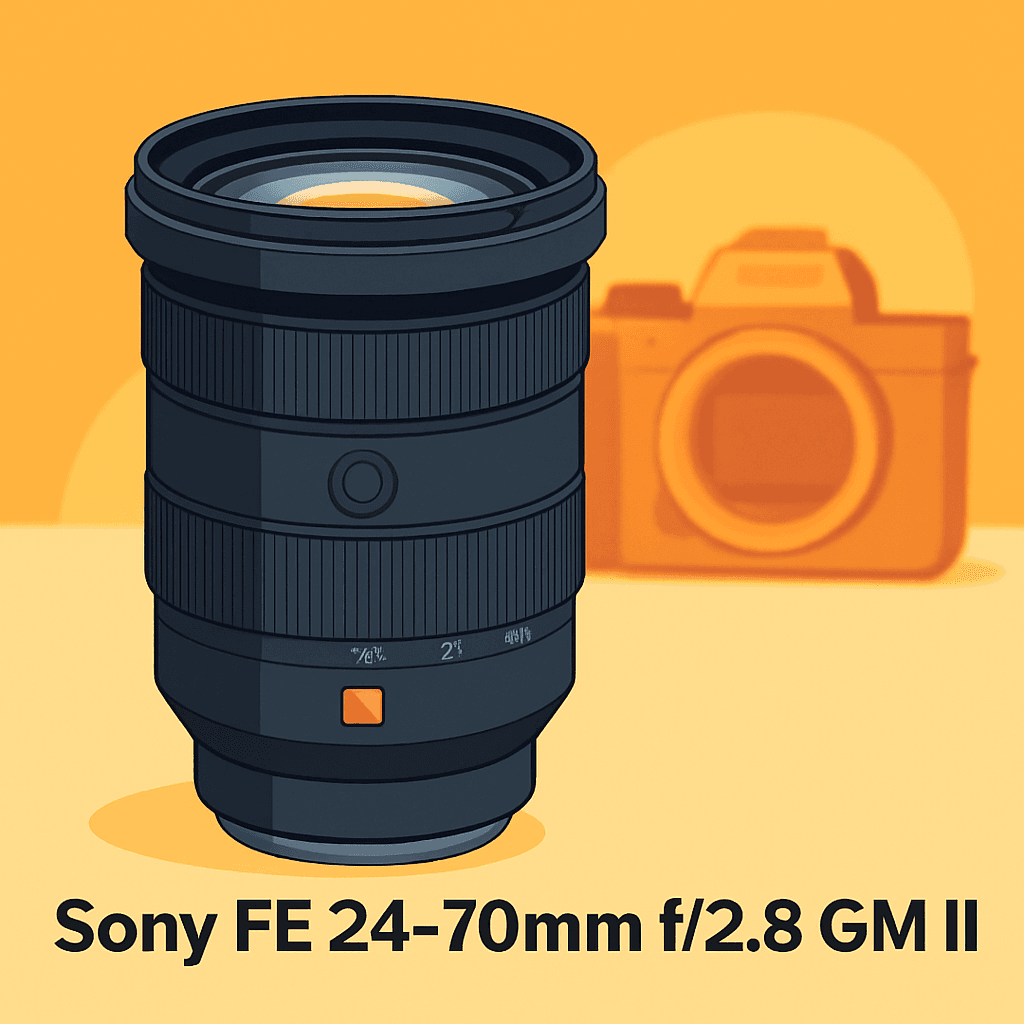
Sony FE 24-70mm f/2.8 GM II
Professional-grade midrange zoom delivers stunning edge-to-edge sharpness, creamy bokeh, and consistent f/2.8 performance. Fast, accurate autofocus and weather-sealed construction make it ideal for studio and on-location work.
Check PriceThe Numbers You Need
| Spec | Value |
|---|---|
| Focal Length | 24–70mm |
| Maximum Aperture | f/2.8 (constant) |
| Mount | Sony E-mount (full-frame) |
| Optical Design | Advanced elements for improved sharpness and reduced aberrations |
| Autofocus | High-speed linear motor focus system |
| Image Stabilization | No in-lens stabilization (rely on in-body stabilization) |
| Minimum Focus Distance | Approx. 0.21 m (wide) |
| Filter Thread Size | 82mm |
| Aperture Blades | 11 (rounded for smooth bokeh) |
| Maximum Magnification | Approx. 0.24× |
| Coatings | Sony Nano AR Coating II |
| Dimensions | Approx. 87.0 mm diameter × 135.5 mm length |
| Weight | Around 695 g |
| Weather Sealing | Yes — dust and moisture resistant |
| Zoom Mechanism | Internal zoom (lens length remains constant during zoom) |
How It’s Built
In my testing the Sony FE 24-70mm f/2.8 GM II feels like a proper pro lens — solid in the hand and well put together. The mount sits tight and the finish inspires confidence when you’re out shooting in less-than-perfect weather. For beginners that means you can focus on framing, not worrying about a little rain or dust.
I really liked the internal zoom design because the lens doesn’t change length as you zoom, so your balance stays steady. That made a big difference on my mirrorless bodies, especially when I had a small cage or a mic mounted up front. For real-world use this equals fewer surprises while moving and smoother pans for video.
The control layout is straightforward and the rings feel good — not too loose, not too stiff. In my testing the focus ring gave precise, tactile feedback that’s great for stills and for pulling focus in video. Beginners will appreciate how easy it is to find and use the rings without fidgeting.
Optically minded touches like the rounded diaphragm and advanced coatings show up in creamy backgrounds and reduced flare when shooting toward bright light. One thing that could be better is the lens’ size and filter needs — larger filters and a heavier feel add cost and extra weight in your bag. Overall it’s built to work hard and handle real shoots.
In Your Hands
The Sony FE 24-70mm f/2.8 GM II proves to be exactly the sort of everyday workhorse you reach for: its wide end is excellent for environmental and architectural context, the midrange feels natural for street and editorial shooting, and the long end tightens into flattering head-and-shoulder portraits. Zooming through the range is intuitive, so swapping from landscape to subject isolation happens without interrupting the flow of a shoot. The lens’s internal zoom keeps the barrel length consistent, which feels reassuring on a tripod or gimbal.
That constant f/2.8 aperture really changes how you work—low-light assignments come within reach and subject separation becomes a creative tool rather than a technical compromise. You still rely on your camera’s in-body stabilization for the most demanding handheld low-light frames, but the lens gives you the aperture headroom to control depth of field and motion blur creatively.
Close-focus capability is surprisingly practical on assignment, letting you pull convincing detail shots for product, food, or editorial close-ups without swapping lenses. Be aware the filter thread is on the larger side, so ND or polarizer shopping and kit standardization are worth planning ahead.
Shooting into bright sources holds up well thanks to Sony’s Nano AR coating—contrast and color remain usable in backlit situations with only restrained veiling flare. The lens carries a noticeable professional heft yet balances nicely on mid-sized Sony bodies for all-day use, and for video the internal zoom plus restrained focus breathing make it an easy go-to for run-and-gun work.
The Good and Bad
- Constant f/2.8 aperture
- Internal zoom (stable length while zooming)
- Weather-sealed, dust and moisture resistant
- High-speed linear motor autofocus system
- No in-lens image stabilization (relies on camera IBIS)
- Large 82mm filter thread (bigger filter ecosystem)
Ideal Buyer
The Sony FE 24-70mm f/2.8 GM II is aimed at photographers who need one pro-grade, do-it-all zoom in their kit. It delivers a constant f/2.8 for low-light work and depth control across 24–70mm. This makes it ideal for pros and serious enthusiasts who shoot weddings, editorial assignments, and daily commercial work and demanding client work.
Reporters and run-and-gun shooters will appreciate the internal zoom and rock-solid handling on Sony full-frame bodies. Weather sealing keeps it reliable in mixed conditions. Owners with camera IBIS will find the lack of in-lens stabilization less of a concern even at slower shutter speeds.
Portrait, product, and food shooters benefit from the close-focus ability and smooth 11-blade bokeh. The high-speed linear-motor AF is tuned for quick acquisition and dependable tracking, and it stays steady in continuous bursts. Video creators like the constant length and controlled breathing during zooms.
If budget, weight, or an 82mm filter ecosystem is a priority, consider the Tamron or Sigma alternatives. But if you want refined ergonomics, the fastest AF response, and the GM look in a modern package, this lens is the natural pick. It’s built for shooters who demand performance across varied assignments, and versatile pro kits and hybrid shooters will get the most from it.
Better Alternatives?
We’ve already gone through the Sony FE 24-70mm f/2.8 GM II in detail — how it handles, how it focuses, and where it shines on a Sony body. If you like what it does but want something different for price, stabilization, or system choice, there are solid alternatives to consider.
Below are three real-world options I’ve used myself, with plain talk about what each one does better and worse than the Sony, and who should pick it.
Alternative 1:

Sigma 24-70mm f/2.8 DG DN II ART Sony E Mount
High-resolution optical design produces exceptional clarity and contrast across the frame. Robust build quality, smooth bokeh, and quick focusing yield excellent value for hybrid shooters seeking pro-grade results on mirrorless bodies.
Check PriceThe Sigma 24-70mm f/2.8 DG DN II ART is the one I reach for when I want nearly-GM image quality but don’t want to pay GM prices. In the field it gives very crisp files, especially in the middle of the frame, and the out-of-focus areas are pleasing for portraits. Compared to the Sony GM II, the Sigma is a real value — you get excellent sharpness and contrast for less money.
Where it falls short versus the Sony is mostly in handling and the very edge cases of autofocus. On fast, unpredictable action I’ve felt the GM II’s tracking and snappier focus slightly ahead of the Sigma. The Sigma is still quick and reliable for weddings, portraits, and most run-and-gun work, but in very demanding sports or tracking jobs the Sony has a small edge.
If you want the best bang for your buck — a top optical performer without the GM price tag — pick the Sigma. It’s ideal for hybrid shooters who do a mix of stills and video and want great image quality without the premium. If you need the absolute fastest, most predictable AF for cutting-edge sports work, the Sony still has the advantage.
Alternative 2:

Tamron 24-70mm f/2.8 Di VC USD G2 Nikon Mount
Versatile workhorse with built-in stabilization for steady handheld shooting, responsive USD autofocus, and refined optics that minimize aberrations—perfect for weddings, travel, and demanding everyday professional assignments.
Check PriceThe Tamron 24-70mm G2 with VC is a practical, no-nonsense zoom I’ve used a lot on Nikon bodies and adapted setups. Its big upside over the Sony GM II is the built-in stabilization (VC) — that helps a lot when you’re shooting handheld in low light or when you don’t have IBIS. The images have good color and contrast straight out of camera, and the lens feels solid on a shoulder for long days.
Where it’s worse than the Sony GM II is modern autofocus and mirrorless ergonomics. The Tamron’s USD AF is strong on Nikon DSLRs, but on mirrorless bodies it won’t be as seamless as the Sony’s newest linear motors and AF systems. Also, the Tamron is an older design compared with the GM II’s coatings and handling, so you may notice slightly different flare behavior and a different feel when zooming and focusing.
This Tamron suits Nikon shooters who need a stable, reliable all-purpose zoom for events, travel, and run-and-gun work — especially when in-lens stabilization matters. If you shoot Sony mirrorless as your main system, the Tamron can still be useful via adapter, but you’ll trade some AF smoothness and the native handling you get from the GM II.
Alternative 3:
Tamron 24-70mm f/2.8 Di VC USD G2 Nikon Mount
Engineered for reliable pro performance, this all-purpose zoom combines effective vibration compensation, fast focusing, and advanced coatings for punchy color and contrast. Compact, balanced design enhances portability without sacrificing image quality.
Check PriceTo add another angle on the same Tamron: I’ve found it to be a very forgiving lens in real shoots. The VC makes a real difference when you need to drop shutter speeds for available light portraits or detail shots, and the lens is easy to balance with a flash or on a monopod. Against the Sony GM II, its stabilization is the clear practical advantage in many everyday shooting situations.
On the flip side, if you’re chasing the absolute best edge-to-edge sharpness, the GM II can pull ahead in some scenes, and the Sony is simply a smoother match to Sony bodies for AF and video work. The Tamron won’t give you quite the same native pairing or the newest AF tweaks the GM II benefits from, so it’s a trade: steadier handheld shots versus the finest AF/handling on Sony bodies.
Choose the Tamron again if you shoot Nikon and want a proven, stabilized zoom for weddings, travel, or low-light hand-held work. It’s also a smart pick if you buy used or need the VC benefit more than the last bit of AF polish that the Sony offers on its own system.
What People Ask Most
Is the Sony FE 24-70mm f/2.8 GM II worth the price?
Yes — if you need top-tier sharpness, faster AF and a lighter, more refined build; casual shooters may prefer the original or third-party options for better value.
How does the Sony FE 24-70mm f/2.8 GM II compare to the original 24-70mm f/2.8 GM?
It’s sharper, quicker to focus and significantly smaller and lighter while maintaining f/2.8 performance, though it doesn’t add optical stabilization.
Does the Sony FE 24-70mm f/2.8 GM II have image stabilization (OSS)?
No — the lens does not include OSS, so you should rely on in-body stabilization or a tripod for steady low-light shots.
Is the Sony FE 24-70mm f/2.8 GM II weather-sealed?
Yes — it has professional dust and moisture sealing and a treated front element to handle working in challenging conditions.
How sharp is the Sony FE 24-70mm f/2.8 GM II?
Very sharp across the frame, with improved corner performance and contrast compared to the original, even wide open.
How heavy is the Sony FE 24-70mm f/2.8 GM II?
It’s noticeably lighter than the first-gen model, roughly around 700 grams, making it easier to carry for all-day shoots.
Conclusion
The Sony FE 24-70mm f/2.8 GM II is the professional standard zoom many will reach for when they need an all‑purpose, pro‑grade optic for Sony bodies. It combines punchy optics, speedy autofocus, an internal zoom design and weather resistance with modern coatings that tame flare. It feels refined in the hand and is aimed squarely at professionals and serious enthusiasts.
In practical use it delivers the kind of handling stability and outright sharpness that speeds a shoot day and reduces retakes. Autofocus is consistently fast and dependable for both stills and run‑and‑gun video, while the lens’ close‑focus ability opens up neat options for detail work. Bokeh is smooth and the coatings hold contrast well even in demanding backlit scenes.
The trade‑offs are straightforward: there’s no in‑lens stabilization so you’ll want a body with IBIS, and the filter footprint plus overall heft won’t suit ultra‑minimal kits. Those considerations don’t negate the lens’ strengths but they matter. For many pros those compromises are acceptable.
If you prioritize reliability, ergonomics and snappy AF in the Sony ecosystem, this lens is worth the investment and will earn its keep. If size, filter cost or budget matter more, Sigma and Tamron offer compelling alternatives, while the original GM remains a used option with pleasing character. Choose based on whether you value uncompromising handling and speed or prefer a smarter compromise on cost and portability.
Sony FE 24-70mm f/2.8 GM II
Professional-grade midrange zoom delivers stunning edge-to-edge sharpness, creamy bokeh, and consistent f/2.8 performance. Fast, accurate autofocus and weather-sealed construction make it ideal for studio and on-location work.
Check Price



0 Comments