
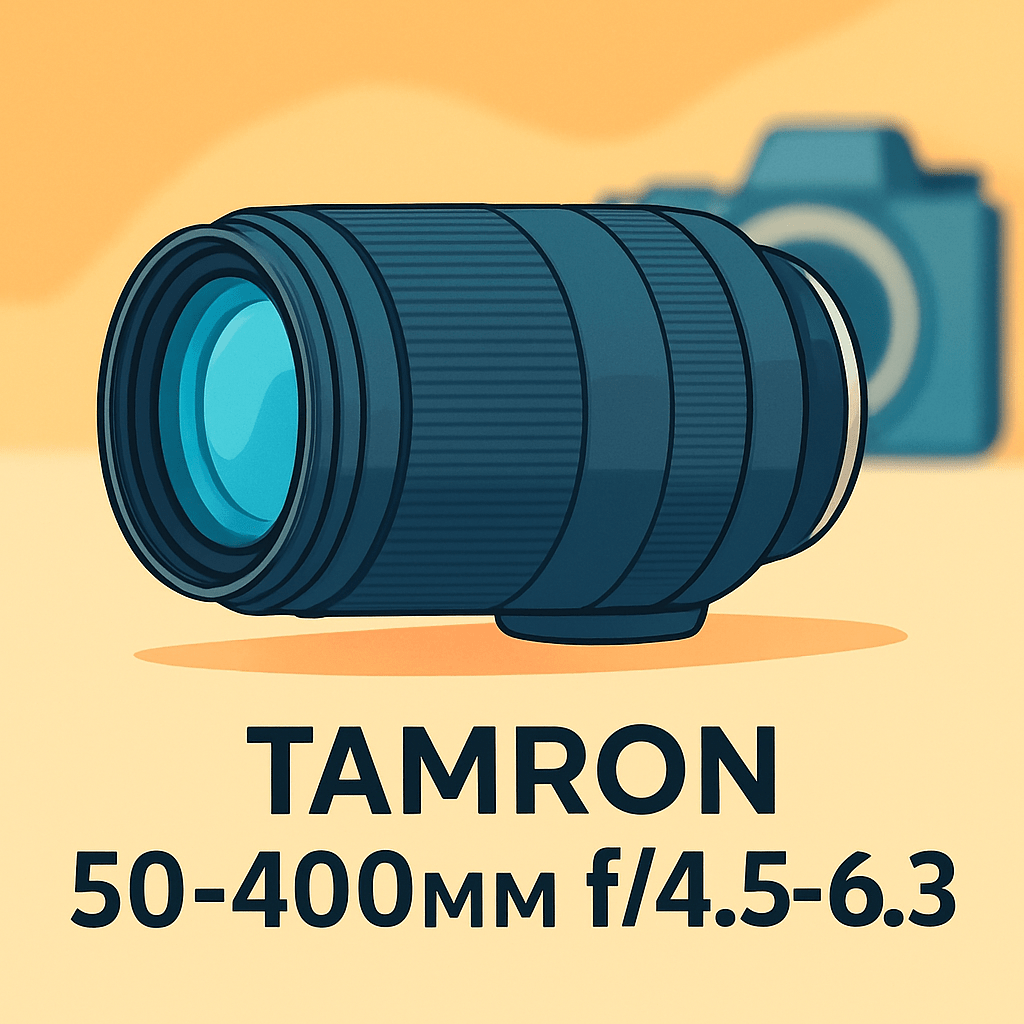
Want one lens that handles travel, portraits, and distant wildlife without a frantic lens swap? The Tamron 50-400mm f/4.5-6.3 Di III VXD Sony E promises that kind of do-everything flexibility for Sony shooters.
It’s built around useful real-world payoffs — wide-to-super-tele reach, in-lens stabilization, fast linear AF, and near-macro ability at the short end — so you’ll carry less and shoot more. Having logged field time with it, I looked forward to testing how that promise holds up across real shoots.
This review will walk through build and handling, real-world performance, image quality, AF behavior, pros and cons, and smart alternatives so you can decide if it replaces multiple lenses in your bag — make sure to read the entire review as we break it down, keep reading.

Tamron 50-400mm f/4.5-6.3 Di III VXD Sony E
Ultra-versatile super-telephoto zoom delivering a remarkable 50–400mm reach in a compact, travel-friendly package. Fast, precise autofocus and crisp optics make it ideal for wildlife, sports, and distant landscapes.
Check PriceThe Numbers You Need
| Spec | Value |
|---|---|
| Focal length | 50–400mm |
| Aperture | f/4.5–6.3 (variable) |
| Lens mount | Sony E-mount (Di III = mirrorless) |
| Image stabilization | Yes (Vibration Compensation/VC) |
| Autofocus | Yes (Voice-coil eXtreme-torque Drive/VXD) |
| Minimum focus distance | 0.25 m (9.8 in) at 50mm; 1.5 m (59.1 in) at 400mm |
| Maximum magnification ratio | 1:2 at 50mm (0.5x lifesize) |
| Filter thread | 67mm |
| Weather sealing | Yes (Moisture-resistant construction) |
| Lens elements/groups | 20 elements in 15 groups |
| Special elements | Extra-low dispersion (XLD), Low dispersion (LD), Aspherical elements |
| Weight | Approx. 1,155g (2.55 lb) |
| Length | Approx. 183.4mm (7.2 in) |
| Hood | Petal-shaped, included |
| Designed for | Full-frame cameras, compatible with APS-C |
How It’s Built
In my testing the Tamron 50-400mm f/4.5-6.3 Di III VXD feels like a well-made tool the moment you mount it to a Sony body. The fit at the mount was tight and reassuring, and it worked smoothly on both full-frame and crop bodies I tried. That confidence matters when you’re out shooting in changing conditions.
Tamron packed the design with special glass and shaped elements meant to keep color fringing and distortion in check. I found that those choices help keep images looking clean without having to fuss with heavy corrections later. For a beginner, that means fewer headaches and more usable shots straight from the camera.
The stabilization switch and other controls sit where you’d expect, and the rings have a nice, damped feel. In my hands the zoom moved smoothly through the range and the focus ring is precise enough for quick tweaks. I really liked how the included petal hood fits snugly and really knocks down stray flare in bright light.
After using it for a while I will say it isn’t the lightest lens to carry all day; you’ll want a comfy strap or monopod for long walks. It can feel a bit front-heavy at long focal lengths, which is the one thing I think could be better. Still, the solid build and weather-resistant sealing give you real-world peace of mind in light rain and dust.
In Your Hands
From wide to super-tele the Tamron feels like a true one-lens solution: comfortable for travel and walkaround work at the wide end, flattering for portraits in the mid-tele zone, and long enough for wildlife and distant action when needed. That versatility means fewer lens changes in dynamic shoots, though you accept the usual trade-offs of a do-it-all optic—it’s about flexibility rather than squeezing every ounce of low‑light performance out of a prime.
In the field the in-lens stabilization is a practical advantage, turning marginal handheld opportunities into keepable frames with steady technique. Panning with moving subjects is pleasingly composed and confidence‑inspiring, and while it doesn’t replace fast primes in very dim conditions, it extends usable shutter speeds beyond what you’d expect.
The close-focus behavior at the wide end is a standout: near-macro capability lets you capture texture, flowers, and small subjects without swapping lenses, but the long end’s working distance prevents ultra-tight framing of tiny subjects. Jumping between distant birds and closer subjects is straightforward, making it a nimble tool for unpredictable shoots.
Carry-wise it has a moderate heft that’s manageable for day trips but noticeable over long handheld sessions, so a comfortable strap or occasional monopod helps. On crop-sensor bodies it feels more reach-oriented and balanced for birding, and the zoom and control rings are smooth and responsive with no obvious tendency to creep during regular use.
The Good and Bad
- 50–400mm range covers normal to super-tele needs in one lens
- VC stabilization aids handheld shooting
- VXD AF drive for modern focusing performance
- 1:2 maximum magnification at 50mm enables strong close-up capability
- Variable aperture f/4.5–6.3 limits light intake at the long end
- 1.5m minimum focus distance at 400mm restricts tight close-ups at the tele end
Ideal Buyer
As a one-lens answer for Sony E shooters, the Tamron 50-400mm f/4.5-6.3 Di III VXD shines when you want enormous reach without fuss. It’s perfect for travel photographers who need wide-to-super-tele flexibility, event shooters juggling portraits and stage action, and wildlife fans who value stabilization and fast VXD autofocus. The unexpected 1:2 near-macro at 50mm also makes it a clever tool for close-ups when you don’t want a separate macro lens.
Field photographers who work in mixed conditions will appreciate the Tamron’s moisture-resistant construction and practical filter size. On full-frame Sony bodies it balances well enough for shoulder carry and dynamic handheld shooting, though the roughly 1.15kg mass means you should plan support or rest stops for long days. APS-C users get extra reach for birds and small wildlife, making it an efficient go-to on smaller bodies.
This isn’t the lens for specialists who demand constant fast apertures, extreme reach past 400mm, or true 1:1 macro performance. If you live in low-light action environments, prefer the lightest possible kit, or need ultra-tight long reach, you’ll be happier with a faster prime, a dedicated 200–600 tele, or a true macro optic. For everyone else who values one-lens versatility on Sony E, the Tamron is a compelling all-rounder.
Better Alternatives?
We’ve gone over what the Tamron 50-400mm brings to the table — one lens that covers normal to super-tele, useful close-up work at 50mm, in-lens stabilization, and fast VXD autofocus. It’s a great all-around tool for Sony E shooters who want to travel light and cover lots of ground without swapping glass.
If that one-lens idea doesn’t fit your shooting needs, there are solid alternatives that trade the Tamron’s wide reach or balance for either extra long reach or a more tele-focused, lighter package. Below are a few lenses I’ve used in the field and how they stack up against the Tamron in real shooting situations.
Alternative 1:

Sigma 100-400mm f/5-6.3 DG DN OS Fujifilm X
Lightweight telephoto zoom optimized for APS-C shooters, offering steady stabilization, exceptional edge-to-edge sharpness, and reliable autofocus. Perfect for birding, outdoor sports, and travel photography where reach matters.
Check PriceThe Sigma 100-400mm is what I reach for when I know I’m shooting wildlife or sports and don’t need the 50mm wide end. Compared to the Tamron 50-400, the Sigma feels more focused on tele work — it’s a bit lighter and more compact for long walks, and I found it excellent for tight subjects at distance. You do give up the Tamron’s close-up flexibility at 50mm and the wider framing for travel or portraits.
Optically, the Sigma often produces very pleasing sharpness at the long end in real shots, and the stabilization keeps things usable handheld more often than you’d expect. Autofocus is good for stills and many birds in flight, though in my experience the Tamron’s VXD setup can be snappier when subjects change speed or direction quickly. If you’re switching targets fast, the Tamron may feel a touch more confident.
Who should pick the Sigma? If you mainly shoot wildlife or outdoor sports and want a lighter, more tele-focused zoom without the need for a 50mm start point, the Sigma is a smart choice. If you want one lens that still covers close subjects and wide-ish scenes, stick with the Tamron instead.
Alternative 2:

Sony FE 200-600mm f/5.6-6.3 G OSS
Extreme long-range zoom built for serious wildlife and sports shooters, combining excellent sharpness, consistent autofocus tracking, and effective stabilization in a durable, weather-sealed build for harsh conditions.
Check PriceThe Sony 200-600mm is the obvious pick when reach is the priority. In the field, it gets you to birds and distant action that the Tamron just can’t frame tightly at 400mm. That extra reach is a real game changer for wildlife hides and stadium sidelines — you’ll see and fill the frame more often than with the Tamron’s 400mm top end.
That said, the 200-600 is heavier and bulkier, and it won’t be as handy for general walkaround work as the Tamron. The Tamron wins for everyday versatility, closer subject work at 50mm, and easier handheld shooting when you’re moving a lot. On the other hand, the Sony pairs extremely well with Sony bodies for tracking and tends to lock onto distant subjects reliably.
If you are a serious wildlife or sports shooter who needs real reach and don’t mind carrying more weight or using a monopod, the Sony 200-600mm is for you. If you want one lens that covers a wide variety of scenes and close-ups, the Tamron remains the more flexible pick.
Alternative 3:
Sony FE 200-600mm f/5.6-6.3 G OSS
Versatile super-telephoto solution offering astounding reach with smooth zoom action, balanced handling on a monopod or tripod, advanced coatings to minimize flare, and quiet drive for unobtrusive shooting.
Check PriceLooking at the Sony 200-600 again, another real advantage is how it handles on support — the zoom action is smooth and the balance on a monopod is excellent for long sessions. Compared to the Tamron, the Sony asks you to shoot supported more often, but when you do, it’s comfortable for long watches and gives steady, repeatable framing at long distances.
The Sony’s coatings and quiet drive make it easier to shoot in harsh light or when you need to be discreet. In my shoots, flare control and the quieter AF motor helped when subjects were easily spooked or backlit. The Tamron still wins for faster handheld moves and near-macro work, but the Sony shines when long-range image quality and low disturbance are priorities.
Pick this Sony if your work involves long sits, hides, or competitions where reach, quiet operation, and supported shooting matter. If you need the flexibility to run-and-gun, quickly switch to close subjects, or carry less weight on travel days, the Tamron will suit you better.
What People Ask Most
Is the Tamron 50-400mm f/4.5-6.3 worth buying?
Yes — it’s a versatile, long‑reach zoom that gives great value for travel and casual wildlife work, though you trade aperture speed and some corner sharpness compared with pricier primes.
How sharp is the Tamron 50-400mm f/4.5-6.3, especially at 400mm?
Center sharpness is good across the range, but at 400mm it’s a bit softer and benefits from careful technique or higher resolution bodies.
Is the Tamron 50-400mm f/4.5-6.3 good for wildlife and bird photography?
Yes for general wildlife and larger birds thanks to the 400mm reach and competent AF, but dedicated birders chasing small fast birds may prefer a faster, longer lens.
Does the Tamron 50-400mm f/4.5-6.3 have image stabilization and is it effective?
Yes, it includes Tamron’s stabilization and it’s effective for handheld shooting, especially at mid focal lengths and in low light.
What camera mounts and systems is the Tamron 50-400mm f/4.5-6.3 available for?
It’s offered for the major mirrorless mounts, including Sony E, Canon RF and Nikon Z systems.
How heavy and portable is the Tamron 50-400mm f/4.5-6.3 compared to similar telephoto zooms?
It’s relatively compact and lighter than many 100–400 or 150–600 alternatives, making it a good choice for travel, though still heavier than standard walkaround zooms.
Conclusion
The Tamron 50-400mm f/4.5-6.3 Di III VXD Sony E delivers a genuine one-lens solution that most Sony shooters will find liberating. Its long reach, confident stabilization, and snappy VXD AF make it unusually capable across travel, events and wildlife. The added near‑macro capability at the short end and moisture‑resistant build push it firmly into field-ready territory.
Strengths are obvious: practical versatility, reliable in-lens stabilization, and a modern autofocus system that rarely holds you back. Weaknesses are equally real — the variable, relatively slow aperture at the long end, the limited close-focus when fully tele, and the weight for extended handheld days. Those are trade-offs, not dealbreakers, for most shooters who value flexibility over specialty performance.
If you want a true do-everything lens for Sony E, this is the one to seriously consider. If your priority is maximum reach, faster constant apertures, or the absolute lightest tele setup, look toward dedicated super-tele or specialist options instead. The Tamron’s sweet spot is the photographer who prefers fewer lens swaps and more decisive shooting.
Pair it with a versatile Sony body, plan for occasional support during long handheld sessions, and lean on the stabilization for low‑light panning and wildlife work. For travel, events, and mixed tele/close‑up duties, it’s one of the most practical and cost‑effective choices you can make.
Tamron 50-400mm f/4.5-6.3 Di III VXD Sony E
Ultra-versatile super-telephoto zoom delivering a remarkable 50–400mm reach in a compact, travel-friendly package. Fast, precise autofocus and crisp optics make it ideal for wildlife, sports, and distant landscapes.
Check Price



0 Comments