
What is focal length? Want to know why some lenses make a scene feel wide while others pull a subject close?
This guide gives a clear focal length definition in millimetres and a simple one-line answer you can use right away. You will learn how focal length in mm changes angle of view, magnification, perspective and depth of field.
We show concrete examples (14mm, 50mm, 200mm), practical lens recommendations, and handy visuals like diagrams and side-by-side photos. The comparisons make it easy to see the difference at a glance.
Read on to pick the right focal length for landscapes, portraits, events or wildlife. The article is beginner-friendly, with short technical notes if you want to dig deeper.
What is focal length?
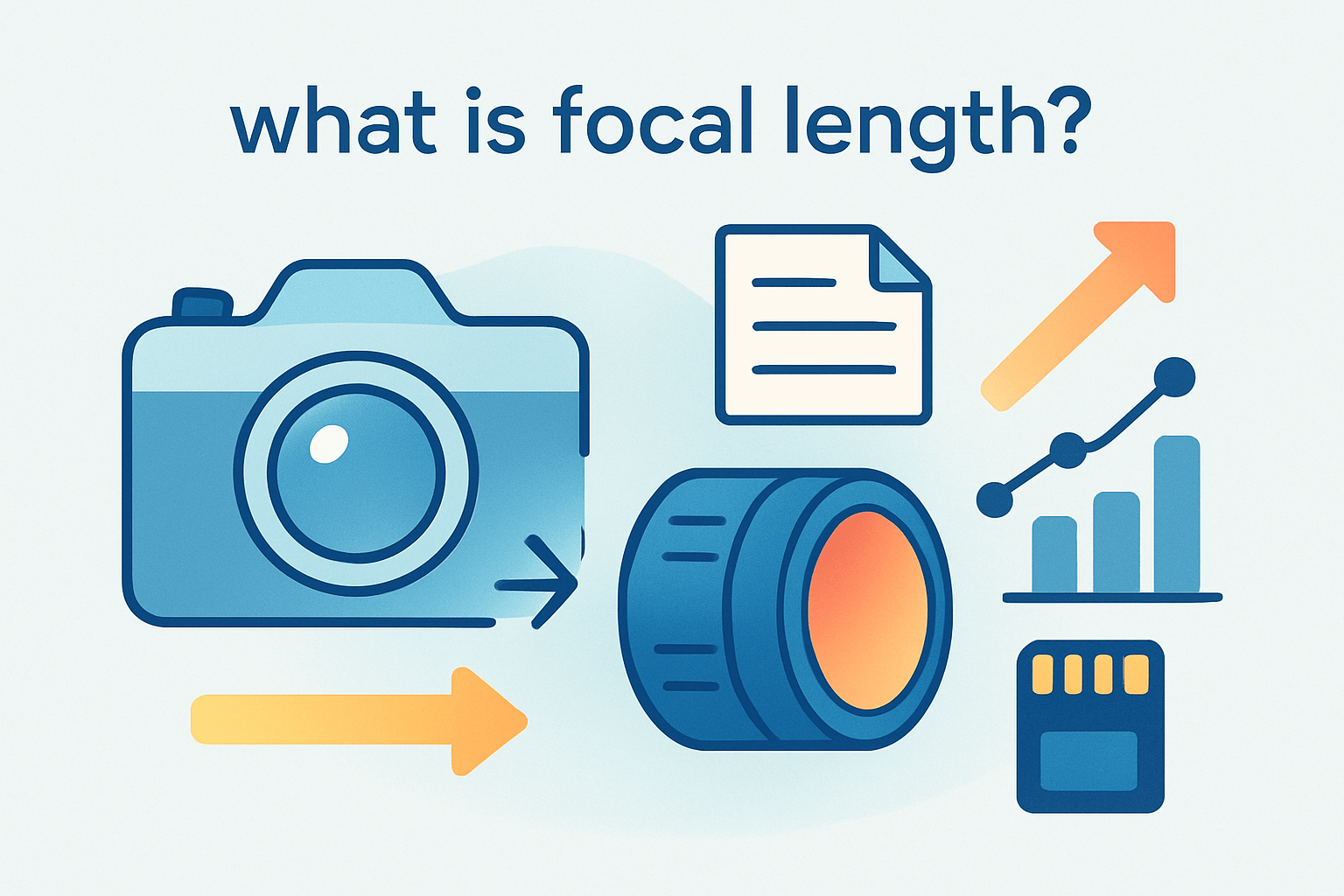
Focal length is the distance, measured in millimetres, between a lens’s optical center (principal plane) and the camera sensor when focused at infinity; it determines the lens’s angle of view and magnification.
If you came here asking “what is focal length?”, think of it like how much of a scene your lens can see and how big it makes things look. Shorter numbers see more of the world at once, while longer numbers zoom in and show a smaller slice.
For the technically curious, focal length is measured from the lens’s principal plane to the focal point on the sensor at infinity focus. It is measured in millimetres and described by standards used across optics; if you want a crisp primer on terminology, see this optical definition.
Don’t confuse focal length with the physical length of the lens. A 50mm lens can be tiny or long depending on its design, but its focal length still defines the same angle of view.
Also remember that focal length is a property that defines angle of view and magnification, not image quality by itself. When people ask “what is focal length?” they often mix it up with zoom power or sharpness, but it simply describes how a lens renders space.
For reference, a useful angle-of-view formula is: angle of view ≈ 2 × arctan(sensor dimension ÷ (2 × focal length)). You don’t need to calculate it daily, but it explains why the same focal length feels different on different sensor sizes.
Here are quick mental anchors on a full-frame camera: 14mm is ultra-wide and dramatic, 50mm feels natural and “normal,” and 200mm is narrow and telescopic. Each step changes what fits in the frame and how big distant subjects appear.
Imagine a simple diagram: light enters the lens, passes the principal plane, converges at the focal point, and lands on the sensor plane. Caption: focal length is the distance from the lens’s optical center to the sensor at infinity focus.
How focal length affects images: angle of view, magnification, perspective and depth of field
Understanding “what is focal length?” unlocks how your photos look and feel. Four levers move together here: angle of view, magnification, perspective, and depth of field.
Angle of view and magnification change with focal length. On full-frame, the diagonal angle of view is roughly 115° at 14mm, 84° at 24mm, 64° at 35mm, 47° at 50mm, 29° at 85mm, and 12° at 200mm.
Shorter focal lengths show a wider slice of the scene with less magnification. Longer ones show a narrower slice with more magnification, which is why a 200mm frame feels tight even if you never move the camera.
Try a simple test from one position: make images at 24mm, 50mm, 85mm, and 200mm. The subject stays in the same spot, yet the background seems to change size, and distant objects appear larger as focal length increases.
Now the perspective and compression nuance. Perspective is set by your camera-to-subject distance, not focal length alone, so moving your feet changes shapes more than twisting the zoom ring does.
Scenario A, same position with different focal lengths: telephoto frames look “compressed” because the tighter angle of view crops a narrower portion of the background, making distant elements appear bigger relative to the subject. The camera did not change distance, so the geometry stayed the same, but the crop fooled the eye.
Scenario B, same framing by moving vs changing focal length: stand close with a wide lens for a face and the nose grows and the ears recede, creating exaggerated perspective. Step back and use a telephoto for the same framing and the features flatten, which is often kinder for portraits.
Depth of field ties everything together with aperture and distance. At the same aperture and subject distance, longer focal lengths blur backgrounds more because magnification grows, though sensor size and viewing conditions also matter.
A practical takeaway for the same framing is this: back up with an 85mm at f/1.8 for a headshot and you’ll see strong background blur and gentle facial compression. Move in with a 35mm at f/1.8 for an environmental portrait and you’ll keep more context with deeper apparent depth of field.
Consider these quick EXIF-style examples to visualize it. Environmental portrait: 35mm, f/2, 1/500s, ISO 200. Headshot: 85mm, f/1.8, 1/250s, ISO 100.
Use these effects to support your story. Telephoto helps isolate the subject and compress busy backgrounds, while wide-angle places your subject inside their environment and adds energy through perspective.
If you prefer a gentle, step-by-step walkthrough of these relationships, this concise beginner’s guide complements the examples above. Pair it with a side-by-side shoot from one tripod spot to cement the differences.
Types of focal lengths and when to use them (wide-angle, standard, telephoto)
Let’s map practical ranges using full-frame equivalents, then match them to real scenes. This makes choosing a lens feel less like guesswork and more like packing the right tool.
Ultra-wide and fisheye, anything under about 20mm, excels indoors, tight interiors, and dramatic landscapes. Expect strong perspective exaggeration and, with fisheyes, intentional curvature for creative effect.
Wide-angle from about 20–35mm handles sweeping landscapes, architecture, street, and environmental portraits. Lines can bow if you tilt the camera, so keep the frame level or correct later to avoid stretched edges.
Standard from 35–70mm gives a natural, easy perspective that suits everyday shooting. These focal lengths are loved for documentary work, walk-around photography, and simple family moments.
Short telephoto from 70–135mm is a portrait classic because faces look flattering and backgrounds soften nicely. Event shooters rely on this range to reach across a room without getting in the way.
Telephoto 135–300mm and super-telephoto above 300mm pull distant subjects closer. Wildlife, field sports, airshows, and mountains across a valley all benefit from this extra reach.
Here are fast “go-to” choices by genre so you can start strong. For landscapes, a 16–35mm zoom is a safe bet, though a 24–70mm adds flexibility for details and portraits on the trail.
For street and documentary, 28–50mm feels natural and discreet, with a 35mm prime as a trusted favorite. For portraits, think 85–135mm for headshots, and 50–85mm for half or three-quarter body framing.
For weddings and events, pair a 24–70mm with a 70–200mm to cover wide scenes and tight moments. For wildlife and sports, as long and fast as your budget allows, often 300–600mm, with stabilization making a big difference.
When building a kit, consider weight, size, and maximum aperture alongside focal length. Travel photographers often love a compact 24–105mm for the all-day range, portrait photographers might carry an 85mm f/1.8 or f/1.4, and hikers balance reach against pack weight.
Picture a clean infographic labeled with ranges and tiny sample photos under each. It’s a quick way to see how focal length shifts framing even before you raise the camera to your eye.
Sensor size and crop factor: calculating effective focal length and real-world impact
Crop factor explains why the same lens looks different on different cameras. The effective 35mm equivalent is simply the focal length multiplied by the crop factor, which changes the field of view you record.
Full-frame has a crop factor of 1.0 and matches the old 35mm film standard. APS‑C is about 1.5 on Sony and Nikon and about 1.6 on Canon, while Micro Four Thirds is 2.0.
That means a 50mm on a 1.5× APS‑C camera frames like a 75mm on full-frame. A 300mm on Micro Four Thirds frames like 600mm on full-frame, which is a big perk for wildlife shooters.
This does not change the lens’s actual focal length; only the field of view changes relative to 35mm. Sensor size also nudges depth of field and noise performance, with larger sensors giving more background blur potential at the same framing and cleaner images at higher ISOs.
Here is a quick formula to connect the dots. Effective focal length = stated focal length × crop factor, and diagonal angle of view ≈ 2 × arctan(diagonal sensor size ÷ (2 × focal length)).
Worked example: the full-frame sensor diagonal is about 43.3mm, so a 50mm lens gives a diagonal AoV of roughly 2 × arctan(43.3 ÷ 100) ≈ 46.8°. Put the same 50mm on a 1.5× APS‑C body and the equivalent framing matches a 75mm on full-frame, yielding a tighter AoV around 32°.
Many people repeat “50mm equals the human eye,” but that is an oversimplification. Human vision is complex with wide peripheral awareness and a narrower central area, so treat 50mm as a handy reference, not a rule.
If you want a deeper dive into how sensor size and lenses interact in practice, this clear set of focal length fundamentals puts crop factors, angles of view, and examples side by side.
Choosing focal length in practice: zoom vs prime, recommended focal lengths and shooting tips
Zooms trade outright speed for flexibility, while primes trade flexibility for optical speed and compact size. If you often move quickly between far and near subjects, a zoom saves time and missed moments.
Pick a zoom for travel, events, and small bags where one lens must do many jobs. Pick primes when you need low light performance, subject isolation, or a lightweight kit that invites you to move and engage.
Teleconverters extend reach without buying a new lens. A 1.4× turns 200mm into 280mm but costs you one stop of light, while a 2× makes 200mm into 400mm and costs two stops, and both can slow autofocus or soften detail.
If you can carry only one travel lens, a 24–105mm or 24–70mm covers near everything. For portraits, an 85mm prime is a gem, while a 50mm is generous for tighter budgets and smaller spaces.
For weddings and events, the 24–70mm and 70–200mm pairing stays glued to pro cameras for a reason. For wildlife, get as long and as bright as you can, such as 300–600mm with stabilization and a sturdy support.
Use focal length to control your background as much as your subject. Longer focal lengths compress and smooth backgrounds, while wide lenses add context and energy, but avoid tight headshots with a wide-angle to prevent distortion of facial features.
Follow the handholding rule of thumb: use a shutter speed at least the reciprocal of your effective focal length. On a 200mm equivalent, aim for 1/200s or faster, but if your lens or camera has stabilization, you can push slower with care.
When in doubt, move your feet first to test how distance changes perspective, then choose the focal length that supports the composition you like. Keep asking yourself “what is focal length?” in the field, because the answer guides not just reach, but story and feel.
Consider building a small gallery with side-by-side fields of view and “hover to compare” depth-of-field examples, with EXIF callouts such as 24mm f/8 1/200s ISO 100 and 200mm f/2.8 1/1000s ISO 400. These visual reminders make your next lens choice more confident and your next shoot more intentional.
What People Ask Most
What is focal length?
Focal length describes how much a lens magnifies a scene and controls the field of view you get in a photo.
How does focal length affect my photos?
Short focal lengths capture wider scenes while long focal lengths make distant subjects appear closer and more cropped.
Do I need different focal lengths for portraits and landscapes?
Yes, portraits often use longer focal lengths to flatter faces and separate the subject, while landscapes use shorter focal lengths to show more of the scene.
Can focal length change without changing lenses?
Some zoom lenses let you change focal length without swapping lenses, while prime lenses have a fixed focal length.
Does focal length affect background blur or separation?
Longer focal lengths tend to compress the background and make it look blurrier, helping subjects stand out.
Is a longer focal length better for close-up shots?
Longer focal lengths help capture close-up details from a distance, but framing and camera stability also matter.
How does focal length influence perspective and distortion?
Short focal lengths can exaggerate distances and distort faces up close, while longer focal lengths give a more natural perspective.
Final Thoughts on Focal Length
Keep 270 in mind — it’s the kind of telephoto marking that reminds you how a lens number translates into reach and background compression. Understanding focal length gives you direct control over what fits in the frame and how subjects relate to their surroundings, from wide context to intimate isolation. Beginners and enthusiasts will see the biggest gains by practicing a few focal-length choices rather than chasing gear.
We started by defining focal length as the distance between a lens’s principal plane and the sensor, and this guide then showed how that single number affects angle of view, magnification, perspective, depth of field and real-world choices. A realistic caution: don’t expect any one lens to solve every problem — perspective still comes from where you stand, and trade-offs in size, speed and cost are real.
Whether you’re shooting streets, portraits or distant wildlife, this primer gives you a map for choosing focal lengths and making smarter framing decisions. Keep experimenting with focal length and camera position — you’ll see immediate improvements and develop a visual instinct that’ll make every shoot feel more deliberate.




0 Comments