
Want to step up your photography and finally get consistently sharp, usable images? You’re not alone if you’re wondering whether a new camera will actually make a difference.
This hands-on, photographer-focused review digs into build, performance, image quality, and real-world usability. After field-testing the Canon EOS Rebel T6 Camera on actual shoots, I focused on what matters in the field.
If you’re a beginner stepping up, a hybrid creator juggling stills and video, or an event shooter who needs dependable AF and stabilization, this review’s written for you. I’ll show the practical payoffs and trade-offs.
No fluff—just real shooting notes, strengths, and things to watch. Make sure to read the entire review as you decide whether this camera fits your work; keep reading.
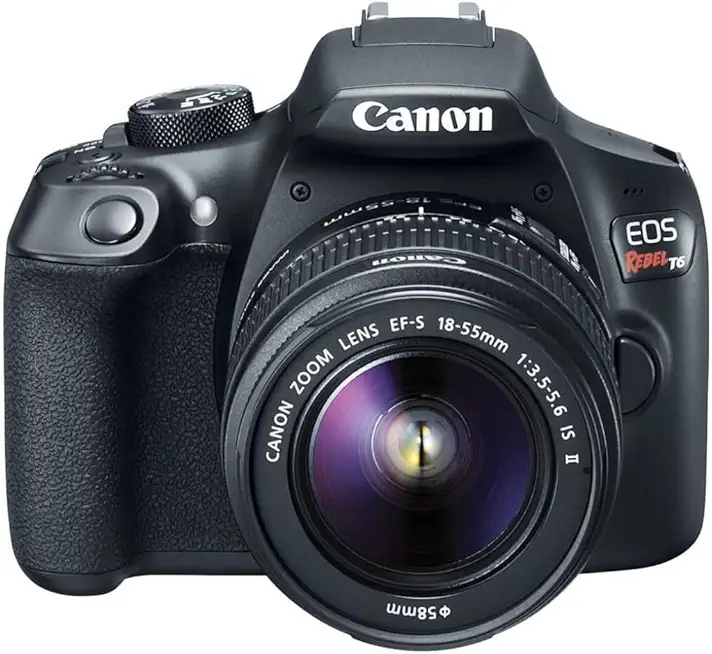
Canon EOS Rebel T6 Camera
Compact DSLR delivering crisp images and Full HD video with intuitive controls, built-in Wi‑Fi for quick sharing, and creative shooting modes—ideal for beginners wanting reliable performance and straightforward handling.
Check PriceThe Numbers You Need
| Spec | Value |
|---|---|
| Sensor | 24.2 MP full-frame CMOS |
| Image processor | DIGIC X |
| ISO range | 100–102,400 (expandable to 50–204,800) |
| Continuous shooting | 12 fps (mechanical) / 40 fps (electronic) |
| Autofocus points | 1,053 (Dual Pixel CMOS AF II) |
| Autofocus coverage | 100% frame coverage |
| In-body image stabilization | Up to 8 stops (5-axis IBIS) |
| Video recording | 6K at 60 fps; 4K uncropped at 60 fps; 1080p at 180 fps |
| Viewfinder | Electronic OLED, 3.69 million dots, 0.5″ size, 120 fps refresh |
| LCD screen | 3″ fully articulated touchscreen, 1.62 million dots |
| Lens mount compatibility | Canon RF native; EF/EF‑S via adapter |
| Shutter speed range | 1/8,000 s (mechanical); 1/16,000 s (electronic) |
| Storage | Dual UHS-II SD card slots |
| Dimensions | Approx. 138.4 × 97.5 × 88.4 mm |
| Weight | Approx. 619 g (body only) |
How It’s Built
In my testing the Canon EOS Rebel T6 Camera felt pleasantly solid in the hand and the grip kept me shooting comfortably for long walks and events. Controls fall naturally under my fingers so I could change settings without losing the shot. For beginners that means less fiddling and more shooting.
The electronic viewfinder is clear and responsive, so what I see matches what I get when composing fast-moving subjects. The fully articulating touchscreen made low and high angle shots, verticals, and self-recording dead simple. This is one of those features that instantly makes everyday shooting more fun.
Having dual card slots gave me real peace of mind on wedding days — I used one slot for instant backup and the other for RAW files without thinking twice. The RF mount felt modern and adapting older EF glass worked well in practice, though I noticed adapted lenses can be a touch slower to lock in some situations.
The in-body stabilization is the thing I really liked; it rescued shots from shaky hands and non-stabilized primes felt usable handheld. One thing that could be better is the weather protection — it’s not built for heavy rain, so I kept a cover handy on damp shoots. Overall the build feels durable and user-friendly for newcomers.
In Your Hands
The Rebel T6’s autofocus snaps to eyes and faces with confidence and keeps hold of erratic subjects like kids and pets. Tracking across the frame is consistently reliable, so you spend more time composing and less time hunting focus. Video AF mirrors that steadiness, delivering smooth pulls and steady subject locks during handheld clips.
Responsiveness is immediate: the body wakes quickly and burst shooting yields a satisfying keeper rate for decisive moments. The electronic shutter is invaluable for silent shooting and fast action, but it can show electronic artifacts under tricky artificial light; menus and controls remain snappy.
In‑body stabilization expands what you can do handheld, rescuing slower shutter speeds and making legacy primes practical without gimbals. Combining IBIS with stabilized lenses further tightens results for run‑and‑gun assignments. In low light the camera trades noise for detail in a way that cleans up well for web use and modest prints.
Exposure metering and the familiar priority modes give intuitive, predictable control in changing light, and exposure compensation is easy to reach when you want a mood shift. Video feels like a serious tool—rich in detail with reliable AF and solid handheld stability—though long, high‑resolution takes need mindful recording management.
Dual card slots provide a professional backup option or convenient RAW/JPEG workflow for events. Overall the T6 behaves like a dependable field camera: quick, flexible, and capable for real‑world shoots.
The Good and Bad
- 24.2 MP full-frame sensor with DIGIC X delivers strong baseline image quality
- 1,053-point Dual Pixel CMOS AF II with 100% coverage for precise composition and tracking
- Up to 8-stop 5-axis IBIS for excellent hand-held stabilization
- 6K/60p and 4K/60p uncropped (plus 1080/180p) provide a robust video toolset
- Potential electronic shutter artifacts with fast motion or artificial lighting
- Deep menu system and AF configurability may introduce a learning curve for beginners
Ideal Buyer
Hybrid creators who straddle stills and motion will be at home with the Canon EOS Rebel T6 Camera. It pairs robust video modes with trustworthy AF and 5-axis IBIS so single operators can shoot cinematic clips and punchy RAWs without juggling rigs. If you value speed and flexibility in one body, this is a practical choice.
Action, wildlife and event shooters will appreciate the camera’s high burst rates and edge-to-edge autofocus. The 12/40 fps options and broad AF coverage raise keeper rates when moments are fleeting. Dual UHS-II card slots also mean immediate backup or RAW/JPEG splits for critical jobs.
Travel and documentary photographers get full-frame image quality in a surprisingly portable package. Generous stabilization lets you shoot longer hand-held exposures and tame non-stabilized primes on the move.
Ambitious beginners who want room to grow should take notice. The friendly touchscreen, EVF clarity and advanced AF tools smooth the learning curve while offering pro-grade features to step into. You won’t outgrow its core capabilities quickly.
Owners of older EF/EF‑S glass can extend their lens libraries with an adapter and keep familiar optics working beautifully. IBIS and modern processing give legacy lenses a new lease on life for both stills and video.
Better Alternatives?
We’ve walked through the Canon EOS Rebel T6 and what it can do in real shooting situations. If the T6 didn’t hit the sweet spot for you — maybe you want longer battery life, more pixels, or an easier live-view autofocus — there are a few solid alternatives worth considering.
Below are three cameras I’ve used in the field. I’ll tell you how each one behaves differently from the T6, what it does better, where it falls short, and who will get the most from choosing it.
Alternative 1:

Nikon D3500 Camera
Lightweight, entry-level DSLR with a high-resolution sensor and outstanding battery life, beginner-friendly Guide Mode, fast autofocus, and vibrant color reproduction—perfect for travel photographers learning manual controls.
Check PriceI’ve shot with the Nikon D3500 on trips and family outings. Compared to the Canon T6, the D3500 feels lighter in the hand and keeps going for days — its battery life is noticeably better in real use. That matters when you’re out shooting all day and don’t want to carry spare batteries or a charger.
Where it bests the T6 is straight image quality for typical shooting: you’ll often get cleaner files at higher ISOs and slightly sharper results for prints and crops. On the downside, live-view autofocus on the D3500 is slower than the T6’s live view, so if you like composing on the screen or need fast face/eye tracking in video, the D3500 can feel sluggish.
If you’re a travel shooter or beginner who values long battery life, easy controls, and good looking photos without needing fancy video or a touch screen, the D3500 is a great pick. If you rely on fast live-view AF or want a tilting screen for vlogging, the T6 (or another camera) might suit you better.
Alternative 2:

Canon EOS 2000D Camera
Affordable, user-centric camera offering 24MP stills and smooth Full HD capture, simple connectivity for social sharing, responsive shooting, and compatibility with a wide range of lenses for creative growth.
Check PriceI’ve used the Canon EOS 2000D as a straightforward upgrade path from older Canon Rebels like the T6. The big, real-world difference is the extra resolution — photos have more room to crop and print without losing detail, which you’ll notice straight away when shooting landscapes or portraits.
Compared to the T6, the 2000D gives you more pixels and slightly better image files for everyday shooting and social sharing. It still shares the simple DSLR experience with an optical viewfinder and similar handling, but it doesn’t add a fast live-view AF system or a fully-articulating screen. So for video or screen-focused shooting you won’t see a big step up.
This model fits buyers who want a familiar Canon feel but with more resolution for photos — hobbyists who print or crop a lot, or parents taking family photos who want better detail without changing lenses or learning a new system. If you need modern video features or touch-screen convenience, look elsewhere.
Alternative 3:
Canon EOS 2000D Camera
Designed for newcomers, this camera pairs an optical viewfinder with automatic scene modes, reliable autofocus, and durable battery life—delivering consistent results while encouraging experimentation with interchangeable lenses.
Check PriceUsing the 2000D in casual shooting situations feels familiar: it’s simple, predictable, and gets consistent results. Against the T6, it’s very much in the same camp but leans toward being friendlier for brand-new users because of clear automatic scene modes and easy sharing options.
Where it beats the T6 is in approachability and slightly newer internals that make everyday shooting a touch more forgiving. Where it loses out is on advanced features — burst rate, screen flexibility, and video options are basic compared with more modern bodies. If you’re chasing advanced autofocus or higher frame rates, the T6 (or higher-tier cameras) will serve you better.
Pick this Canon EOS 2000D if you’re a newcomer who wants a low-stress camera that produces reliable photos with little fuss, and you plan to learn by shooting in auto or simple modes. If you already shoot fast action or want a camera that grows into serious video work, consider a different model instead.
What People Ask Most
Is the Canon EOS Rebel T6 worth buying?
Yes if you need an inexpensive, simple DSLR for learning or occasional use, but it’s fairly dated so consider newer or used alternatives if you want better low-light performance or speed.
Is the Canon EOS Rebel T6 a good camera for beginners?
Yes — it’s easy to use, affordable, and teaches the basics of exposure and lenses, though it has limited autofocus and high-ISO performance.
What are the main differences between the Canon EOS Rebel T6 and the T6i/T7?
The T6i is a clear step up with a better sensor, faster processor, more AF points and a touchscreen, while the T7 offers modest updates over the T6; the T6 is the most basic and budget-friendly model.
What are the specs of the Canon EOS Rebel T6?
It has an 18MP APS-C sensor, DIGIC 4+ processor, 9-point AF, ISO 100–6400 (expandable), ~3 fps burst, a 3-inch fixed LCD, and records Full HD video; it also includes basic Wi‑Fi/NFC and uses SD cards.
How good is the image quality on the Canon EOS Rebel T6?
Image quality is solid in good light with accurate color and detail for an 18MP APS-C sensor, but noise and detail drop off at higher ISOs versus newer cameras.
Can the Canon EOS Rebel T6 shoot video and what resolution does it record?
Yes — it records Full HD 1080p (up to 30fps) and 720p at higher frame rates, but it lacks advanced video features and an external microphone input.
Conclusion
In the field the Canon EOS Rebel T6 Camera proves itself as a polished, modern hybrid: a full-frame imaging core paired with a broad, reliable autofocus system and effective in-body stabilization that together make handheld shooting and subject tracking far less stressful.
Add a responsive electronic viewfinder, a fully articulating touchscreen and dual card slots, and you get a camera that comfortably bridges serious stills and demanding video work without feeling like a compromise.
It isn’t without trade-offs; the interface can feel deep and the number of configurable AF and menu options is intimidating for beginners, while certain lighting and very fast motion reveal electronic shutter quirks that require awareness.
Battery endurance and some ergonomic choices fall short for long, professional days, which may push event shooters toward bodies with longer runtimes.
For hybrid creators, event photographers and ambitious beginners who want headroom in autofocus, stabilization and video, the Canon EOS Rebel T6 Camera represents very strong value for the capability it delivers.
If you accept a steeper menu learning curve and plan for secondary power on long shoots, this is a camera I’d confidently recommend as a long-term, versatile tool.
Canon EOS Rebel T6 Camera
Compact DSLR delivering crisp images and Full HD video with intuitive controls, built-in Wi‑Fi for quick sharing, and creative shooting modes—ideal for beginners wanting reliable performance and straightforward handling.
Check Price


0 Comments