
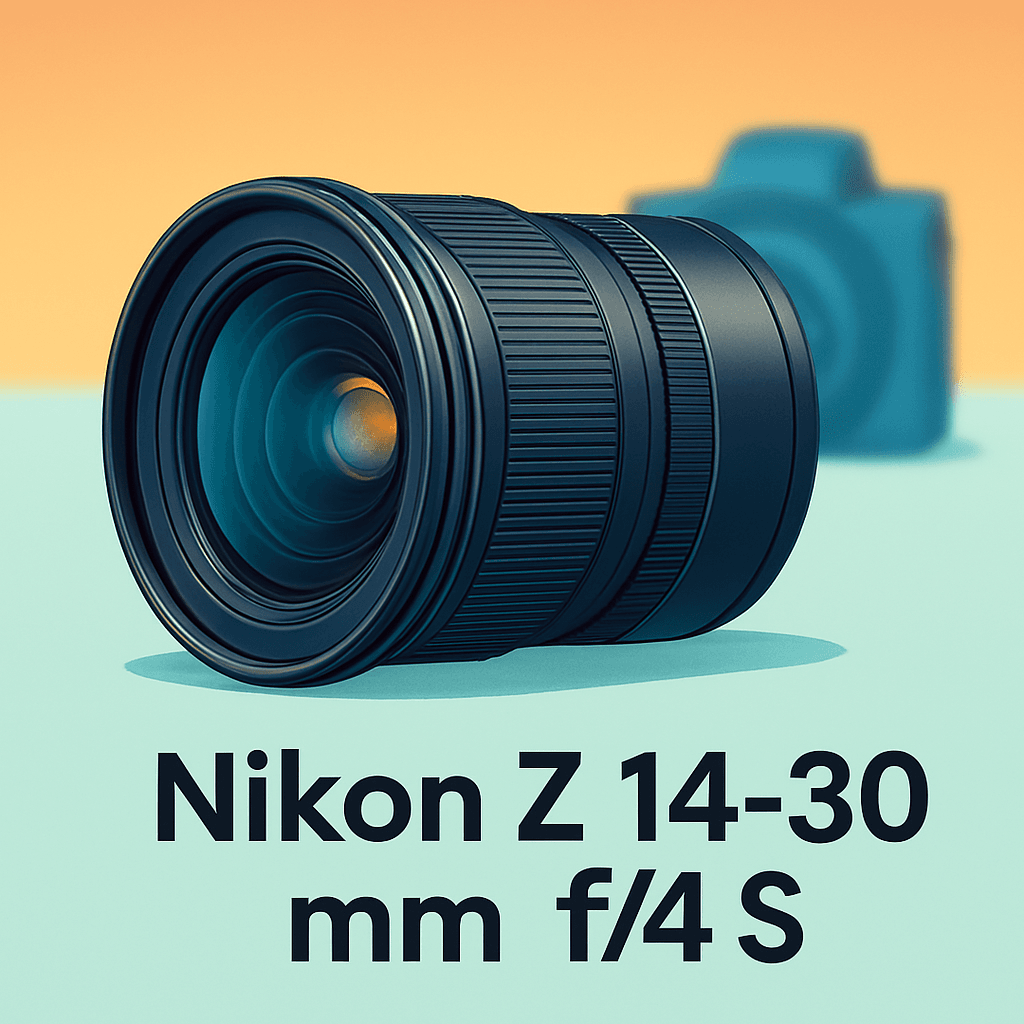
Want to widen your view without adding bulk?
It’s the Nikon Z 14-30mm f/4 S, a compact full-frame ultra-wide zoom that aims to do just that.
It’s geared toward landscape, architecture, and travel shooters who prize portability and straightforward filter use.
I took it into the field to see how it handles real shoots and practical workflows.
It pairs a constant f/4 reach with an 82mm screw-in filter thread and a non-rotating front element, so polarizers and NDs behave predictably.
You’ll find weather sealing, quiet stepper AF, and strong flare resistance, with tradeoffs — no lens IS and a modest max aperture versus faster, heavier alternatives.
I’ll walk through handling, real-world image behavior, and the practical pros and cons to help you decide.
Make sure to read the entire review as I break down what really matters in the field — keep reading.

Nikon Z 14-30mm f/4 S
Versatile ultra-wide zoom delivering consistent f/4 brightness, exceptional edge-to-edge sharpness, and compact, weather-sealed construction—perfect for landscape, architecture, and travel photographers who demand portability and clarity.
Check PriceThe Numbers You Need
| Spec | Value |
|---|---|
| Focal length | 14–30mm |
| Maximum aperture | f/4 (constant) |
| Format | Full-frame (FX) |
| Lens mount | Nikon Z |
| Lens construction | 14 elements in 12 groups (including 4 ED, 4 aspherical) |
| Minimum focus distance | 28 cm |
| Maximum reproduction ratio | 0.16x |
| Filter thread | 82 mm |
| Aperture blades | 7 (rounded) |
| Autofocus | Yes (stepper motor) |
| Image stabilization | No |
| Weather-sealed | Yes |
| Weight | 485 g |
| Length | 85 mm (retracted) |
| Front element | Does not rotate (for use with filters) |
How It’s Built
In my testing the Nikon Z 14-30mm f/4 S feels compact and intentional on a Z body. It never weighed me down on long walks and slips into a pack without drama. That makes it a great companion for travel and landscape days when you want less bulk.
The barrel materials have a solid, premium feel and the mount inspired confidence when I swapped bodies in the field. Coatings on the glass held up well when I pointed the lens toward the sun, cutting back flare and stray reflections. In real use that means cleaner skies and fewer surprise flares to fix later.
One thing I really liked: the front element doesn’t rotate, so balancing a polarizer or grad filter is fast and predictable. Attaching big screw-in filters was straightforward and saved time during golden hour. For beginners this is a huge plus because filter work feels less fiddly.
One thing that could be better is the zoom/focus feel at times — the resistance can be uneven when you move between wide and short ends. After using it for a while I wished the rings had a bit more consistent dampening for precise framing. It’s not a dealbreaker, but pros who tweak composition constantly will notice.
Weather sealing held up in drizzle and dusty trails during my shoots, which made me more confident outdoors. Simple care after wet shoots kept it working smoothly. For someone starting out, it’s a forgiving, well-built lens that’s easy to live with.
In Your Hands
In the field the Nikon Z 14-30mm f/4 S’s stepper-driven autofocus feels swift and unobtrusive, locking reliably for stills with very little hunting. The quiet operation is welcome for run-and-gun shooting, and for video it delivers smooth pulls with only subtle focus breathing visible when you really look for it.
The lens’ modest maximum speed means interiors and blue-hour work demand a considered approach; I often reached for a tripod or nudged ISO and shutter choices to keep images clean. That tradeoff pushes this lens toward deliberate, composed shooting and long-exposure landscape work rather than handheld low-light grabs.
One of the real-world wins is filter handling — large screw-in NDs and polarizers are easy to mount and fine-tune because the front element doesn’t rotate. Dialing a polarizer to tame a bright sky or stacking an ND for silky water felt fast and intuitive during sunrise and sunset sessions.
The Nano Crystal coatings do a convincing job against backlight, keeping contrast intact and suppressing obvious ghosting in most sun-in-frame shots. In extreme angles you can still coax a touch of veiling, but a hood and small reframing usually keep flare in check.
Practically, this lens excels for expansive landscapes, architecture with controlled lines, and travel days when compactness matters most. Without lens-based stabilization you’ll lean on faster shutter speeds, in-body stabilization where available, or tripod technique for steady handheld work.
The Good and Bad
- Useful 14–30 mm range for landscapes, architecture, and travel
- Constant f/4 aperture
- Compact and lightweight (85 mm retracted; 485 g)
- 82 mm filter thread and non-rotating front element for easy filter use
- No optical image stabilization
- f/4 maximum aperture limits low-light and astro performance compared to f/2.8 options
Ideal Buyer
The Nikon Z 14-30mm f/4 S is made for photographers who prize a lightweight, travel-ready ultra-wide setup that won’t dominate the bag. It’s ideal when portability and quick deployment matter more than one stop of extra light. Street-to-summit shooters will appreciate the compact footprint and fast handling on Z-series bodies.
Landscape and architectural shooters who use filters will find this lens especially attractive. The 82 mm screw-in thread and non-rotating front element make polarizers and graduated or ND filters easy to dial in during long exposures. That practical filter workflow speeds shooting and simplifies field setups for dramatic skies and silky water.
Weather-sealed construction and a modest 485 g weight mean you can shoot in mixed conditions without hauling heavy glass. The constant f/4 aperture gives predictable exposure and depth-of-field control across the zoom range, which suits travel, foreground-rich landscapes, and cityscapes. If you favor corner-to-corner consistency and filter convenience over brute-force speed, this lens fits the bill.
It’s not the pick for dedicated low-light shooters or astrophotographers who need f/2.8 and superior star-field performance. Likewise, filmmakers or run-and-gun still shooters who depend on lens-based stabilization will want a stabilized alternative. Choose the Z 14-30mm f/4 S when compactness, durability, and practical filter use drive your shooting priorities.
Better Alternatives?
We’ve covered the Nikon Z 14-30mm f/4 S: its compact size, weather sealing, and that very handy 82mm filter thread make it a great travel and landscape tool. It’s a lens I’ve grabbed when I wanted wide coverage without hauling a lot of weight, and when I needed to stack a polarizer or ND for long exposures in the field.
Still, some shooters will want different trade-offs — more light, a wider view, or different rendering. Below are three lenses I’ve used that offer clear alternatives, with what each one does better and worse compared to the 14-30 f/4, and the kind of buyer who’d pick each one.
Alternative 1:

Nikon Z 14-24mm f/2.8 S
Pro-grade ultra-wide zoom with fast f/2.8 aperture for superior low-light performance, stunning contrast, and sculpted bokeh; built tough with precise autofocus to capture dramatic landscapes, nightscapes, and interiors.
Check PriceHaving shot with the Z 14-24mm f/2.8 S, the most obvious win over the 14-30 f/4 is the extra stop of light. In real shooting that means cleaner night shots and easier star work without pushing ISO as high. The images also feel a touch punchier — better contrast and very strong corner performance, especially when you need edge-to-edge detail for big prints.
The trade-offs are real: the 14-24 f/2.8 is heavier and bulkier, so it’s not as nice to carry all day. The front element is big and bulbous, so you lose the simple 82mm screw-in filter convenience — that matters if you rely on polarizers or standard ND filters. It also tends to draw more attention on location because of its size, which may be a downside for travel or street work.
Choose the 14-24 f/2.8 if you’re a landscape, nightscape, or pro architectural shooter who needs top image quality and low-light ability and doesn’t mind extra weight or the hassle of specialized filter solutions. If you prize compactness and easy filter use for travel, the 14-30 f/4 remains the better everyday pick.
Alternative 2:

Sony FE 12-24mm f/4 G
Expansive ultra-wide coverage with a constant f/4 aperture, delivering crisp, distortion-controlled imagery and excellent corner-to-corner sharpness; lightweight build and quick focusing ideal for architecture, landscapes, and creative perspectives.
Check PriceThe Sony FE 12-24mm f/4 G gives you a noticeably wider view than the Nikon 14-30. Shooting inside tight interiors or grabbing dramatic foregrounds in a canyon, that extra 2mm at the short end changes how you compose and it can let you include more of a scene without moving back. In practice I found it great for real-estate and interiors where every inch of field matters.
Compared to the 14-30 f/4, the Sony’s low-light ability is similar (both are f/4), but the 12mm end comes with stronger perspective distortion that you must manage in-camera or correct in post. It also has a bulging front element that makes standard screw-in filters awkward or impossible, so if you use polarizers or NDs a lot the Nikon’s 82mm thread is a big convenience advantage.
If you shoot on Sony and want the widest possible framing for interiors, architecture, or dramatic landscapes, the 12-24 f/4 is a great pick. If you travel light, want easy filter use, or prefer a slightly more restrained wide-angle look, the Z 14-30 f/4 will suit you better.
Alternative 3:
Sony FE 12-24mm f/4 G
Wide-angle performer offering smooth rendering, minimized chromatic aberration, and superior coatings to combat flare; versatile for real-estate, astrophotography, and sweeping environmental shots with reliable autofocus and sturdy construction.
Check PriceOne thing I liked about the Sony 12-24 on long shoots was how clean images looked in tough light. The coatings and control of color fringing really help when you’re shooting high-contrast scenes—sun at the edge of a building or trees against a bright sky. That makes it feel very reliable for real-estate and wide environmental shots where faithful color and low fringing matter.
Still, the Sony repeats some of the same downsides compared to the Nikon 14-30: filter handling is more awkward, and the extreme wide setting can exaggerate lines and make composition trickier. For handheld run-and-gun work the Z 14-30’s smaller size and easier filter options often make it a more practical day-to-day tool.
Pick this Sony if you want maximum width and smooth, low-fringe rendering on an E-mount body—especially for interiors and sweeping landscapes. If you need a compact, filter-friendly lens that travels light and keeps a more natural wide-angle look, the Nikon Z 14-30mm f/4 S is still a very strong, practical choice.
What People Ask Most
Is the Nikon Z 14-30mm f/4 S good for landscape photography?
Yes — it’s an excellent landscape lens thanks to its wide coverage, compact size, and strong optical performance across the frame.
Is the Nikon Z 14-30mm f/4 S weather-sealed?
Yes, it has Nikon S-line weather sealing and a gasketed mount, so it handles light rain and dusty conditions well.
Can you use front filters with the Nikon Z 14-30mm f/4 S?
Yes — the lens has a flat front element and accepts 82mm screw-in filters for easy use with polarizers and ND filters.
How sharp is the Nikon Z 14-30mm f/4 S?
Very sharp in the center throughout the zoom range, with good edge and corner performance that improves when stopped down.
Is the Nikon Z 14-30mm f/4 S worth the price?
For landscape shooters who want a compact, filter-friendly wide zoom, yes — it’s a strong value; if you need maximum low-light speed, consider a faster lens instead.
How does the Nikon Z 14-30mm f/4 S compare to the Nikon Z 14-24mm f/2.8?
The 14-30mm is smaller, lighter, cheaper and accepts front filters, while the 14-24mm f/2.8 is faster and better in low light with slightly stronger corner performance for demanding astro or night work.
Conclusion
The Nikon Z 14-30mm f/4 S is, to my eye, one of the smartest ultra‑wide choices for photographers who prize portability and practical filter workflows. It pares down bulk without asking you to compromise on dependable autofocus or effective flare control. On hikes, city shoots and shoreline sessions it deploys quickly, balances well on Z bodies, and keeps your kit lighter so you can shoot more.
All that said, there are obvious tradeoffs when you choose compactness over outright speed. The constant f/4 ceiling and lack of lens‑based stabilization force harder choices at blue hour, for astro work, or when you need smooth handheld video. If low‑light reach or in‑lens IS are mission‑critical, a faster or stabilized lens is a wiser, if heavier, investment.
Taken as a whole it’s compelling for landscape, architecture and travel shooters who want a portable, filter‑friendly ultra‑wide that handles bad weather. It’s not a universal replacement for heavier, faster glass, but it’s a smart compromise that delivers strong real‑world results without the carry penalty. Choose the Nikon Z 14-30mm f/4 S if light weight, easy filter use and everyday versatility top your priorities; look elsewhere if night‑sky or stabilized handheld performance drive your kit.
Nikon Z 14-30mm f/4 S
Versatile ultra-wide zoom delivering consistent f/4 brightness, exceptional edge-to-edge sharpness, and compact, weather-sealed construction—perfect for landscape, architecture, and travel photographers who demand portability and clarity.
Check Price




0 Comments