
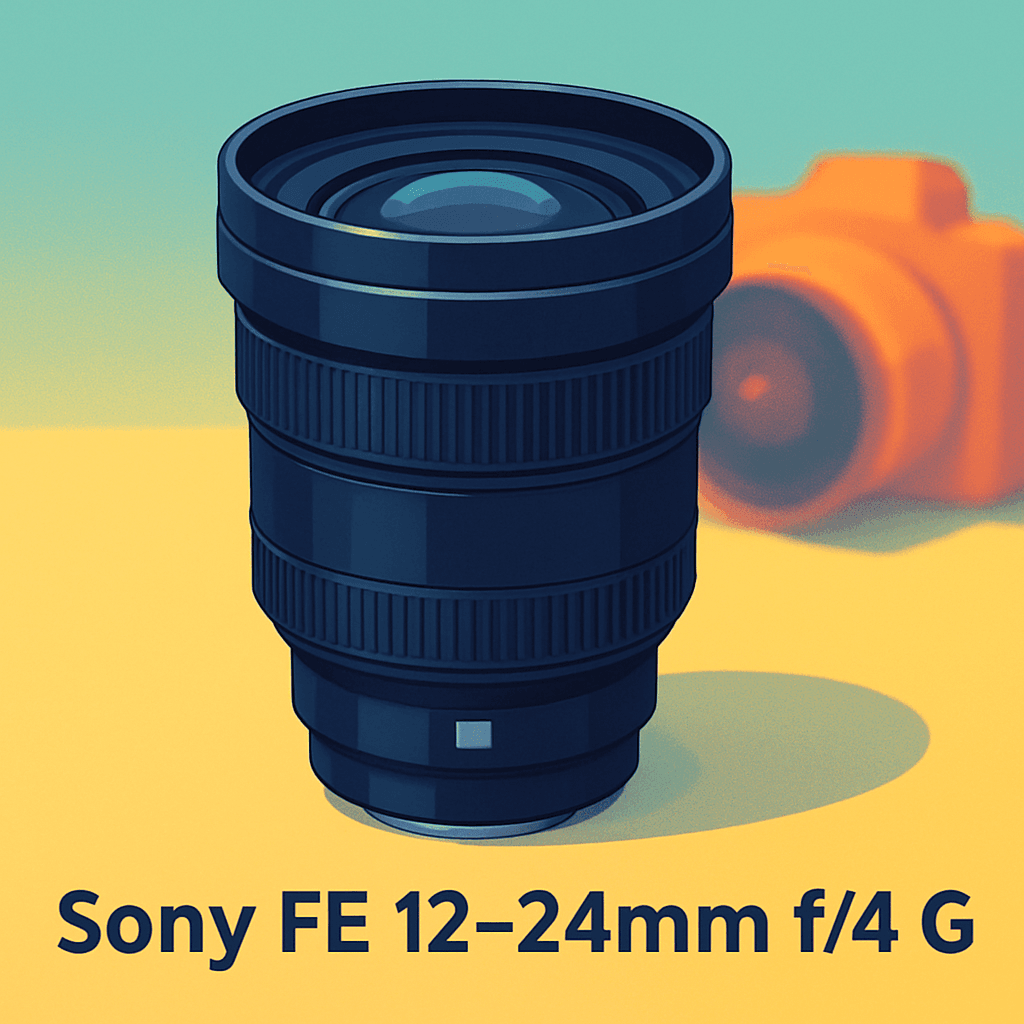
Want to make cramped interiors look cinematic or turn sweeping landscapes into immersive panoramas?
The Sony FE 12-24mm f/4 G is a constant‑aperture ultra‑wide zoom for Sony full‑frame bodies. It gives true 12mm perspective, an internal zoom for steady balance, fast quiet AF, and weather resistance you’ll notice on location.
I spent a few days shooting interiors, architecture, and landscapes with it to see how those advantages translate on real shoots. Those sessions showed where it shines and where compromises matter.
If you’re a Sony shooter who needs expansive angles, compact handling, or quiet focusing for hybrid work, this review will dig into the practical payoffs and trade‑offs — keep reading.

Sony FE 12-24mm f/4 G
Expansive ultra-wide zoom delivering edge-to-edge sharpness and low distortion for sweeping landscapes and interiors. Lightweight, weather-resistant design with a consistent aperture for reliable exposures and creative perspectives.
Check PriceThe Numbers You Need
| Spec | Value |
|---|---|
| Focal Length | 12–24mm |
| Maximum Aperture | f/4 (constant) |
| Lens Mount | Sony E-mount (Full-frame) |
| Format Compatibility | Full-frame |
| Lens Type | Ultra-wide-angle zoom |
| Optical Design | 16 elements in 12 groups |
| Minimum Focus Distance | 0.28 meters |
| Maximum Magnification | 0.14× |
| Image Stabilization | No (relies on camera body stabilization) |
| Aperture Blades | 7, circular aperture |
| Filter Size | None (bulbous front element; no filter thread) |
| Lens Coating | Nano AR Coating II (reduces flare and ghosting) |
| Dimensions | Approx. 88.5 mm diameter × 117.6 mm length |
| Weight | Approx. 565 grams |
| Autofocus | Fast and quiet linear motor |
How It’s Built
In my testing the Sony FE 12-24mm f/4 G felt compact and balanced on Sony full‑frame bodies. Its internal zoom keeps the lens length constant, so balance stays steady on a gimbal or handheld. That makes it easy to focus on framing instead of fighting weight shifts.
I found the build very solid, with zoom and focus rings that have nice damping. The mount is tight and the weather sealing gave me confidence shooting in light rain. In practice that means fewer surprises in the field.
The bulbous front element means you can’t use screw‑in filters, so landscape shooters need a holder or post work. What I really liked was the internal zoom and light weight that kept long days easy. One thing that could be better is the lack of a front filter thread.
Pack it carefully to protect the exposed front glass — a padded pouch helps. I found it easy for beginners to hold and control, and its compact size won’t overwhelm your kit. It’s a capable ultra‑wide that’s ready for field work with a little planning.
In Your Hands
There’s no optical stabilization in the barrel, so you’ll be leaning on your camera’s in-body stabilization or raising ISO and slowing shutter speeds when light drops. In practical shooting, that means trading a touch of noise or motion blur for the wider framing rather than relying on the lens to hold everything steady. Still, with solid IBIS the lens remains entirely usable handheld for most reportage and travel work.
Close-focus capability lets you dramatize foregrounds against sweeping backgrounds, and the internal-zoom design keeps balance consistent as you reframe. Autofocus is quiet and unobtrusive, which pays dividends for run-and-gun video and when you need seamless focus transitions on a gimbal. The steady handling makes architectural sweeps and interior panoramas feel deliberate rather than awkward.
Backlit scenes are easier to manage than you’d expect thanks to modern coatings that temper flare and ghosting, but composition still matters—place the sun thoughtfully and you’ll avoid surprise veiling. The bulbous front element complicates traditional screw-in filters, so bring alternative filter solutions or plan workarounds for long-exposure landscapes and delicate interior exposures. A hood and a protective bag sleeve are essentials in the kit.
Packed up, the lens is noticeably more pocketable than many specialty ultra-wides, which encourages carrying it as a go-to option. Its combination of steady handling, silent AF, and wide framing makes it a photographer’s tool for tight interiors, dramatic vistas, and hybrid video work where reliability and balance trump brute optics.
The Good and Bad
- True ultra-wide coverage at 12mm on full-frame
- Constant f/4 aperture throughout the zoom range
- Internal zoom for consistent balance and dust protection
- Fast, quiet linear motor AF suitable for stills and video
- No optical stabilization (depends on body IBIS)
- No front filter thread due to bulbous front element
Ideal Buyer
The Sony FE 12-24mm f/4 G is for photographers who chase expansive perspective — architects, interior shooters, and landscape photographers who need true 12mm coverage on full-frame. Its constant f/4, internal zoom and weather‑resistant build make it a compact, dependable tool for travel and location work. If you prize drama, edge‑to‑edge framing and light, balanced gear, this lens delivers.
Hybrid shooters and videographers who rely on body IBIS will appreciate the quiet linear AF and internal zoom, which keep focus pulls smooth and balance steady on gimbals. The 0.28 m close‑focus ability also lets you punch in foreground detail for dynamic near‑to‑far compositions. Just be mindful of the bulbous front element and no screw‑in filter option when planning shoots.
Skip this lens if you need f/2.8 low‑light speed, in‑lens stabilization, or straightforward screw‑in filters for long exposures; those needs point you toward the Sigma 14‑24mm f/2.8, Sony 16‑35mm f/4 OSS, or Tamron 17‑28mm f/2.8 instead. For photographers who prioritize absolute ultra‑wide reach, portability and reliable AF over maximum light‑gathering or filter convenience, the 12–24 G is a clear choice. It’s a specialist tool for specific creative problems, not a do‑everything wide.
Better Alternatives?
We’ve gone over the Sony FE 12-24mm f/4 G — what it does well and where it asks you to make some trade-offs. It gives you true 12mm coverage, a compact feel, and solid weather resistance, but it’s f/4 (not as bright as f/2.8 lenses), has no optical stabilization, and the bulbous front element means no screw-in filters. Those are the real-world quirks that push some shooters to look at other lenses.
If you want something that keeps a lot of the wide-angle usefulness but trades a little bit of that extreme 12mm look for other benefits, there are a few obvious alternatives. Below I’ll run through three lenses I’ve used in the field, explaining what each does better and worse than the 12–24 and which kind of shooter would pick them.
Alternative 1:

Sony FE 16-35mm f/4 Vario-Tessar ZA
Versatile wide-angle zoom crafted for travel and landscape shooters, offering precise contrast, Zeiss T* coating for flare control, compact handling, and consistent performance across the frame.
Check PriceThe Sony 16–35mm f/4 Vario‑Tessar ZA is a great option if you don’t absolutely need 12mm. In real shooting I found it a bit more everyday-friendly: the range goes to 35mm so it covers more general wide-to-normal needs, and the Zeiss T* coating gives a pleasing contrast and reliable control of flare in backlit scenes. Compared to the 12–24, you lose that extreme ultra-wide look at 12mm, so interiors and very tight architecture shots don’t have the same dramatic feel.
Where it beats the 12–24 in practice is stabilization and handling. The 16–35 has OSS (optical steady shot), which helps handheld low-light stills and steadier video on bodies without the best IBIS. I noticed fewer motion-blurred frames at dusk and smoother hand-held video pans. It’s also a familiar, balanced feel on camera for walkaround use, and you can get away with higher shutter speeds when you’re not braced.
Buyers who prefer this lens are travel shooters and hybrid videographers who want a capable wide zoom that’s easier to use handheld. If you shoot a lot in mixed light and want stabilization or a little more reach to 35mm, this is the practical, less-specialized choice. If you need the pure 12mm perspective or slightly lighter weight, stick with the 12–24.
Alternative 2:

Sigma Sony E 14-24mm f/2.8 DG DN
Bright ultra-wide zoom with a fast f/2.8 aperture for low-light shooting and astrophotography. Exceptional corner-to-corner resolution, robust construction, and advanced coatings minimize aberrations and ghosting.
Check PriceThe Sigma 14–24mm f/2.8 is the jump-up-for-light option. I’ve used it for nightscapes and interior shots where the extra stop of light matters — at f/2.8 you can keep ISOs lower and capture stars or dim interiors much cleaner than the f/4 Sony. The lens has very strong sharpness across the frame even wide open, so your corners hold up in real scenes without having to stop down a lot.
Compared to the 12–24, the Sigma gives you one stop more light and often better corner detail at similar focal lengths, but it starts at 14mm, so you do sacrifice the extreme 12mm field of view. It’s also larger and heavier, and like the Sony, it has a big front element with no standard screw-in filters, so landscape shooters who rely on filters will need workarounds.
If you shoot nights, astro, events in dim venues, or you want shallower depth-of-field control for creative looks, the Sigma is the lens you’ll lean toward. It’s for shooters willing to carry a bit more weight in exchange for brighter apertures and top-notch sharpness. If you need 12mm or want the smallest, lightest set-up, the 12–24 still wins.
Alternative 3:
Sigma Sony E 14-24mm f/2.8 DG DN
Engineered for professional wide-angle work, this fast-aperture optic delivers dramatic perspective, smooth bokeh, precise autofocus, and weather-sealed reliability—ideal for nightscapes, landscapes, and dynamic interior scenes.
Check PriceLooking at the same Sigma from a slightly different angle: this lens is built like a pro tool. On long shoots I appreciated the solid feel and quiet autofocus — it locks quickly and stays confident on stills and video. The fast f/2.8 helps create separation when you want it, and for dynamic interiors or dramatic night skylines the Sigma gives you punchy, usable images straight from the camera.
What it can’t do as well as the 12–24 is give you the widest possible framing. That 12mm edge is missing, so if your work depends on that extreme wide perspective (real estate photos of tight rooms, dramatic architectural exteriors from close up), the Sony 12–24 has the advantage. Also, the Sigma is heavier, so you’ll notice the weight when hiking or running through long jobs.
This version of the Sigma is for pros and serious enthusiasts who need fast glass and rock-solid performance for nightscapes, landscapes, and busy interiors where autofocus and build matter. If you want speed and image quality and don’t need the very widest 12mm point-of-view, this is a top pick. If you need the lightest, smallest ultra-wide or the 12mm look, stick with the Sony 12–24 f/4 G.
What People Ask Most
Is the Sony FE 12-24mm f/4 G good for landscape photography?
Yes — its ultra-wide coverage and strong edge-to-edge performance when stopped down make it excellent for dramatic landscapes and big scenes.
Is the Sony FE 12-24mm f/4 G good for astrophotography?
It can be used for Milky Way work thanks to low coma and wide field of view, but f/4 means you’ll need higher ISO or longer exposures compared with faster lenses.
Is the Sony FE 12-24mm f/4 G weather-sealed?
Yes, it has dust and moisture resistance for outdoor use, though you should still be cautious in heavy rain or salt spray.
Does the Sony FE 12-24mm f/4 G accept screw-on filters?
No, the front element is bulbous so it doesn’t take standard screw-on filters; use rear/gel filters or specialized filter systems instead.
How sharp is the Sony FE 12-24mm f/4 G?
Very sharp in the center at f/4 and especially sharp across the frame by f/5.6–f/8, with good micro-contrast for an ultra-wide zoom.
How does the Sony FE 12-24mm f/4 G compare to Sony 16-35mm lenses?
The 12-24mm gives a noticeably wider perspective for landscapes and architecture, while 16-35mm options are more versatile for general shooting and often offer faster apertures or better low-light performance.
Conclusion
The Sony FE 12-24mm f/4 G is a specialist lens that gets straight to the point: it delivers an immediate, dramatic ultra-wide look with consistently reliable handling and whisper-quiet autofocus. It feels designed for photographers who value expansive perspective, compact form, and predictable behavior in the field. Used as intended, it’s more tool than compromise.
Its strengths show up where space and scale matter most—tight interiors, architectural lines, and sweeping landscapes—where control of perspective and comfortable balance trump headline aperture numbers. The internal zoom and weather resistance make it a steady companion for handheld and hybrid shooters, and modern coatings help tame difficult backlight. For compositional work that demands precision, it’s very rewarding.
There are practical tradeoffs to live with, however. The absence of in-lens stabilization and the bulbous front element that rules out standard screw-in filters require either a body with IBIS or alternate approaches to low-light and filtration. If you need the ultimate low-light speed or conventional filter workflows, other lenses will be more convenient.
Choose the Sony FE 12-24mm f/4 G when uncompromised ultra-wide coverage, portability, and ergonomic performance are your priorities. If you lean toward faster apertures, built-in stabilization, or easier filter use, consider competing zooms instead.
Sony FE 12-24mm f/4 G
Expansive ultra-wide zoom delivering edge-to-edge sharpness and low distortion for sweeping landscapes and interiors. Lightweight, weather-resistant design with a consistent aperture for reliable exposures and creative perspectives.
Check Price




0 Comments