
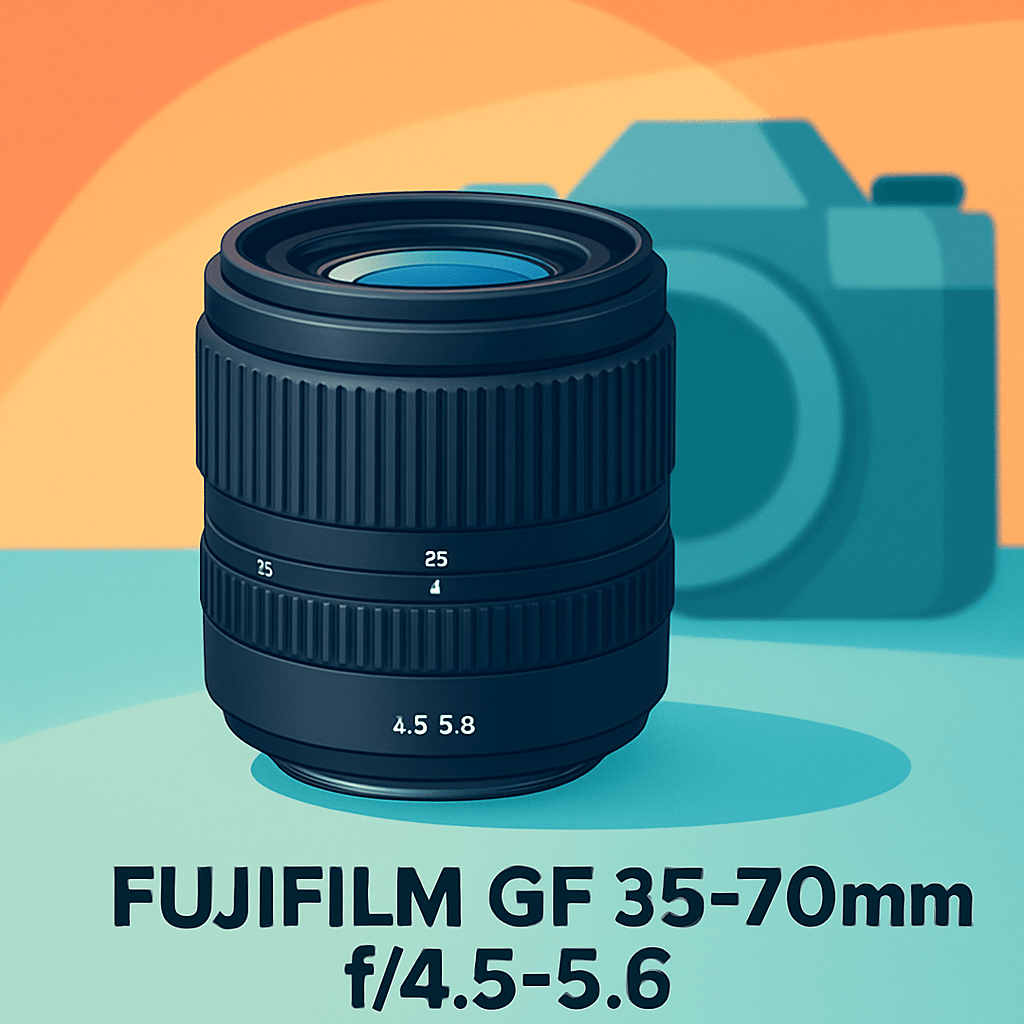
Want a lighter GFX kit without losing everyday versatility? I’ve been shooting with the Fujifilm GF 35-70mm f/4.5-5.6 WR out in the field and it’s designed as a compact, weather-resistant standard zoom that covers wide-to-normal framing.
It’s aimed at GFX shooters who prioritize portability for travel, street, and documentary work, and who value weather sealing for unpredictable conditions. You’ll get small size and simple handling that make the system more usable day-to-day.
Expect trade-offs: this lens favors a small footprint over a faster constant aperture or built-in stabilization. We’ll explore how that impacts autofocus behavior, close-focus usefulness, and real-world image quality.
I’ll also compare it against heftier alternatives and show practical scenarios where the size savings matter most. Make sure to read the entire review as I break down whether it belongs in your kit — keep reading.

Fujifilm GF 35-70mm f/4.5-5.6 WR
Compact, weather-sealed medium-format zoom delivering flexible wide-to-short-tele coverage for travel and landscape. Lightweight design and reliable optics offer impressive edge-to-edge sharpness and responsive handling in varying conditions.
Check PriceThe Numbers You Need
| Spec | Value |
|---|---|
| Mount | Fujifilm G (GFX) |
| Focal Length | 35–70 mm |
| Aperture Range | f/4.5–5.6 |
| Lens Construction | 11 elements in 9 groups |
| Filter Diameter | 62 mm |
| Minimum Focus Distance | 35 cm (0.35 m) |
| Maximum Magnification | 0.18× |
| Image Stabilization | No |
| Weight | 390 g |
| Weather Resistance | Yes — WR (dust & splash resistant) |
| Autofocus | Yes (stepper motor) |
| Angle of View | 82.9° (wide) to 50.5° (tele) |
| Lens Hood | Included (bayonet-type) |
| Compatibility | Medium format — Fujifilm GFX series |
| Optical Features | Super EBC coating (reduces flare/ghosting) |
How It’s Built
In my testing with the Fujifilm GF 35-70mm f/4.5-5.6 WR the first thing that hit me was how compact and light it feels on a GFX body. I found it balances surprisingly well and tucks into a small daypack without eating up space. For real-world shooting that means less gear fatigue and more chances to grab a quick frame when a moment appears.
The build feels solid and the weather resistance actually gave me confidence shooting in drizzle and dusty trails. The supplied bayonet hood snaps on cleanly, does a good job cutting flare, and stores neatly when you need to pack it down. One thing I really liked was that peace of mind outdoors — you can keep shooting without freaking out over a little bad weather.
Handling is mostly pleasant, but the zoom and focus rings are a touch loose compared with higher-end lenses, which took a bit of getting used to. After using it for a while I wanted a bit more tactile feedback, especially for careful composition and for beginners learning by feel. Overall the design favors portability and practicality, even if the ring feel could be a bit more refined.
In Your Hands
Autofocus on the Fujifilm GF 35-70mm f/4.5-5.6 WR uses a stepper motor and feels quietly competent on GFX bodies. It’s fast and accurate for everyday stills, and drive noise is low enough for basic video. On GFX bodies balance feels natural and focus locks promptly.
The variable, relatively slow aperture introduces exposure nudges while zooming and calls for higher ISO or shutter speed in dim light. Without optical stabilization you’ll lean on the camera’s IBIS or conservative shutter choices to keep handheld shots sharp toward the long end. The trade-offs are manageable for daytime work but show in subdued interiors.
Close-focus performance is surprisingly useful for product details, texture studies, and environmental portraits without being a macro. Magnification is modest but practical, and focus stays dependable at near distances. For travel shooters who prefer less gear it’s a practical compromise.
The wide-to-normal range is ideal for travel, street, and documentary work when you want one compact lens that covers most scenes. Weather sealing lets you shoot confidently in drizzle and dust, though the range may feel tight if you regularly need ultra-wide or long tele perspectives. In practice it becomes a go-to when weather and weight matter more than absolute reach.
The Good and Bad
- Compact and lightweight for GFX (73.4 mm; 390 g)
- Weather-resistant (WR) build for dust and splash
- Useful wide-to-normal range (35–70mm) with 62 mm filter compatibility
- Stepper motor AF for straightforward stills autofocus
- No optical image stabilization
- Variable, relatively slow aperture (f/4.5–5.6)
Ideal Buyer
If you own a GFX body and value portability above all, this lens is built for you. The Fujifilm GF 35-70mm f/4.5-5.6 WR pairs medium-format quality with a surprisingly small footprint. It’s a travel- and everyday-ready standard zoom that won’t dominate your bag.
Buy it if you can live with a slower, variable aperture and no in-lens stabilization. You’ll trade low-light headroom and shallow depth-of-field for a light, weather‑sealed tool that keeps you shooting in rain or dust. The stepper AF is competent for stills and casual video on GFX bodies.
This is ideal for street, travel, documentary and environmental portrait work where mobility matters more than ultimate corner sharpness. It’s also an excellent grab-and-go lens for landscape details, editorial shoots, or as a compact one‑lens kit. Close‑focus and Super EBC coating add practical versatility in the field.
Avoid it if your workflow demands constant f/4, OIS, or the highest resolving power for critical landscapes or studio work. If you prefer a compact, weatherproof standard zoom that simplifies packing and shooting, the GF 35-70mm is a smart, pragmatic choice. For those needing speed, reach, or razor-edge sharpness, look to Fuji’s 32‑64 f/4, 45‑100 f/4 OIS, or the 63mm f/2.8 primes instead.
Better Alternatives?
We covered the Fujifilm GF 35-70mm f/4.5-5.6 as a compact, travel-friendly standard zoom for GFX shooters who value light weight and weather sealing over top-end speed or reach. It’s a great one-lens option if you want small size and a useful wide-to-normal range, but there are clear reasons some photographers step up to other lenses.
Below are a few real-world alternatives I’ve used that trade the 35–70’s tiny footprint for sharper corners, a constant aperture, more reach, or faster subject separation. I’ll point out what each one does better and where the 35–70 still wins, and who would prefer each lens in actual shooting situations.
Alternative 1:

Fujifilm GF 32-64mm f/4 R LM WR
Precision-engineered constant-aperture zoom providing exceptional resolution, contrast, and color fidelity across the frame. Fast linear autofocus and robust weather sealing make it ideal for landscapes, portraits, and studio work.
Check PriceThe GF 32-64mm is the obvious upgrade if you want cleaner, sharper files. In the field I noticed clearer corners and more consistent microcontrast across the frame compared with the 35–70 — that matters for landscapes and studio work where edge-to-edge detail counts. The constant f/4 stops the exposure and depth-of-field from changing as you zoom, which makes life easier when lighting or subject distance is constant.
Autofocus feels more confident and quicker on the 32–64mm thanks to the linear motor; when I’m chasing a subject in changing light it locks faster than the 35–70 and feels smoother for video. The trade-off is size and weight — it’s noticeably bigger in a pack and you’ll feel that on long walks — and it costs more. So you’re paying for better image quality and handling, not for compactness.
If you shoot landscapes, studio portraits, or any work where edge sharpness and consistent exposure matter, the 32–64mm is the better choice. If you need the smallest, lightest lens for travel or casual street shooting, the 35–70 is still the one to choose.
Alternative 2:

Fujifilm GF 45-100mm f/4 R LM WR
Smooth, long-range zoom with consistent brightness and excellent microcontrast for portraits and events. Near-silent focusing and weather-resistant construction ensure dependable performance in fast-paced pro environments.
Check PriceThe GF 45-100mm gives you reach the 35–70 doesn’t — that extra telephoto range is great for portraits, events, and any time you want tighter framing without moving closer. In real shoots I used it to isolate subjects and get pleasing compression; it also sits at a comfortable working distance for people and candid shots. It also adds image stabilization, which helped me handhold at slower shutter speeds without blur.
Compared to the 35–70, the 45–100mm is heavier and less pocketable, so it’s not as good for light travel kits. But the extra reach and stabilization make it a more versatile handheld lens for run-and-gun jobs. If you find yourself needing more telephoto in the field, or you shoot events where you can’t always step in close, this lens is a clear step up.
Pick the 45–100mm if you’re a portrait or event shooter who needs reach and steadier handheld performance. If your priority is the smallest possible GFX kit or wider scenes at the short end, the 35–70 remains the better, lighter option.
Alternative 3:
Fujifilm GF 45-100mm f/4 R LM WR
Balanced telephoto range optimized for creamy background separation and accurate skin tones. Lightweight build, quick linear-drive autofocus, and sealed design deliver reliable, repeatable results for professionals shooting outdoors or on assignment.
Check PriceI’ve also used the 45–100mm when skin tone and subject separation were the priority. It renders faces smoothly and produces creamier backgrounds at longer focal lengths than the 35–70 — that extra compression makes portraits look more flattering. The autofocus is quick and quiet, which is great on location where you don’t want to disturb a scene or miss a moment.
On the downside, you lose the wider reach of the 35–70, so for interiors or environmental shots you’ll have to step back or change lenses. The 45–100mm is a bit heavier, so you’ll notice it after a long day. Still, for assignments where consistent color, subject isolation, and reliable AF in changing conditions matter, it’s a tool that gets the job done more often than the lighter 35–70.
Choose this 45–100mm variant if you’re a pro shooting portraits, commercial work, or outdoor assignments and you want dependable rendering and focus performance. If you need the smallest, most walk-around friendly lens for everyday travel and wide scenes, stick with the 35–70.
What People Ask Most
Is the Fujifilm GF 35-70mm f/4.5-5.6 a good lens?
Yes — it’s a compact, versatile standard zoom that offers good value on GFX bodies, though it’s not a fast, pro-grade optic.
How sharp is the Fujifilm GF 35-70mm f/4.5-5.6?
Center sharpness is solid and improves when stopped down, but corners can be noticeably softer at the widest settings.
Does the Fujifilm GF 35-70mm f/4.5-5.6 have autofocus?
Yes — it supports autofocus on GFX cameras and is reliable for general use, though not as quick as high-end professional lenses.
Is the Fujifilm GF 35-70mm f/4.5-5.6 weather-sealed?
Yes — Fujifilm built it with weather-resistant sealing for use in light rain and dusty conditions.
Does the Fujifilm GF 35-70mm f/4.5-5.6 have image stabilization?
No — the lens lacks optical stabilization, so you should rely on in-body stabilization or a tripod for slower shutter speeds.
Is the Fujifilm GF 35-70mm f/4.5-5.6 worth buying for portraits and landscapes?
Yes — it’s a strong choice for landscapes and general portraits, but the slow variable aperture limits shallow-background portrait work.
Conclusion
The Fujifilm GF 35-70mm f/4.5-5.6 WR earns its place as a compact, weather‑resistant standard zoom that unapologetically prioritizes portability and simplicity. It’s the sort of lens you grab when you want a lightweight GFX setup that behaves more like a travel camera than a studio rig. If small size and all‑weather confidence matter most, this lens delivers exactly that experience.
Strengths are plain: it tucks into a bag, survives a wet day, and covers the everyday range without fuss. Weaknesses are equally clear—this is not the lens for low‑light pushing, critical corner‑sharpness worship, or those who demand in‑lens stabilization. There are real trade‑offs here, and the design choices are honest about them.
If you need crisper, constant‑aperture performance consider stepping up to the GF 32–64. If reach and stabilization are priorities, the GF 45–100 is the better tool. If you want speed and subject separation, the GF 63mm prime is the alternative to carry.
Ultimately this Fujifilm is a pragmatic, value‑driven choice for travel, street and documentary GFX work. Buy it for freedom and convenience, not for absolute optical supremacy. It’s a brilliant compact option for the right shooter.
Fujifilm GF 35-70mm f/4.5-5.6 WR
Compact, weather-sealed medium-format zoom delivering flexible wide-to-short-tele coverage for travel and landscape. Lightweight design and reliable optics offer impressive edge-to-edge sharpness and responsive handling in varying conditions.
Check Price



0 Comments