

Which Fujifilm model truly earns the title of the best Fujifilm camera for photography in 2026? This guide makes a quick comparison of five standout Fujifilm cameras aimed at stills-focused photographers and hybrids alike, all tested in real-world shooting. It’s written for shooters who care about image quality, autofocus, handling, and real-world usability, not just lab numbers.
I’ll break down what matters beyond raw specs, with hands-on notes that explain how each body performs in the field and in common shooting scenarios. You’ll get concise pros and cons that cut through marketing hype while highlighting practical trade-offs. No technical overload—just the essentials you need to choose with confidence and build a kit that actually fits your workflow.
We’ll also map each option to the photographer it suits best, from travel and street shooters to studio and landscape pros who demand different features. Expect comparisons that highlight trade-offs like resolution versus portability, burst speed versus buffer capacity, video chops versus stills-first design, and how that affects day-to-day shooting. There’s something for hobbyists, enthusiasts, and working professionals looking to upgrade or refine their main camera.
Whether you’re upgrading or buying your first Fujifilm, this introduction sets the stage for a clear, practical decision tailored to your shooting priorities. Flip the page and you’ll find a friendly, no-nonsense tour through strengths, weaknesses, use-case recommendations, and real shooting notes to speed your decision. Let’s find the best Fujifilm camera for photography that fits your vision, your subjects, and the way you like to work.
1. Top Choice for Photographers

Fujifilm X-T5 body
Compact flagship APS-C mirrorless shooter offering exceptional image quality, speedy autofocus, and rugged handling for enthusiasts and professionals.
Check PriceAs a working photographer, the Fujifilm X-T5 quickly became my go-to for stills. Its 40.2MP APS-C X-Trans CMOS 5 HR sensor delivers exceptional detail and dynamic range that hold up when cropping or making large prints.
The camera feels built for shooting — a weather-sealed body with analogue-style controls gives tactile, intuitive handling that keeps you in the moment. Fujifilm’s 7-stop 5-axis IBIS and an ISO range of 64–51,200 (extended) make it surprisingly versatile in low light and for handheld landscapes or portraits.
Autofocus is fast and reliable, with AI subject detection and human/animal recognition that makes tracking subjects during bursts much less stressful. You also get 15 fps continuous shooting and solid real-world burst performance, though the full-resolution RAW buffer is noticeably limited for very long high-speed runs.
Video capabilities are capable — 6.2K 30p and 4K 60p are available — but this is primarily a stills-first camera; videographers will appreciate the options but may find some pro video workflows better served by other bodies. Overall, if your priority is high-resolution stills, superb handling, and dependable AF in a compact, lighter body than many pro alternatives, the X-T5 is an excellent choice.
- 40.2MP image quality
- 7-stop 5-axis IBIS
- Fast AF with human/animal detection
- Weather-sealed body + analogue controls
- Small full-resolution RAW buffer
- Video not ideal for dedicated videographers
2. Iconic Street and Travel Compact

Fujifilm X100VI
Elegant fixed-lens compact blending retro controls with advanced hybrid viewfinder, superb color science, and pocketable performance for street and travel photographers.
Check PriceThe Iconic Street and Travel Compact is a fixed-lens premium compact built around a 40MP APS-C X-Trans sensor and a razor-sharp 23mm f/2 fixed prime (35mm equivalent). It’s astonishing how much image quality Fujifilm squeezed into a truly pocketable body.
Handling is deliberately minimal — an analog-inspired interface that encourages slower, more intentional shooting. The camera delivers classic Fujifilm color science and film simulations that make JPEGs sing straight out of the camera.
Stabilization and shooting flexibility are strong for a compact: IBIS up to 6 stops and a built-in ND filter expand low-light and creative options. The fixed 23mm means framing is physical — you move with the camera rather than zoom — which is perfect for street work but less flexible for unpredictable scenes.
Video chops are noteworthy for a compact: up to 6.2K 29p in 10-bit color, so you can grab very high-quality clips alongside stills. Just be mindful that the ergonomics aren’t optimized for long-form video sessions, so it’s best for short clips and travel b-roll rather than lengthy shoots.
In short, this camera is a near-perfect companion for street and travel photographers who value image quality, color, and discretion. If you need reach or constant zoom flexibility, look elsewhere — but if you want a high-res, pocketable camera that encourages creative, intentional shooting, this one is tough to beat.
- 40MP APS-C X-Trans sensor
- Razor-sharp 23mm f/2 (35mm equiv)
- Classic Fujifilm color & film simulations
- IBIS up to 6 stops + built-in ND filter
- Fixed focal length limits framing
- Video ergonomics not ideal for long sessions
3. Pro Hybrid for Photo and Video

Fujifilm X-H2 body
High-resolution APS-C mirrorless body with blazing-speed autofocus, pro video specs, and durable build for hybrid creators demanding detail and speed.
Check PriceThe Fujifilm X-H2 is a true pro hybrid built around a 40MP X-Trans CMOS 5 HR APS-C sensor, and it feels like Fujifilm’s answer for shooters who want the highest-resolution files without giving up serious video chops. As a working photographer I appreciate how that resolution delivers clean crops and fine detail for commercial, landscape, and studio work.
It’s no slouch in speed either — up to 15 fps with the mechanical shutter and even faster with electronic modes — which makes it useful for wildlife and action when paired with solid AF. The camera’s advanced autofocus with subject detection and tracking is tuned for fast-moving subjects, so you actually get usable frames in challenging situations.
On the video side the X-H2 stands out: 8K 30p, 4K 60p, and open-gate 6.2K give serious options for filmmakers and hybrid creators. Those specs surpass many competitors, so if you need high-res video from an APS-C body this camera delivers professional-grade footage.
The body includes in-body 5-axis IBIS and a weather-sealed construction, which together let you shoot handheld in tougher conditions and nail tack-sharp exposures at slower shutter speeds. That combination is especially handy for landscapes, run-and-gun commercial shoots, and mixed photo/video assignments.
There are trade-offs. The X-H2 is heavier and a bit bulkier than Fujifilm’s lighter models, so it’s less ideal as an all-day carry for street or travel work. Also, 40MP stills and 8K video produce very large files, so be prepared for increased workflow and storage demands.
Overall, if you’re a professional or serious hybrid shooter wanting top APS-C image quality plus extensive video features, the X-H2 is an excellent choice.
- 40MP X-Trans sensor — superb detail
- Advanced AF with subject detection/tracking
- 8K 30p, 4K 60p and open-gate 6.2K video
- In-body 5-axis IBIS and weather-sealed build
- Heavier and less pocketable
- Large files increase workflow complexity
4. Creator-Friendly Compact Hybrid Camera
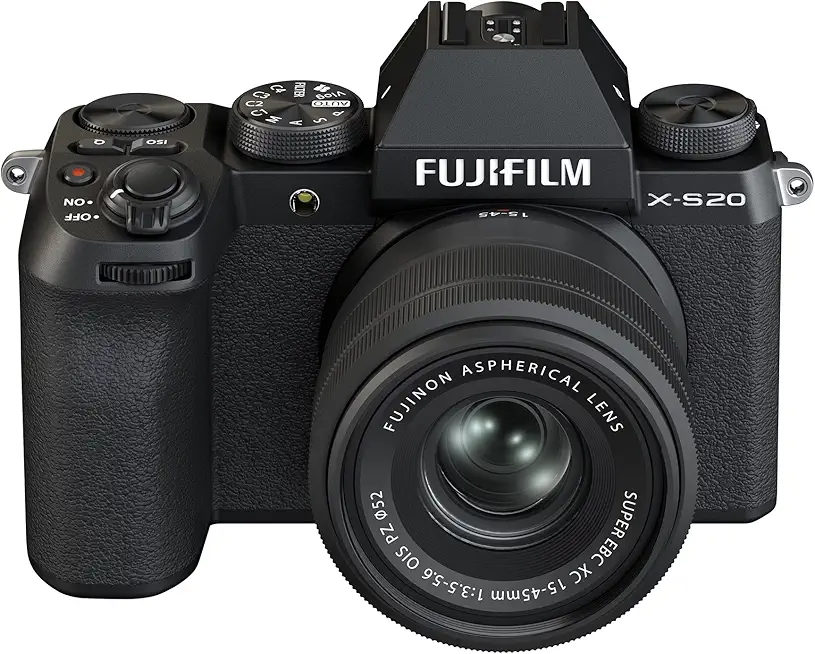
Fujifilm X-S20 with XC15-45mm lens
Versatile vlogging-ready kit combining compact interchangeable-lens convenience, stabilized 4K capture, and easy controls for creators on the move.
Check PriceThe Creator-Friendly Compact Hybrid Camera is built around a 26MP APS-C stacked sensor that prioritizes speed and responsiveness over the highest possible resolution. As a working photographer, I appreciate that stacked design — it boosts AF speed and keeps the camera feeling snappy during long shooting days.
Autofocus and subject tracking here are genuinely excellent, handling both stills and video reliably. That makes it easy to keep moving subjects sharp without hunting for focus, which is a real time-saver on assignments.
Video specs are generous for a compact body: 6.2K open gate, 4K 60p and even 4K 120p for high-frame-rate work. If you create mixed-format content — short clips, b-roll, and occasional long-form pieces — those options give you a lot of creative flexibility.
Stabilization and ergonomics are also well thought out: IBIS with around 7 stops of correction helps handheld work look steady, and the fully articulating touchscreen is ideal for vloggers and solo creators. The body is compact and comfortable, so it’s easy to carry all day.
There are trade-offs to be aware of. Some users report overheating during extended video recording, so long continuous takes may be limited. Also, at 26MP it won’t match the pixel count of 40MP flagship APS-C cameras, but that’s the compromise for speed and hybrid features.
Overall, this camera is a smart choice if you’re a hybrid photographer or content creator who values fast AF, a friendly interface, strong video capabilities, and portability without the complexity of larger pro bodies.
- Excellent AF and subject tracking
- Fully articulating touchscreen — great for vloggers
- IBIS with around 7 stops of correction
- 6.2K open gate and 4K up to 120p for versatile video
- Overheating concerns during long video recording
- 26MP resolution lower than 40MP flagships
5. Ultimate Medium Format Image Quality

Fujifilm GFX100 II body
Ultra-high-resolution medium-format body delivering extraordinary dynamic range, precision color, and professional-grade stabilization for demanding commercial and fine-art photography.
Check PriceThe Fujifilm GFX100 II is the camera I turn to when absolute image quality is the priority. Its 102MP medium-format sensor delivers unmatched detail, tonal gradation, and color fidelity that you can see in every print and crop.
It’s surprisingly capable beyond stills: the body offers up to 8 fps continuous shooting and 8K 30p video, plus 5-axis IBIS to help keep everything steady in the hand. That combination makes it a rare medium-format tool that can handle studio portraiture, commercial work, and even landscape shoots with confidence.
Autofocus on the GFX100 II is fast for a medium-format system, but it’s worth noting it isn’t optimized for very fast-moving subjects the way some smaller-sensor sports bodies are. For portraits, fashion, product, and fine-art landscape work it’s an absolute dream, but you’ll want to avoid relying on it for high-speed action.
Be pragmatic about workflow: those 102MP files are enormous and will demand robust computing power and plenty of storage. The body is compact for medium format yet heavier than APS-C models, so it’s fantastic in the studio or on planned location shoots, less so as an everyday street camera. If you’re a pro who values ultimate image quality and can handle the processing, this camera pays dividends in every frame.
- 102MP resolution — unmatched detail
- Superior tonal gradation and color accuracy
- 5-axis IBIS plus 8K 30p video
- Weather-sealed, robust medium-format body
- Heavier and more cumbersome than APS-C
- Very large files require high-end processing/storage
Which Fujifilm Camera Is Right for You
Picking the right Fujifilm is less about the biggest spec sheet and more about how you shoot day-to-day. If you spend most of your time chasing decisive moments on the street, the fixed 23mm X100VI does something cameras with zooms can’t: it makes you frame better and move with intention. It’s pocketable, fast, and gives you that tactile Fujifilm experience that encourages deliberate shooting.
If you’re starting out or want an easy learning curve, the X-M5 is a gentle but capable entry point—user-friendly menus, good video, and a body you won’t be intimidated by. Move up to an enthusiast body like the X-T50 if you want many X-T5 features in a smaller package; it’s a great compromise between portability and capability.
For photographers who live for stills—portraits, landscapes, commercial work—the X-T5 is the sweet spot: high-resolution files, robust weather sealing, and excellent AF in a comfortable package. If your work mixes fast action or serious video, the X-H2 brings pro-level AF, higher frame rates and 8K video, but expect larger files and a heavier workflow.
Content creators who need an articulating screen and snappy AF will find the X-S20 hard to beat; it’s a compact hybrid that handles both short documentary shoots and vlogging well. And if absolute image quality is your priority—studio, fine art, or high-end commercial—the GFX100 II delivers medium-format detail that changes how prints and crops look, but be ready for storage, processing time, and a heftier kit.
Beyond model choice, think lenses, weight, and workflow: a lighter kit keeps you shooting longer, while 40MP and 102MP cameras demand faster cards and more computer power. If possible, rent or try cameras in person—handling, button layout, and how a camera feels on a strap often decide the purchase more than a spec sheet ever will.
Weight Considerations for Travel Photography
When I plan a trip I think of weight first, then compromise. If I want to wander city streets all day I grab a compact kit — something like an X-T30 with the XF 18‑55mm f/2.8‑4 comes in under 700 g. It lets me shoot wide to short-tele without killing my shoulders and still delivers sharp, versatile images.
For the pocketable, distraction-free approach the X100VI is hard to beat. That fixed 23mm f/2 (35mm equiv) delivers a 40MP file in a body you can actually tuck into a jacket. You give up framing flexibility, but you gain speed, discretion, and a joyously light bag.
If I need creative variety I accept more weight. An X-T5 with an ultrawide and a normal prime — roughly a 10‑24mm and a 35mm — pushes a kit toward 1.7 kg. That’s still manageable for a day hike, but it changes how I pack and move; I carry a sturdier strap and plan shorter shooting sessions.
Think beyond the body and lenses. Extra batteries, cards, a small travel tripod and a protective pouch all add up. I always budget 300–500 g for these bits, because running out of power or protection ruins more shoots than a slightly heavier camera ever will.
Comfortable carrying matters as much as weight. A compact backpack or a sling — my go-to is the Peak Design Everyday Sling 10L — keeps gear accessible and balanced. Distribute weight close to your back and use a wide strap to avoid hot spots on long days.
Finally, match kit to the trip. If you’ll be hopping trains and shooting urban scenes, go minimalist. If you’ve planned landscapes or portraits, accept the extra kilos for better optics. Travel photography is less about the lightest possible kit and more about choosing the lightest kit that still lets you get the images you want.
What People Ask Most
What is the best Fujifilm camera for photography?
The Fujifilm X-T5 is widely praised as the best choice for photographers thanks to its high-resolution sensor, strong autofocus, and excellent handling. It offers a balanced toolset for stills-first shooters who want robust performance and ergonomics.
Which Fujifilm camera is best for portrait photography?
The Fujifilm GFX100 II is favored for portrait work due to its medium-format sensor and superior tonal gradation and color accuracy. The X-T5 is a strong APS-C alternative that delivers excellent detail and dynamic range for portraiture.
Which Fujifilm camera is best for landscape photography?
The GFX100 II is ideal for landscapes because of its exceptional detail, dynamic range, and color fidelity. The X-T5 is also well suited for outdoor work with high resolution, weather sealing, and effective stabilization.
What is the best Fujifilm camera for beginners?
The Fujifilm X-M5 is recommended as an entry-level option due to its user-friendly interface and capable video features. It provides an approachable learning curve while still delivering strong image quality.
Which Fujifilm camera is best for street photography?
The Fujifilm X100VI is popular for street and travel photography thanks to its compact fixed 23mm lens, sharp optics, and classic Fujifilm color science. Its pocketable size and tactile controls encourage an intentional, unobtrusive shooting style.
Which Fujifilm camera has the best autofocus for photography?
The Fujifilm X-H2 offers the most advanced autofocus with subject detection and tracking for fast-moving subjects. The X-T5 and X-S20 also provide very capable, reliable AF performance for a wide range of shooting situations.
What is the best Fujifilm mirrorless camera for professional photographers?
The Fujifilm X-H2 is a top choice for professionals who need a high-performance APS-C hybrid with advanced video and imaging features. The GFX100 II is the go-to for those who prioritize the ultimate medium-format image quality, while the X-T5 suits professionals focused mainly on stills.
Conclusion on Best Fujifilm Camera for Photography
Choosing the right Fujifilm camera ultimately comes down to matching your shooting priorities—whether you favor high-resolution stills, hybrid photo/video work, portability for street and travel, or the absolute best image quality for studio and landscape work.
Use the comparisons here to weigh the most important trade-offs: resolution, autofocus and tracking, video capability, portability, and the workflow and storage demands that follow larger files.
Think about the subjects you shoot, how much gear you want to carry, and how much post-processing you’re willing to manage; the best choice balances those needs rather than chasing a single spec.
If you want to keep improving, read more articles on our site to sharpen your shooting technique, camera handling, and workflow decisions; they’re designed to help you get better results with whatever gear you pick.
Have questions or want advice for your specific setup? Leave a comment below and we usually reply within a few hours.




0 Comments