
Ever wondered which flash will finally make your Nikon images sing after sunset?
Whether you’re a portrait pro, a wedding photographer, or a hybrid shooter, the right Speedlight can transform your work.
In this ultimate 2026 guide we compare five top Nikon-compatible flashes across real-life shooting scenarios.
We focus on practical strengths, everyday limitations, and which setups each flash truly excels at.
Coverage includes Nikon’s SB-5000, SB-700 and SB-500, plus the Godox V860III and the Neewer Z880.
These picks span flagship OEM systems, mid-range workhorses, compact travel options, and budget-friendly third‑party choices.
You’ll get concise, magazine-style breakdowns of features, real-world pros and cons, and practical shooting notes.
We skip the fluff and zero in on what actually matters when you’re on a shoot.
Expect clear use-cases for portraits, events, travel, and hybrid photo/video work.
I’ll point out which models suit tight rooms, bright daylight, and fast-action sequences.
The guide also includes buying tips to avoid compatibility headaches and costly returns.
You’ll learn when to prioritize battery life, wireless control, and rugged build over raw power.
By the end you’ll be ready to match a flash to your Nikon body, lens kit, and shooting style.
Let’s cut through the specs and marketing and find the Speedlight that truly improves your images.
1. Nikon SB-5000 AF Speedlight

Nikon SB-5000 Speedlight
Professional radio-controlled flash with advanced cooling, rapid recycle, high-speed sync, and powerful, consistent output for demanding studio and on-location photography.
Check PriceThe Nikon SB-5000 AF Speedlight is Nikon’s top-tier flash, built for pros who need power, speed and reliable performance. Its recycling times of 1.8–2.6 seconds make it fast enough for action and event work, and the strong guide number plus a flexible zoom head gives you coverage for a variety of focal lengths.
A standout is the built-in cooling system — Nikon rates it to allow over 100 full-power shots without overheating — which matters when you’re shooting long ceremonies or fast-paced receptions. It supports Nikon CLS and has an integrated RF wireless receiver for off-camera use, so you can run multi-flash setups without bulky adapters.
It runs on AA batteries, which keeps things simple in the field and easy to source, though serious users often pair it with optional external power packs to improve runtime and recycle performance. The durable construction and pro-style controls make it comfortable for advanced users who want tactile control and reliability under pressure.
If you’re a wedding, event or studio photographer who needs a robust Nikon-native flash system, the SB-5000 is an excellent choice thanks to its speed, cooling and wireless-ready design. Be aware that it uses AA cells rather than a built-in Li-ion pack, and its RF system is receiver-only, so it can’t act as an RF commander in your kit.
- Fast recycling (1.8–2.6 s)
- Cooling allows >100 full-power shots
- Integrated RF wireless receiver
- Durable, professional build and controls
- Uses AA batteries (no Li-ion)
- RF is receiver-only (not a commander)
2. Nikon SB-700 AF Speedlight

Nikon SB-700 Speedlight
Versatile TTL flash offering reliable bounce and tilt head, accurate exposure, and flexible wireless control for creative fill and off-camera lighting.
Check PriceThe Nikon SB-700 AF Speedlight is a solid mid‑range option that balances features and usability for enthusiast photographers. It’s compact and lightweight, yet offers a useful zoom range (24–120 mm) that covers wide to short-tele focal lengths for portrait and event work.
Its tilt-and-swivel head makes bounce lighting easy, so you can soften shadows and create natural-looking portraits indoors. The flash supports Nikon i-TTL and balanced flash metering, which means you get reliable automatic exposures in mixed lighting without endless manual tweaks.
Recycling times are moderate — noticeably slower than premium Speedlights — so if you’re shooting high-frame-rate sports or nonstop action, you may feel the limits. For run-and-gun event work or portrait sessions where a little pause between pops is acceptable, its performance is more than adequate.
The controls are intuitive and beginner-friendly, yet the build quality and ergonomics feel solid enough for regular use. It also works well both on‑camera and as a wireless off‑camera unit, giving you creative flexibility for simple lighting setups without a steep learning curve.
In short, the SB-700 is a dependable, versatile flash for photographers who want good output, bounce capability and reliable i-TTL metering in a compact package — especially useful for portraits, indoor events and enthusiasts stepping up from entry-level flashes.
- Flexible tilt/swivel head for bounce
- Accurate i-TTL and balanced flash metering
- Solid build quality and ergonomics
- Works on‑camera and as wireless off‑camera
- Slower recycling versus premium Speedlights
- Less powerful for large venues or bright daylight
3. Nikon SB-500 AF Speedlight
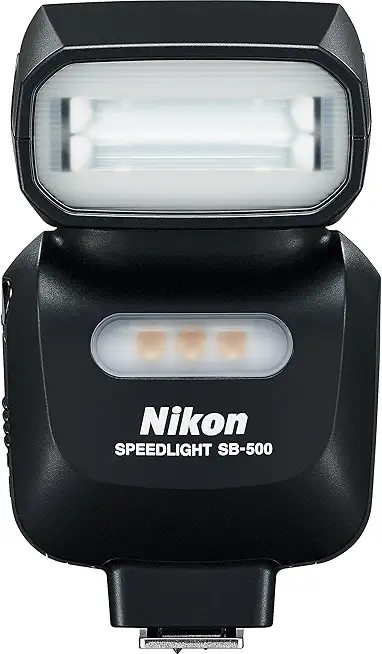
Nikon SB-500 Speedlight
Compact, portable flash delivering balanced fill light, easy bounce capability, and simple wireless optical control for travel and run-and-gun shooting.
Check PriceSmall, light and designed for portability, the Nikon SB-500 AF Speedlight is an excellent grab-and-go flash for photographers who travel, shoot street scenes or create video content. Its guide number of 24 makes it well suited for indoor work and close-up fill flash where you need a quick, discreet burst of light.
What sets the SB-500 apart for hybrid shooters is the built-in LED video light with two output levels. That LED is genuinely useful for run-and-gun vloggers and casual video creators who don’t want a separate light rig.
The SB-500 supports i-TTL metering, so exposure is generally reliable and easy when paired with compatible Nikon cameras. It can operate wirelessly as a slave unit, so you can drop it into a light setup to add rim or fill light without wrestling with complex menus.
Keep in mind the flash’s limitations: recycling times are around 2.6–3.5 seconds, so it isn’t ideal for fast-paced action or sustained burst shooting. The modest GN24 also means it won’t cover large venues or bright daylight situations; consider it a short-range tool.
In summary, the SB-500 is a highly practical choice if you want a compact flash that doubles as a simple video light and plays well in casual off-camera setups. If your work is primarily portraits in small spaces, travel photography, street work or vlogging, it’s a smart, lightweight option. If you need long reach, rapid recycle or a master controller for multi-flash rigs, look elsewhere.
- Very portable and lightweight
- Built-in LED for video (two levels)
- Supports i-TTL for easy exposure
- Good for casual photographers and vloggers
- Limited power for bright/large scenes
- Cannot serve as master in wireless setups
4. Godox V860III Third-Party Flash for Nikon

Godox V860III-N Speedlight
High-performance TTL flash with rechargeable lithium pack, fast recycle, HSS support, and built-in 2.4G wireless system for seamless off-camera use.
Check PriceThe Godox V860III for Nikon is a workhorse that punches above its price. With a guide number of roughly 60 it gives you the reach you need for event and wedding work without constantly bumping ISO or widening apertures.
It supports full Nikon TTL and High-Speed Sync up to 1/8000 s, which makes it great for balancing flash with bright ambient light or freezing motion outdoors. That HSS capability alone makes it valuable for shooters who mix ambient and flash frequently.
The flash has a built-in 2.4G wireless radio system, so setting up off-camera groups is quick and robust. You can use it as master or slave in radio setups, which simplifies multi-light control on location.
One of the biggest practical wins is the rechargeable Li-ion battery. Compared with AA setups the V860III recycles faster and sustains longer shooting sessions, so you spend less time waiting and more time shooting.
Build quality feels solid and the head offers the usual tilt and swivel for bounce work. It’s light enough to sit on a stand or bracket without toppling, which matters during long events or when you run multiple heads.
Two caveats: some users report occasional firmware quirks that require updates, and as a third-party unit service and support differ from Nikon’s channels. In practice these are manageable for most freelancers and enthusiasts, but worth noting if you require manufacturer-level peace of mind.
Overall, this is a highly practical flash for event photographers, freelancers and enthusiasts who want pro-level features—TTL, HSS 1/8000 s, GN ~60 and radio control—without Nikon’s premium price tag.
- High guide number (~60)
- Rechargeable Li-ion battery with fast recycle
- Full Nikon TTL and 2.4G wireless compatibility
- Lightweight with tilt/swivel head
- Firmware updates sometimes required for full Nikon compatibility
- Third-party support may differ from Nikon service
5. Neewer Z880 2.4G TTL Speedlight for Nikon

Neewer Z880-N Speedlight for Nikon
Affordable high-output flash with rapid recycling, tilt/swivel head, and user-friendly controls, ideal for beginners upgrading from on-camera lighting.
Check PriceThe Neewer Z880 2.4G TTL Speedlight for Nikon is a surprisingly capable budget flash that I often recommend to hobbyists and newcomers. It gives you TTL, Manual and Strobe modes plus a tilt-and-bounce head, so you can sculpt light for portraits and small events without much fuss.
What stands out is the built-in 2.4G wireless Q system that can serve as either master or slave in multi-flash setups. That makes off-camera work practical straight out of the box and lets you expand lighting setups without buying extra radio triggers.
The user interface is approachable, with a clear LCD and intuitive controls that make learning flash basics faster. Recycling speed and output are solid for the price class — not on par with premium units, but more than adequate for indoor shoots, small gatherings and practice sessions.
There are a few caveats to keep in mind. Build quality isn’t as rugged as professional-brand flashes, so if you travel heavily or work in rough conditions you may prefer a tougher unit. Also, some users have reported minor quality-control issues such as inconsistent battery contacts, so check your unit on arrival and keep spare batteries handy.
Overall, if you’re on a tight budget or just getting into off-camera flash, the Z880 gives a lot of practical features for the money. It balances ease of use, wireless flexibility and usable power, making it a sensible first step into TTL-capable, multi-flash work.
- Master/slave wireless functionality for multi-flash setups
- Easy to operate with modern LCD/UI
- Decent power and recycling for its class
- Supports TTL and manual control modes
- Build quality less rugged than Nikon/Godox units
- Occasional battery/contact issues reported by users
How to Choose the Right Flash
Compatibility is the first filter. If you shoot Nikon, prioritize flashes that support CLS and i‑TTL so your camera and flash talk the same language. Double‑check compatibility for Z‑series bodies — some bodies only support a subset of older Speedlights.
Decide early whether you need reach or portability. High guide‑number heads give you reliable fill in large rooms and bright daylight, while compact units are lighter, less obtrusive and often include handy LED video lights for hybrid work. Choose the tool that matches where and how you shoot most.
Control modes are your creative toolbox. TTL is a lifesaver for run‑and‑gun situations, while manual control is essential for predictable, repeatable multi‑flash setups. Look for flash exposure compensation and FV Lock so you can tweak flash output independently of ambient exposure.
Don’t forget physical features: tilt and swivel for bounce, and a zoom head that reads your lens focal length for cleaner light falloff. Flashes that pass colour‑temperature data to the camera save time under mixed lighting and reduce post‑processing headaches.
Wireless options matter more than most photographers expect. Optical Advanced Wireless Lighting works indoors, but radio control is far more reliable outdoors and in complex setups. Many third‑party systems now include 2.4 GHz radio — they’re great, but check for firmware or commander compatibility with Nikon mirrorless bodies.
Battery and recycle time determine how comfortably you work. Lithium‑ion packs recharge faster and sustain long shoots; AA units are convenient but usually slower. For events and fast sequences prioritize fast recycle, good thermal management and real‑world shot‑to‑shot performance.
Ultimately match the flash to your shooting style and budget. Prioritize compatibility and control first, then weigh power, size and wireless features. If you can, test a unit on your camera — nothing beats seeing how it behaves in your hands.
Tips for Better Flash Photography
Flash can be a photographer’s best friend or its loudest giveaway. Rather than blasting subjects straight on, bounce or diffuse the light to soften shadows and tame red‑eye; softer light almost always reads as more natural and flattering.
Don’t let flash dominate the scene. Balance ambient and flash by using slow‑sync or manual exposure so the background retains detail while the flash freezes your subject.
Think of flash output as a separate exposure control. Use flash exposure compensation to dial the flash power up or down independently, rely on TTL for quick metering, and use FV Lock to hold a consistent flash output when lighting is tricky.
When you need more shape and depth, go off‑camera. Optical or radio controllers let you place lights to the side or behind your subject, which instantly removes flat frontal illumination and creates dimensionality.
Match the flash head to the job. Zoom the head and tweak tilt and swivel to suit your lens and bounce surface; small changes in head angle dramatically affect falloff and catchlights.
Think about workflow as well as output. Recycle times matter for events and action — faster recycling keeps you from missing decisive moments and reduces the need to drop power between frames.
Keep an eye on color and preview results when possible. Some Nikon-compatible flashes pass color‑temperature info to the camera, and modeling flashes let you see how the light wraps a face before you commit to the shot.
Finally, experiment. A few quick tests with different bounce surfaces, compensation settings and off‑camera positions will teach you far more than one theoretical read‑through and quickly improve your results.
What People Ask Most
What is the best flash for Nikon cameras?
The best flash depends on your shooting needs and budget. Choose one that supports Nikon i-TTL and fits the balance you want between power, portability, and wireless control.
Which Nikon speedlight is best for portraits?
A portrait-friendly speedlight offers a tilting and swiveling head for bounce and consistent TTL metering for skin tones. Look for a unit that is easy to diffuse and gives predictable, soft light.
What is the best external flash for Nikon D750?
Pick a flash that is fully compatible with Nikon i-TTL and the camera’s hotshoe to ensure proper metering and control. Consider features like power, recycle behavior, battery type, and whether you need wireless functionality.
Can third-party flashes work with Nikon TTL?
Many reputable third-party flashes are designed to work with Nikon’s TTL system. Confirm compatibility with your camera model and keep firmware updated to maintain reliable performance.
How do I choose the right flash for my Nikon camera?
Start by confirming compatibility with Nikon’s metering and wireless systems, then weigh power versus portability and the battery solution you prefer. Also consider build quality, ease of use, and whether you need on- or off-camera control.
What are the differences between the Nikon SB-700 and SB-5000?
One model is positioned as a higher-end unit with faster performance and advanced cooling and wireless features, while the other is a midrange option focused on portability and ease of use. Your choice should reflect whether you prioritize professional-level speed and features or compact versatility.
How do I set up an off-camera flash with a Nikon speedlight?
Use an optical or radio controller and set the speedlight to the appropriate remote or slave mode according to the controller type. Position the flash for the desired light direction, test exposures, and adjust power or TTL settings until the balance with ambient light looks right.
Conclusion for Best Camera Flash for Nikon
Choosing the right Nikon-compatible flash is about balancing compatibility, power, features and real-world use so you can pick the unit that best fits your camera and shooting needs.
Match your choice to camera support (CLS/i-TTL), shooting style and budget, and weigh trade-offs like raw power versus portability and battery/runtime for the situations you shoot most.
Use the product overviews, the how-to checklist and the practical tips in this guide as a roadmap: test settings, practice bounce and diffusion, and prioritise the features that improve your workflow.
If you want to sharpen your technique and gear knowledge, read more of our site’s photography guides and reviews to build confidence with flash lighting and expand your creative options.
Have a question or want to share your own experience with any of these flashes? Leave a comment below — we usually reply within a few hours.


0 Comments