
Which flash will make your Nikon photos pop after sunset and still deliver creamy, natural skin tones in 2026? With new models and third‑party options flooding the market, shopping for a speedlight can feel like deciphering a dense spec sheet. This guide cuts through the jargon to show what really matters when you add off‑camera light to your kit.
We compare five top Nikon‑compatible flashes to help you decide what to buy in 2026. The focus is practical performance, not marketing spin. Whether you’re a wedding pro, portrait shooter, or hobbyist looking to level up, the right flash can change how you light a scene.
The side‑by‑side look centers on the factors that shape daily use: power output, battery type (AA vs Li‑ion), wireless/TTL/HSS support, build and size, and overall value. You’ll see why battery chemistry affects recycle speed, why wireless reliability matters for off‑camera work, and how ergonomics influence long shoots. We also weigh convenience and cost so you can choose a unit that fits your shooting tempo and budget.
Recommendations are drawn from hands‑on testing, pro feedback, and compatibility notes for Nikon bodies. Read on and you’ll quickly know which flash belongs in your bag this year.
1. Nikon SB-5000 AF Speedlight Review

Nikon SB-5000 Speedlight
Powerful wireless TTL flash with high-speed sync, advanced heat management, and consistent output for professional action and portrait photography.
Check PriceThe Nikon SB-5000 AF Speedlight is a top-tier professional flash built for weddings, events, and studio work. It’s praised for reliability and a robust build that lets it handle hundreds of consecutive shots without overheating.
Its recycling is the fastest among Nikon flashes, which makes a real difference when you’re shooting nonstop during a reception or a fast-moving editorial session. The flash head is flexible with a wide zoom and smooth tilt/rotate, so you can shape light quickly without fiddling.
Where the SB-5000 really shines is wireless control. It has a built-in RF wireless receiver that removes line-of-sight limits and supports up to six groups in both radio and optical modes. That roughly 30 m effective range and reliable radio control let you hide lights, spread them across a venue, or trigger third‑party units with minimal interference.
The unit has a clear LCD and becomes intuitive once you learn the menus. Expect a bit of a learning curve up front, but after a few shoots you’ll appreciate the unified flash control with compatible cameras. The body is solid and weather resistant, so it stands up to heavy use outdoors and in fast-paced event environments.
If you travel light, be aware it’s larger and heavier than many competitors. But for a pro who needs reliability, fast recycle, radio wireless and rugged construction, the SB‑5000 is hard to beat.
- Exceptional durability and consistent performance under heavy use.
- Fastest recycling speed among Nikon flashes.
- Reliable radio (RF) wireless control with minimal interference.
- Strong build quality and weather resistance.
- Larger and heavier than many competitors; less travel-friendly.
- Controls/menu have a learning curve.
2. Godox V1-N Review
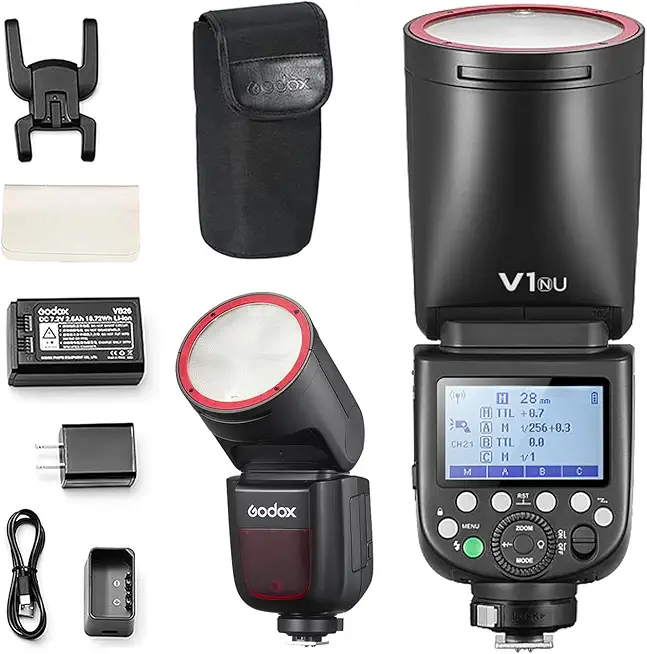
Godox V1-N Flash for Nikon
Round-head LED-powered flash delivering soft falloff, magnetic modifier compatibility, long-lasting battery, and consistent color for creative on-camera lighting.
Check PriceThe Godox V1‑N is a favorite for portraits and event work because its round head produces a soft, very natural-looking light that flatters skin tones and eases harsh shadows. As a photographer I reach for it when I want a fast, flattering key or a pleasing catchlight without fuss.
Its built‑in Li‑ion battery gives genuinely fast recycling and long runtime, so you can shoot through long portrait sessions or event bursts without constantly swapping cells. The magnetic modifier system is a small but brilliant touch — snap on a diffuser or gel and you’ve changed the character of the light in seconds.
On the connectivity side the V1‑N integrates cleanly with Nikon for reliable TTL and HSS, and it plays nicely inside the wider Godox ecosystem for multi‑flash setups. That makes it a practical choice if you want on‑camera ease plus off‑camera flexibility later.
There are tradeoffs: it has slightly less power than some competitors, so in very bright daylight you may need to push ISO or add support light. The round head is bulkier and less pocketable than rectangular heads, so it’s not the most travel‑compact flash — but for portraits and events its light quality and battery performance make it a strong, mostly positive choice.
- Round head delivers flattering, soft light for portraits.
- Li-ion battery: fast recycle and long sessions.
- Quick magnetic modifiers; flexible on-the-go.
- Reliable TTL/HSS for multi-flash setups.
- Slightly less power than some competitors; may need higher ISO in bright conditions.
- Bulkier round head; less pocketable.
3. Nikon SB-700 AF Speedlight Review

Nikon SB-700 Speedlight
Compact TTL flash with balanced light control, flexible zoom range, reliable wireless triggering, ideal for events and studio fill.
Check PriceAs a working photographer I reach for the SB-700 when I need a dependable, travel-friendly flash that won’t slow me down. It’s favored by enthusiasts and semi-pros because it balances useful features, compact size, and consistent performance in a small package.
The head is flexible with a wide zoom and smooth tilt/rotate, which makes it easy to shape light for portraits, fill, and on-location work. The controls are intuitive and the clear LCD makes adjustments quick, so you can focus on the shot rather than wrestling menus.
Optical wireless lets the SB-700 work off-camera for basic multi-flash layouts, and it can act as a master or remote unit in Nikon’s CLS — note this optical system requires line-of-sight and supports two groups, so it’s best for simple setups. It also provides AF-assist (24–135 mm) and preserves i-TTL and commander functions with many Nikon DSLRs (D90, D7000, D750) and Z-series mirrorless bodies (Z5, Z6, Z7, Z9) where supported.
There are trade-offs: recycling is slower than higher-end models, and it uses AA batteries, which are convenient but mean shorter continuous high-speed work than Li-ion alternatives. Still, for travel, events, and mixed shooting where portability, reliability, and straightforward operation matter most, the SB-700 is a strong, practical choice.
- Compact and lightweight; easy to carry.
- Reliable and consistent output.
- Flexible flash head for creative lighting.
- Beginner-friendly controls and clear LCD.
- Slower recycling vs higher-end models.
- Optical wireless needs line-of-sight; less reliable in complex setups.
4. Godox V860III-N Review

Godox V860III-N Flash for Nikon
High-capacity Li-ion powered strobe offering fast recycle, TTL and HSS support, stable color, and seamless 2.4G wireless integration.
Check PriceThe Godox V860III-N is a workhorse I reach for when I need reliable power for events and portraits. It’s popular for events/portraits due to high power and Li-ion battery, which translates to consistent output when you’re shooting long receptions or back-to-back sessions.
The built-in Li-ion battery gives fast recycling and long runtime, so you won’t be constantly swapping AAs or worrying about slow recycle times during a dance floor or ceremony. Fast recycling and long runtime make it ideal for extended shoots where speed and uptime matter.
The head is flexible with wide zoom and tilt/rotate, so bouncing and shaping light is easy whether you’re inside a small room or working a large venue. That flexibility lets you use small modifiers or angle the flash for pleasing catchlights without contorting your setup.
Wireless-wise it’s solid: reliable wireless TTL and HSS; compatible with Godox ecosystem. That means TTL accuracy, high-speed sync for mixing ambient, and seamless integration if you already use Godox triggers or off-camera flash units.
Build is reassuring for field work — robust build and weather resistance for outdoor/event use. If you’re an event or portrait shooter who needs a strong, dependable flash with modern features, this is mostly a win. Be aware it’s larger and heavier than some competitors, and occasional firmware quirks with wireless TTL can appear (usually fixed with updates).
- High power output for bright conditions and large venues
- Li-ion battery: fast recycle and long runtime
- Flexible head for creative setups
- Reliable TTL/HSS in multi-flash rigs
- Larger and heavier than some competitors
- Occasional firmware quirks with wireless TTL
5. Godox TT685II-N Review

Godox TT685II-N Flash for Nikon
Versatile on-camera strobe with TTL/HSS, built-in 2.4G wireless master/slave, quick recycle, and consistent exposures for hybrid shooters.
Check PriceAs a working photographer I often recommend the Godox TT685II-N when someone wants a capable flash without breaking the bank. It’s popular with beginners and budget-conscious users because it combines high power output with reliable wireless TTL, so it handles most shoot situations well.
The head is flexible with a wide zoom range and smooth tilt/rotate, which makes shaping light for portraits or small groups straightforward. Controls are user-friendly and the clear LCD keeps settings visible and simple to change on the fly.
Being part of the Godox ecosystem is a real plus — the TT685II-N integrates easily with other Godox units for multi-flash setups using Godox wireless. That wireless TTL reliability saves time during events and run-and-gun shoots where quick, predictable exposure is key.
It runs on AA batteries, which are widely available worldwide. That’s great for travel or remote shoots where you can’t recharge a proprietary pack, though recycling is slower compared with Li-ion models.
Overall, if you want a practical, value-driven flash that gives you strong output, decent ergonomics, and dependable TTL in a Godox system, the TT685II-N is a solid choice. It’s especially suited to hobbyists, event shooters on a budget, and anyone building out a Godox off-camera kit.
- Excellent value: strong power and reliable performance.
- Flexible head and wide zoom range.
- Easy-to-use controls; clear LCD.
- Compatible with Godox wireless ecosystem.
- Slower recycling vs Li-ion flashes.
- Runs on AA batteries.
Nikon Camera Compatibility Guide
Nikon’s flashes speak Nikon’s language: the Creative Lighting System (CLS) and i‑TTL metering. That means modern Speedlights like the SB‑5000 and SB‑700 will preserve TTL metering and most wireless commander features on a wide range of DSLRs (D90, D7000, D750 etc.) and many Z mirrorless bodies (Z5, Z6, Z7, Z9) — but always test the exact combination before a paid job.
The SB‑5000 is the easiest way to get full-featured radio control on Nikon bodies. It supports radio groups (up to six), works in optical mode too, and offers unified control from the camera when the body supports it. Older units such as the SB‑600/SB‑800 will still fire and can be useful as remotes, but they lack modern radio integration and may require manual tweaks on newer mirrorless cameras.
Mirrorless Z cameras generally support CLS optical wireless natively, but radio features can be finicky. Some Z bodies require firmware updates or an external WR‑R10/WR‑R11 adapter to unlock full radio control with certain Speedlights. If you plan hidden or widely spaced lights, factor that accessory into your kit list.
AF‑assist is another practical compatibility detail. Many Speedlights provide AF‑assist lamps that help low‑light focusing, but coverage varies by model and lens focal length — for example, SB‑700 supports AF‑assist roughly for 24–135mm, while older SB‑800/SB‑600 note 24–105mm ranges. If you shoot in dim venues, confirm your flash’s assist pattern matches your lenses.
Don’t forget third‑party N‑designated flashes. Godox “‑N” models (V1‑N, V860III‑N, TT685II‑N) are built to speak Nikon TTL/HSS and integrate with Godox’s radio system, making them practical, cost‑effective alternatives. Keep firmware current and trial them on your camera — small quirks are often ironed out in updates.
Bottom line: match the flash’s communication method (optical vs radio), TTL/HSS support, AF‑assist coverage, and any adapter/firmware requirements to your specific Nikon body. I always run a quick on‑camera and off‑camera test before clients arrive — it saves headaches later.
Built-In Wireless Features
Wireless control is one of those features that turns a single flash into a creative tool. Whether you want subtle rim light, a three‑light portrait setup, or hidden off‑camera strobes at a wedding, understanding the differences between optical and radio systems will save you time and headaches on a shoot.
Nikon’s optical Creative Lighting System (CLS) is simple and reliable for straightforward off‑camera work. It uses coded infrared pulses from a camera pop‑up or a commander Speedlight to control remote units, but it needs line‑of‑sight and can struggle in bright sun or when flashes are hidden behind objects. Optical setups are great for quick two‑group arrangements and for photographers who value on‑camera simplicity.
Radio wireless, as implemented in Nikon’s SB‑5000, frees you from those line‑of‑sight limits. It supports up to six independent groups, works through obstacles, and gives more consistent triggering at distances typically up to about 30 m. For complex setups, wedding receptions, or large venues, radio is worth the extra cost for the reliability it delivers.
Groups, channels and master/remote roles let you sculpt light precisely. Assigning lights to groups lets you set ratios and compensations independently, while channels help avoid interference from other photographers. If you need a dedicated controller for advanced setups, Nikon has standalone units, and many third‑party controllers also play nicely with both optical and radio systems.
Mirrorless bodies introduce a few extra considerations. Z‑series cameras handle CLS natively, but full radio functionality with certain Speedlights can require firmware updates or accessories like the WR‑R10/WR‑R11. Always check camera and flash firmware before a job to avoid surprises.
Beyond triggering, Nikon’s wireless systems also pass useful functions to the commander: balanced fill‑flash, auto FP high‑speed sync, FV lock and remote flash compensation. In practice, FV lock is a lifesaver when you need consistent exposures across a sequence, and HSS lets you keep wide apertures in bright conditions.
My practical rule: use optical for simple, quick setups and radio whenever reliability, distance or hidden lights matter. Update firmware, run a quick test before clients arrive, and practice switching groups and ratios so you can adjust light on the fly without fumbling during the shoot.
What People Ask Most
What is the best flash for Nikon cameras?
There is no single best flash; the right choice depends on your shooting style, battery preference, wireless needs, and budget. Higher-end units tend to suit professional work while compact or third-party options can offer excellent value for enthusiasts and beginners.
What is the best flash for Nikon D850?
Pick a flash that supports Nikon i-TTL and the wireless capabilities you need so the camera’s exposure automation is preserved. Both Nikon speedlights and compatible third-party units are commonly used successfully with the D850.
Which Nikon flash is compatible with my camera?
Many modern Nikon flashes work with Nikon DSLRs and mirrorless bodies and support i-TTL metering, but compatibility can vary by model. Check your camera’s hot shoe and the flash manufacturer’s compatibility notes before purchasing.
Can third-party flashes work with Nikon cameras?
Yes, reputable third-party flashes are built to work with Nikon TTL and wireless systems and often provide good performance for the price. Some advanced features or firmware behavior may differ, so verify compatibility and keep firmware updated when available.
How do I choose the right flash for my Nikon camera?
Consider factors such as whether you need TTL or high-speed sync, battery type, wireless control options, size, and durability to match your typical shooting scenarios. Compare features and handling to find the flash that fits your workflow and budget.
What is the difference between the Nikon SB-700 and SB-5000?
The SB-5000 adds radio wireless control and is designed for heavier professional use, while the SB-700 is more compact and beginner-friendly with optical wireless functionality. Both provide flexible head movement but target different levels of use and complexity.
Do Nikon flashes support TTL and high-speed sync?
Many Nikon flashes support i-TTL metering and high-speed sync modes to work with faster shutter speeds. Always check the specific model’s specifications to confirm the exact TTL and sync features offered.
Conclusion for Best Nikon Flashes
This roundup brought together five Nikon-compatible flashes and focused on the practical differences that matter most: relative power, battery type, wireless/TTL/HSS support, build and size, and overall value, plus notes on camera compatibility and wireless workflows.
Our goal was to give a clear, real-world sense of how each unit performs for portraits, events, travel, or studio work so you can weigh features against your shooting style and budget.
If you want to build on this comparison and sharpen your lighting skills, check out more guides and gear roundups on the site to explore techniques and matching accessories in depth.
Please leave a comment with your setup questions or experiences — we usually reply within a few hours to help you decide or troubleshoot.
When picking a flash, match your choice to your shooting style, preferred battery type, wireless needs, and budget to get the best balance of performance and convenience.



0 Comments