
What is linear perspective in photography? Why do parallel lines seem to meet and make a flat picture feel deep?
This article answers what is linear perspective in photography in plain language. It links the idea from Renaissance art to modern camera work.
You will learn about horizon lines, vanishing points, and orthogonal lines. I will explain one-, two-, and three-point perspective with clear photo examples and overlays.
Practical tips cover camera height, lens choice, settings, and simple post-processing fixes. Try the exercises, check the EXIF info, and use the mini challenges to improve your shots.
What is Linear Perspective?
Lines can pull you into a photo like a magnet. If you’ve ever wondered what is linear perspective in photography, it’s the secret behind that pull.
Railroad tracks narrowing to a point show how the eye reads distance through converging lines. 24mm, f/8, 1/250s, ISO 100.
Linear perspective is the geometric effect where parallel lines in three-dimensional space appear to converge toward one or more vanishing points on the picture plane. Your camera projects those lines onto a flat sensor, creating a convincing illusion of depth.
The method was formalized in Renaissance art, then became second nature to photographers. It’s different from atmospheric perspective, which uses haze and lower contrast, and from size, overlap, and focus cues. Here, line direction and convergence do the heavy lifting.
Think of a straight road, a corridor, or city tram lines guiding your gaze. In each case, the vanishing point acts like a visual destination that organizes the whole frame.
The Horizon Line, Vanishing Point(s) and Orthogonal Lines
Understanding what is linear perspective in photography starts with the horizon line, which represents your eye level. Raise the camera and the horizon climbs; lower it and the horizon drops. This shifts power between foreground and sky without changing the world itself.
Place the horizon high to stretch the foreground and make lines surge toward you. Place it low to open the sky and elongate verticals. Keep it level for calm geometry, or tilt carefully if you want tension and motion.
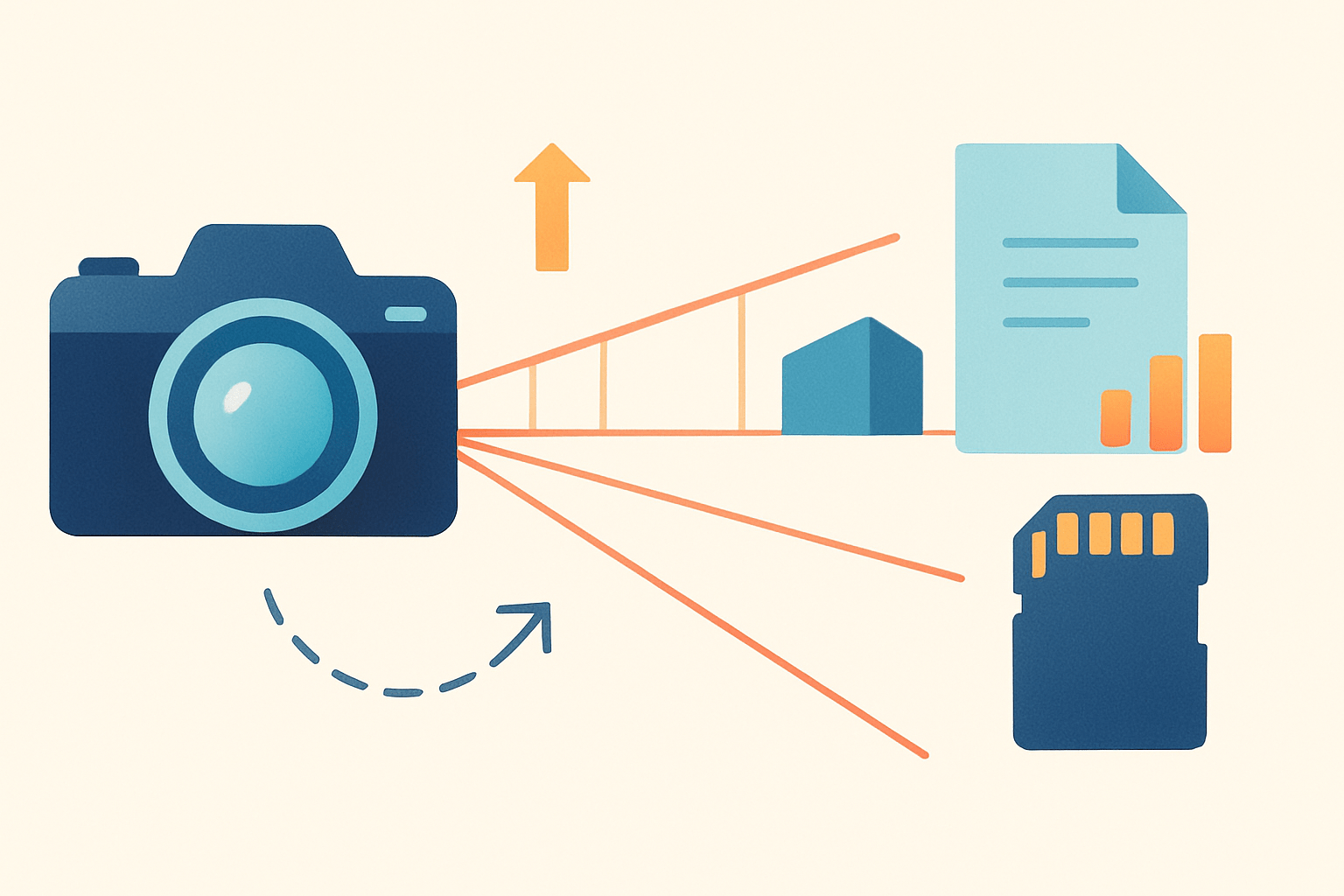
Vanishing points are where sets of parallel lines in the real world seem to meet in the frame. With the camera level and facing a wall head-on, the vanishing point sits on the horizon; rotate left or right and you get two vanishing points along that horizon. Tilt the camera up or down and verticals gain a third vanishing point above or below the horizon.
Orthogonal lines are those real-world parallels that converge in your image and point to the vanishing points. They’re powerful guides that pull the eye through depth and toward your subject. Use them to create flow rather than letting them clash or compete.
To find the horizon and vanishing points on location, scan for long edges like curbs, rooflines, rails, or tile seams. Mentally extend those edges and note where they intersect, then build your composition around that crossing.
Compositional choices are simple but decisive: place the vanishing point off-center to add tension, or center it for symmetry and calm. If you want a quick refresher on the geometry behind it, read about linear perspective and notice how camera height and tilt control vanishing point positions.
Types of Linear Perspective (one-, two-, three-point)
One-point perspective happens when you face a plane head-on and all major lines converge to a single vanishing point. Corridors, straight highways, and railways are classic subjects. Centering the point feels orderly; moving it off-center adds a subtle push across the frame.
Two-point perspective appears when you stand at a corner and angle the camera so two sets of edges recede. Architecture and street scenes use this constantly, splitting the frame into left and right flows. Keep the camera level to hold verticals straight while the two horizontal sets converge.
Three-point perspective adds a vertical vanishing point by tilting up or down, perfect for skyscrapers or deep atriums. It’s dramatic and can feel towering or dizzying. Use it with intention, because strong tilt plus wide angles can exaggerate distortion.
For quick field choices, match scene and setup thoughtfully. For one-point, try eye-level with a 20–35mm lens to emphasize a crisp pull into the frame; for two-point, step back from a corner and rotate until both building faces balance; for three-point, go low and tilt up to accentuate height. For more examples and ideas, browse perspective in photography and note how different angles change the mood.
How to Use Linear Perspective in Photography
Start by scouting for lines that naturally converge, such as roads, rail tracks, riverbanks, rows of trees, fences, or building facades. Walk the scene and watch how those lines shift as you move, then stop where the flow feels clean and intentional.
Choose camera position and height to control intensity. A low stance exaggerates depth and makes lines feel steeper, while eye-level feels natural and balanced. A high viewpoint can flatten the foreground and clarify patterns.
Pick your focal length to sculpt convergence. Wide-angle lenses amplify the difference between near and far, boosting the pull of orthogonals and making the foreground larger. Telephoto compresses space and softens convergence, useful when you want a calmer, graphic read.
Control horizon and vanishing point placement to guide attention. Put the horizon on the lower third for a sky-led mood, or on the upper third to hero the ground and leading lines. Center the vanishing point for symmetry, or offset it to create energy and a gentle visual tug.
For settings, aim for f/8–f/16 to keep lines sharp front to back, especially in landscapes and architecture. Use a tripod indoors or at dusk, consider a tilt-shift or shift lens to tame verticals, and know when to correct perspective in-camera versus later. If you’re new to the tools, try this perspective photography primer before you head out.
Compose with layers: a strong foreground detail to anchor scale, midground lines that carry the eye, and a background vanishing point as the destination. Including a person near the foreground gives scale and a human story. Avoid cutting major orthogonals awkwardly at the frame edge; let them enter and exit cleanly.
Adapt the approach to the genre. For architecture, keep the camera level or use shift to hold verticals true; for landscape, look for diagonals in rivers, ridges, and paths; for street, use lines to guide toward a subject or gesture; for interiors, lean into symmetry and a tripod for precision. Before-and-after tests with small camera moves will teach you faster than specs ever will.
Practical Exercises, Common Mistakes & Post‑Processing Tips
Exercise 1: Find a corridor or long hallway and shoot a one-point composition. Vary camera height from ground level to eye level, and compare how the lines feel. Review which height makes the vanishing point feel strongest.
Exercise 2: Stand at a street corner and build a two-point perspective. Rotate slowly until both building faces balance, then test 24mm versus 50mm to see how convergence changes. Note how each focal length affects edge clarity.
Exercise 3: Look up at a tall structure for a three-point framing. Try a very low angle and then step back to reduce tilt. Evaluate how much drama you want versus how much distortion you can accept.
Common mistakes are easy to fix once you see them. A crooked or chopped horizon is solved by careful leveling and a firm crop, and a vanishing point hugging the frame edge needs a slight reposition. If faces warp at wide angles, step back or switch to a longer focal length, and simplify scenes when too many lines fight for attention.
In post, use Transform or Guided Upright to straighten and correct perspective where needed. Crop to strengthen the flow of lines, convert to black and white to emphasize structure, and dodge or burn along orthogonals to guide the eye. Decide when to accept convergence for artistic intent versus correcting it for architectural fidelity, and let the story of the picture lead that choice. Finally, if you still ask what is linear perspective in photography, revisit your edits and watch how line placement alone can change the emotion of a frame.
What People Ask Most
what is linear perspective in photography?
Linear perspective is a way of using straight lines in a scene to show depth, where parallel lines appear to meet at a vanishing point. It helps make flat photos look three-dimensional.
How can I use linear perspective to make photos more dramatic?
Position yourself so strong lines lead toward a point in the frame, like roads or railings, and compose low or centered to emphasize convergence. This draws the viewer’s eye and adds visual tension.
What common mistakes should I avoid with linear perspective?
Avoid crooked horizons, forcing lines that cut off awkwardly, and overusing convergence which can feel fake. Also watch for lens distortion that bends straight lines unnaturally.
Can linear perspective make small spaces look bigger?
Yes, aligning lines to lead into the distance creates the illusion of depth and can make tight interiors feel more spacious. Use low angles and wide pathways to enhance the effect.
Is linear perspective the same as depth of field?
No, linear perspective is about how lines and shapes show depth, while depth of field controls how much of the scene is in focus. You can combine both for strong depth in an image.
How do I find the vanishing point in a scene?
Follow parallel lines like sidewalks, edges of buildings, or train tracks and see where they appear to meet on the horizon. That meeting spot is your vanishing point to compose around.
How can I practice linear perspective as a beginner?
Start by shooting roads, hallways, and rows of trees or buildings, experimenting with different heights and angles to see how lines converge. Review your shots to notice which compositions create the strongest depth.
Final Thoughts on Linear Perspective in Photography
Linear perspective is the simplest way to make a flat photo feel lived-in — it helps you shape depth, guide the eye, and give scale to subjects; try the quick 270 drill to make vanishing points obvious. That control’s especially useful for landscape, architecture and street photographers who want cleaner, more intentional compositions.
Don’t overdo it: extreme angles or wide lenses can create unwanted distortion or awkward crops, so be ready to tweak framing or fix perspective in post. If you came here wondering “what makes a flat image feel deep,” the guide walked you through horizon lines, vanishing points, orthogonals, the three perspective types, practical setups and corrective edits to prove it.
With a little practice and the exercises in the main section, your compositions will start reading with believable depth and stronger storytelling. Keep exploring angles, lenses and edits — you’ll start seeing converging lines everywhere and feel confident making them work for you.





0 Comments